On this page
Use Vなくてもいい when not doing an action is acceptable: 明日は来なくてもいいです means “You do not have to come tomorrow.” The pattern removes a requirement; it does not forbid the action, so coming may still be possible.
That remaining choice is the heart of the grammar. English don't have to is easy to misread as must not, but Japanese keeps those meanings in different forms.
Make the ない-form, then replace its final い
Start with the complete plain negative. Remove only the final い of ない, then add くてもいい.
書く → 書かない → 書かなくてもいい
The first change depends on the verb group; the second is always ない → なくてもいい. Do not attach the ending directly to the dictionary form or the ます-stem.
| Dictionary form | Plain negative | Optional action | Meaning |
|---|---|---|---|
| 書く(かく) | 書かない | 書かなくてもいい | do not have to write |
| 読む(よむ) | 読まない | 読まなくてもいい | do not have to read |
| 食べる(たべる) | 食べない | 食べなくてもいい | do not have to eat |
| する | しない | しなくてもいい | do not have to do |
| 来る(くる) | 来ない(こない) | 来なくてもいい(こなくてもいい) | do not have to come |
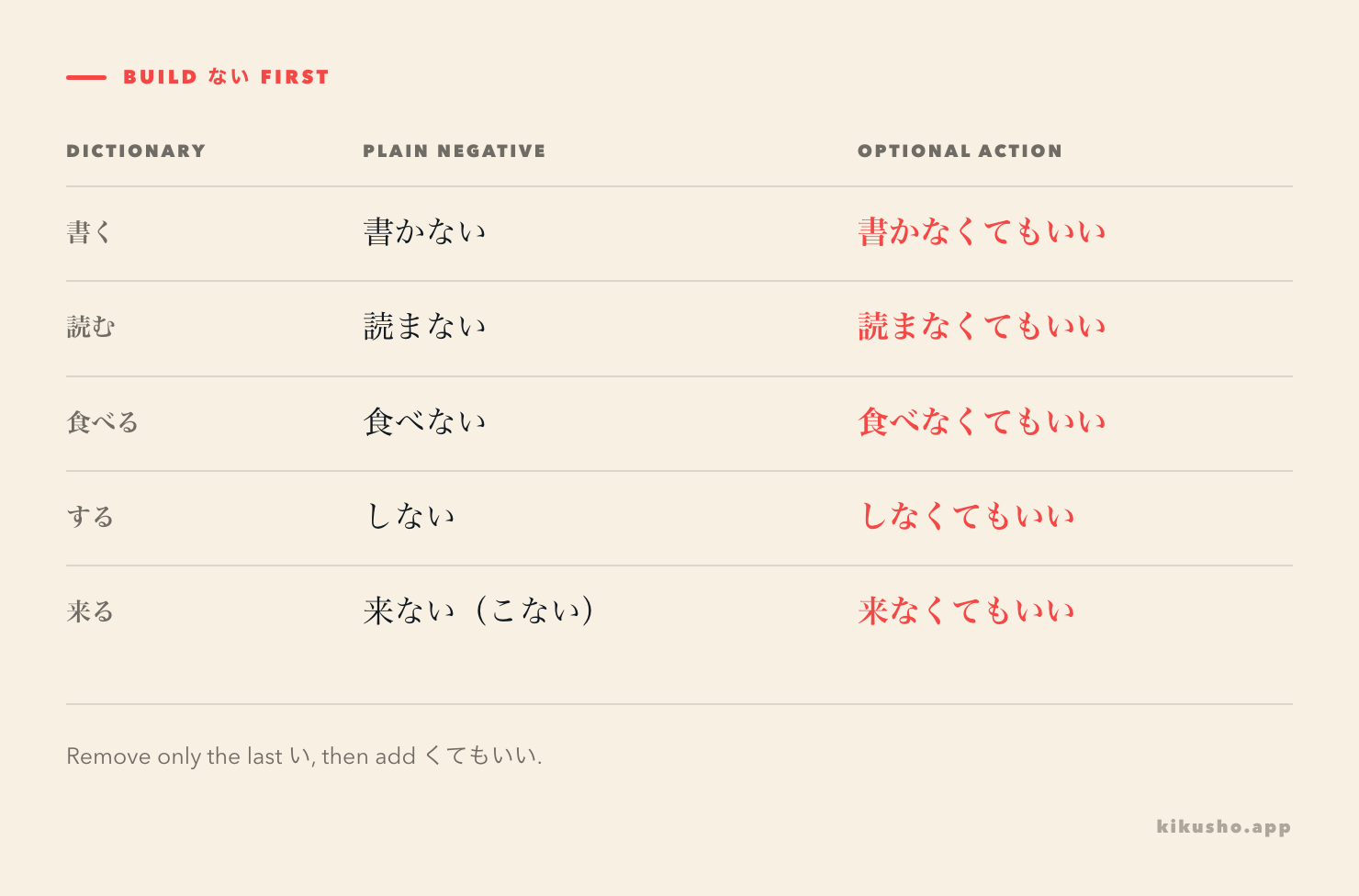
The plain-negative lesson covers how godan, ichidan and irregular verbs reach their ない-forms. Once you have 読まない, the new operation is small: 読まな + くてもいい. Forms such as × 読むなくてもいい, × 読みなくてもいい and × 読まないてもいい skip or duplicate a step.
JLPT Sensei's なくてもいい reference gives the same attachment: remove the last い of the verb's ない-form and add くてもいい. Tofugu's independently written てもいい guide explains why: auxiliary ない connects like an い-adjective, changing its final い to く before て.
なくてもいい makes the action optional
Think of なくてもいい as accepting the negative situation: “even if you do not do it, that is okay.” In ordinary English, that becomes “you do not need to” or “you do not have to.”
申込書は今日出さなくてもいいです。
もうしこみしょは きょう ださなくても いいです。
You do not have to submit the application today.
The sentence removes today's requirement. It does not necessarily remove the deadline altogether; a later date may still apply.
全部食べなくてもいいですよ。
ぜんぶ たべなくても いいですよ。
You do not have to eat all of it.
The listener may eat all of it, eat some of it, or stop. The exact choices come from the context, but the grammar says that completing the named action is unnecessary.
一人で決めなくてもいいよ。
ひとりで きめなくても いいよ。
You do not have to decide alone.
This can reassure someone rather than announce a formal rule. Bunpro's reference describes the pattern as “okay even if A is not done” and notes its common reassuring sense, similar to “don't worry about doing A.”
Keep permission, optionality, obligation and prohibition apart
Four nearby patterns answer four different questions. The affirmative or negative action comes first; the ending then says whether that action is acceptable, required or forbidden.
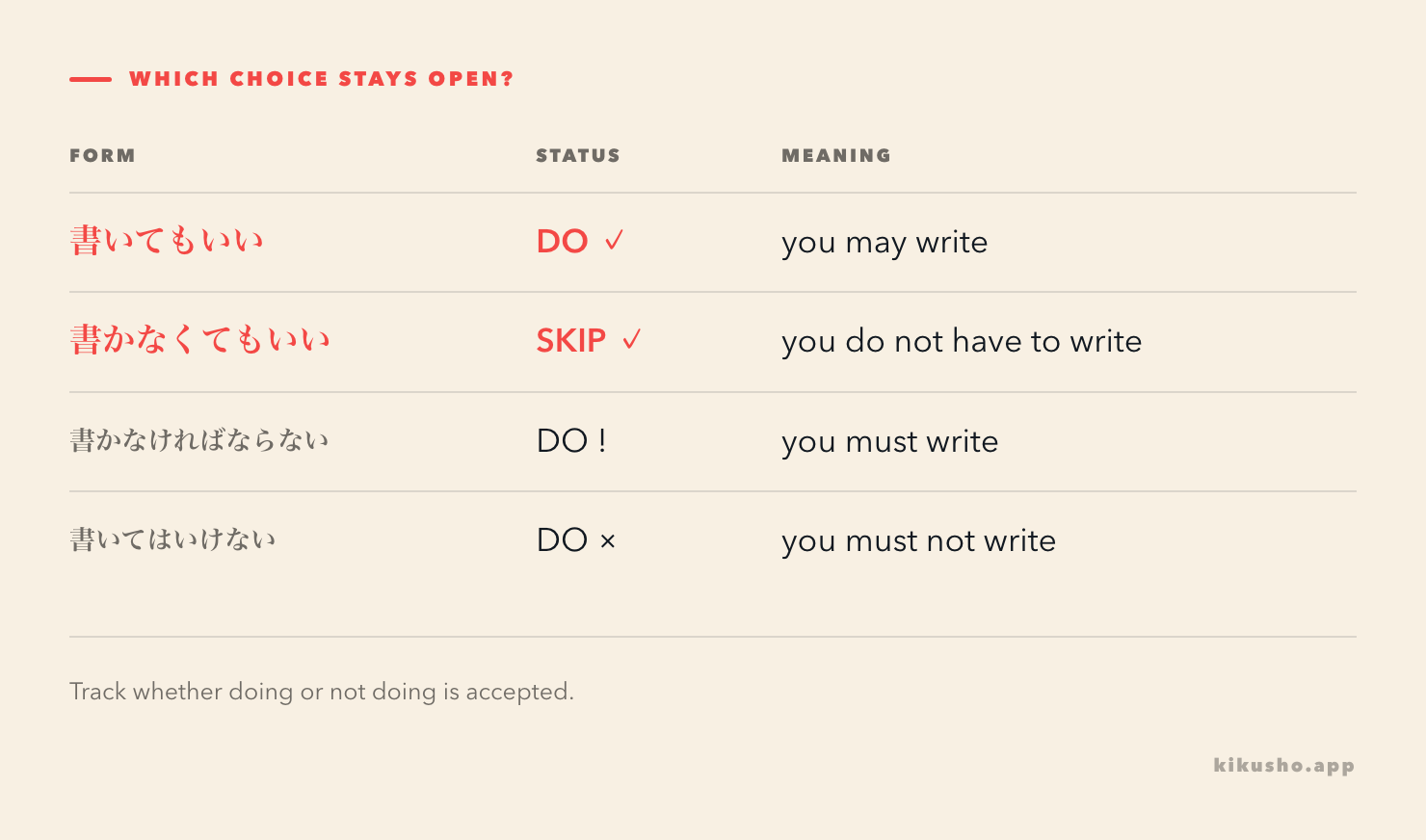
| Pattern | What it says about 書く | Natural translation |
|---|---|---|
| 書いてもいい | doing it is acceptable | you may write |
| 書かなくてもいい | not doing it is acceptable | you do not have to write |
| 書かなければならない | not doing it is unacceptable | you must write |
| 書いてはいけない | doing it is unacceptable | you must not write |
The negative in 書かなくてもいい belongs to 書かない, “not write.” The final いい then accepts that negative choice. By contrast, 書いてはいけない starts from the affirmative action 書いて and rejects it.
This is why you don't have to write cannot be translated with a prohibition. The permission and prohibition lesson teaches てもいい and てはいけない together. The obligation lesson handles なければならない, なきゃ and なくちゃ. Put the four in one map so English wording does not make the choice for you.
A question asks whether omission is acceptable
Add ですか to ask whether you may leave the action undone.
明日の会議に出なくてもいいですか。
あしたの かいぎに でなくても いいですか。
Is it okay if I do not attend tomorrow's meeting?
This question does not ask for permission to attend. It asks whether non-attendance is acceptable. A clear affirmative answer can keep the same negative action:
はい、出なくてもいいです。
はい、でなくても いいです。
Yes, you do not have to attend.
If attendance is required, avoid answering with a dense double negative. State the obligation directly:
いいえ、出なければなりません。
いいえ、でなければ なりません。
No, you must attend.
The words はい and いいえ agree or disagree with the whole proposition “not attending is okay.” They do not mechanically translate the English words yes and no. Repeating the decisive grammar after them keeps the answer unambiguous.
なくていい is the shorter conversational form
The particle も can be omitted: 行かなくてもいい and 行かなくていい both say that going is unnecessary. The shorter form is common in conversation.
急がなくていいよ。
いそがなくて いいよ。
You do not need to hurry.
JLPT Sensei explicitly lists も as optional, and Bunpro notes that leaving it out makes the expression more casual or friendly. Tofugu explains that も contributes an “even if” shade to てもいい; ordinary speech often does without that extra emphasis.
Keep なくてもいいです as the dependable study form. It exposes the connection to てもいい and is easy to recognize on a test. Use なくていい once the relationship is clear, rather than treating it as a different rule.
The more formal written alternative なくてもよい changes いい to its stylistic equivalent よい. It does not change which action is optional.
The same logic can accept a negative state
The grammar is not limited to verbs. Because adjective and noun negatives also end in forms that connect with て, the expression can accept a state that is absent.
| Word type | Negative accepted with てもいい | Meaning |
|---|---|---|
| い-adjective | 甘くなくてもいい | it does not have to be sweet |
| な-adjective | 静かじゃなくてもいい | it does not have to be quiet |
| noun | 日本語じゃなくてもいい | it does not have to be Japanese |
Tofugu documents these wider attachments with 甘くなくてもいい, 上手じゃなくてもいい and a noun example. For an N5 verb question, identify the verb's ない-form first. The wider pattern matters because it shows that なくてもいい accepts a negative condition; it is not a special translation attached only to actions.
Level lists disagree between N5 and N4
JLPT Sensei classifies なくてもいい as N5. Bunpro labels it N4, and the Tanos study list also places it at N4. That disagreement is about teaching order, not about the form or meaning.
The official JLPT FAQ explains that the post-2010 test does not publish a vocabulary, kanji or grammar specification. Third-party level lists are therefore estimates. This curriculum follows the JLPT Sensei N5 assignment and teaches the form only after its prerequisites: the plain negative and affirmative てもいい.
If you save a sentence such as 明日は制服を着なくてもいいです in Kikusho, keep the condition 明日は and the object 制服を on the card. An editable note can then record whether the option applies for one day, one event or a general rule. Saving only なくてもいい would preserve the ending while losing the choice it governs.
Practice: decide which choice remains open
Answer all seven questions before opening the explanations. Each one tests whether the action is allowed, optional, required or forbidden.
Question 1
Choose the form that means “You do not have to bring a dictionary tomorrow.”
明日は辞書を__。
- さ: 持ってもいいです
- し: 持たなくてもいいです
- す: 持ってはいけません
- せ: 持たなければなりません
Question 2
Complete the three-step formation of “do not have to read.”
読む → __ → 読まなくてもいい
- さ: 読みない
- し: 読まない
- す: 読まなくて
- せ: 読んで
Question 3
Which sentence says that taking a photograph is prohibited?
- さ: 写真を撮ってもいいです。
- し: 写真を撮らなくてもいいです。
- す: 写真を撮ってはいけません。
- せ: 写真を撮らなければなりません。
Question 4
Arrange every chunk once to ask “Is it okay if I don't come tomorrow?”
いいですか / 明日 / 来なくても
Question 5
Read the exchange. Choose the clearest reply when attendance is required.
学生:授業に出なくてもいいですか。
先生:__。
- さ: はい、出てもいいです
- し: はい、出なくてもいいです
- す: いいえ、出なければなりません
- せ: いいえ、出てはいけません
Question 6
Choose the natural shorter conversational version of 急がなくてもいいよ.
- さ: 急がないいいよ
- し: 急がなくていいよ
- す: 急いではいいよ
- せ: 急がないてもいいよ
Question 7
Explain how the available choice changes between these two signs.
靴を脱がなくてもいいです。
靴を脱いではいけません。
Answers and explanations
Answer 1
し: 持たなくてもいいです. The accepted choice is 持たない, not bringing the dictionary. Choice さ permits bringing it, す forbids bringing it, and せ requires bringing it.
Answer 2
し: 読まない. First form the complete plain negative, then replace its final い: 読まない → 読まなくてもいい. 読みない wrongly attaches ない to the ます-stem, while 読んで begins the affirmative てもいい route.
Answer 3
す: 写真を撮ってはいけません. てはいけません rejects the affirmative act of taking a photograph. Choice し says taking one is unnecessary, so it does not create a ban.
Answer 4
明日来なくてもいいですか is the complete question. 来る has the irregular negative 来ない(こない), which becomes 来なくても(こなくても) before いいですか.
Answer 5
す: いいえ、出なければなりません. The student's question proposes that non-attendance is acceptable. The teacher rejects that proposition and states the obligation to attend. Choice せ would forbid attendance, the opposite rule.
Answer 6
し: 急がなくていいよ. Conversational Japanese can omit も without changing the core meaning. The other choices break the connection after ない or use the affirmative て-form incorrectly.
Answer 7
靴を脱がなくてもいいです says removing your shoes is optional: keeping them on is accepted. 靴を脱いではいけません forbids removing them. The first leaves two possibilities open; the second closes the “remove them” possibility.
Common questions
What does なくてもいい mean in Japanese?
Verb なくてもいい means that not doing the action is acceptable, so the action is not required. It often translates as “do not have to” or “it is okay not to.” It leaves both doing and not doing available unless the wider context removes one of those choices.
How do I form なくてもいい from a verb?
Make the verb's plain ない-form, remove the final い of ない, and add くてもいい. 書く becomes 書かない and then 書かなくてもいい; 食べる becomes 食べない and then 食べなくてもいい; する and 来る become しなくてもいい and 来なくてもいい.
What is the difference between てもいい and なくてもいい?
Vてもいい accepts doing the action, while Vなくてもいい accepts not doing it. 入ってもいい means entering is permitted; 入らなくてもいい means entering is optional. The negative belongs to the action, not to いい.
Is なくてもいい N5 or N4 grammar?
JLPT Sensei lists it at N5, while Bunpro and Tanos place it at N4. These are independent study classifications because the JLPT does not publish an exhaustive grammar list. This curriculum teaches it after the N5 ない-form and てもいい foundations.