On this page
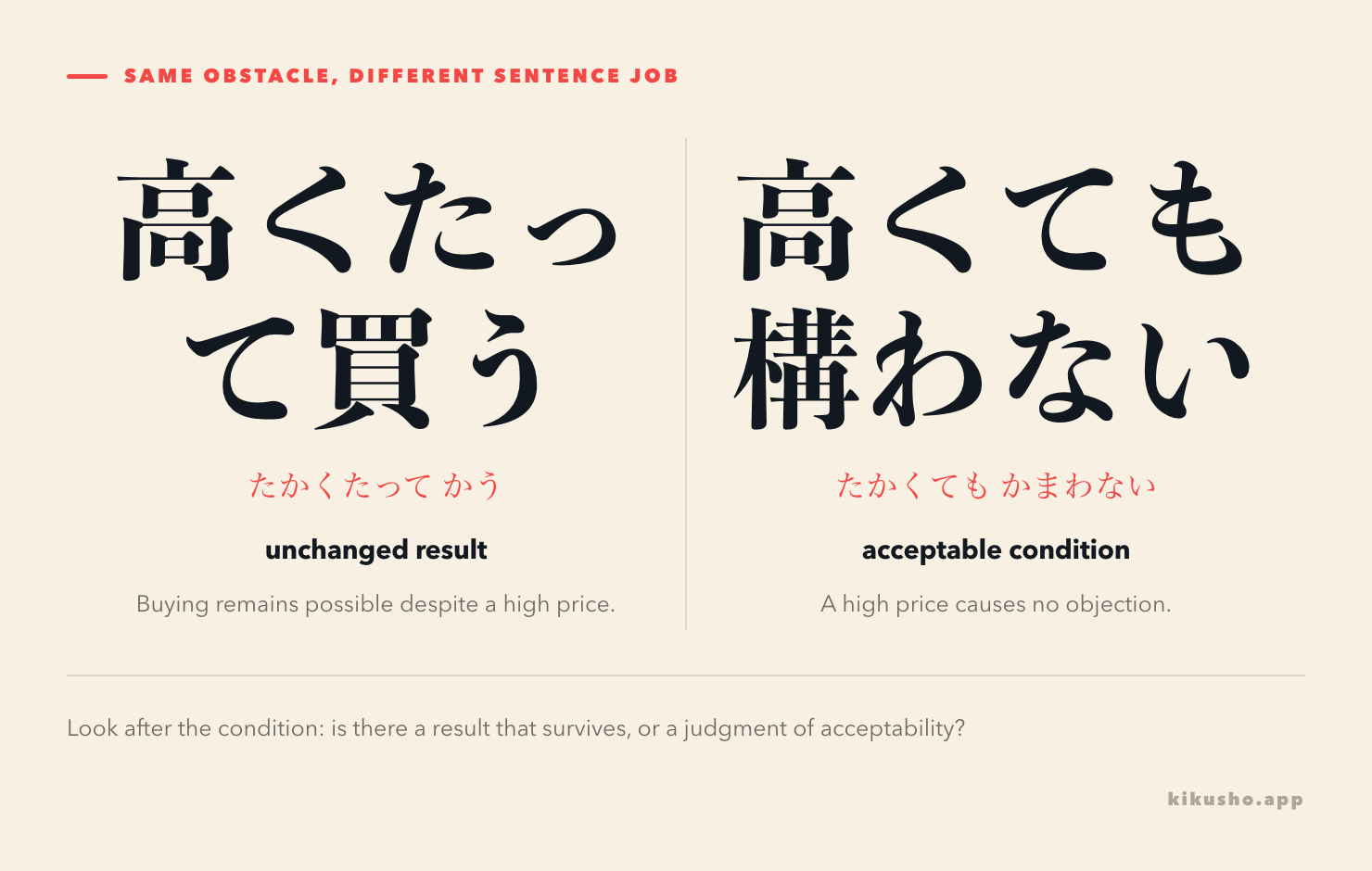
雨が降ったって行く keeps the decision to go unchanged even if it rains. 雨が降っても構わない says that rain itself is acceptable to the speaker. The first is a casual concession; the second expresses no objection and can also grant permission.
The shared sounds hide different sentence jobs. Ask what comes after the condition: an unchanged result, or a judgment that the condition is all right.
One pattern protects a result; the other accepts a choice
Place the same adjective before each form:
高くたって、必要なら買います。
たかくたって、ひつようならかいます。
Even if it is expensive, I will buy it if I need it.
値段は少し高くても構いません。
ねだんはすこしたかくてもかまいません。
I don't mind if the price is a little high.
In the first sentence, 買います survives the obstacle 高い. In the second, 構いません evaluates a high price as acceptable. Nothing after ~たって inherently means permission; nothing about ~ても構わない requires a stubborn second action.
| Form | Question it answers | Core reading |
|---|---|---|
| A たって、B | Does B remain true despite A? | Even if A, B |
| A ても構わない | Is A acceptable? | I do not mind if A |
| A ても構いませんか | Does the listener accept A? | May I A? / Do you mind if A? |
The lesson on どんなに, いくら and たとえ~ても develops the neutral concessive system. This lesson adds the casual ending ~たって and separates it from a permission phrase that also contains ても.
Build ~たって from the past-shaped form
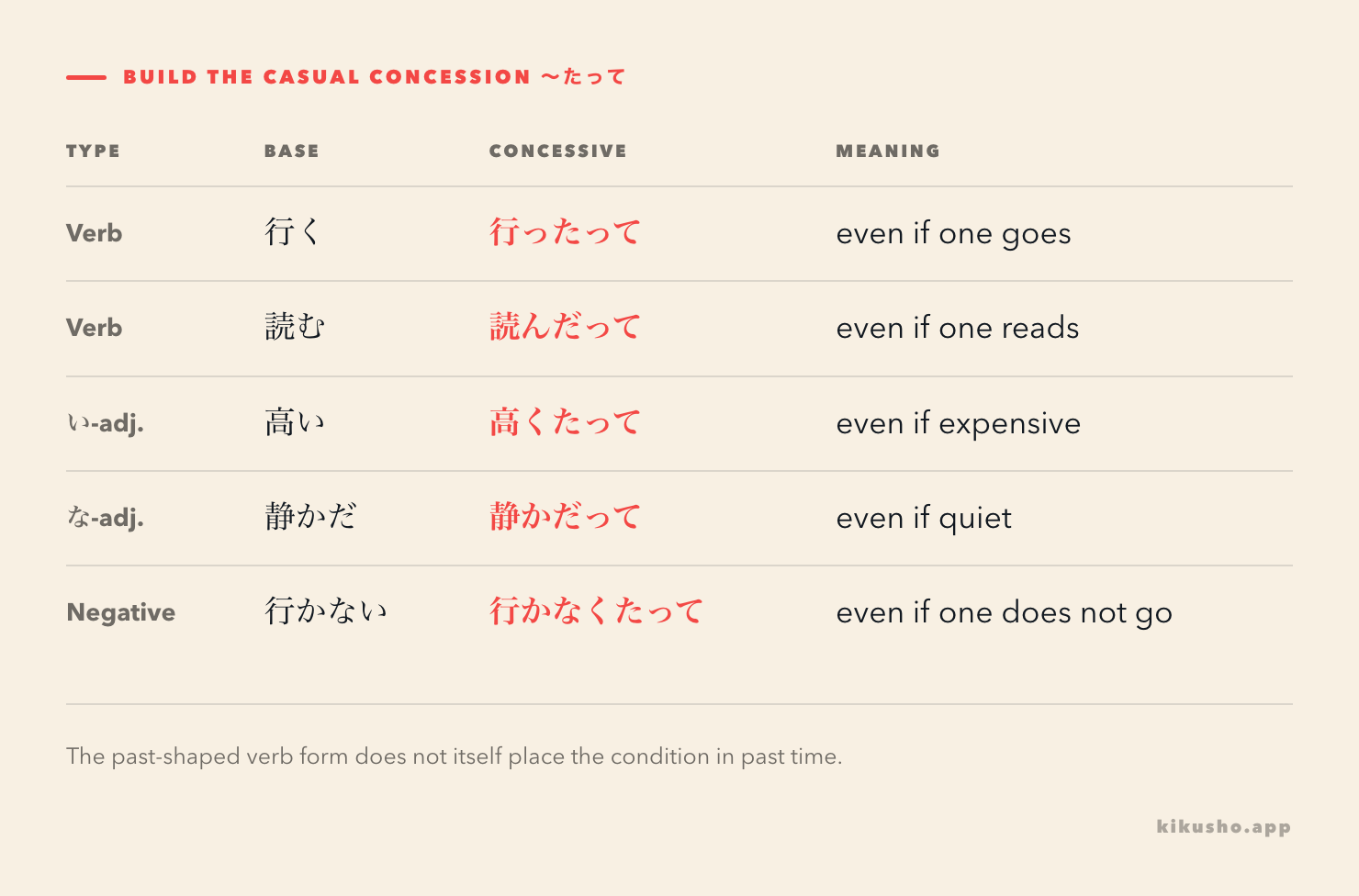
For verbs, take the plain past and add って. The resulting surface form follows the same sound changes you already know from the past tense:
| Base | Plain past | + って | Concessive meaning |
|---|---|---|---|
| 行く | 行った | 行ったって | even if someone goes |
| 読む | 読んだ | 読んだって | even if someone reads |
| 話す | 話した | 話したって | even if someone speaks |
| 食べる | 食べた | 食べたって | even if someone eats |
| する | した | したって | even if someone does it |
This does not make the condition past. 明日雨が降ったって行きます can describe tomorrow: “Even if it rains tomorrow, I will go.” The form is past-shaped, but the time comes from the whole sentence.
Adjectives and nouns take their own rows:
| Predicate | ~たって form | Example fragment |
|---|---|---|
| い-adjective 高い | 高くたって | price does not alter the result |
| な-adjective 静かだ | 静かだって | quietness does not alter the result |
| noun 子供だ | 子供だって | even a child / even if it is a child |
| negative verb 行かない | 行かなくたって | even if someone does not go |
| negative adjective 高くない | 高くなくたって | even if it is not expensive |
誰に聞いたって、答えは同じだよ。
だれにきいたって、こたえはおなじだよ。
“No matter who you ask, the answer is the same.”
そんなに急がなくたって、間に合うよ。
そんなにいそがなくたって、まにあうよ。
“Even if you don't hurry that much, you'll make it.”
Bunpro's ~たって reference records these verb, adjective, noun and negative attachments and marks the expression as casual. It places the form at N2; JLPT Sensei places it at N3. These are publisher estimates because the JLPT does not publish a complete grammar list.
Casual emphasis is part of ~たって
Neutral ても works in speech and writing. たって belongs to conversation and often carries insistence, frustration or reassurance.
いくら説明したって、彼は信じないよ。
いくらせつめいしたって、かれはしんじないよ。
No matter how much you explain, he won't believe you.
The speaker sounds personally invested in the unchanged result. In a report or careful written explanation, いくら説明しても is the safer form. The meaning stays concessive; the register changes.
Do not identify every だって as this pattern. 子供だって分かる can mean “Even a child understands,” but conversational だって also has quotation and “because” uses. Read the construction around it. Here, a candidate condition or unexpected member is set against a result that still holds.
~ても構わない says there is no objection
構う (かまう) includes the idea of minding or concerning oneself with something. Its negative 構わない says that the proposed state causes no objection.
Use the ordinary ても or でも attachment:
| Predicate type | Acceptable form | Meaning |
|---|---|---|
| verb 使う | 使っても構わない | using it is acceptable |
| negative verb 使わない | 使わなくても構わない | not using it is acceptable |
| い-adjective 安い | 安くても構わない | a low price is acceptable |
| な-adjective 簡単だ | 簡単でも構わない | something simple is acceptable |
| noun コピーだ | コピーでも構わない | a copy is acceptable |
この席を使っても構いません。
このせきをつかってもかまいません。
“You may use this seat / I don't mind if you use this seat.”
答えたくなければ、答えなくても構いません。
こたえたくなければ、こたえなくてもかまいません。
“If you do not want to answer, you do not have to.”
The second sentence literally accepts not answering, so English often prefers “you do not have to.” It does not mean that answering is forbidden.
Bunpro's ~ても構わない lesson gives the full predicate table and distinguishes a basic permission from the “I don't mind” perspective. A Japan Foundation grammar explanation treats Vなくてもかまいません as equivalent to Vなくてもいいです, while noting that the 構いません version is more formal.
Permission emerges from who controls the choice
When the listener wants to act and the speaker can accept or reject that action, ~ても構わない grants permission:
A:ここに荷物を置いても構いませんか。
ここににもつをおいてもかまいませんか。
May I leave my luggage here?B:はい、構いません。
はい、かまいません。
Yes, that's fine.
The polite question asks whether the action would trouble the listener. In everyday situations, 置いてもいいですか is more ordinary. 構いませんか can sound more formal or businesslike, especially when the issue is a rule, format or acceptable option.
The answer 構いません is affirmative: “I do not mind.” Do not mistake the negative ending for refusal. A refusal must name a problem or say the action is not allowed.
The ~てもいい and ~てはいけない lesson gives the earlier permission and prohibition foundation. ~ても構わない adds the speaker's lack of objection; it does not replace every everyday ~てもいい.
The forms can overlap in one sentence
Because ~たって is a concessive linker, 構わない can follow it:
少し古くたって構わない。
すこしふるくたってかまわない。
“I don't mind even if it is a little old.”
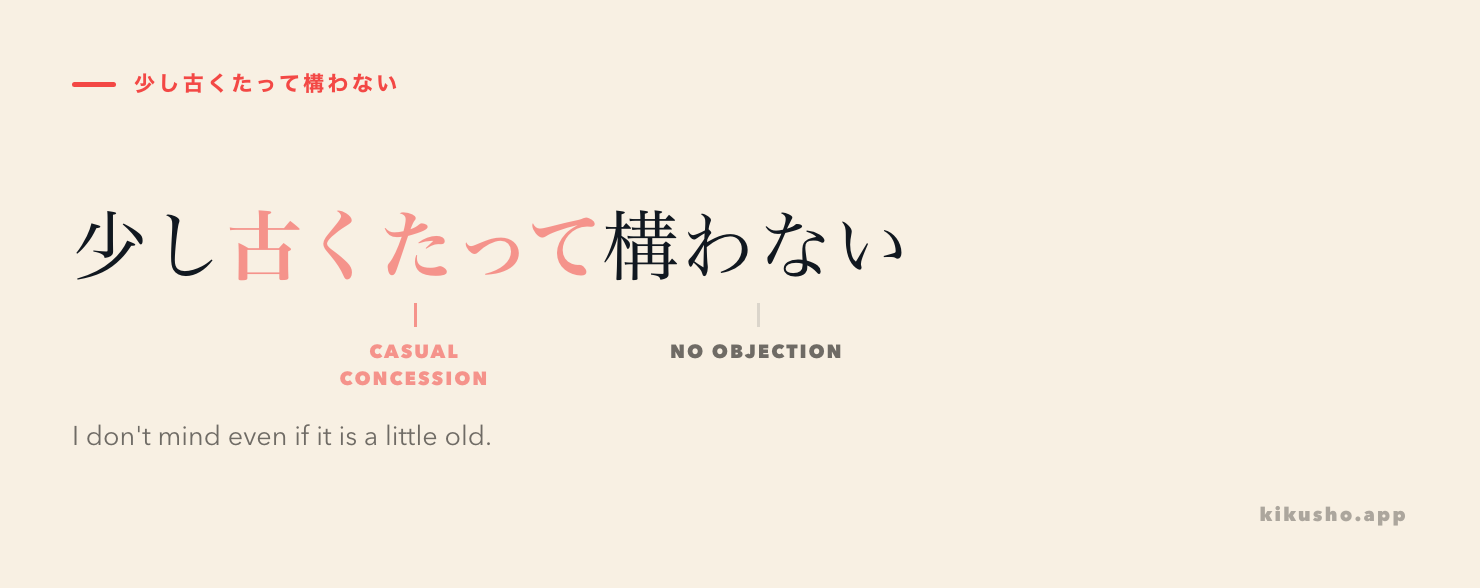
The more neutral version is 少し古くても構わない. Both sentences end in a judgment of acceptability. The first uses the casual, emphatic concessive 古くたって; the second uses standard 古くても inside the conventional phrase.
That overlap shows why translation alone is unreliable. The words “I don't mind even if” may contain both jobs. Parse from left to right:
- 古くたって concedes that it may be old.
- 構わない judges that possibility acceptable.
In Kikusho, keep the final predicate when you capture such a line. A card with only 古くたって remembers the concessive link but loses whether the speaker will buy the object, reject it, or simply not mind.
Practice: six decisions
Answer every item before moving to the explanations.
Question 1: unchanged result.
Choose the form that makes “I will go” survive the possibility of rain.
雨が( )、行きます。
- A. 降っても構いません
- B. 降ったって
- C. 降ってはいけません
- D. 降る構いません
Question 2: acceptable option.
The application may be handwritten or typed. Complete the sentence that accepts a handwritten form.
手書き( )。
- A. だって提出します
- B. でも構いません
- C. たってはいけません
- D. でも行きます
Question 3: い-adjective formation.
Choose the casual concessive form of 難しい.
- A. 難しいたって
- B. 難しくたって
- C. 難しだって
- D. 難しくても構う
Question 4: negative permission.
Choose the sentence meaning “You do not have to answer.”
- A. 答えなくても構いません。
- B. 答えたって構います。
- C. 答えては構いません。
- D. 答えなくたってはいけません。
Question 5: sentence order.
Put these chunks in a natural order: 私は / 誰に反対されたって / 計画を変えません.
Question 6: two jobs in context.
Select the pair that first protects a decision from cost, then accepts a colour choice.
少し( )、必要なら買います。色は黒( )。
- A. 高くたって / でも構いません
- B. 高くても構いません / だって買います
- C. 高いだって / ても構いません
- D. 高くたって構いません / でも買います
Mark the linker and the final judgment separately before checking the explanations.
Answers and explanations
Answer 1. The rain clause needs B, 降ったって. The result 行きます remains true despite rain. A says rain is acceptable, which answers a different question. C forbids rain grammatically but makes no sensible permission relation here.
Answer 2. B, 手書きでも構いません. A noun takes でも before 構いません, and the phrase accepts handwriting as an allowed format. D lacks the no-objection judgment and leaves the sentence without a subject for 行きます.
Answer 3. B, 難しくたって. Remove final い and add くたって. A wrongly attaches the ending to the dictionary form, while C uses the noun and な-adjective pattern.
Answer 4. A, 答えなくても構いません. The negative action, not answering, is accepted. That produces “you do not have to answer,” not “you must not answer.”
Answer 5. 私は誰に反対されたって、計画を変えません。 The passive condition comes before the unchanged decision: “No matter who opposes me, I will not change the plan.”
Answer 6. A. 高くたって concedes a high price while buying remains possible; 黒でも構いません accepts black as an option. B reverses the intended jobs, and C contains two malformed attachments.
Common questions
What does ~たって mean in Japanese?
~たって is a casual, often emphatic equivalent of concessive ~ても. It means “even if,” “even though,” or “no matter,” and introduces a condition that does not change the following result.
How do you form ~たって?
Verbs use the plain past plus って, such as 行ったって and 読んだって. い-adjectives use ~くたって, while nouns and な-adjectives use ~だって. Negative forms include 行かなくたって and 高くなくたって.
What does ~ても構わない mean?
It says that a choice or situation is acceptable: “I don't mind if” or “it is all right if.” Addressed to another person, it can grant permission; as ~ても構いませんか, it can ask permission.
Is ~ても構わない more polite than ~てもいい?
~ても構いません can sound more formal and frames the matter as causing no objection. ~てもいいです is the more ordinary permission expression. Politeness still depends on the full sentence and relationship.