On this page
行くな means “Do not go,” while 行きなさい means “Go.” The endings look related, but the first blocks an action with dictionary-form + な and the second orders it with ます-stem + なさい.
One contrast decides the direction
Put the same verb into the two patterns and the polarity reverses:
そこに行くな。
そこに いくな。
Do not go there.
そこに行きなさい。
そこに いきなさい。
Go there.
The command 行くな keeps the dictionary form 行く and adds な. The instruction 行きなさい starts from 行きます, removes ます, and adds なさい. Do not reason from the shared sound alone; inspect the verb immediately before it.
| Speaker's direction | Form | Example | Result |
|---|---|---|---|
| stop the action | dictionary-form + な | 触るな | Don't touch. |
| require the action | ます-stem + なさい | 座りなさい | Sit down. |
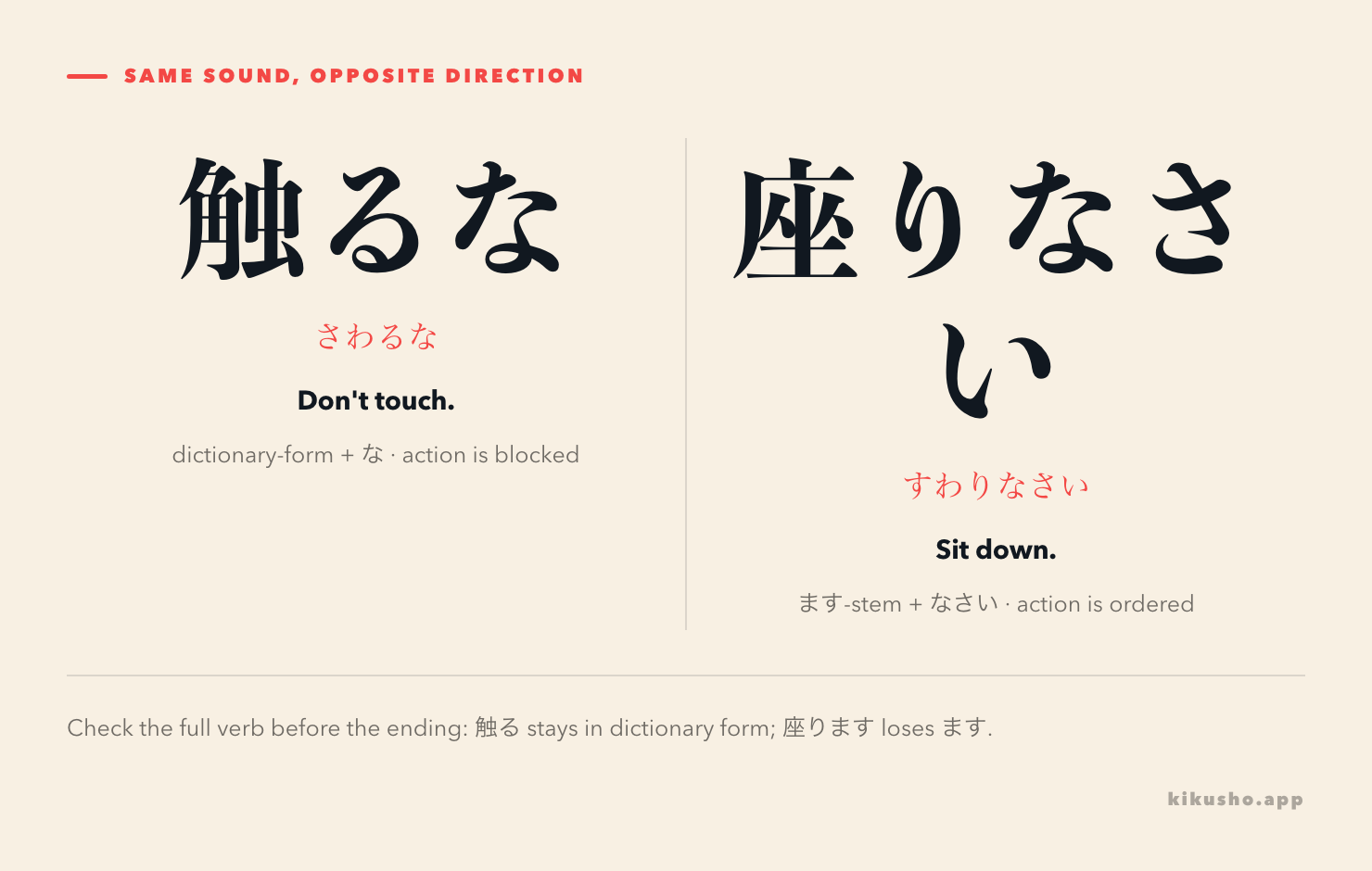
The Japan Foundation's Irodori grammar reference identifies V-るな as the prohibitive imperative and forms it by adding な to a dictionary-form verb. Its Vなさい lesson independently describes なさい as an order, instruction or warning made from the ます-stem.
な attaches without conjugating the dictionary form
For the blunt prohibition, keep each verb exactly as it appears in the dictionary:
| Verb | Dictionary form + な | Meaning |
|---|---|---|
| 行く, to go | 行くな | Don't go. |
| 食べる, to eat | 食べるな | Don't eat. |
| する, to do | するな | Don't do it. |
| 来る, to come | 来るな | Don't come. |
There is no change from く to き, no removal of る and no negative conjugation. 食べないな is not the prohibitive form taught here; the required structure is 食べるな.
This form is short and forceful. It fits an urgent warning such as 危ない!触るな!, a strict order, a sign or a line of dramatic dialogue. It can also encourage someone by prohibiting failure: 負けるな! means “Don't lose!” or “Hang in there!” The grammar still prohibits an outcome, while the situation makes it supportive.
The Japan Foundation's article on instructions, orders and prohibitions calls dictionary-form + な concise and quite strong. That strength is why it is risky as a default way to address a stranger, colleague or customer.
なさい starts from the ます-stem
To build なさい, first make the polite ます-form, remove ます, and attach なさい:
| Dictionary form | ます-form | ます-stem + なさい |
|---|---|---|
| 行く | 行きます | 行きなさい |
| 食べる | 食べます | 食べなさい |
| する | します | しなさい |
| 来る | 来ます | 来なさい |
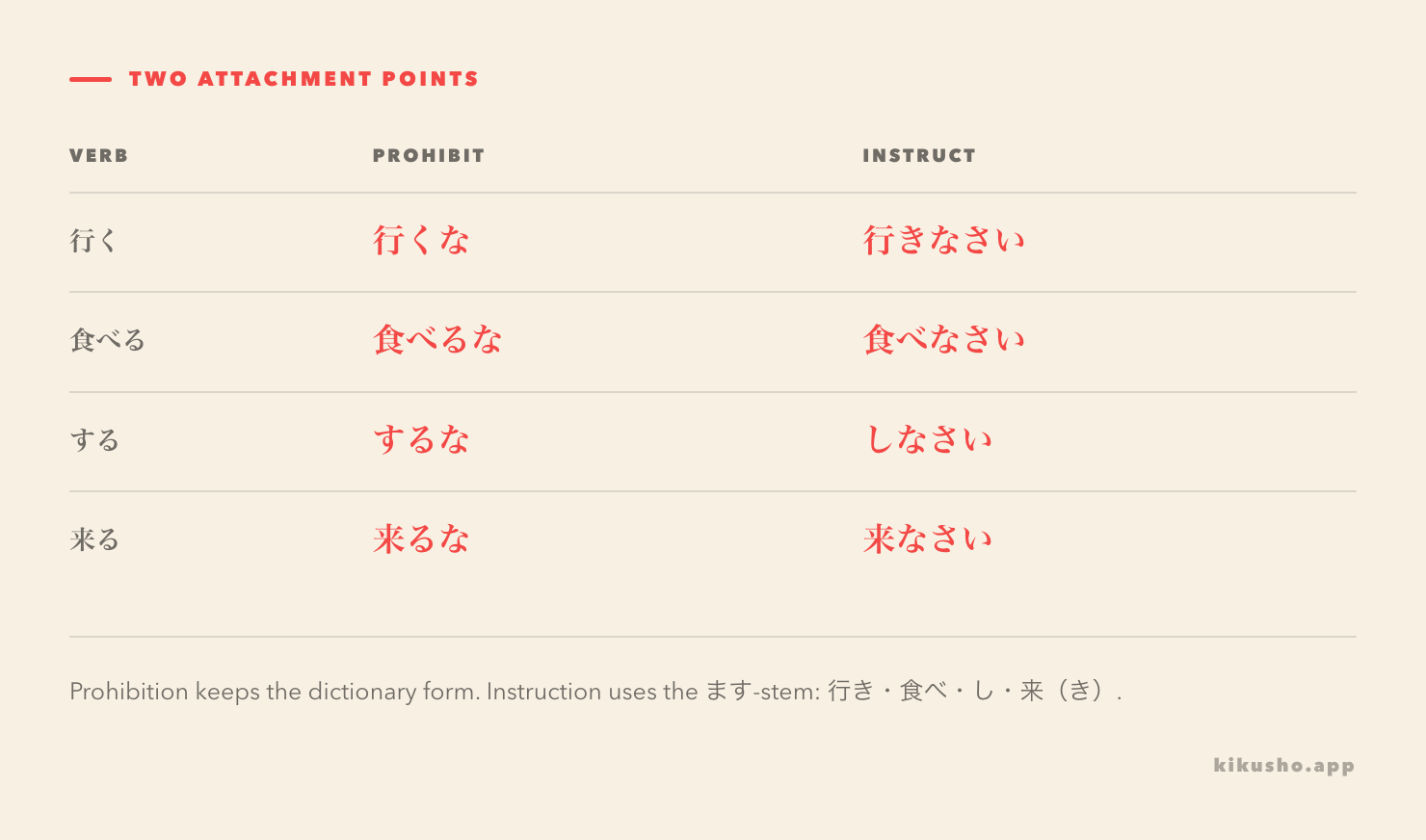
The irregular readings matter: 来るな is くるな, but 来なさい is きなさい. With する, compare するな and しなさい. These pairs expose the two different attachment points better than a regular verb does.
なさい gives a positive instruction:
もう遅いから、早く寝なさい。
もう おそいから、はやく ねなさい。
It is already late, so go to bed.
次の質問に答えなさい。
つぎの しつもんに こたえなさい。
Answer the following question.
JLPT Sensei's なさい reference and NIHONGO NET both place the form at N4 and give the same stem attachment. Bunpro's なさい entry also treats it as an N4 command.
The ます-stem does not make なさい polite to the listener
A parent can tell a child 宿題をしなさい, and a teacher can write 正しい答えを選びなさい on an exercise. In both cases the speaker or text has authority to direct the listener. The form sounds less abrupt than a bare imperative such as しろ, but it is still a command from above.
That makes こちらに来なさい a poor default request to a customer or manager. The ます-stem is part of the construction; it does not grant the sentence the listener-directed politeness of こちらに来てください. The Japan Foundation ranks the bare imperative as strongest, followed by なさい and then the て-form, while noting that superiors use なさい toward subordinates.
Compare the available choices:
| Sentence | Main job | Typical effect |
|---|---|---|
| 触るな。 | blunt prohibition | direct, forceful “Don't touch.” |
| 触らないでください。 | negative request or instruction | polite wording: “Please don't touch.” |
| 触ってはいけません。 | rule or prohibition | “You must not touch.” |
| 座りなさい。 | authoritative positive instruction | “Sit down.” from someone directing you |
| 座ってください。 | positive request or clear instruction | polite “Please sit.” |
Use the ないで and ないでください lesson for negative requests, the ~てください lesson for positive requests, and the ~てはいけない lesson for rule-based prohibition.
なさい does not take a negative verb
The productive pattern in this lesson is positive ます-stem + なさい. Forms such as 食べないなさい and 食べなくなさい are not valid ways to say “Don't eat.” Choose the negative expression by meaning and relationship:
- 食べるな for a blunt ban.
- 食べないでください for a politely worded request not to eat.
- 食べてはいけません for a rule saying eating is not allowed.
- 食べるのをやめなさい for an authority figure ordering someone to stop eating.
The last example is positive なさい attached to やめます → やめなさい. Its object, 食べるの, names the activity to stop. なさい itself has not become negative.
Three other な forms are separate grammar
Position and intonation keep this prohibitive な apart from several common lookalikes.
Reflective sentence-final な or なあ expresses a thought or feeling:
いいなあ。
That sounds nice. / I'm envious.
It does not follow a dictionary-form verb to prohibit that action. The なあ, ね and よ lesson covers this conversational ending.
な-adjective な links an adjective to a noun: 静かな部屋, “a quiet room.” It occupies a noun-modifying slot, not the end of a command.
Finally, casual speech can shorten positive なさい to forms such as 食べな. Because that short form can look like the prohibitive particle, use the attachment to decode it: 食べるな contains the dictionary form and means “Don't eat”; 食べな comes from 食べなさい and tells someone to eat. This shortening is relationship-sensitive, so master the full form before producing it.
Publishers do not agree on where to place every item. JLPT Sensei and NIHONGO NET classify prohibitive な at N4, matching this curriculum, while Bunpro labels its prohibitive な entry N5. All three place なさい at N4. These are teaching classifications because the JLPT does not publish an exhaustive grammar list.
When you save a command in Kikusho, keep the subject relationship and situation with it. A voice card containing only 行きなさい hides whether it came from a parent, a teacher or an exercise instruction. Review the captured sentence before saving it, then compare it with 行くな and 行ってください so the attachment and register remain visible.
Choose the action and the relationship
Commit to all seven choices first; the explanations stay together after the final passage.
Question 1: grammar choice. A parent tells a child to go to bed. Choose the ending for 早く寝__。
- A. るな
- B. なさい
- C. ないなさい
- D. てはいけない
The family relationship is part of the clue.
Question 2: meaning. What does ここに入るな tell the listener?
- A. Enter here.
- B. Please enter here.
- C. Do not enter here.
- D. Entering here is possible.
Question 3: register. You need to ask a customer to sit down. Which is the safest ordinary choice?
- A. 座れ。
- B. 座るな。
- C. 座りなさい。
- D. 座ってください。
Question 4: sentence composition. Arrange the pieces to write an exercise instruction meaning “Answer the next question”: 答えなさい / 次の / に / 質問.
Question 5: attachment. Choose the correct pair for 来る.
- A. prohibition 来な; instruction 来るなさい
- B. prohibition 来るな; instruction 来なさい
- C. prohibition 来ないな; instruction 来りますなさい
- D. prohibition 来なさい; instruction 来るな
Question 6: lookalikes. Which sentence uses な as a reflective ending rather than a prohibition?
- A. そこに行くな。
- B. このボタンを押すな。
- C. いいなあ。
- D. 忘れるな。
Question 7: text grammar. An invigilator says: 試験が始まります。教科書を開くな。まず、名前を書きなさい。それから、次の質問に答えなさい。 What must the students do?
- A. Students may open the textbook, but they must not write their names.
- B. Students are forbidden to open the textbook and are instructed to write their names before answering the next question.
- C. Students are politely invited to open the textbook and may skip the questions.
- D. Every な in the passage is a reflective sentence ending.
Answers and explanations
Answer 1. B, 寝なさい. Remove ます from 寝ます and attach なさい for the parent's positive instruction. 寝るな would reverse the meaning to “Don't sleep.”
Answer 2. C. 入る is the dictionary form and な makes a strong prohibition: “Do not enter here.”
Answer 3. D, 座ってください. It is a politely worded request or instruction. 座りなさい would position the speaker as an authority over the customer, while A is a bare imperative and B forbids sitting.
Answer 4. 次の質問に答えなさい。 The noun phrase 次の質問 is marked by に with 答える, and 答えます → 答えなさい creates the instruction.
Answer 5. B. Prohibitive な keeps dictionary-form 来る, read くる, giving 来るな. なさい uses the stem of 来ます, read きます, giving 来なさい.
Answer 6. C, いいなあ. It voices a reaction such as admiration or envy. In A, B and D, な follows a dictionary-form verb and prohibits the named action.
Answer 7. B. 開くな blocks opening the textbook. 書きなさい and 答えなさい positively order the students to write and answer, so the similar endings encode opposite directions.
When one of these commands appears, inspect the whole verb before な. A preserved dictionary form points to “do not”; a ます-stem before なさい points to “do it,” and the relationship tells you whether the command fits the scene.
Common questions
What is the difference between な and なさい in Japanese commands?
Dictionary-form + な is a strong negative command: 行くな means “Do not go.” A verb's ます-stem + なさい is a positive instruction: 行きなさい means “Go.” The similar endings therefore point in opposite directions.
Is なさい a polite way to ask someone to do something?
Not in ordinary conversation between equals. It is less abrupt than a bare imperative, but it still places the speaker above the listener and is typical of parents, teachers, written instructions and warnings.
How do you make a negative command with なさい?
Do not attach なさい to a negative verb. Choose a form that matches the situation, such as Vないでください for a polite request, Vてはいけません for a rule, or dictionary-form + な for a blunt prohibition.
Is the な in 行くな the same as sentence-final な or なあ?
No. In 行くな, な follows a dictionary-form verb and forbids the action. Reflective な or なあ expresses a reaction, as in いいなあ, and adjective な links a な-adjective to a noun, as in 静かな部屋.