On this page
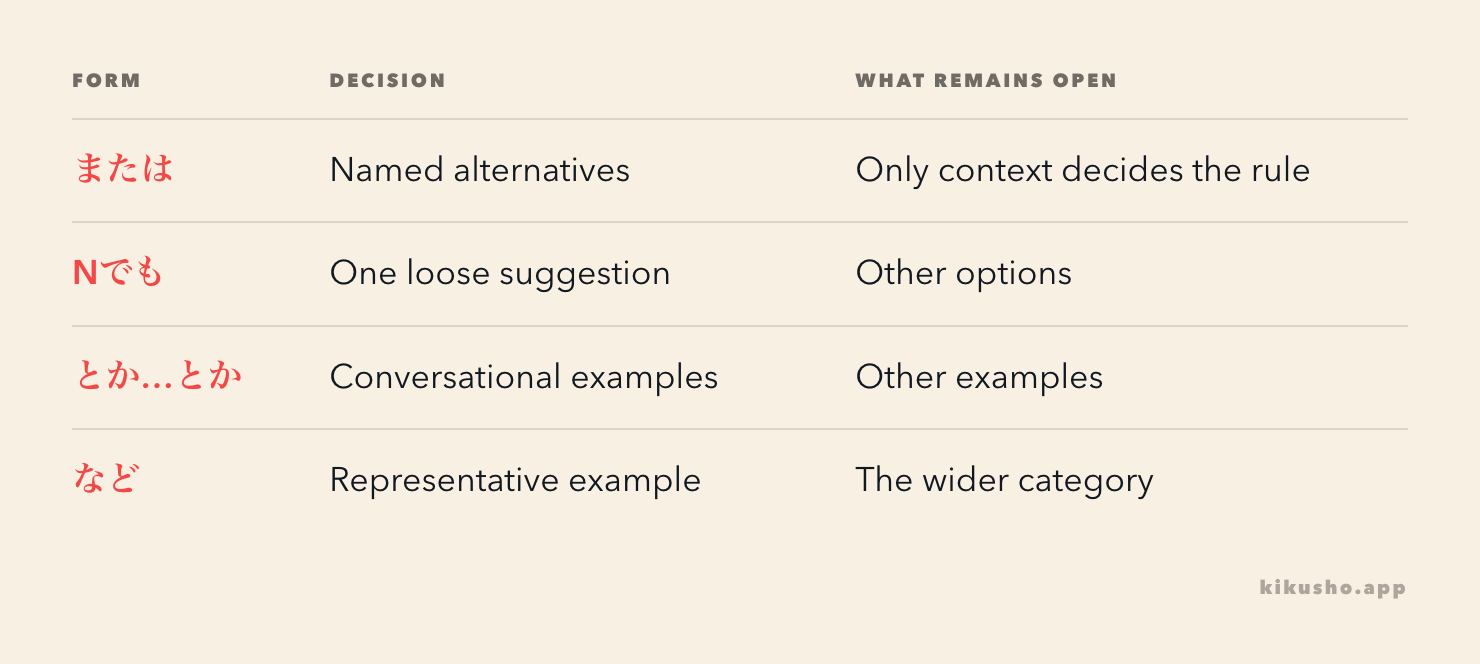
Use または when the named options are the alternatives. Use Nでも to float one loose option, とか…とか to give conversational examples, and など to mark a representative example or close a neutral list. The key question is whether the listener must choose among stated options or should understand them as samples from a larger set.
Decide whether you are naming options or giving examples
All four forms can appear where English uses words such as “or,” “something like,” or “for example,” but they organize the possibilities differently.
| Form | What the speaker does | Basic shape | Typical register |
|---|---|---|---|
| または | presents named alternatives | AまたはB | formal or written |
| Nでも | floats one easy suggestion | Nでも | conversational |
| とか…とか | lists open-ended examples | AとかBとか | conversational |
| など | marks a representative example or closes a list | Nなど / AやBなど | neutral |
Compare these two short phrases:
電話またはメールで連絡してください。
でんわ または メールで れんらくして ください。
Please contact us by phone or email.
お茶でも飲みませんか。
おちゃでも のみませんか。
Would you like tea or something?
The first sentence names the accepted routes. または connects the alternatives that matter to the instruction. The second does not ask the listener to choose between “tea” and an unspoken second drink. でも offers tea as one easy example while leaving room for coffee, water, or another idea.
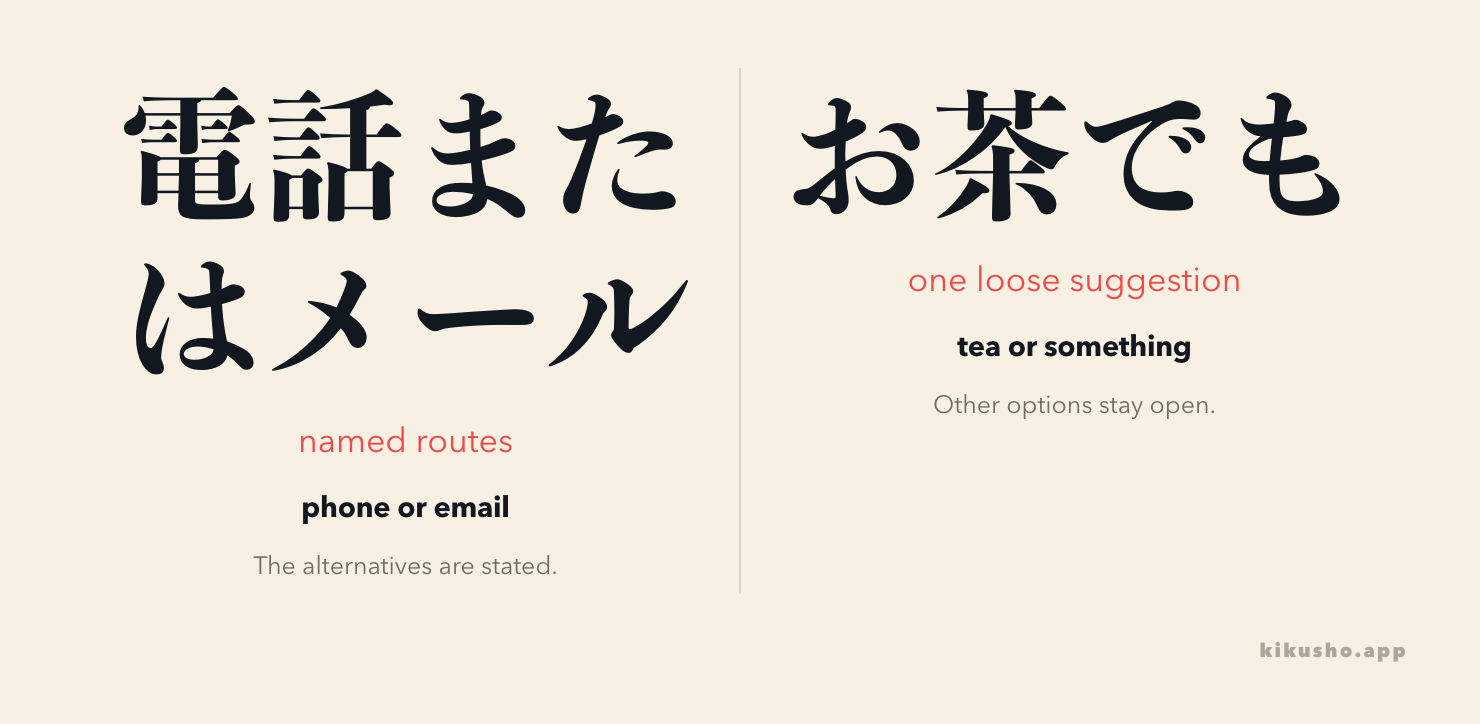
That contrast is the center of the whole lesson. または points across the named choices. でも, とか, and など point beyond what was named.
または connects explicit alternatives
Use または between alternatives in notices, forms, instructions, rules, and careful explanations. It often connects nouns, but it can connect longer phrases or clauses too.
現金またはカードで払えます。
げんきん または カードで はらえます。
You can pay by cash or card.
申込書を郵送する、または受付に持ってきてください。
もうしこみしょを ゆうそうする、または うけつけに もってきて ください。
Mail the application form, or bring it to reception.
The conjunction presents the items as alternatives; context decides the practical rule. A form may require exactly one selection, while a shop that accepts cash or card simply says that either method is available. Do not force an exclusive “one but never both” meaning into every sentence.
In everyday conversation, か is often lighter and more natural: コーヒーか紅茶、どちらがいい? asks “Coffee or tea—which would you like?” または fits the wording of a written choice: コーヒーまたは紅茶をお選びください, “Please choose coffee or tea.” The guide to か in Japanese questions and alternatives helps with that conversational version.
Nでも offers one loose option
After a noun or pronoun, でも can present one convenient example for a suggestion. The speaker is not insisting on that exact item.
週末は映画でも見よう。
しゅうまつは えいがでも みよう。
Let's watch a movie or something this weekend.
ここで少し休憩でもしませんか。
ここで すこし きゅうけいでも しませんか。
How about taking a short break here?
The pattern is noun + でも. In 映画でも見る, the object particle を is replaced by でも. With another role, the needed particle may remain before でも: 公園にでも行こう, “Let's go to a park or somewhere.” The core meaning stays open-ended: the noun is an example, not a boundary around the choice.
This use is different from sentence-opening でも, meaning “but.” In 行きたい。でも、時間がない, でも connects two statements. It is also different from a question word plus でも, as in 誰でも, “anyone.” The N5 lesson on contrastive でも covers the sentence-opening use; here, the relevant pattern is a noun immediately followed by でも.
とか lists conversational examples
Use とか when you want to mention examples casually, especially in speech. It can follow nouns or plain-form verb phrases, and the list remains non-exhaustive.
週末は掃除するとか、買い物に行くとかします。
しゅうまつは そうじする とか、かいものに いく とか します。
On weekends I do things like clean and go shopping.
バッグには本とかノートとかが入っています。
バッグには ほんとか ノートとかが はいって います。
There are things like books and notebooks in the bag.
The second とか is often omitted: 本とかノートが入っています still sounds open-ended. A single example also works: 映画とかどう?, “How about a movie or something?” With several examples, repeating とか makes the conversational rhythm and the open list especially clear.
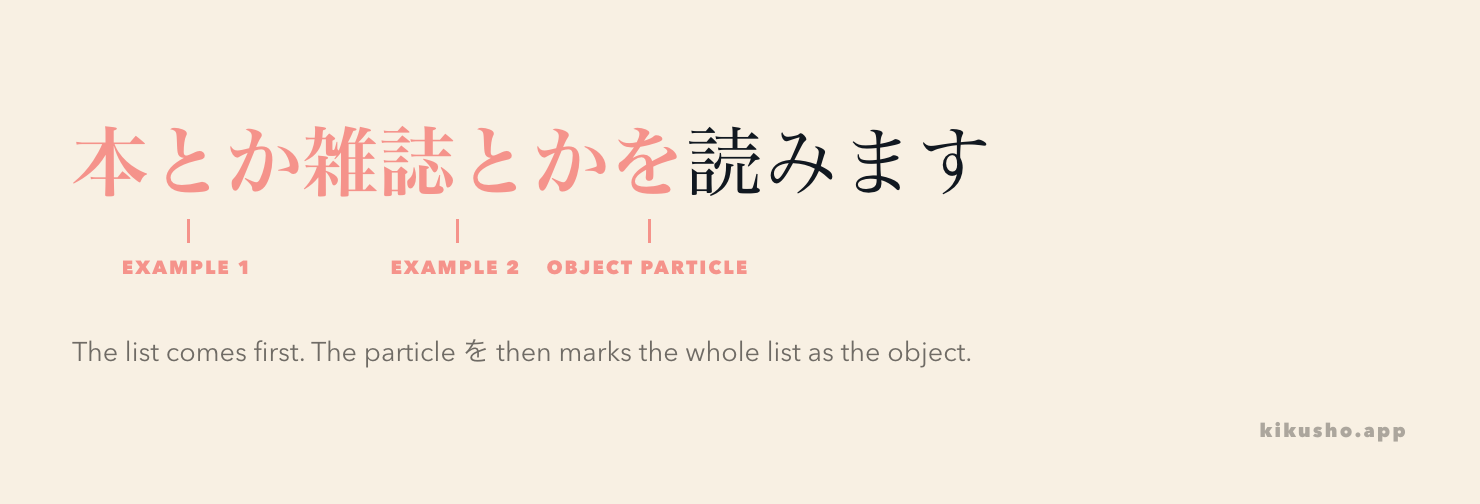
Place the case particle after the completed list. In 本とか雑誌とかを読む, the whole example list is the object, so を comes after the final とか. In 京都とか奈良とかに行きたい, に marks the destinations after they have been listed.
など marks a representative example or closes a neutral list
Use など after one noun to mean “such as” or after the final item in a list to mean “and so on.” It is neutral enough for speech and writing.
水泳などのスポーツが好きです。
すいえいなどの スポーツが すきです。
I like sports such as swimming.
机の上に本やノートなどがあります。
つくえの うえに ほんや ノートなどが あります。
There are books, notebooks, and similar things on the desk.
The common frame AやBなど combines two jobs. や links representative nouns, and など closes the open list. The N5 lesson on と and や explains why や already suggests an incomplete list; など makes that “these and similar things” reading explicit.
Unlike とか, など does not normally follow every item: use 本とか雑誌とか, but 本や雑誌など. Unlike または, neither phrase limits the listener to the named items. Both books and magazines are examples from a larger category.
At a higher level, など can also belittle or distance something, especially in patterns related to なんか and なんて. That evaluative use belongs to the N3 comparison of とか, なんて, なんか and など. At N4, first master the neutral representative-example use.
One message can change with the marker
Watch what happens when the nouns stay similar but the marker changes:
| Sentence | Natural interpretation |
|---|---|
| 電話またはメールで知らせてください。 | Use one of the named contact routes: phone or email. |
| メールでも送りましょうか。 | Shall I send an email or something? Email is one suggestion. |
| 電話するとか、メールを送るとかしてください。 | Do something like call or send an email. These are conversational examples. |
| 電話やメールなどで知らせてください。 | Contact us by phone, email, or a similar method. The list is representative. |
English “or” can hide these differences. Japanese makes you decide whether the list sets the available alternatives, proposes one easy candidate, sounds like conversational sampling, or neutrally names members of a wider class.
This distinction is useful when reading menus, forms, and notices. A line that says 現金またはカード names payment alternatives. A description with 卵やチーズなど gives representative ingredients. The guide to reading a Japanese menu shows how those small structural words help you scan before you know every dish name.
The N4 label is a study guide
JLPT Sensei places でも, または, とか~とか, and など at N4. Bunpro independently describes Nでも as an open suggestion, とか as a conversational example list, and など as a representative example from a broader group. Shogakukan's dictionary comparison of または, もしくは, and あるいは confirms that または selects among alternatives and that everyday speech often uses か.
The JLPT does not publish an exhaustive grammar list for the current test, so “N4 grammar” is a practical teaching classification rather than an official item guarantee. The four forms are useful together because one decision—named alternatives or open examples—prevents the most common mix-ups.
Kikusho turns that decision into recall practice. Save a sentence from a form, menu, or conversation, identify what the list is doing, and review it with the context still attached. A marker becomes easier to remember when it is tied to a choice you actually had to interpret.
Practice: choose the relationship first
Question 1 — grammar choice. A written application says: 電話__メールでご連絡ください。 The two named methods are the accepted alternatives.
① でも
② とか
③ または
④ など
Question 2 — grammar choice. You make a relaxed suggestion: 疲れたから、お茶__飲みませんか。
① でも
② または
③ など
④ しか
Question 3 — sentence composition. Use とか…とか to say: “On Sundays I do things like read books and listen to music.” Use 日曜日, 本を読む, and 音楽を聞く.
Question 4 — grammar choice. Complete the neutral representative list: 教室には机や椅子__があります。
① または
② でも
③ など
④ しか
Question 5 — sentence composition. Write a formal instruction meaning “Please reply by phone or email,” using 電話, メール, and または.
Question 6 — text grammar. Compare: 申込書は郵送またはオンラインで提出できます and 申込書は郵送するとか、オンラインで送るとかできます. Which sentence sounds like an official statement of accepted methods? What does the other sentence present the methods as?
Question 7 — text grammar. A friend says: 駅の近くでコーヒーでも飲もう。あの辺には喫茶店とかパン屋とかがあるよ。 What does でも imply about coffee, and what does とか imply about the two types of shop?
Answers and explanations
Answer 1: ③, または. The instruction names phone and email as the relevant alternatives. でも would offer phone as a loose suggestion, while とか and など would make the methods sound like examples from a wider set.
Answer 2: ①, でも. お茶でも飲みませんか floats tea as an easy suggestion and leaves other drinks or activities possible. または needs another stated alternative; など marks a representative example but does not make this natural invitation pattern.
Answer 3: 日曜日は本を読むとか、音楽を聞くとかします。 Each plain-form verb phrase takes とか. The repeated marker presents both activities as conversational examples, so other Sunday activities remain possible.
Answer 4: ③, など. 机や椅子など means desks, chairs, and similar classroom items. や links representative nouns, and など closes the non-exhaustive list.
Answer 5: 電話またはメールで返事をしてください。 電話またはメールでご返信ください is a more formal alternative. In both, または joins the two named response methods, and で marks the means.
Answer 6: The sentence with または sounds like the official statement: mailing and online submission are the accepted alternatives. The sentence with とか…とか gives those actions as conversational examples and leaves open the possibility of other submission methods. That openness makes it less suitable for a rule that must define what is accepted.
Answer 7: コーヒーでも offers coffee as one relaxed possibility; the friend is open to another drink or a similar plan. 喫茶店とかパン屋とか gives coffee shops and bakeries as examples of places in the area, without claiming those are the only kinds of shop there.
When a form feels ambiguous, ask what remains outside the phrase. With または, the sentence directs attention to the named alternatives. With でも, とか, and など, the named item or items point toward other unstated possibilities.
Common questions
What is the difference between または and とか in Japanese?
または presents named alternatives, especially in formal or written contexts: AまたはB means A or B. とか gives one or more conversational examples and leaves other possibilities open: AとかBとか means things like A and B.
What does noun + でも mean in a suggestion?
Nでも offers the noun as one loose example rather than the only choice. お茶でも飲みませんか means “Would you like tea or something?” Tea is a convenient suggestion, and another drink could work too.
Can とか follow verbs as well as nouns?
Yes. とか can follow nouns and plain-form verb phrases. For example, 本を読むとか音楽を聞くとか lists reading and listening to music as conversational examples of possible activities.
What is the difference between とか and など?
とか is conversational and can mark each example in a list. など is more neutral, usually follows one representative noun or closes a list, and often appears in AやBなど. Both normally signal that the examples are not exhaustive.