On this page
といい and たらいい both place いい, “good,” after a condition and present what comes before it as desirable. That can voice a hope about an outcome, or offer an action as a possible solution.
明日は晴れるといいですね。
あしたは はれると いいですね。
I hope it is sunny tomorrow.
分からなかったら、先生に聞いたらいいですよ。
わからなかったら、せんせいに きいたら いいですよ。
If you do not understand, you could ask the teacher.
The first sentence evaluates future weather, which nobody controls. The second puts forward a practical action. English may translate both with “it would be good if” or “should,” so the speech act matters more than a single gloss.
This lesson teaches inventory item g-f4eff8702517, といい/たらいい. JLPT Sensei places it at N3, while J-nihongo and Bunpro's separate といい entry use N4. Those labels come from teaching publishers because the JLPT does not publish an exhaustive grammar syllabus.
The ending evaluates either an outcome or a route
Start by asking who could bring the event about.
| Scene | Example | What the speaker does |
|---|---|---|
| weather, recovery, another person's arrival | 雨がやむといいね | hopes for a desirable outcome |
| an imagined chance for oneself | また会えたらいいな | wishes that the chance becomes real |
| a listener's open problem | 駅員に聞くといいですよ | offers a useful route |
| a conversational suggestion | もう一度やってみたらいいよ | proposes one action to try |
In a hope, いい does not predict that the event will happen. 明日晴れるといい says sunshine would be welcome; it is different from 明日は晴れるはずだ, which presents sunshine as expected.
In advice, the pattern evaluates an action without making it an order. The Japan Foundation's account of advice expressions treats たらいい, といい and ばいい as related positive recommendations. It describes たらいい as the most conversational of the three and といい as somewhat more formal or definite in advice.
That is a tendency, not a promise about tone. 休んだらいい can sound caring after someone asks for help, or impatient when clipped to “then just rest.” The relationship, reason and sentence-ending particle still shape what the listener hears.
といい follows a plain non-past predicate
For a verb, attach といい to the plain non-past form. The form before と may be affirmative or negative.
| Predicate | Pattern | Example |
|---|---|---|
| verb, affirmative | V dictionary form + といい | 間に合うといい |
| verb, negative | Vない + といい | 雨が降らないといい |
| い-adjective | い-adjective + といい | 安いといい |
| な-adjective | な-adjective stem + だといい | 静かだといい |
| noun | noun + だといい | 明日が休みだといい |
新しい部屋が静かだといいですね。
あたらしい へやが しずかだと いいですね。
I hope the new room is quiet.
旅行中は雨が降らないといいな。
りょこうちゅうは あめが ふらないと いいな。
I hope it does not rain during the trip.
The だ before と matters with a noun or な-adjective. 部屋が静かといい omits the copula required by this pattern; use 静かだといい.
For advice, a dictionary-form verb is common:
疲れたときは、少し休むといいですよ。
つかれた ときは、すこし やすむと いいですよ。
When you are tired, it is a good idea to rest a little.
The surrounding 疲れたときは names the problem, while 休むといい presents the recommended response.
たらいい uses the ordinary たら conditional
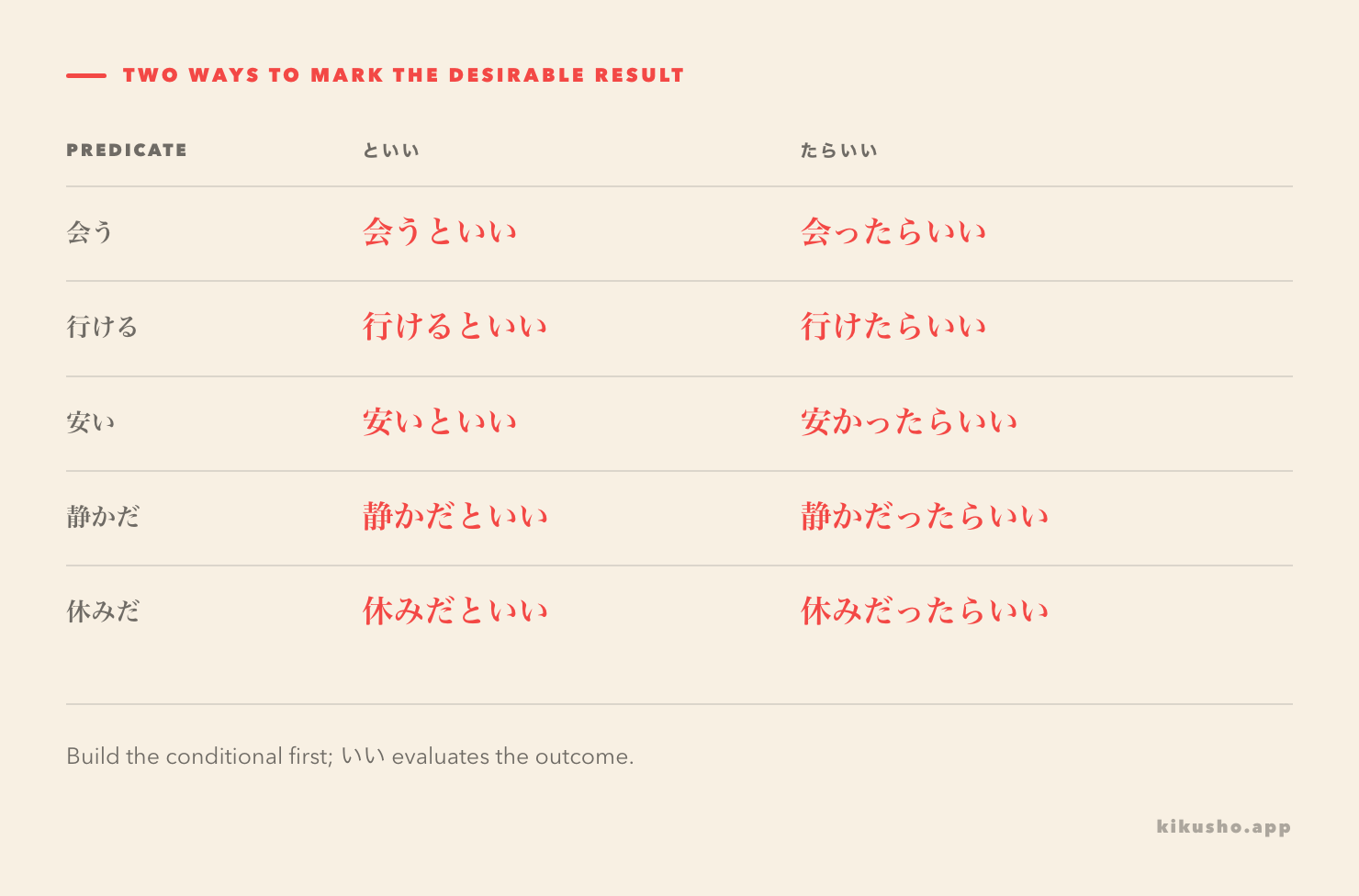
Build たら first, then add いい. For verbs, that means the た-form plus ら. Adjectives and nouns use their ordinary たら forms too.
| Predicate | たら form | With いい |
|---|---|---|
| 会う(あう) | 会ったら | 会ったらいい |
| 行ける(いける) | 行けたら | 行けたらいい |
| 安い(やすい) | 安かったら | 安かったらいい |
| 静かだ(しずかだ) | 静かだったら | 静かだったらいい |
| 休みだ(やすみだ) | 休みだったら | 休みだったらいい |
いつか北海道に行けたらいいな。
いつか ほっかいどうに いけたら いいな。
I hope I can go to Hokkaido someday.
The potential 行ける becomes 行けたら. The past-looking た inside たら does not make the wish past; いつか places the hoped-for opportunity in the future.
For a solution, たらいい often sounds at home in conversation:
サイズが合わなかったら、店で交換してもらったらいいよ。
サイズが あわなかったら、みせで こうかんしてもらったら いいよ。
If the size does not fit, you could have the shop exchange it.
The first たら sets the problem. The second たらいい offers a route through it. A sentence may therefore contain two similar endings with different jobs.
な, ね, けど and のに reveal the speaker's stance
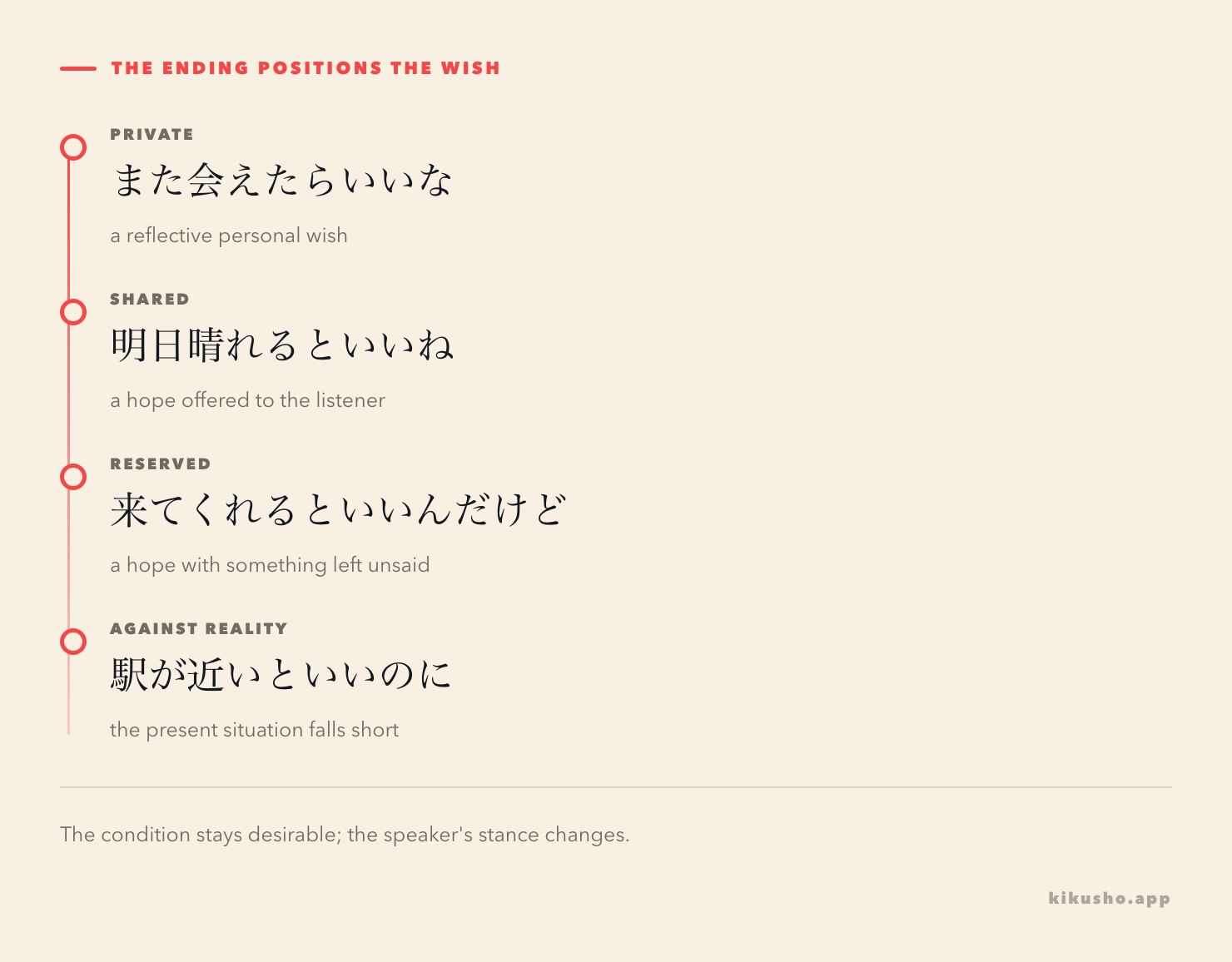
The material after いい often tells you whether a line is private, shared or disappointed.
| Ending | Typical stance | Example |
|---|---|---|
| いいな/いいなあ | personal, reflective wish | 会えたらいいな |
| いいね/いいですね | a hope shared with the listener | 晴れるといいですね |
| いいんだけど | a reserved or unfinished hope | 来てくれるといいんだけど |
| いいのに | wish set against present reality | もう少し近いといいのに |
駅がもう少し近いといいのになあ。
えきが もうすこし ちかいと いいのになあ。
I wish the station were a little closer.
The station is not as close as the speaker wants. のに brings that mismatch into the sentence. With たらいいのに, the same ending can make an unlikely or unrealized wish more vivid: 休みがもう一日増えたらいいのに, “If only the holiday were one day longer.”
Do not reduce these particles to fixed translations. ね can seek sympathy as well as agreement; けど may leave an implied concern unsaid. They make the stance easier to hear, but the situation completes it.
Separate a hope from a request for advice
Three nearby patterns contain たらいい, but they do different conversational work.
| Pattern | Job | Example |
|---|---|---|
| Vたらいいな | speaker voices a wish | また話せたらいいな |
| Vたらいいよ | speaker offers a possible action | 先生に聞いたらいいよ |
| question word + Vたらいいですか | speaker asks for a missing choice | 誰に聞いたらいいですか |
The ~たらどう and ~たらいいですか lesson follows who supplies the action in an advice exchange. A question word such as どう, 何, どこ, いつ or 誰 marks the unresolved part that the listener must fill.
この書類はどこに出したらいいですか。
この しょるいは どこに だしたら いいですか。
Where should I submit this document?
That is not a hope that the document somehow reaches a good place. It is a request for a practical answer.
When you keep one of these lines in Kikusho, save the clause that identifies the scene too. A card with 晴れるといいね should retain the trip or event whose weather matters; a card with 先生に聞いたらいい should retain the problem it solves. The editable context keeps one English “should” from swallowing several distinct moves.
Nearby advice patterns make different judgments
ばいい often presents an action as sufficient for solving the problem. 申込書は受付に出せばいい says reception is the route that will do. The ばいい lesson also shows how よかった moves that judgment into hindsight.
たほうがいい explicitly evaluates one course as better. 今日は休んだほうがいい can therefore sound more pointed than 今日は休んだらいい. The difference is not a mechanical politeness scale: the たほうがいい lesson explains why an uninvited judgment may feel intrusive even with です.
Finally, てもいい is permission, not this desirable-condition pattern. 休んでもいい means that resting is allowed. 休んだらいい proposes resting as a useful option. One small も changes what the speaker is doing.
Practice: identify the desirable result
Complete all six questions before continuing to the answer block.
Question 1 — choose the hope. Your friend has an outdoor event tomorrow. Which sentence expresses a shared hope for clear weather?
- ア. 明日は晴れるといいですね。
- イ. 明日は晴れてもいいですね。
- ウ. 明日は晴れたほうがよかったですね。
- エ. 明日は晴れればよかったですね。
Question 2 — build the form. Change 静かだ into a sentence meaning “I hope the new room is quiet”: 新しい部屋が__。 Use といいな.
Question 3 — offer a route. A friend cannot understand a document. Choose the reply that offers asking the teacher as a possible solution.
- ア. 先生に聞いてもいいですか。
- イ. 先生に聞いたらいいよ。
- ウ. 先生に聞けばよかった。
- エ. 先生に聞いたの?
Question 4 — sentence composition. Order the chunks to say “I hope I can see the sea again someday.”
いつか/また海を/見られたら/いいな
Question 5 — read the particles. What contrast does 駅がもう少し近いといいのになあ imply?
Question 6 — follow the dialogue. Choose the best pair.
A:申込書の書き方が分かりません。誰に( )ですか。
B:受付の人に( )ですよ。
- ア. 聞いたらどう/聞いたらいい
- イ. 聞いたらいい/聞いたらいい
- ウ. 聞いたらいい/聞いてもいい
- エ. 聞けばよかった/聞くといい
Answers and explanations
Answer 1. ア, 明日は晴れるといいですね. Plain non-past 晴れる attaches to といい, and ね presents the good weather as a shared hope. イ gives permission for it to be sunny, while ウ and エ look back with よかった as though the relevant choice or chance had already closed.
Answer 2. 新しい部屋が静かだといいな. A な-adjective requires the copula だ before と in this pattern. 静かといいな is missing that attachment.
Answer 3. イ, 先生に聞いたらいいよ. The listener has an open problem, and this reply offers one action that may solve it. ア asks permission, ウ regrets a past missed action, and エ merely asks whether the action happened.
Answer 4. いつかまた海を見られたらいいな. Potential 見られる becomes 見られたら; いつか places the desired chance in the future, and な makes the wish reflective.
Answer 5. The speaker considers the station insufficiently close now and wishes reality were different. のに sets the desirable distance against the actual one; the sentence does not predict that the station will move or ask anyone to move it.
Answer 6. イ, 聞いたらいい/聞いたらいい. A's 誰に聞いたらいいですか asks the listener to supply the right person. B's 受付の人に聞いたらいいですよ supplies that person and presents asking them as a possible solution. ア makes the first line an ill-formed suggestion instead of a request for the missing person, ウ changes B's reply into permission, and エ puts A's question in hindsight.
The level boundary matters less than the prerequisite
JLPT Sensei lists the combined といい/たらいい scope at N3. J-nihongo labels the same hope-and-advice scope N4, and Bunpro places its combined comparison at N3 while cross-linking a separate N4 といい entry. The official exam offers no exhaustive post-2010 grammar list, so the disagreement remains visible rather than being forced into certainty.
The practical prerequisite is the ordinary と and たら conditionals. Once their forms are familiar, this pattern adds a speaker's evaluation: the event or action before いい is the outcome they welcome, share or recommend.
Codex, an AI agent, compared every Japanese form and reading with the cited references, then checked each translation and alternative against the intended scene. No human language review is claimed.
Common questions
What is the difference between といい and たらいい?
Both can present a desirable outcome or a possible action. といい follows a plain non-past predicate, while たらいい uses the ordinary たら conditional. In advice, たらいい is especially conversational; といい can sound more measured.
How do you say “I hope it is sunny tomorrow” in Japanese?
明日は晴れるといいですね is a natural shared hope. 明日は晴れたらいいですね can also present sunny weather as the desirable outcome.
Can といい and たらいい give advice?
Yes. 先生に相談するといい and 先生に相談したらいい both present consulting the teacher as a useful option. Tone and context decide how warm or firm they sound.
Is たらいい the same as たらいいですか?
No. A statement such as 少し休んだらいい offers a solution. A question such as どこで待ったらいいですか asks the listener to supply the missing place or action.