On this page
Use AといってもB when A is still a fair label but B makes its scope smaller or less impressive. Use AというよりB when B is the better label and replaces A.
旅行といっても、日帰りです。
りょこうと いっても、ひがえりです。
It is a trip, though only a day trip.
旅行というより、出張です。
りょこうと いうより、しゅっちょうです。
Rather than a trip, it is a business trip.
The first speaker accepts 旅行 and corrects the scale you might imagine. The second speaker decides that 旅行 is the wrong category and substitutes 出張. This lesson teaches inventory items g-3cdd21847d82, といっても, and g-f04605c5e2d8, というより.
Ask whether the first label survives
The decision takes one question: after the correction, can you still call the thing A?
| What the speaker does | Pattern | Result |
|---|---|---|
| Keeps A, but limits its expected scale or effect | AといってもB | A remains true |
| Replaces A with a more accurate description | AというよりB | B is the preferred label |
In 旅行といっても、日帰りです, a day trip is still travel. In 旅行というより、出張です, the speaker reclassifies the event as work. English translations such as “although” and “rather than” can help, but the survival of A is the dependable test.
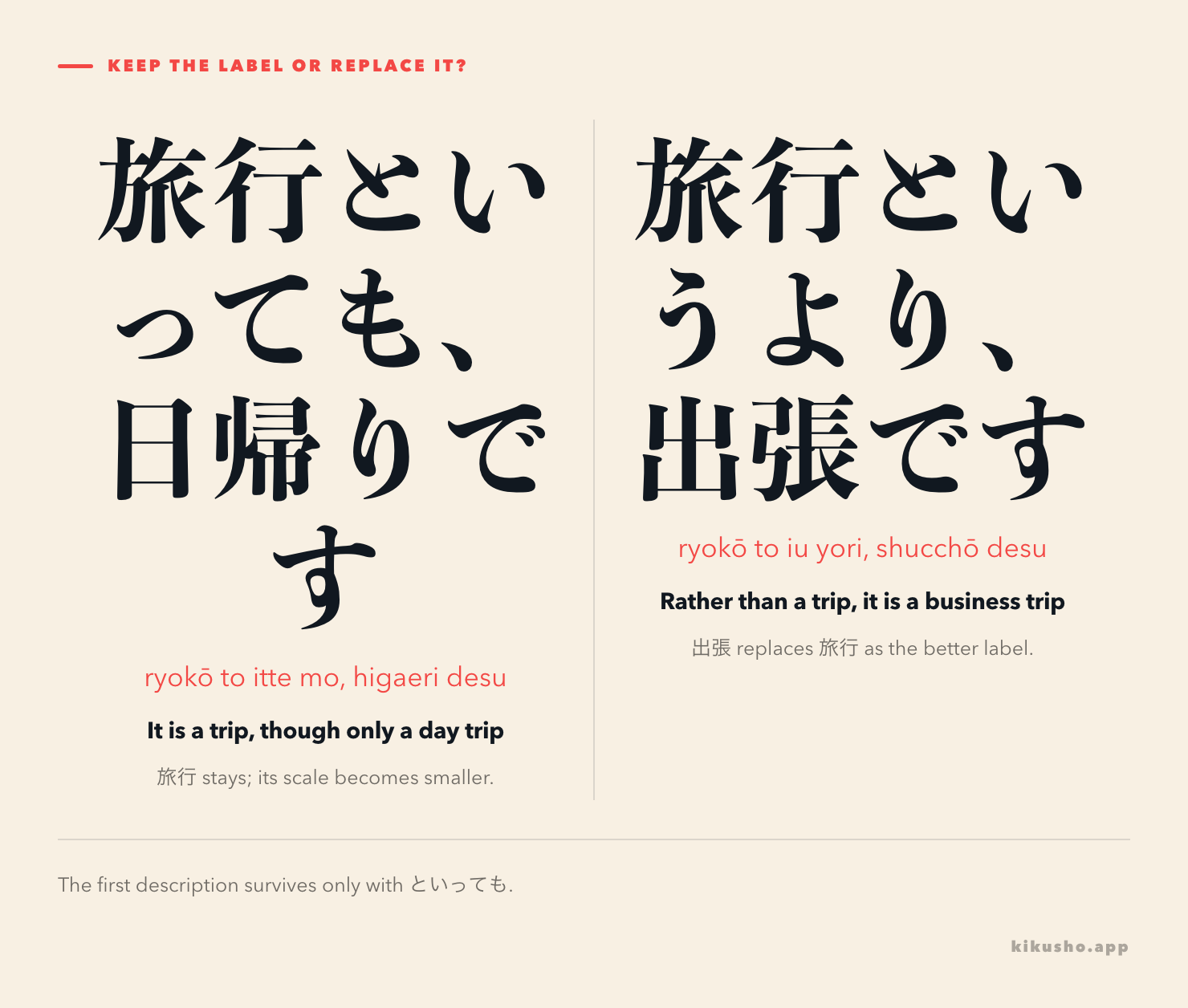
といっても keeps the category and narrows the expectation
AといってもB presents A, anticipates what the listener may infer from it, then uses B to limit that inference. B often makes the amount, seriousness, size or practical effect smaller than expected.
料理ができるといっても、簡単なものだけです。
りょうりが できると いっても、かんたんな ものだけです。
I can cook, though only simple things.
The ability to cook is real. 簡単なものだけ prevents the listener from imagining a highly skilled cook.
春だといっても、朝はまだ寒いです。
はるだと いっても、あさは まだ さむいです。
Even though it is spring, the mornings are still cold.
It really is spring. The second clause blocks the ordinary expectation of consistently warm weather. This explanatory correction is why といっても can resemble “although,” yet it is narrower than a general-purpose contrast marker.
The Japan Foundation's teaching material lists plain verbs and adjectives before the form. Nouns and な-adjectives can keep だ, while forms without it also occur.
| Before といっても | Example |
|---|---|
| Verb, plain form | できるといっても |
| い-adjective | 高いといっても |
| な-adjective | 静かだといっても/静かといっても |
| Noun | 春だといっても/春といっても |
The connector can also look back to a completed statement.
毎日運動しています。といっても、十分ぐらい歩くだけです。
まいにち うんどうして います。と いっても、じゅっぷんぐらい あるくだけです。
I exercise every day. That said, I only walk for about ten minutes.
Here といっても corrects the expectation created by the whole previous sentence. The label “exercise every day” survives.
一口にXといっても opens a category
一口にXといっても means that one broad name covers many different members.
一口に日本料理といっても、地域によって味が違います。
ひとくちに にほんりょうりと いっても、ちいきに よって あじが ちがいます。
Even under the single name “Japanese food,” flavors differ by region.
The category is not rejected. The speaker warns that its name hides internal variety.
というより replaces one description with another
AというよりB asks the listener to revise the description itself. A may not be completely false, but B is closer to what the speaker means.
この部屋は静かというより、寂しいです。
この へやは しずかと いうより、さびしいです。
This room is lonely rather than quiet.
The speaker does not merely say that the room is quieter than expected. 寂しい captures the feeling better than 静か.
彼は怒っているというより、困っているようです。
かれは おこって いると いうより、こまって いるようです。
He seems troubled rather than angry.
Both descriptions concern the same person and moment. The second one revises how the listener should interpret his expression.
The attachment again uses a plain predicate.
| Before というより | Example |
|---|---|
| Verb, plain form | 怒っているというより |
| い-adjective | 難しいというより |
| な-adjective | 静かだというより/静かというより |
| Noun | 趣味だというより/趣味というより |
In casual speech, というより often continues into というか, another self-correcting expression. The speaker may be searching for the exact wording rather than making a formal comparison. For the N3 pattern, first learn the complete AというよりB relationship: A is proposed, then B is chosen as more apt.
The same nouns reveal the meaning change
Using one pair of labels makes the difference visible.
子どもといっても、もう高校生です。
こどもと いっても、もう こうこうせいです。
They are a child, though already a high-school student.
The speaker keeps 子ども but removes the image of a very young child.
子どもというより、もう大人です。
こどもと いうより、もう おとなです。
They are already an adult rather than a child.
This time 大人 replaces 子ども as the preferred category. The two sentences can describe similar ages, but they make different judgments about which label should survive.
The same contrast works with activities.
仕事といっても、メールを一通送るだけです。
しごとと いっても、メールを いっつう おくるだけです。
It is work, though it only involves sending one email.
仕事というより、趣味で続けています。
しごとと いうより、しゅみで つづけて います。
I keep doing it as a hobby rather than as work.
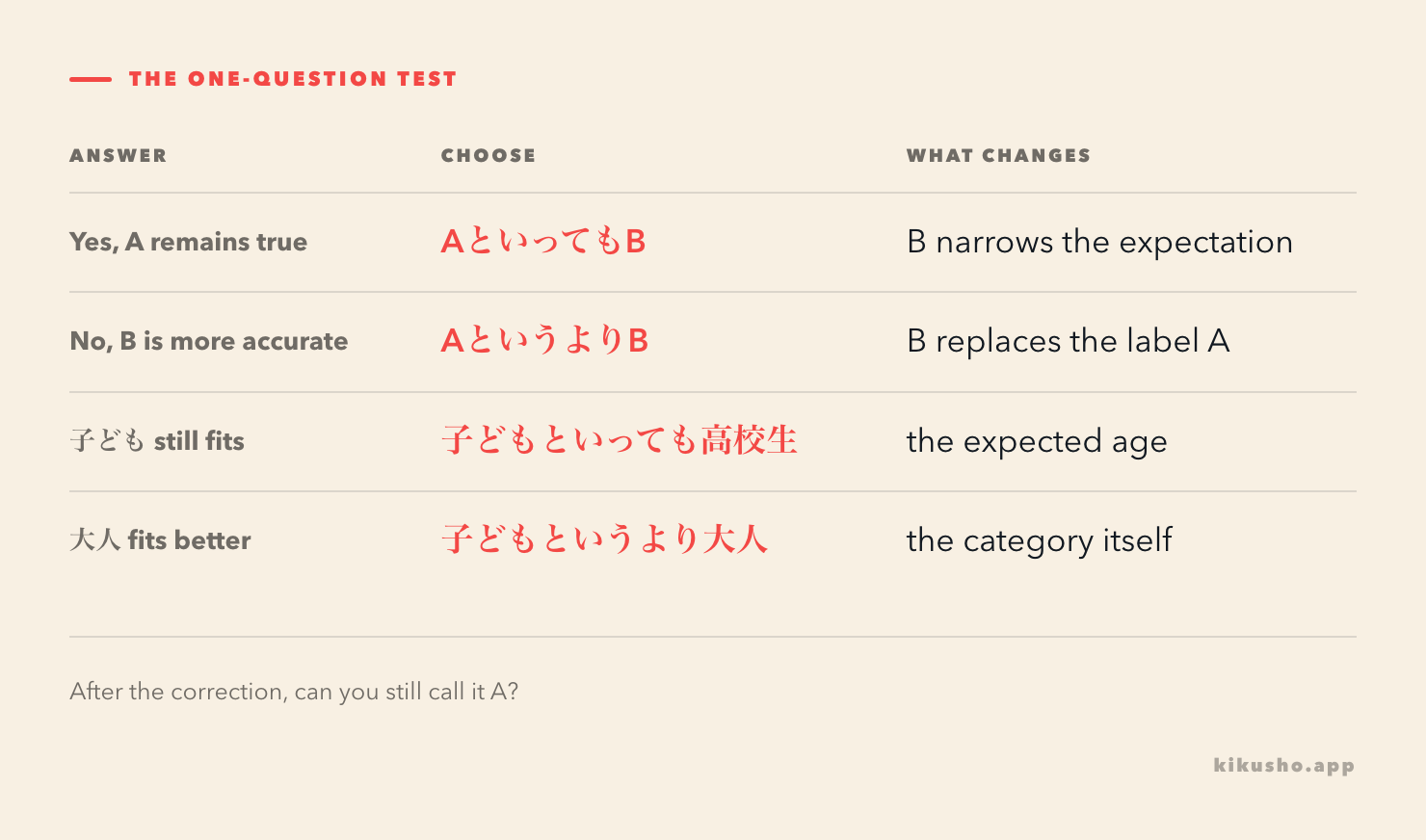
Nearby forms correct different parts of a message
Several expressions built around 言う can appear near these two, but each performs another conversation move.
| Form | What changes | Example move |
|---|---|---|
| AといってもB | the expectation created by A | “It is A, but only…” |
| AというよりB | the label A itself | “B is a better description than A” |
| AとはいえB | the conclusion drawn from an accepted A | “Granted A; even so, B” |
| Aといってもいい | whether A is an acceptable assessment | “It is fair to call it A” |
| Aといえば | the topic under discussion | “Speaking of A…” |
Compare the three corrections:
初心者といっても、三年勉強しています。
しょしんしゃと いっても、さんねん べんきょうして います。
I am a beginner, though I have studied for three years.
初心者というより、中級者です。
しょしんしゃと いうより、ちゅうきゅうしゃです。
I am an intermediate learner rather than a beginner.
初心者とはいえ、説明は正確でした。
しょしんしゃとは いえ、せつめいは せいかくでした。
Although they are a beginner, their explanation was accurate.
The first narrows the expected inexperience. The second replaces the proficiency label. The third accepts the label while resisting a conclusion about the quality of the explanation. The ものの and とはいえ lesson develops that more formal concessive contrast, while the reporting-views lesson separates bare といっても from といってもいい.
Keep both sides together when you review
Neither form carries its full job alone. A card showing only といっても = although loses the expectation being corrected; a card showing というより = rather than loses the two competing descriptions.
In Kikusho, save a complete contrast such as 旅行といっても、日帰りです or 静かというより、寂しいです. Keep A and B visible on the same card. During review, ask whether A survives. That small decision retrieves the Japanese relationship instead of an English gloss shared with several other connectors.
Practice: keep the label or replace it
Commit to all six responses before consulting the answer block.
Question 1 — limit the claim. Which expression belongs in 料理ができる__、卵焼きしか作れません?
- A. というより
- B. といっても
- C. といえば
- D. ということは
Question 2 — replace the label. The speaker decides “interview” is the more accurate description: 会話__、面接のようでした.
- A. といっても
- B. とはいえ
- C. というより
- D. といえば
Question 3 — compare the meanings. Which sentence keeps 子ども as a usable description while limiting the image it creates?
- A. 子どもというより、もう大人です。
- B. 子どもといっても、もう高校生です。
- C. 子どもといえば、元気です。
- D. 子どもということは、学生です。
Question 4 — order the chunks. Make one natural sentence from だけです/旅行といっても/近くの町へ行く.
Question 5 — read the exchange.
A: 新しい事務所は広いですか。
B: 広い__、前より少し大きいだけです。
Choose the form that lets B keep “spacious” as a loose description while reducing A's expectation.
- A. というより
- B. といっても
- C. といえば
- D. といってもいい
Question 6 — explain the contrast. In one sentence each, explain what happens to 仕事 in these examples: 仕事といっても、メールを一通送るだけです and 仕事というより、趣味です.
Answers and explanations
Answer 1. B, といっても. Being able to cook remains true, but 卵焼きしか作れません limits the skill the listener may imagine.
Answer 2. C, というより. 面接 replaces 会話 as the more accurate description. といっても would keep “conversation” and merely restrict an expectation about it.
Answer 3. B. A high-school student can still be called a child, so といっても preserves the label while adjusting the likely age. A explicitly replaces “child” with “adult.”
Answer 4. 旅行といっても、近くの町へ行くだけです。 The sentence keeps the category “trip” and narrows its scale to going to a nearby town.
Answer 5. B, といっても. B allows 広い to stand, then explains that the difference from the old office is small. A would make the following phrase a replacement description, but 前より少し大きいだけ is a limit on degree.
Answer 6. In 仕事といっても, the activity is still work, but sending one email makes it smaller than expected. In 仕事というより、趣味です, 趣味 replaces 仕事 as the speaker's preferred label.
N3 is the useful study boundary
JLPT Sensei lists といっても as N3 and separately lists というより as N3. Bunpro independently places というより at N3 and explains it as choosing a more accurate way to express something. The Japan Foundation's といっても material supports the attachment patterns and the idea that the second clause corrects an expectation associated with the first.
The prerequisite is control of plain verb and adjective forms, plus noun and な-adjective predicates with だ. These N3 labels are practical study estimates rather than an official boundary: the JLPT does not publish an exhaustive grammar syllabus. What matters in a timed question is the semantic test. Preserve A and narrow its implications with といっても; replace A with the better B using というより.
Common questions
What is the difference between といっても and というより?
といっても keeps the first description but limits the expectation it creates. というより replaces the first description with a more accurate second one.
What does といっても mean in Japanese?
In AといってもB, A remains broadly true, but B corrects an exaggerated or incomplete impression. 旅行といっても、日帰りです means it is still a trip, only a day trip.
What does というより mean in Japanese?
AというよりB presents B as a better description than A. 旅行というより、出張です means “Rather than a trip, it is a business trip.”
Are といっても and というより N3 grammar?
JLPT Sensei places both forms at N3, and Bunpro also places というより at N3. These are editorial study levels because the JLPT publishes no exhaustive grammar syllabus.