On this page
せいぜい三日 puts three days at the top of the range: “three days at most.” 三日はかかる puts three days at the bottom: “it will take at least three days.” The number can be identical, but the open side of the scale points in the opposite direction.
Ask which amounts the speaker still allows
Start with one task and one estimate:
この作業にかかるのは、せいぜい三日です。
この さぎょうに かかるのは、せいぜい みっかです。
This task will take three days at most.
The speaker allows one, two or three days, but rules out a longer duration. Now move は after the quantity:
この作業には三日はかかります。
この さぎょうには みっかは かかります。
This task will take at least three days.
Here, a shorter duration is ruled out. Three days is the floor, and four or more remain possible.
| Form | Boundary | Still possible | Ruled out |
|---|---|---|---|
| せいぜい三日 | Upper estimate | Three days or fewer | More than three days |
| 三日はかかる | Lower estimate | Three days or more | Fewer than three days |
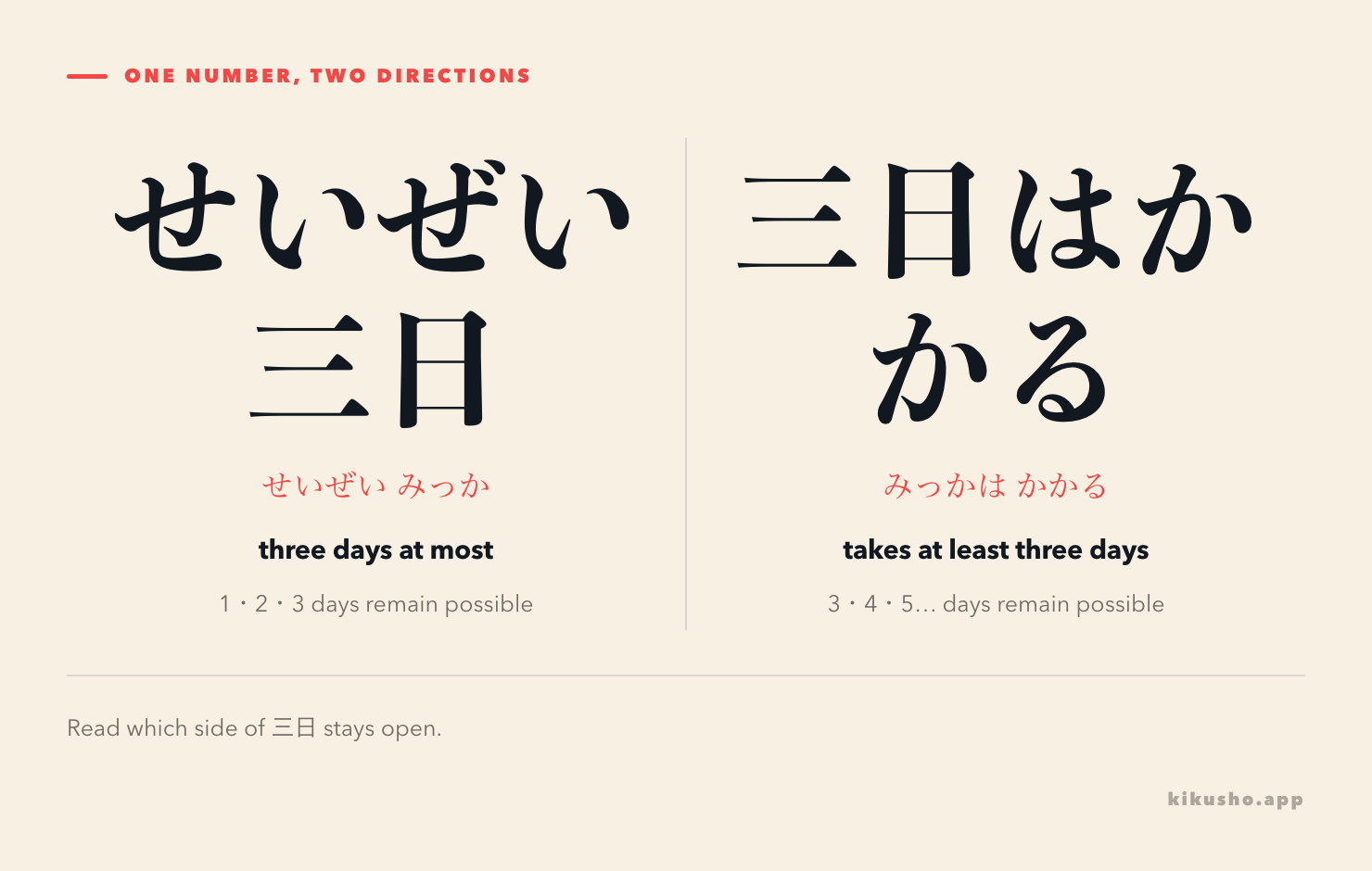
The quickest test is not “Which phrase translates as at least?” Ask which nearby amounts the speaker still considers possible. If the range remains open below the number, use せいぜい. If an estimate or requirement leaves the range open above it, quantity+は is the likely frame.
せいぜい presents the most a situation can reach
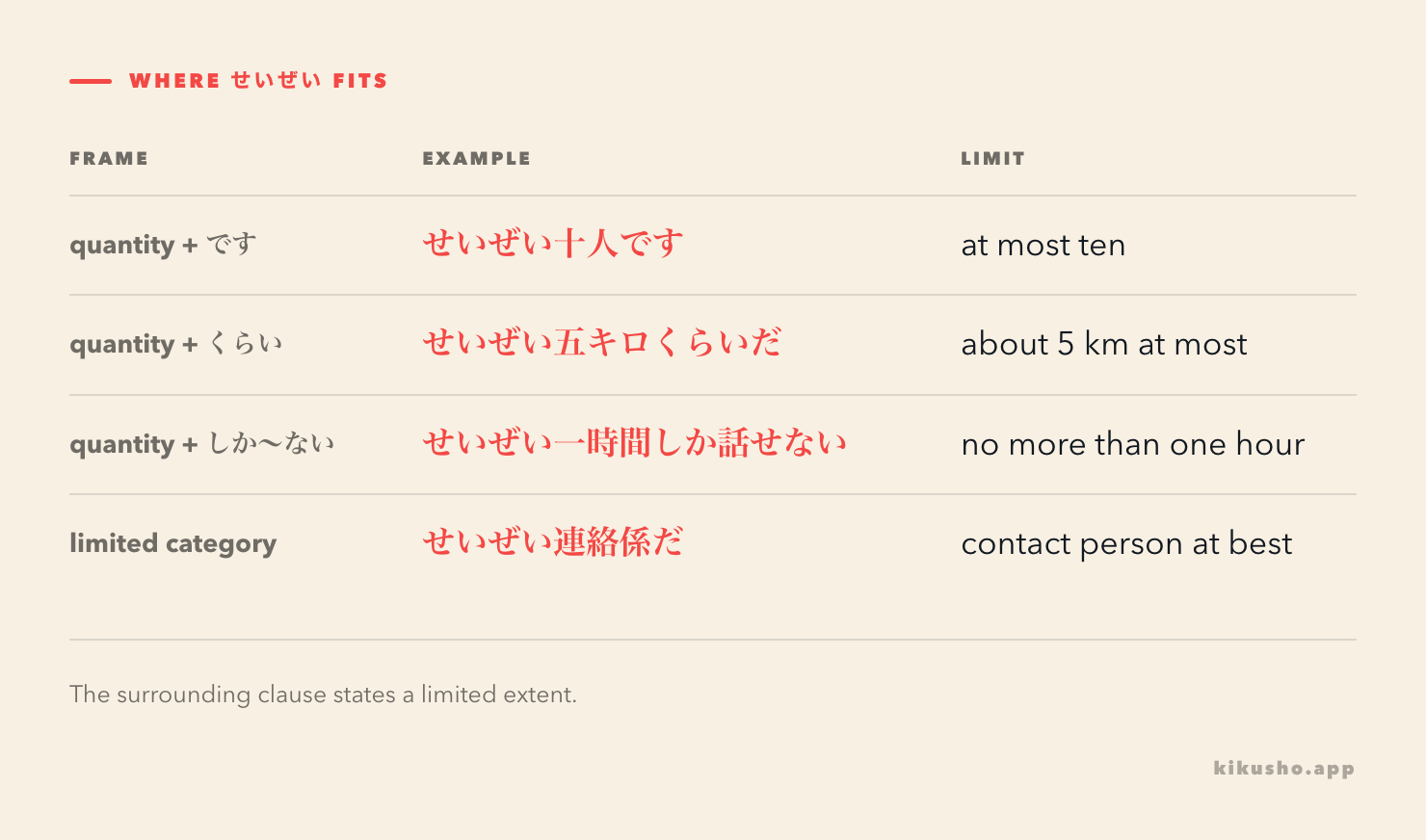
せいぜい(精々, seizei)is an adverb. In its boundary use, it comes before the quantity, category or degree judged to be the maximum:
| Shape | Example | Boundary |
|---|---|---|
| せいぜい + quantity + だ/です | 参加者はせいぜい十人です | At most ten participants |
| せいぜい + quantity + くらい/程度 + だ | 歩けるのはせいぜい五キロくらいだ | About five kilometres at most |
| せいぜい + quantity + しか~ない | せいぜい一時間しか話せない | Can speak for no more than an hour |
| せいぜい + limited category + だ | 私にできるのはせいぜい連絡係だ | At best, I can serve as the contact person |
Shogakukan's dictionary entry defines this reading as the point reached even after estimating generously. That often carries an evaluation: the maximum is lower, smaller or less impressive than someone might hope.
今の予算で招待できるのは、せいぜい十人です。
いまの よさんで しょうたいできるのは、せいぜい じゅうにんです。
With the present budget, we can invite ten people at most.
The sentence does not promise ten invitations. It says that even the highest plausible number does not exceed ten.
A corpus-based teaching study by Miho Fujiwara found that せいぜい frequently appears in a frame that identifies the topic and then states its limited degree, such as XはせいぜいY程度だ. The study also found more restricted verbal patterns, notably しか with a negative predicate. That is why a bare formula such as “put せいぜい before any verb” is too broad. Build a clause that says how far the action or state reaches.
Quantity+は sets a floor only when the context supports one
In the lower-bound pattern, attach は after a complete quantity expression:
- 三日+は → 三日は
- 一万円+は → 一万円は
- 十人+は → 十人は
- 二回くらい+は → 二回くらいは
Then use a predicate that makes a minimum useful, often an estimate, requirement, expected attendance, possession or duration:
修理には一万円は必要でしょう。
しゅうりには いちまんえんは ひつようでしょう。
The repair will probably require at least 10,000 yen.
説明には二時間はかかります。
せつめいには にじかんは かかります。
The explanation will take at least two hours.
明日の会議には十人は来ると思います。
あしたの かいぎには じゅうにんは くると おもいます。
I think at least ten people will come to tomorrow's meeting.
This is contrastive は doing scale work. It highlights the stated amount against unstated alternatives. In these sentences, the speaker treats smaller alternatives as insufficient or unlikely while leaving larger ones open. Bunpro's quantity+は reference describes that contrastive source and gives the formation number or amount + counter + optional くらい + は. A Japanese-language teaching unit published by Japan's Agency for Cultural Affairs likewise pairs quantity+は with quantity+も in duration and price estimates.
The counter stays attached to the number. Say 十人は, 三冊は and 二時間は, not 十は when the intended unit is people, books or hours.
は is not an arithmetic sign by itself
Treating は as a permanent “greater than or equal to” symbol creates errors. Its basic contribution here is contrast, and the rest of the clause tells you which side of the number is relevant.
Compare these continuations:
一回は行きました。もう一度行くつもりです。
いっかいは いきました。もう いちど いく つもりです。
I have been once, at least. I intend to go again.
一回は行きましたが、それだけです。
いっかいは いきましたが、それだけです。
I did go once, but that is all.
The same 一回は行きました can support different implications. The first continuation keeps higher counts open. The second closes them. With かかる, 必要だ, いる or a prospective 来る, the lower-bound interpretation is usually much easier to recover because the speaker is estimating what the situation will require or reach.
For a measured quantity already completed, another particle may express the intended stance more directly. 三時間もかかった says three hours felt long; 三時間しかかからなかった says it took only three hours. The quantity+も lesson compares those evaluations with a neutral count. The だけ and くらい lesson covers restriction, approximation and the separate rhetorical minimum use of くらい.
The same scale makes the contrast visible
One budget can produce opposite forecasts:
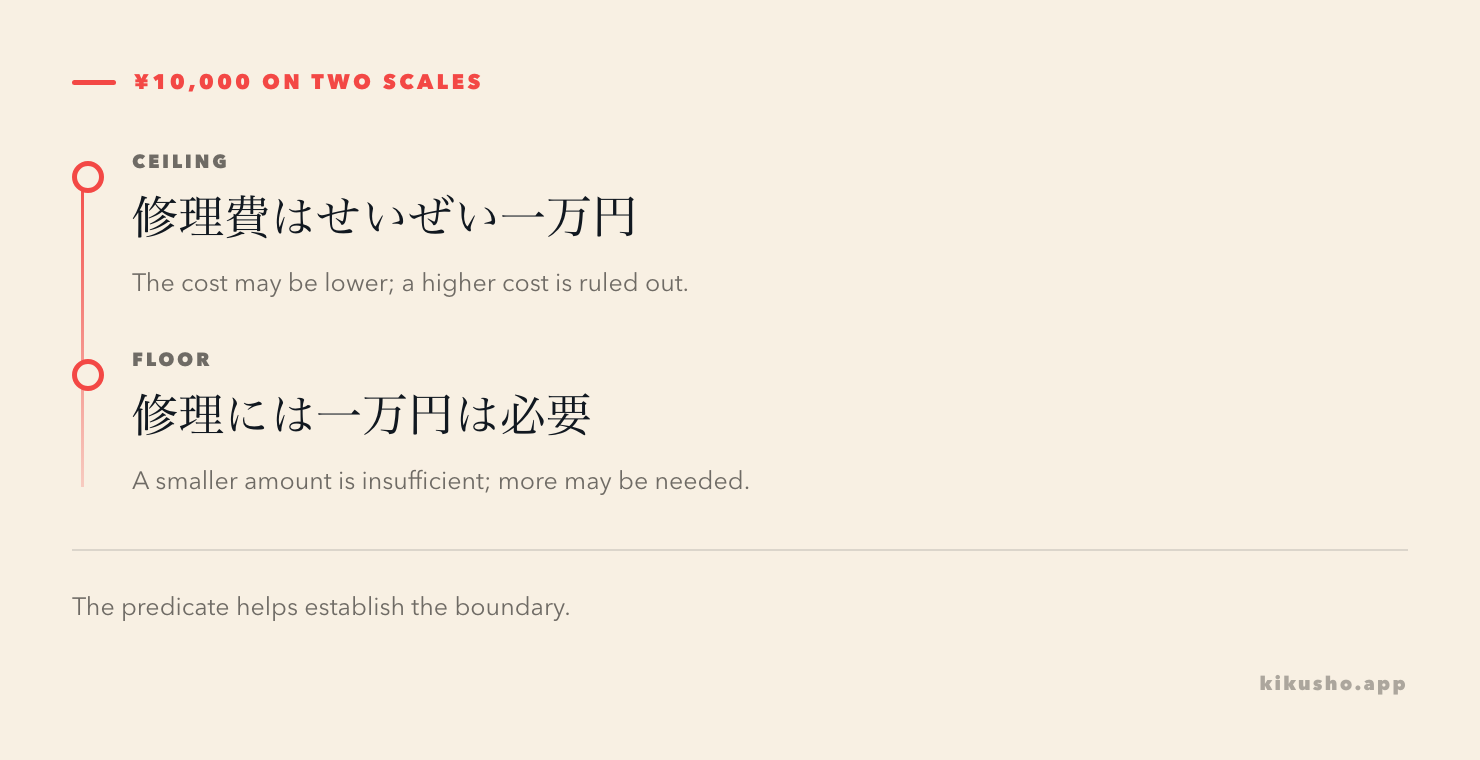
修理費はせいぜい一万円でしょう。
しゅうりひは せいぜい いちまんえんでしょう。
The repair cost will be 10,000 yen at most.
修理には一万円は必要でしょう。
しゅうりには いちまんえんは ひつようでしょう。
The repair will probably require at least 10,000 yen.
In the first sentence, 一万円 is the ceiling of the estimate. In the second, it is the minimum amount needed. The predicates reinforce the direction: a forecast of the total cost accepts a maximum, while 必要だ asks what amount cannot be reduced further.
Do not combine both markers merely to intensify the number. せいぜい三日はかかる invites conflicting boundary readings unless a wider context gives each marker a separate contrast. For the plain opposition taught here, choose せいぜい三日だ for a maximum or 三日はかかる for a minimum.
せいぜい also has an effort reading
The dictionary records a second meaning: doing as much as one's ability permits.
私もせいぜい努力します。
わたしも せいぜい どりょくします。
I will make as much effort as I can too.
This is not a numerical upper estimate, though the idea of reaching a limit remains. せいぜい頑張ってください can be a sincere “do your best,” but it can also sound cool, challenging or sarcastic when the relationship and intonation suggest “good luck getting very far.” Avoid learning the phrase as a universally warm encouragement.
JLPT Sensei lists both “at most” and “to the utmost” under N3. Bunpro places せいぜい at N2 and quantity+は at N4, while JLPT Sensei places both target items at N3. These labels are publisher estimates; the JLPT does not publish an exhaustive grammar-item list. For this lesson, the useful prerequisite is control of counters and contrastive は, not faith in one official-looking boundary.
When a real conversation gives you a number, keep the entire estimate in Kikusho. A card containing 三日 alone loses whether the speaker promised a maximum or warned about a minimum. Save せいぜい三日です or 三日はかかります, then use the editable nuance field to record which side of the range stays open.
Test both ends of the range
Answer all six questions before checking the block below.
Question 1. A manager says a room can hold no more than twenty people. Choose the best completion: この部屋に入れるのは、__二十人です。
- ア. せいぜい
- イ. 二十人は
- ウ. さらに
- エ. すでに
Question 2. What does 準備には二時間はかかります most naturally mean in an estimate?
- ア. Preparation cannot take more than two hours.
- イ. Preparation takes exactly two hours.
- ウ. Preparation will take at least two hours and may take longer.
- エ. Two hours felt surprisingly long after preparation finished.
Question 3. Choose the sentence that sets 5,000 yen as a likely maximum.
- ア. 五千円は必要です。
- イ. せいぜい五千円でしょう。
- ウ. 五千円も必要でした。
- エ. 五千円しかありません。
Question 4. Arrange the pieces to say “At least fifteen people will probably attend”: でしょう / 十五人は / 参加する.
Question 5. Read the exchange and choose the interpretation supported by the reply.
A:何人ぐらい招待できますか。
B:予算が少ないので、せいぜい十人です。
- ア. At least ten people must be invited.
- イ. Ten people is the greatest number the present budget is likely to allow.
- ウ. Exactly ten people have already accepted.
- エ. Fewer than ten people cannot be invited.
Question 6. Read the short passage and choose the correct pair.
会場は小さいので、入れるのは__三十人です。ただ、予約した人だけでも二十人いますから、当日は二十人__来るでしょう。
- ア. せいぜい / は
- イ. は / せいぜい
- ウ. せいぜい / も
- エ. しか / は
Answers and explanations
Answer 1. ア, せいぜい. The relative clause この部屋に入れるのは asks for the maximum capacity, and せいぜい二十人です places twenty at that ceiling. イ would duplicate the quantity already printed and would not form the sentence.
Answer 2. ウ. After the complete duration 二時間, contrastive は presents two hours as the floor of this estimate. ア reverses the open side of the range. イ removes the contrastive allowance for a longer duration. エ would be more naturally expressed with 二時間もかかりました.
Answer 3. イ, せいぜい五千円でしょう. せいぜい places 5,000 yen at the upper end of the forecast. ア makes that amount a requirement and commonly suggests a minimum. ウ evaluates a completed requirement as large, while エ says only 5,000 yen is available.
Answer 4. 十五人は参加するでしょう。 The quantity and counter form 十五人, は follows that whole unit, and the prospective predicate 参加するでしょう makes the lower estimate clear.
Answer 5. イ. The limited budget supplies the scale, and せいぜい sets ten invitees as its likely ceiling. ア and エ turn the reply into a lower-bound requirement. ウ invents completed acceptances, while the exchange only discusses capacity.
Answer 6. ア, せいぜい / は. The small venue creates a maximum, so 入れるのはせいぜい三十人です means no more than thirty can enter. Twenty reservations make twenty a reasonable minimum attendance estimate, so 二十人は来るでしょう leaves a higher turnout possible. イ reverses both boundaries, ウ turns twenty into a notably large count, and エ lacks the negative predicate required by the restrictive しか pattern.
The last passage contains both forms because it contains two independent judgments: the room's ceiling and the crowd's floor. Following the noun or number alone will not reveal that architecture; the predicate on each side does.
Common questions
What does せいぜい mean before a number?
Before a quantity, せいぜい sets an upper estimate: even with a generous calculation, the amount will not go beyond that point. せいぜい三日 means three days at most.
Why can は after a quantity mean at least?
Contrastive は singles out the stated amount against alternatives. With an estimate or requirement such as 三日はかかる, the context rejects smaller amounts and leaves larger ones possible, producing the reading at least three days.
Does せいぜい always sound negative?
No. Its upper-bound use often presents the result as limited, but せいぜい also has an effort meaning close to as much as possible. Tone and the relationship between speakers decide whether an exhortation sounds sincere or dismissive.
Are せいぜい and quantity plus は officially N3 grammar?
JLPT Sensei lists both at N3, while Bunpro places せいぜい at N2 and the quantity pattern at N4. These are study-list estimates because the JLPT does not publish an exhaustive official grammar syllabus.