On this page
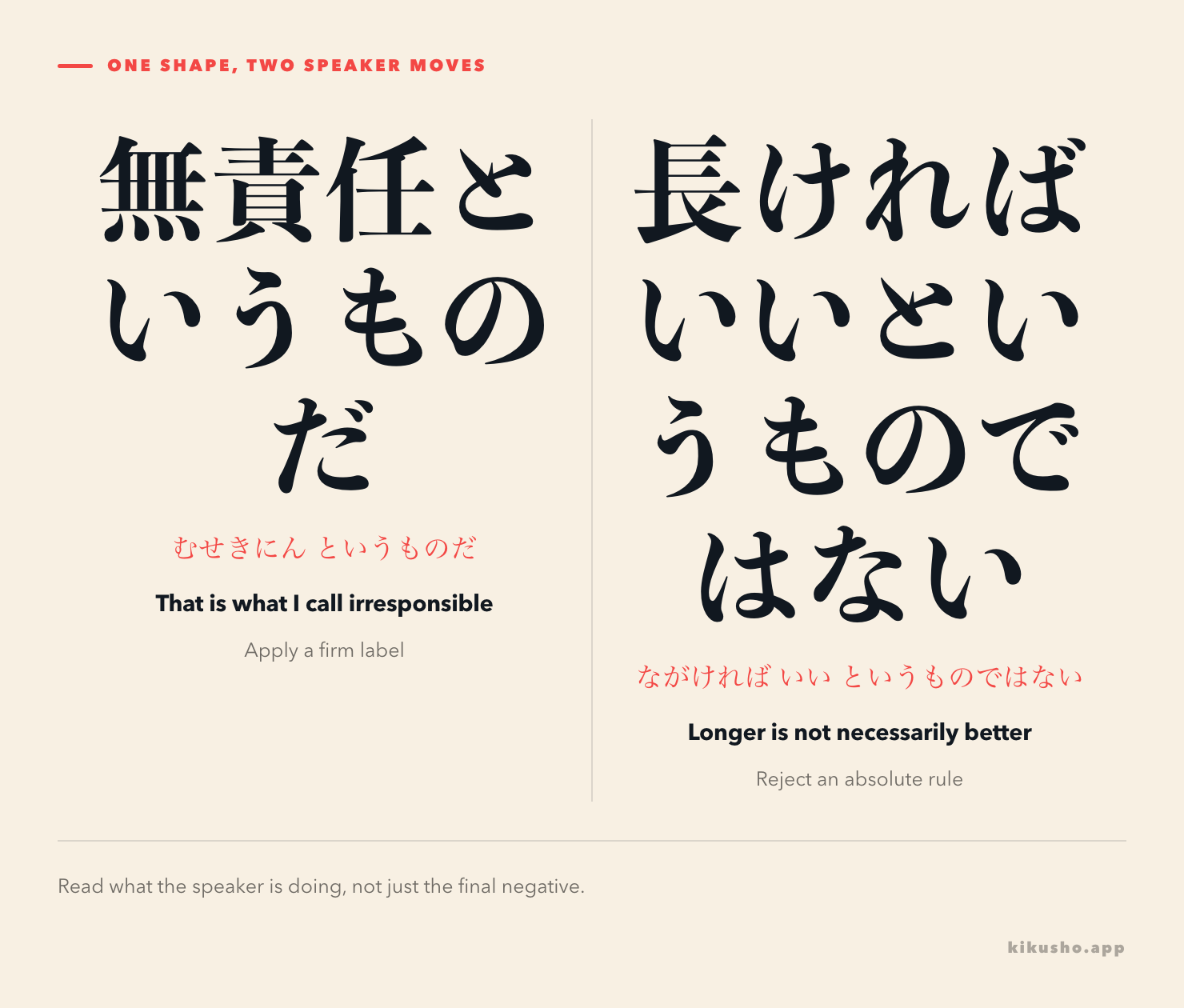
Use というものだ to give a situation a firm evaluation: 事情も聞かずに部下を責めるのは、無責任というものだ, “Blaming an employee without hearing the circumstances is what I would call irresponsible.” Use というものではない to reject an absolute rule: 毎日長時間働けば成果が上がるというものではない, “Working long hours every day does not necessarily improve results.”
The two forms look like an affirmative-negative pair, but they do different jobs. The first delivers the speaker's judgment; the second limits a claim that is too simple or too broad.
This lesson covers inventory items g-e5c9956e16fe, というものだ, and g-59a07a6577ff, というものではない. JLPT Sensei and J-nihongo teach the affirmative at N2; Bunpro, JLPT Sensei and NIHONGO NET place the negative pattern at N2. These are teaching labels; the JLPT does not publish an exhaustive grammar syllabus.
というものだ turns the situation into a judgment
In this use, the clause before のは presents conduct or a situation. The phrase after the comma tells the reader how the speaker evaluates it.
困っている人を見て見ぬふりをするのは、冷たいというものだ。
こまっている ひとを みて みぬ ふりを するのは、つめたい というものだ。
Ignoring someone in trouble is what I would call coldhearted.
The speaker is not merely reporting that somebody used the word 冷たい. They are applying that label themselves. Depending on context, English may use “that is truly…,” “that is exactly what… means,” or a direct judgment such as “that is irresponsible.”
十年間、一度も約束を破らなかった。それこそ信頼というものだ。
じゅうねんかん、いちども やくそくを やぶらなかった。それこそ しんらい というものだ。
For ten years, she never broke a promise. That is what trust really means.
Words such as それこそ, “that precisely,” fit naturally because というものだ identifies the right label or conclusion. The judgment can sound principled or emphatic. It remains the speaker's assessment, however; the construction does not prove that everyone agrees.
というものではない rejects an overgeneralization
The negative pattern normally answers an unstated claim that sounds too absolute. A frequent logic is “if A happens, B will follow” or “doing A is enough.”
値段が高ければ、品質も良いというものではない。
ねだんが たかければ、ひんしつも いい というものではない。
A high price does not necessarily mean good quality.
This sentence does not claim that expensive products are bad. It leaves room for both possibilities and rejects only the automatic link between price and quality.
単語をたくさん覚えれば、自然に話せるというものではない。
たんごを たくさん おぼえれば、しぜんに はなせる というものではない。
Memorizing many words does not by itself guarantee natural speech.
The ~ば condition often reveals the generalization being challenged. The pattern also works without an explicit conditional when the supposed rule is clear:
努力だけで、すべての問題が解決するというものではない。
どりょくだけで、すべての もんだいが かいけつする というものではない。
Effort alone does not necessarily solve every problem.
Do not make the negative mechanically
Starting with 無責任というものだ and changing だ to ではない does not normally give the simple thought “it is not irresponsible.” The longer negative form invites a different reading: the speaker is qualifying a broad proposition.
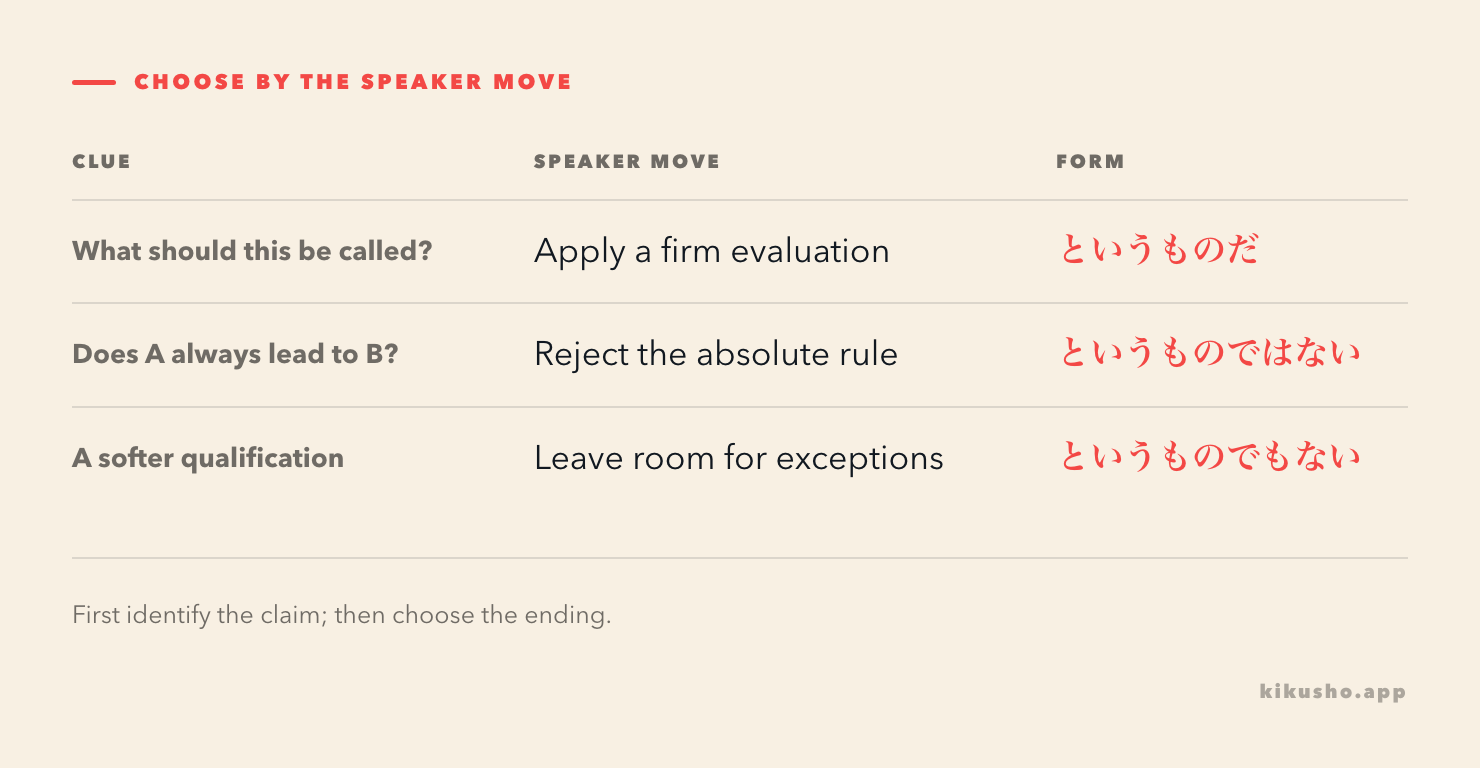
Compare the questions each sentence answers:
| Form | Hidden question | Speaker's move |
|---|---|---|
| というものだ | What should this conduct be called? | Applies a strong evaluation |
| というものではない | Does A always mean B? Is A alone enough? | Rejects the absolute rule |
相手の意見を最後まで聞くのが、礼儀というものだ。
あいての いけんを さいごまで きくのが、れいぎ というものだ。
Listening to the other person's full opinion is what courtesy means.
丁寧な言葉を使えば、それだけで礼儀正しいというものではない。
ていねいな ことばを つかえば、それだけで れいぎただしい というものではない。
Using polite words alone does not necessarily make someone courteous.
Both sentences concern courtesy, but the first names an ideal and the second resists an easy formula.
Attachment depends on what という quotes
Before both patterns, verbs and い-adjectives normally appear in plain form.
| Before the pattern | Example |
|---|---|
| Verb, plain form | 話せるというものではない |
| い-adjective, plain form | 詳しければ分かりやすいというものではない |
| Noun used as the evaluation label | 無責任というものだ |
| Full noun or な-adjective proposition | 良い品だというものではない |
The last two rows may look inconsistent, but their structures differ. In 無責任というものだ, 無責任 is the label that the speaker applies. In 良い品だというものではない, 良い品だ is a complete proposition inside the quotation-like という: “it is a good product.” Noun and な-adjective predicates may therefore retain だ when the whole proposition is being qualified.
The wider という family also names things, quotes content and connects a label to a noun. Review how という names and frames clauses if the quoted boundary is unclear. Here, the important reading is the evaluation or rejected-rule pattern at the end of the sentence.
ではない, でもない and conversational forms
というものでもない has the same core function as というものではない and can sound a little less categorical.
説明は、詳しければ詳しいほど分かりやすいというものでもない。
せつめいは、くわしければ くわしいほど わかりやすい というものでもない。
Explanations do not necessarily become clearer simply by becoming more detailed.
In conversation, では may contract to じゃ, and もの may shorten to もん:
| Careful form | Conversational form |
|---|---|
| というものだ | ってものだ / ってもんだ |
| というものではない | というものじゃない |
| というものではない | というもんじゃない / ってもんじゃない |
These contractions change register, not the central logic. In formal reading passages and careful writing, expect the full forms.
というものではない and わけではない overlap, but focus differently
Both forms can produce “not necessarily” in English. わけではない usually corrects an inference or limits a statement in its current context.
甘い物が嫌いなわけではない。ただ、今日は食べたくない。
あまい ものが きらいな わけではない。ただ、きょうは たべたくない。
It is not that I dislike sweets. I simply do not want any today.
No general social rule is under debate. The speaker corrects the likely inference “you dislike sweets.”
有名な大学を出れば、必ず成功するというものではない。
ゆうめいな だいがくを でれば、かならず せいこうする というものではない。
Graduating from a famous university does not guarantee success.
Here the target is a formula presented as a general truth. 必ず, だけ, すべて, a conditional ~ば, or a comparison such as ~ほど often makes that target visible. The full わけだ and わけではない comparison covers inference, partial negation and impossibility together.
Plain ものだ belongs to a wider family
Do not remove という and assume the meaning stays the same. Plain ものだ can express recollection, a general tendency, advice or admiration. Plain ものではない can warn that one should not do something.
人の秘密を話すものではない。
ひとの ひみつを はなす ものではない。
You should not reveal another person's secret.
That is advice about proper conduct. By contrast, 秘密を知っている人が犯人だというものではない means “Knowing the secret does not necessarily make someone the culprit,” a rejected inference. See the four uses of ものだ and the ものではない warning for the plain forms.
Keep the claim and its correction together
For review, do not save only というものではない = not necessarily. Keep the proposition that the form limits: 高ければ良い品だというものではない. A useful prompt is “Which absolute link is being rejected?”
For というものだ, save the situation and its label together: 事情を聞かずに責めるのは無責任というものだ. Ask “What judgment does the speaker apply?” This prevents the two visually similar endings from collapsing into one vague translation.
Practice
1. Choose the strong evaluation
事情を確かめずに相手を批判するのは、__。
ア. 公平というものではない
イ. 無責任というものだ
ウ. 無責任なわけではない
2. Reject the automatic rule
値段が高ければ、必ず品質も良い__。
ア. というものだ
イ. というものではない
ウ. ものだった
3. Identify what the speaker is doing
十年間、一度も約束を破らなかった。それこそ信頼というものだ。
ア. naming a strong evaluation
イ. rejecting an absolute rule
ウ. correcting a mistaken inference about the speaker
4. Choose the contextual correction
「どうしてケーキを食べないの? 甘い物が嫌いなの?」
「嫌いな__。今日はお腹がいっぱいなんだ。」
ア. というものだ
イ. というものではない
ウ. わけではない
5. Build the rejected generalization
Put all four pieces in order.
ア. 成功する イ. 毎日長く働けば ウ. というものではない エ. 必ず
6. Choose the slightly softer variant
説明は、長ければ長いほど分かりやすい__。
ア. というものでもない
イ. ってもんだ
ウ. ものでは話さない
7. Read the manager's conclusion
ある会社では、会議の時間を二倍にすれば良い案が増えると考えた。しかし、長い会議では参加者が疲れ、発言も減った。部長は「時間をかければ良い案が出る__」と結論づけた。
ア. というものではない
イ. というものだ
ウ. わけがないものだ
Answers and explanations
- イ. 無責任というものだ. The situation receives the speaker's firm label 無責任. ア would reject “fair” as a general description, while ウ says that the person is not necessarily irresponsible.
- イ. というものではない. ~ば, 必ず and the price-quality link create an absolute rule for the speaker to reject. The sentence leaves open the possibility that some expensive products are good.
- ア. naming a strong evaluation. それこそ points to the preceding conduct and presents 信頼 as exactly the right label. No broad rule is being denied.
- ウ. わけではない. The speaker corrects the listener's immediate inference that refusing cake means disliking sweets. The exchange is about this person's reason today, not a general principle.
- イ–エ–ア–ウ: 毎日長く働けば、必ず成功するというものではない. The conditional and 必ず state the overgeneralization; というものではない limits it.
- ア. というものでもない. It qualifies the idea that length always creates clarity and is a common, slightly softer alternative to というものではない. イ would affirm a judgment, and ウ is not a grammatical completion.
- ア. というものではない. The company's experience disproves the simple formula “more meeting time produces better ideas.” The manager rejects that general rule rather than applying a label to the meeting.
The exact query returns many N2 explanations, but presenting the forms as a positive and its negative invites the wrong editing strategy. Read for the speaker's move: というものだ applies a firm label; というものではない removes the certainty from an overbroad claim.
This lesson was reviewed for both inventory items, plain-form attachment, noun and な-adjective propositions with だ, ではない/でもない variation, conversational contractions, and the boundaries with わけではない and plain ものだ/ものではない. AI-assisted comparison and editing were used to check the examples and ensure that every exercise has one intended answer.
Common questions
What is the difference between というものだ and というものではない?
というものだ applies a strong label or evaluation to a situation: that is exactly what X is. というものではない rejects an absolute rule or an oversimplification: it is not necessarily true that X.
Is というものではない simply the negative of というものだ?
No. The affirmative presents the speaker's judgment, while the negative usually limits a generalization such as “if A, then always B” or “A alone is enough.” Translating both word by word hides this functional difference.
What is the difference between というものではない and わけではない?
というものではない challenges a supposed rule or principle and often sounds evaluative. わけではない more neutrally corrects an inference or says that a statement does not fully apply in the current context.
Can というものではない become というものじゃない?
Yes. というものじゃない and というもんじゃない are conversational variants. というものでもない is also common and can sound slightly softer than というものではない.