On this page
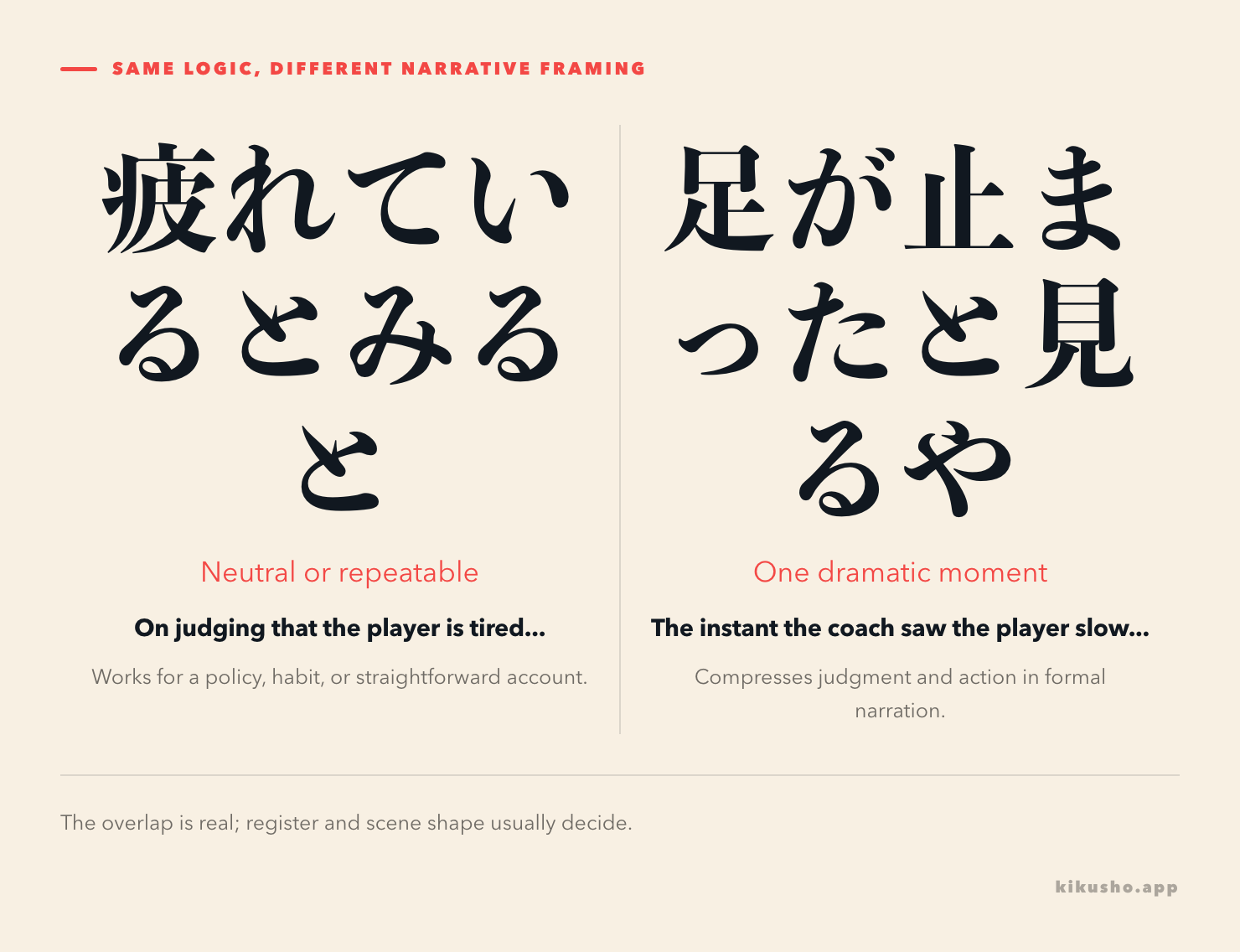
とみると and と見るや both mean that someone judges a situation and reacts promptly. Choose とみると for a neutral or repeatable judgment-to-response pattern; choose と見るや when formal narration zooms in on a swift, often decisive move.
店員は客が困っているとみると、すぐに声をかけた。
てんいんは きゃくが こまっているとみると、すぐに こえを かけた。
When the clerk saw that the customer needed help, the clerk immediately spoke to them.
警備員は男が逃げると見るや、出口へ走った。
けいびいんは おとこが にげるとみるや、でぐちへ はしった。
The moment the guard realized the man was going to flee, he ran toward the exit.
Both observers interpret a clue and act. The first sentence explains a service response without making the scene dramatic. The second presents the guard's assessment and movement as one tight narrative beat.
This lesson verifies inventory items g-5c1b8a4e8159, とみると, and g-a6695e2c2741, と見るや. JLPT Sensei lists the first at N1 as a response made as soon as someone realizes something. J-nihongo independently describes a prompt change of attitude or behavior after judging a fact to be true. JLPT Sensei's と見るや entry and Hane's explanation place the second at N1 and emphasize immediate reaction in literary or report-like narration.
The shared core is assessment followed by response
The と before 見る marks the content of a judgment. In 雨がやんだとみる, the observer takes “the rain has stopped” to be true. The following と or や then moves the sentence into the observer's response.
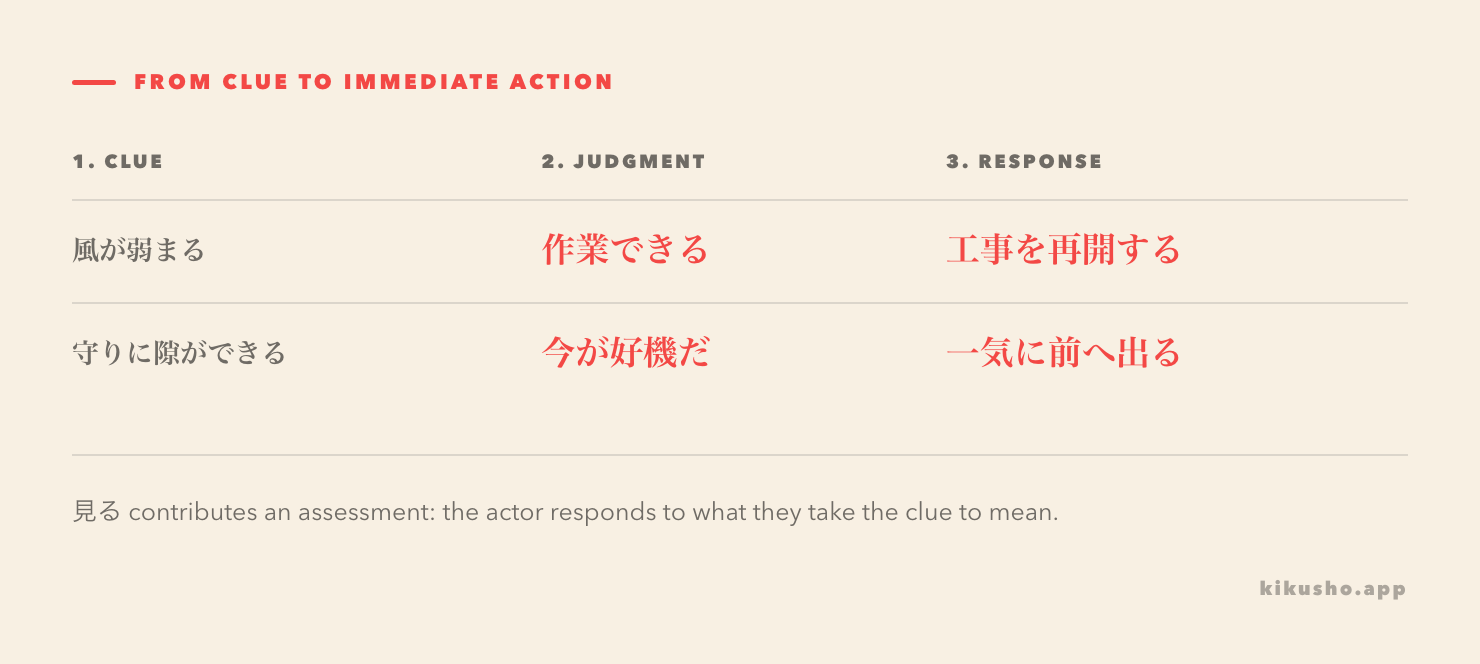
作業員たちは風が弱まったとみると、工事を再開した。
さぎょういんたちは かぜが よわまったとみると、こうじを さいかいした。
Once the workers judged that the wind had eased, they resumed construction.
This is more specific than simple sequence. 風が弱まると、工事を再開した can mean that one event followed another. Adding みる makes the workers' recognition the bridge: they observed the wind, decided conditions had improved, and acted on that decision.
The main-clause actor is normally the person or animal making the judgment. In 犬は主人が帰ったとみると、玄関へ走った, the dog recognizes the owner's return and runs. The subject inside the judged clause, 主人, is different from the observer, 犬.
とみると can describe a pattern of conduct
とみると works in a specific event, but it can also expose what someone habitually does whenever they reach a certain assessment.
彼は相手が反論しないとみると、いつも要求を増やす。
かれは あいてが はんろんしないとみると、いつも ようきゅうを ふやす。
Whenever he judges that the other person will not object, he increases his demands.
店主は客が商品に興味を示したとみると、詳しい説明を始める。
てんしゅは きゃくが しょうひんに きょうみを しめしたとみると、くわしい せつめいを はじめる。
When the owner sees that a customer is interested in a product, the owner begins a detailed explanation.
Words such as いつも, たびに and a nonpast main predicate can support this repeated reading. The reaction need not be physically sudden. It may be a change in terms, attitude, strategy or tone:
担当者は交渉が長引くとみると、期限を一週間延ばした。
たんとうしゃは こうしょうが ながびくとみると、きげんを いっしゅうかん のばした。
When the person in charge judged that negotiations would drag on, they extended the deadline by a week.
The decision follows promptly from the forecast, even though the predicted delay has not finished occurring. This shows why 見る means “judge” rather than literal eyesight.
と見るや compresses a narrated turning point
と見るや places the judgment and response next to each other with little narrative distance. It suits news-like accounts, biographies, historical writing and dramatic prose better than relaxed conversation.
選手は相手の守りに隙ができたと見るや、一気に前へ出た。
せんしゅは あいての まもりに すきが できたとみるや、いっきに まえへ でた。
The instant the player spotted a gap in the opponent's defense, she surged forward.
指揮官は撤退路が断たれると見るや、部隊に進路変更を命じた。
しきかんは てったいろが たたれるとみるや、ぶたいに しんろへんこうを めいじた。
As soon as the commander judged that the retreat route would be cut off, he ordered the unit to change course.
The pattern does not merely say “after.” It presents the response as evidence of rapid situational judgment. Adverbs such as すぐ, 直ちに, 一気に and 即座に often reinforce the speed, although や already supplies a sharp transition.
In ordinary conversation, a speaker would more often say ~とわかると, ~と思ったら or ~のを見て. Using と見るや in casual chat can sound intentionally theatrical.
Build the proposition before the quotative と
Verb and i-adjective predicates use plain forms. Full noun and na-adjective propositions normally retain だ.
| Judgment content | Pattern | Example |
|---|---|---|
| action or event | plain verb + とみると/と見るや | 雨がやんだとみると |
| quality | i-adjective + とみると/と見るや | 相手が弱いとみると |
| na-predicate | stem + だ + とみると/と見るや | 継続は困難だと見るや |
| noun predicate | noun + だ + とみると/と見るや | 原因は故障だとみると |
Formal prose also permits compact assessments such as 形勢不利と見るや and 成功の見込みなしとみると. These behave like labels supplied to Xと見る, “judge X to be so,” rather than full quoted sentences. Do not turn that compression into a rule that だ is always forbidden.
The writing of みる varies. Hiragana can make the construction feel grammaticalized; 見る keeps the connection with assessment visible. The assigned forms use the conventional contrast とみると and と見るや, but the choice of script does not create a new meaning.
The observer and the trigger must be recoverable
Both constructions work best when readers can identify who assesses the situation and what clue prompted the assessment.
私が席を立つと見るや、彼は話題を変えた。
わたしが せきを たつとみるや、かれは わだいを かえた。
As soon as he saw that I was about to leave my seat, he changed the subject.
The person standing is 私. The implicit observer is 彼, who also performs the following action. English may make that observer explicit even though Japanese does not.
A main clause describing a slow, unrelated development weakens the construction:
? 雨がやんだと見るや、町は数年かけて発展した。
Once the rain stopped, the town developed over several years.
The town's long development is neither an immediate response nor the action of an observer who assessed the rain. A simple temporal form belongs there.
Do not confuse judgment with bare visual 見るや
There is a related surface pattern in which 見る remains an ordinary verb and や means “as soon as”:
子どもは母親の姿を見るや、駆け寄った。
こどもは ははおやの すがたを みるや、かけよった。
As soon as the child saw his mother, he ran to her.
Here 母親の姿を is the object of 見る. There is no proposition followed by quotative と. Compare:
子どもは母親が来たと見るや、駆け寄った。
こどもは ははおやが きたとみるや、かけよった。
The moment the child realized that his mother had arrived, he ran to her.
The second sentence contains the proposition 母親が来た plus quotative と. Both scenes involve seeing and reacting, but the grammar before 見るや is different.
The broader family of literary immediate-sequence expressions includes や否や, が早いか and なり. The comparison of や否や, が早いか and なり explains those forms without the added component of situational judgment. For surprising rapid changes with かと思うと, see the lesson on かと思ったら and related timing forms.
Practice: identify the judgment and the register
Question 1 — grammar choice. Complete a neutral description of repeated conduct: 彼は相手が新人だ__、急に説明を省く。
① と見るや
② とみると
③ を見るや
④ と見ても
Question 2 — grammar choice. Complete the dramatic report: 消防隊は建物内に人が残っている__、直ちに中へ入った。
① と見るや
② とみれば
③ を見たら
④ としても
Question 3 — attachment. Complete the full na-adjective proposition: 責任者は作業の継続が困難__、中止を命じた。
① なと見るや
② のと見るや
③ だと見るや
④ でと見るや
Question 4 — subject tracking. In 私が眠ったとみると、猫は布団の上に乗ってきた, who makes the judgment, and who is judged to be asleep?
Question 5 — habitual or one-off. Which form better fits a biography narrating one decisive escape, 危険だとみると or 危険だと見るや? Explain the stylistic choice.
Question 6 — structure. Explain the difference before 見るや in 先生の姿を見るや、静かになった and 先生が来たと見るや、静かになった.
Question 7 — production. Write a pair about the same coach: one sentence with とみると describing a repeatable substitution policy, and one with と見るや narrating a sudden substitution in a specific match.
Answers and explanations
Resolution 1
Use ② とみると. The nonpast 省く describes a characteristic response whenever he judges the other person to be new. と見るや would push the sentence toward a single compressed narrative scene.
Resolution 2
Use ① と見るや. The formal report presents the firefighters' assessment and immediate entry as one decisive sequence. 直ちに reinforces the speed already conveyed by や.
Resolution 3
Use ③ だと見るや: 作業の継続が困難だと見るや. 困難だ is a complete na-adjective predicate placed before the quotative と.
Resolution 4
The cat makes the judgment and then climbs onto the bedding. 私 is the person the cat judges to have fallen asleep. The subject of the embedded clause is therefore different from the implicit observer and main-clause actor.
Resolution 5
危険だと見るや better suits the stated biography scene. Both forms can describe a quick response, but と見るや gives a one-time turning point a tighter and more literary narrative rhythm.
Resolution 6
In 先生の姿を見るや, 先生の姿を is the direct object of the ordinary verb 見る, followed by temporal や. In 先生が来たと見るや, 先生が来た is a proposition and と marks what the children judge to be true before they react.
Resolution 7
One model is 監督は選手が疲れているとみると、早めに交代させる and 監督は主将の足が止まったと見るや、すぐ控え選手を呼んだ. The first presents a general coaching policy; the second narrates one rapid decision in a particular match.
Let the narrative purpose choose the form
First locate the assessment before と and the response after 見る. If the sentence explains how someone tends to act once they reach that assessment, とみると is the natural default. If a formal narrator wants the judgment to trigger a decisive action in a single beat, と見るや supplies the sharper cut.
An AI agent checked the two curriculum items, N1 study-source placement, proposition attachment, observer tracking, habitual and one-off readings, register, every Japanese example and all seven practice resolutions using the references linked above. This lesson has not received a human Japanese-language review.
Common questions
What is the difference between とみると and と見るや?
Both link a judgment about a situation to a prompt reaction. とみると is flexible enough for recurring behavior and ordinary explanatory narration, while と見るや gives a one-off transition a more literary, compressed and dramatic feel.
What does 見る mean in these constructions?
It usually means to judge, recognize or assess rather than merely to see with the eyes. The clause before と states what the person takes to be true, and the following clause reports the response.
What comes before とみると and と見るや?
A plain-form proposition normally comes before と. Verb and i-adjective predicates use their plain forms; a full noun or na-adjective proposition normally retains だ. Compact labels such as 形勢不利 may also occur with と見る in formal narrative.
Can とみると describe repeated behavior?
Yes. とみると can describe a person's characteristic response whenever they make the relevant judgment. と見るや more strongly stages one immediate reaction in a specific narrated scene.