On this page
となると and となれば mean “if that is the case” or “once it comes to that.” They do not merely connect a condition to a result: they establish a situation as the new frame for discussion, then draw out what it would require, change or imply.
今年N1を受けるとなると、勉強時間を今の倍に増やす必要がある。
ことし エヌワンを うけるとなると、べんきょうじかんを いまの ばいに ふやす ひつようが ある。
If I am really going to take N1 this year, I need to double my study time.
海外で働くとなれば、家族とも十分に話し合わなければならない。
かいがいで はたらくとなれば、かぞくとも じゅうぶんに はなしあわなければ ならない。
If it comes to working abroad, I will need to discuss it properly with my family.
In both sentences, the first clause becomes a planning assumption. The second clause is the practical consequence of accepting it.
This lesson verifies inventory item g-b274a54bb805, which groups となると/となれば. JLPT Sensei and Hane place the family at N1. Teacher reference N1et places the same forms at N2 and describes them as introducing the outcome or reaction once a proposed situation becomes real. The level estimate differs, but the sources agree on the conditional framing.
なる turns a proposal into the case under discussion
A basic conditional presents a relationship:
海外で働けば、外国語を使う機会が増える。
かいがいで はたらけば、がいこくごを つかう きかいが ふえる。
If you work abroad, you get more opportunities to use a foreign language.
This can sound like a general consequence. 海外で働くとなれば instead invites the listener to imagine that working abroad has become the actual plan. From that frame, the speaker calculates paperwork, family decisions, cost or preparation.
海外で働くとなれば、ビザの条件を詳しく確認しなければならない。
かいがいで はたらくとなれば、ビザの じょうけんを くわしく かくにんしなければ ならない。
If working abroad is what we are now considering, we must check the visa conditions carefully.
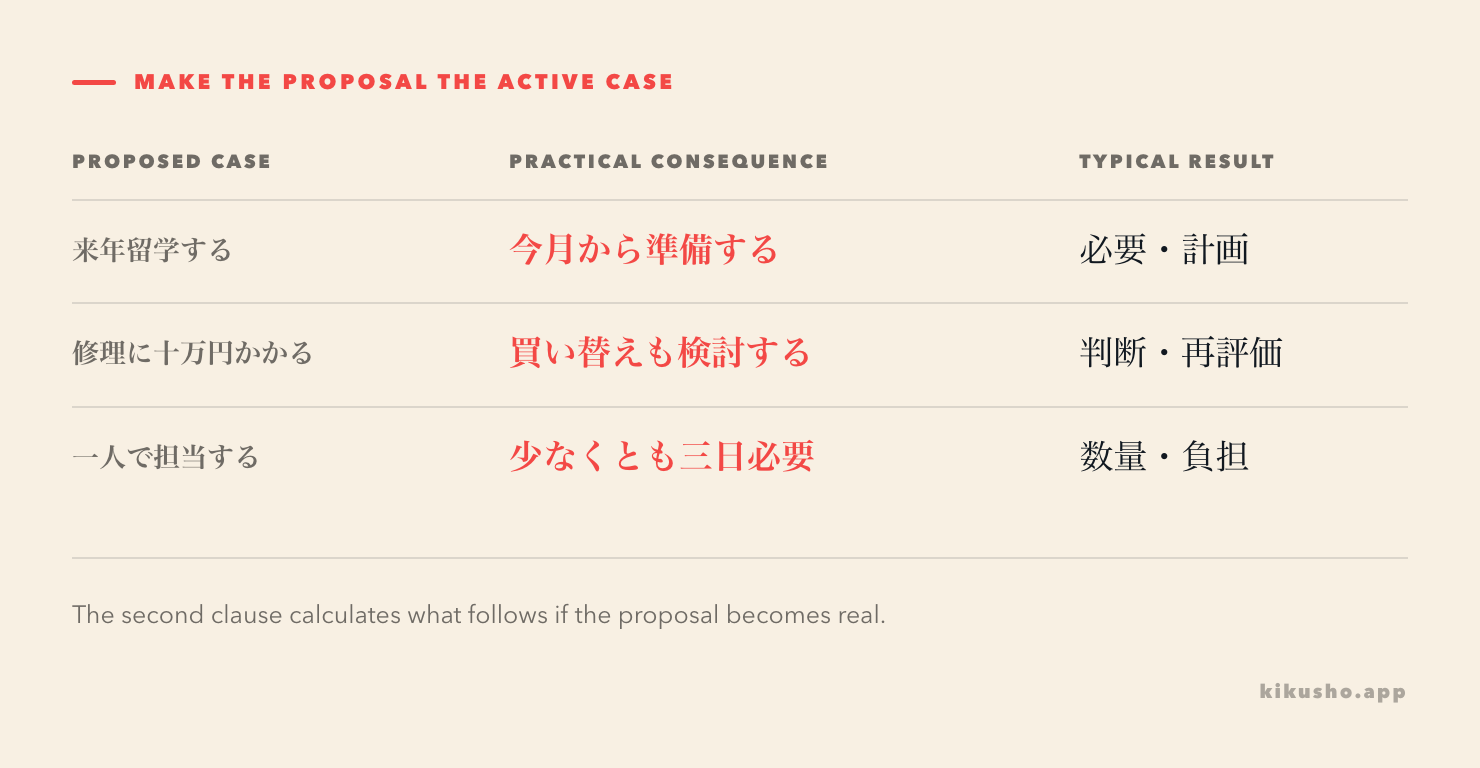
The following clause often contains 必要だ, ~なければならない, 難しい, 問題になる, a quantity, a decision or the speaker's reaction. These predicates show the mental work encouraged by the construction.
となると often feels closer to a recognized case
The と conditional commonly presents a result that follows once the preceding situation is established. With となると, the speaker often sounds as if new information has made them reconsider the matter.
来月から三人でこの仕事を担当するとなると、予定を組み直したほうがいい。
らいげつから さんにんで この しごとを たんとうするとなると、よていを くみなおした ほうが いい。
If only three of us will handle this work from next month, we should redo the schedule.
修理に十万円かかるとなると、買い替えも検討する必要がある。
しゅうりに じゅうまんえん かかるとなると、かいかえも けんとうする ひつようが ある。
If the repair is going to cost 100,000 yen, we also need to consider replacing it.
The condition may still be uncertain. “Recognized case” does not mean confirmed fact; it means the speaker is now treating the proposition seriously enough to reason from it.
となれば can preserve a more hypothetical stance
The ば form in となれば is well suited to “if it were to become the case.” It often leaves a little more distance between the current situation and the proposed one.
一人で全て準備するとなれば、少なくとも一週間は必要だろう。
ひとりで すべて じゅんびするとなれば、すくなくとも いっしゅうかんは ひつようだろう。
If one person were to prepare everything, at least a week would probably be necessary.
本当に計画を中止するとなれば、関係者への説明が欠かせない。
ほんとうに けいかくを ちゅうしするとなれば、かんけいしゃへの せつめいが かかせない。
If the plan were truly to be cancelled, an explanation to everyone involved would be essential.
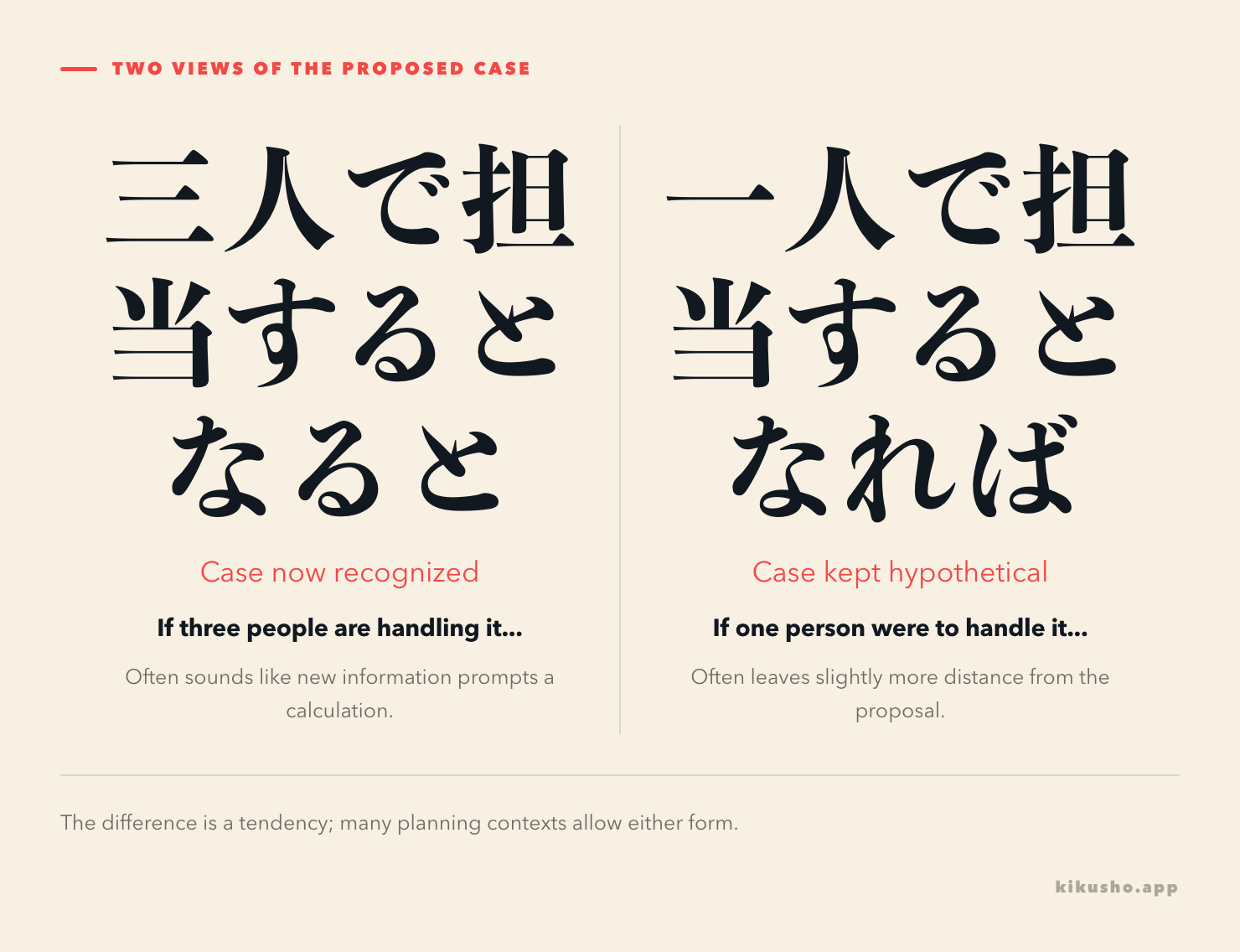
Do not turn this tendency into an absolute contrast. In many planning discussions, replacing one with the other changes little. The predicate, evidence and conversation may carry more weight than the conditional ending.
Attach nouns directly and predicates in plain form
The material before となると/となれば names the case being considered.
| Input | Pattern | Example |
|---|---|---|
| noun | noun + となると/となれば | 海外勤務となれば |
| verb | plain verb + となると/となれば | 引っ越すとなると |
| i-adjective | plain i-adjective + となると/となれば | 費用が高いとなると |
| na-adjective | na-adjective + だ + となると/となれば | 管理が複雑だとなると |
車での移動となると、駐車場も予約しておく必要がある。
くるまでの いどうとなると、ちゅうしゃじょうも よやくしておく ひつようが ある。
If we are talking about travelling by car, we also need to reserve parking.
条件が厳しいとなれば、応募者は減るかもしれない。
じょうけんが きびしいとなれば、おうぼしゃは へるかもしれない。
If the conditions are strict, the number of applicants may fall.
An action can also be packaged with の: 一人で運ぶのとなると大変だ. The nominalizer presents the activity as a topic-like case. Direct 一人で運ぶとなると is usually leaner and equally clear.
いざ marks the gap between theory and the real moment
The frequent frame いざ~となると/となれば means “when it actually comes time to…” It often contrasts easy talk or preparation with difficulty at the decisive moment.
何度も練習したが、いざ発表するとなると緊張してしまう。
なんども れんしゅうしたが、いざ はっぴょうするとなると きんちょうしてしまう。
I practised many times, but when the moment to present arrives, I get nervous.
いざ家を買うとなれば、場所だけでなく将来の収入も考えなければならない。
いざ いえを かうとなれば、ばしょだけでなく しょうらいの しゅうにゅうも かんがえなければ ならない。
Once buying a house becomes a real decision, you have to consider future income as well as location.
いざ does not make the condition more certain by itself. It spotlights the point where an abstract idea becomes a decision, test or action.
Keep three nearby constructions separate
First, ともなると/ともなれば adds も and commonly points to reaching a notable age, rank, scale or stage, followed by what naturally accompanies it:
社長ともなれば、判断の責任は重い。
Once you become company president, the responsibility for decisions is heavy.
This is the “once you reach that level” use of ともなると/ともなれば. Plain となれば does not require an elevated stage.
Second, とあれば often makes a condition a sufficient reason for willingness or an exceptional action:
子どものためとあれば、どんな苦労も惜しまない。
If it is for my child, I will spare no effort.
The とあれば and とあって comparison separates hypothetical grounds from actual circumstances. となると instead asks what follows once the proposed case is adopted.
Third, ことになると can mean “when the subject turns to…”:
音楽のことになると、彼は急に話が止まらなくなる。
When it comes to music, he suddenly cannot stop talking.
This topic meaning is related but narrower. Do not assume every English “when it comes to” should become bare となると.
Practice: draw the consequence from the case
Question 1 — grammar choice. Complete the planning inference: 来年留学する__、今月中に出願準備を始める必要がある。
① となると
② とあって
③ ときたら
④ とみるや
Question 2 — nuance. Which form slightly better preserves a hypothetical reading in もし一人で担当する__、三日は必要だろう, となると or となれば?
Question 3 — attachment. Complete the noun case: 移動手段が飛行機__、荷物の重さにも注意しよう。
① だとなると
② となると
③ なとなると
④ のとなると
Question 4 — interpretation. In 修理に一か月かかるとなると、代わりの機械を借りなければならない, what situation becomes the frame, and what consequence follows?
Question 5 — contrast. Choose between となれば and ともなれば: 部長__、自分の仕事だけでなくチーム全体に責任を持つべきだ.
Question 6 — いざ. Explain the contrast in 準備は簡単だと思っていたが、いざ始めるとなると迷うことが多い.
Question 7 — production. Write two sentences about moving to another city: use となると to state a practical consequence, then use いざ~となれば to describe what becomes difficult at the real decision point.
Answers and explanations
Implication 1
Use ① となると. The plan to study abroad next year becomes the premise from which the speaker derives the need to begin preparing the application this month.
Implication 2
となれば slightly better preserves the explicitly hypothetical stance introduced by もし: もし一人で担当するとなれば、三日は必要だろう. となると is also possible if the speaker treats the one-person arrangement as the case now under serious consideration.
Implication 3
Use ② となると: 移動手段が飛行機となると. The noun 飛行機 attaches directly to となると; do not insert だ, な or の in this noun pattern.
Implication 4
The frame is the repair taking one month. Once that duration is accepted, the practical consequence is the need to rent or borrow a replacement machine.
Implication 5
Use ともなれば. Becoming a department head is a notable rank or stage, and the following duty is presented as naturally appropriate to that standing. Plain となれば could set up a particular proposed appointment, but it would not highlight the status-based norm as clearly.
Implication 6
The first clause reports the speaker's abstract expectation that preparation would be easy. いざ始めるとなると shifts to the real moment of starting, where many decisions become difficult. いざ marks the gap between thinking about the action and actually facing it.
Implication 7
One model is 別の町へ引っ越すとなると、通勤時間を計算し直す必要がある。いざ引っ越すとなれば、長年使った家具を手放す決心がつかない. The first draws a logistical consequence; the second describes hesitation at the actual decision point.
Treat the first clause as a planning assumption
When you meet となると/となれば, ask what changes if the proposed situation becomes the case. The answer may be a new cost, duty, difficulty, decision or evaluation. となると often presents that case as newly recognized; となれば can leave it more hypothetical, but their shared framing function matters more than forcing a sharp boundary.
An AI agent checked the assigned inventory item, competing level estimates, attachment, the overlap between the two conditionals, the いざ frame, nearby constructions, every Japanese example and all seven practice explanations against the linked sources. No human Japanese-language review has been performed.
Common questions
What do となると and となれば mean?
They mean roughly “if that is the case” or “once it comes to that.” The speaker accepts a proposed situation as the frame and then considers the consequences, requirements or change of perspective that follow.
What is the difference between となると and となれば?
They overlap heavily. となると often sounds like the speaker now faces or recognizes the case and draws a consequence; となれば can keep the case slightly more hypothetical. Context often makes either possible.
What comes before となると and となれば?
Nouns attach directly, while verbs and adjectives use plain forms. A nominalized action may use の, as in 一人で準備するのとなると, though a direct plain verb is often more concise.
How is となると different from a basic conditional?
A basic と or ば can state a trigger and result. Adding なる frames the preceding situation as a case now being contemplated, then invites the speaker's calculation, concern, requirement or revised evaluation.