On this page
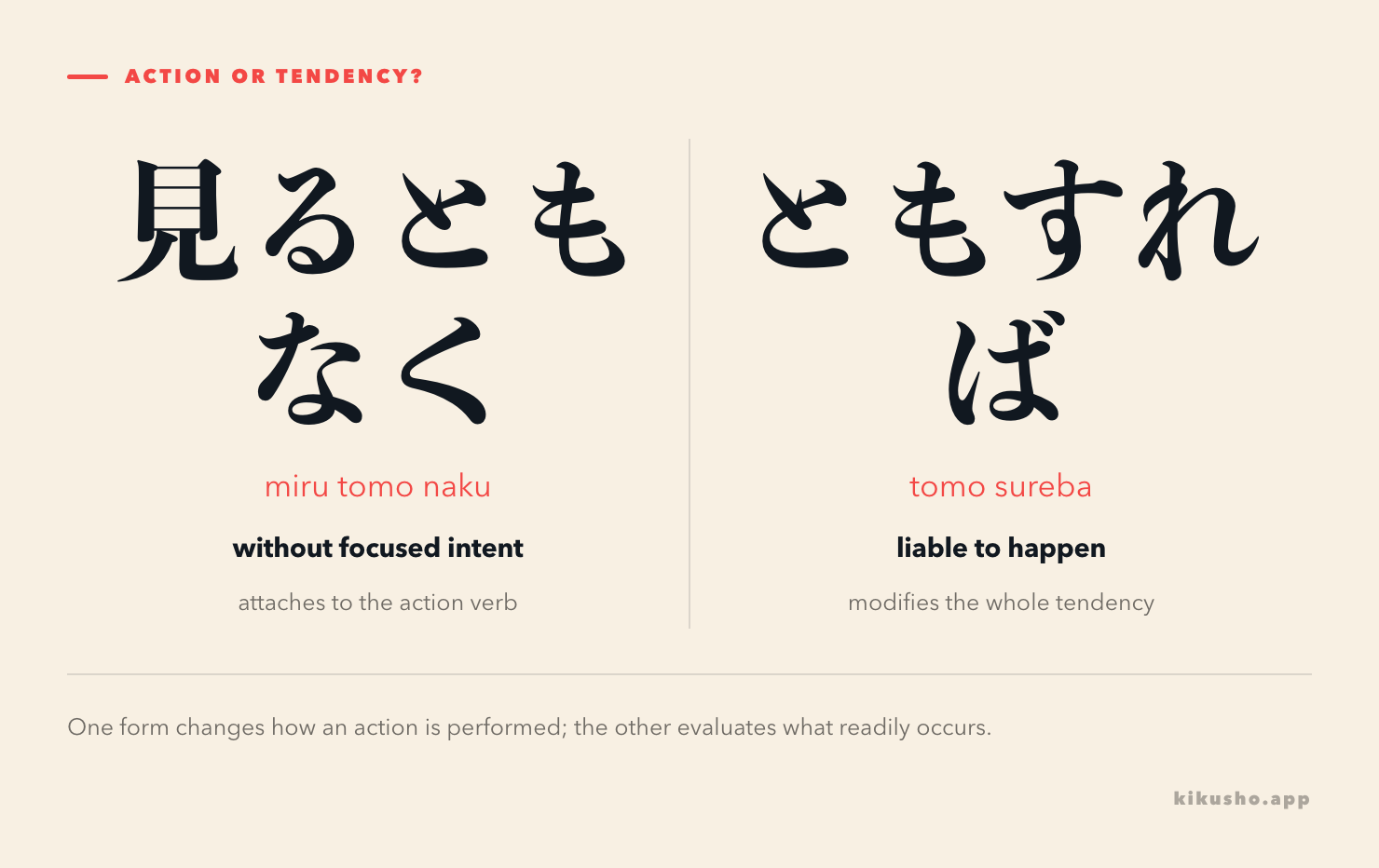
Use V-るともなく/V-るともなしに when an action happens without a clear intention or target. Use ともすれば before a clause when something tends to happen, especially when that tendency is undesirable. The forms look similar, but their attachment and scope are completely different.
窓の外を見るともなく見ていた。
まどの そとを みるともなく みていた。
I was gazing out of the window without really meaning to.
人はともすれば、自分に都合のよい情報だけを集めがちだ。
ひとは ともすれば、じぶんに つごうの よい じょうほうだけを あつめがちだ。
People tend to collect only information that suits them.
In the first sentence, ともなく belongs to 見る and tells us how the looking happened. In the second, ともすれば comments on the whole claim about human behavior. This distinction is more useful than trying to connect the two expressions through the shared sound とも.
This lesson verifies inventory items g-5fd167ac4571, ともなく/ともなしに, and g-c67d9ff5afbe, ともすれば. 日本語NET and JLPT Sensei describe the first family as an N1 construction for action without a definite purpose. Kotobank's dictionary entry and Hane's N1 reference describe ともすれば as an adverb for a state or behavior that easily arises if left unchecked.
V-るともなく removes deliberate focus from an action
Attach ともなく to the dictionary form of an intentional action, especially a verb of perception or attention such as 見る, 聞く, 読む or 考える. The person still performs the action, but does not set out to do it with a particular aim.
ラジオを聞くともなく聞いていたら、故郷の名前が耳に入った。
ラジオを きくともなく きいていたら、ふるさとの なまえが みみに はいった。
I was listening to the radio without paying particular attention when I heard the name of my hometown.
待合室で雑誌を読むともなく読んでいるうちに、名前を呼ばれた。
まちあいしつで ざっしを よむともなく よんでいる うちに、なまえを よばれた。
While idly reading a magazine in the waiting room, my name was called.
The verb often appears twice: 見るともなく見る, 聞くともなく聞く, and 読むともなく読む. The first occurrence carries the construction; the second states the action that continued. This repetition is normal and makes the “doing it, but without consciously setting out to” meaning easy to recognize.
The construction does not mean that the action happened accidentally in the sense of a sudden mishap. The person in 雑誌を読むともなく読んでいた was indeed reading. What is absent is a firm purpose, close attention or chosen target.
V-るともなしに makes the same action adverbial
V-るともなしに shares the same core meaning. It explicitly packages the unfocused action as the manner in which the following event or realization occurs.
テレビを見るともなしに見ていると、昔の友人が映った。
テレビを みるともなしに みていると、むかしの ゆうじんが うつった。
As I watched television without really paying attention, an old friend appeared on screen.
通りを歩きながら、会話を聞くともなしに聞いていた。
とおりを あるきながら、かいわを きくともなしに きいていた。
While walking down the street, I found myself listening to the conversation without intending to.
In many contexts, ともなく and ともなしに can replace each other. ともなしに can sound more explicitly adverbial because of に. ともなく is especially familiar in the repeated-verb frame. Treat that as a usage tendency rather than a rigid difference in meaning.
These expressions are most natural when deliberate control is plausible. A speaker can choose to look, listen or read, then do so absent-mindedly. A purely involuntary event such as rain falling does not normally need a construction about missing intention.
Question words plus ともなく leave the referent unspecified
The same family also follows an interrogative word. Here it means that no particular person, place, time or thing is specified.
誰からともなく拍手が始まり、やがて会場全体に広がった。
だれからともなく はくしゅが はじまり、やがて かいじょう ぜんたいに ひろがった。
Applause began with no identifiable initiator and soon spread through the hall.
休日には、どこへともなく出かけたくなる。
きゅうじつには、どこへともなく でかけたく なる。
On a day off, I feel like going somewhere without any particular destination.
何を買うともなく店内を歩いていた。
なにを かうともなく てんないを あるいていた。
I was walking around the shop without having anything particular in mind to buy.
With a question word, avoid forcing a literal question into the translation. 誰ともなく does not ask “who?” It deliberately leaves the initiator unidentified. どこへともなく removes a set destination. The general idea of missing specification connects this use with V-るともなく, even though the surface structures differ.
ともすれば marks an unchecked tendency or risk
ともすれば is an adverb placed before a clause. It says that, given ordinary human habits or the current circumstances, a particular result can easily occur. The result is often undesirable, shortsighted or worth guarding against.
忙しい職場では、ともすれば説明が後回しになりやすい。
いそがしい しょくばでは、ともすれば せつめいが あとまわしに なりやすい。
In a busy workplace, explanations are liable to be postponed.
専門家は、ともすれば初心者の疑問を単純すぎると考えてしまう。
せんもんかは、ともすれば しょしんしゃの ぎもんを たんじゅんすぎると かんがえてしまう。
Experts can easily dismiss beginners' questions as too simple.
数字だけで評価すると、ともすれば大切な変化を見落としかねない。
すうじだけで ひょうかすると、ともすれば たいせつな へんかを みおとしかねない。
If we evaluate only by numbers, we may well overlook an important change.
Common partners make the tendency visible: ~がちだ, ~やすい, ~てしまう, ~かねない and ~に陥る. These endings are not required, but they frequently reinforce the idea that the result emerges easily unless someone takes care.
The dictionary definition behind ともすれば can be understood as “if things are allowed to take their course.” That explains why the expression often carries a warning. It does not merely report statistical frequency; it frames the tendency as something people should notice, question or prevent.
ともすると is a close alternative
ともすると is a near-synonym of ともすれば. Both can introduce a general tendency, and both frequently lead to a negative or cautionary outcome.
慣れた作業は、ともすると確認を怠ってしまう。
なれた さぎょうは、ともすると かくにんを おこたってしまう。
With familiar work, one can easily neglect the checks.
ともすれば often sounds more literary or formal, which makes it common in essays, commentary and carefully reasoned speech. ともすると can feel a little more conversational, but the overlap is broad. On the JLPT, use the clause meaning and the surrounding predicate before relying on a subtle register preference.
Do not confuse either adverb with どうすれば, “what should I do?” The sequence すれば in ともすれば is part of a fixed adverb, not an open question asking for a method.
Attachment and scope decide the answer
| Form | Position | What it contributes | Typical signal |
|---|---|---|---|
| V-る + ともなく | inside an action phrase | action without a clear intention or focus | 見るともなく見ていた |
| V-る + ともなしに | adverbial action phrase | same core meaning, explicitly linked to what follows | 聞くともなしに聞いていた |
| question word + (particle) + ともなく | inside a phrase | person, place or object left unspecified | 誰からともなく、どこへともなく |
| ともすれば + clause | before a proposition | tendency or risk that easily arises | ともすれば忘れがちだ |
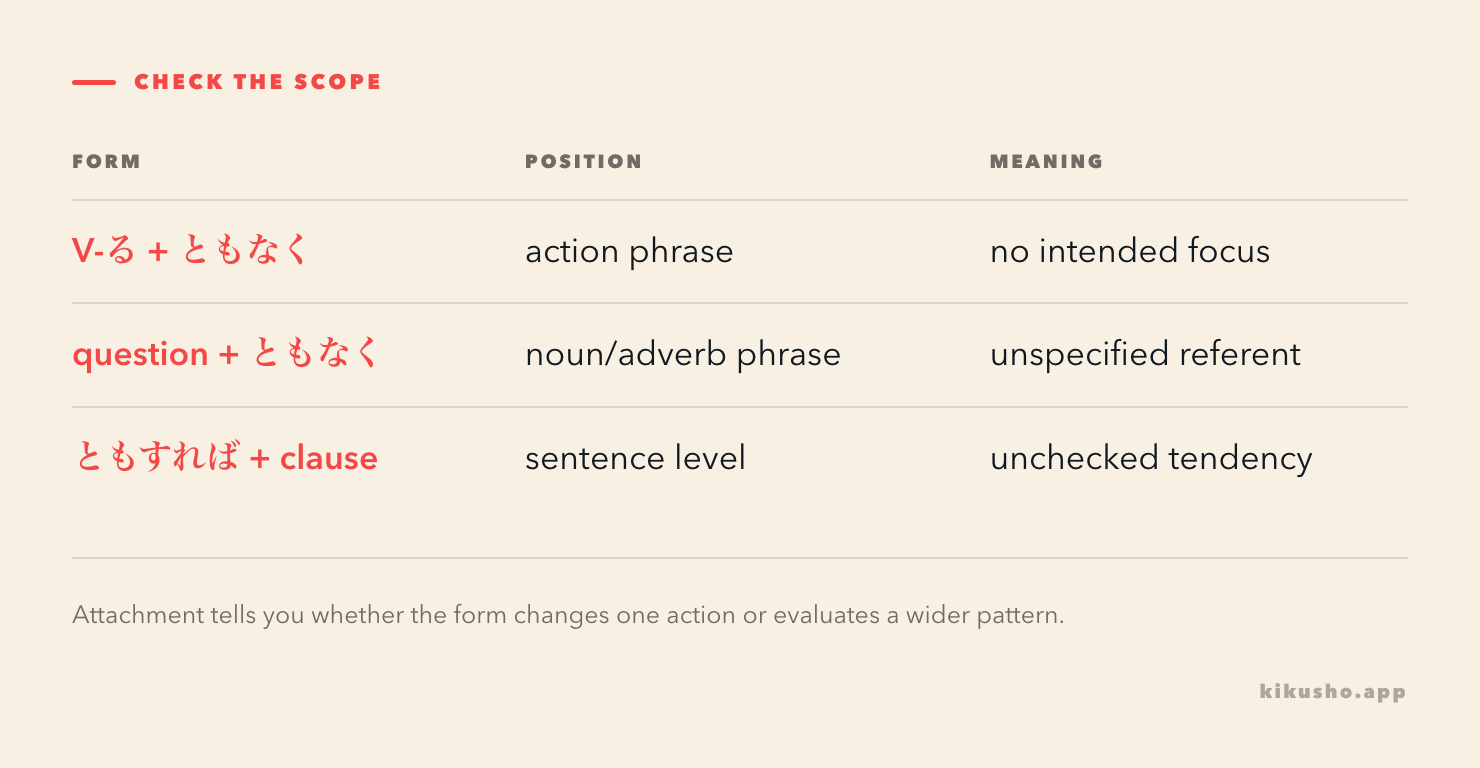
This scope test prevents the most common error. In 音楽を聞くともなく聞く, the object 音楽を belongs to 聞く, and ともなく changes the manner of listening. In ともすれば音楽だけ聞いて勉強を忘れる, the adverb evaluates the larger tendency to choose music and neglect study.
The neighboring N3 pattern がち often appears after ともすれば, but each part has its own job. The だらけ, がち and 気味 lesson explains how がち attaches to a verb stem or noun to describe repeated proneness. ともすれば stands outside that predicate and warns that the tendency readily appears.
Practice: identify the action phrase or the whole-clause tendency
Keep every answer closed until you have completed all seven questions.
Question 1 — action without focus. Complete: 窓の外を__見ていたら、急に雨が降り始めた。
① 見るともなく
② ともすれば
③ 誰ともなく
④ 見るがちに
Question 2 — tendency. Complete: 便利さばかり求めると、__安全への注意を忘れがちだ。
① 聞くともなく
② どこへともなく
③ ともすれば
④ 誰ともなしに
Question 3 — unspecified person. At the end of a moving speech, applause begins with no identified initiator. Complete: __拍手が起こった。
① 誰からともなく
② 誰かともすれば
③ 聞くともなく
④ どこへともなしに
Question 4 — interpretation. In ラジオを聞くともなしに聞いていた, was the speaker not listening at all, listening with a precise purpose, or listening without focused intention? Explain what the repeated 聞く contributes.
Question 5 — scope. Explain why ともすれば describes more than the manner of 考える in 人はともすれば自分の経験だけが正しいと考えてしまう.
Question 6 — contrast. Choose the best pair: 休日、__車を走らせていた。慣れた道では、__速度を確認しなくなることがある。
① どこへともなく / ともすれば
② ともすれば / どこへともなく
③ 誰ともなく / 見るともなく
④ ともすると / 誰ともなしに
Question 7 — production. Write two sentences about reading online news. In the first, use 読むともなく読んでいた for unfocused reading. In the second, use ともすれば to warn about a biased habit.
Answers and explanations
Finding 1
Use ① 見るともなく: 窓の外を見るともなく見ていたら、急に雨が降り始めた. The speaker was looking outside without a deliberate focus. The second 見ていた states the continuing action; 見るともなく characterizes how it was performed.
Finding 2
Use ③ ともすれば. It stands before the proposition 安全への注意を忘れがちだ and warns that this undesirable tendency can easily arise when convenience is valued above everything else.
Finding 3
Use ① 誰からともなく: 誰からともなく拍手が起こった. The phrase leaves the person who initiated the applause unspecified. It is not an indirect question and does not mean that everyone consciously chose the same starter.
Finding 4
The speaker was listening, but without focused intention. The repeated form confirms the action: 聞いていた says the listening continued, while 聞くともなしに removes a defined purpose or close attention from it. The sentence does not mean that no sound was heard.
Finding 5
ともすれば is placed before the whole claim that people may regard only their own experience as correct. It marks that judgment as an easily arising human tendency. It does not describe a special absent-minded manner of one isolated act of thinking.
Finding 6
Use ① どこへともなく / ともすれば. どこへともなく車を走らせていた removes a fixed destination from the drive. ともすれば速度を確認しなくなる warns of a risk that can readily appear on a familiar road.
Finding 7
One model is 昨夜、ニュースを読むともなく読んでいたら、地元の駅の名前が目に入った。ともすれば、自分の意見に合う記事だけを選んでしまう. The first sentence presents reading without a prior target; the second warns of a whole-clause tendency toward confirmation bias.
Let the grammar reveal the size of the claim
When the expression follows a deliberate-action verb, look for missing intention, attention or a chosen target. When it follows a question word, look for an unspecified referent. When ともすれば comes before a full clause, look for a tendency that can emerge if no one corrects it. Attachment reveals whether the grammar modifies one action or comments on a wider pattern of behavior.
An AI agent reviewed the two assigned inventory records and checked the N1 label, attachment, scope, register, Japanese sentences and exercise solutions against the cited references. A human Japanese-language editor has not reviewed this lesson.
Common questions
What does ともなく mean in Japanese?
After a dictionary-form verb, ともなく means doing the action without a clear intention, purpose or object in mind. 見るともなく見ていた means that someone was looking without deliberately focusing on anything.
What is the difference between ともなく and ともなしに?
They share the same core meaning and attachment. ともなしに makes the adverbial role especially clear, while ともなく is often followed by a repeated verb such as 見るともなく見ていた or 聞くともなく聞いていた.
What does ともすれば mean?
ともすれば is a sentence-level adverb meaning that something tends or is liable to happen if circumstances are left unchecked. It commonly introduces an undesirable habit, bias or risk.
Are ともなく and ともすれば interchangeable?
No. V-るともなく sits inside an action phrase and removes a definite intention or target. ともすれば modifies a whole proposition and marks it as a recurring tendency or risk.