On this page
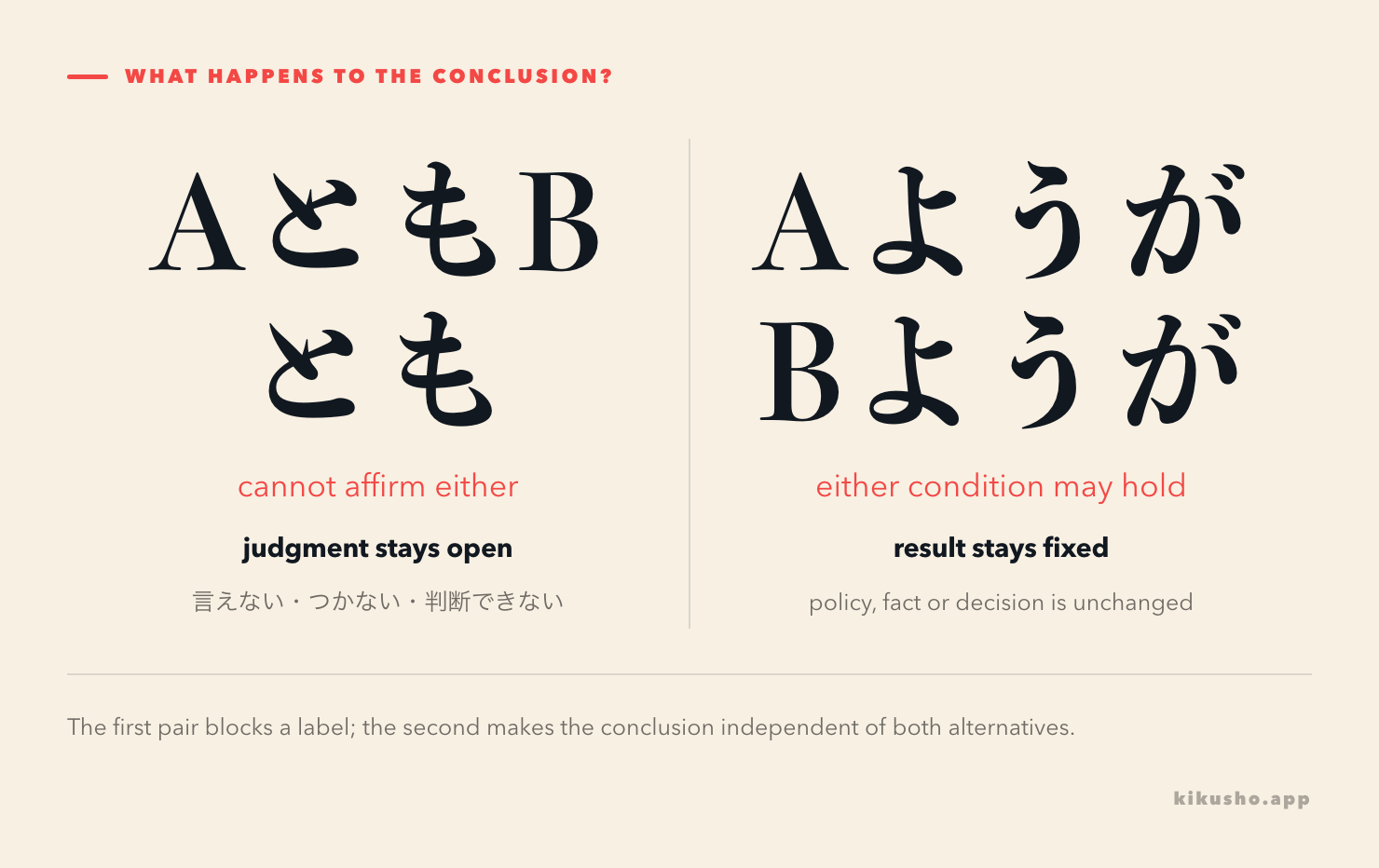
Use とも~とも when neither of two labels or statements can be affirmed. Use ようが~ようが or ようと~ようと when either alternative may occur but the following conclusion will stay the same. One construction suspends judgment; the other makes a judgment independent of the conditions.
この返事は賛成とも反対とも言えない。
この へんじは さんせいとも はんたいとも いえない。
This response cannot be called either agreement or opposition.
相手が賛成しようが反対しようが、調査結果は公表する。
あいてが さんせいしようが はんたいしようが、ちょうさけっかは こうひょうする。
Whether the other side agrees or objects, we will publish the survey results.
The first sentence leaves the response unclassified. The second acknowledges two possible reactions and commits to publication under both. English “whether A or B” can translate either pattern, so the job performed by the final clause matters more than the English gloss.
This lesson verifies inventory item g-bfb594c8f7dc, とも~とも, and g-c124d4f03350, ようが~ようが/ようと~ようと. JLPT Sensei's とも~とも reference and N1et describe an N1 pattern for alternatives that cannot be distinguished or asserted. JLPT Sensei's ようが~ようが reference and Hane teach the second family as N1 concessive alternatives whose choice does not affect the result.
とも~とも presents two labels without choosing one
Each とも follows a candidate description or proposition. A later negative expression states that the speaker cannot affirm either one, cannot tell them apart or finds that neither label fits neatly.
彼の説明は本気とも冗談ともつかない。
かれの せつめいは ほんきとも じょうだんとも つかない。
His explanation is impossible to identify as either serious or a joke.
この案が良いとも悪いとも、今の資料だけでは判断できない。
この あんが いいとも わるいとも、いまの しりょうだけでは はんだんできない。
From the current materials alone, we cannot judge this proposal good or bad.
担当者は計画を続けるとも中止するとも言っていない。
たんとうしゃは けいかくを つづけるとも ちゅうしするとも いっていない。
The person in charge has said neither that the plan will continue nor that it will be cancelled.
Common endings include 言えない, 言っていない, つかない, 判断できない and 決められない. These predicates do the decisive work. The paired とも lays out the two candidates; the ending denies a stable classification, statement or decision.
Keep the alternatives parallel
The two candidates should perform the same grammatical job and represent a meaningful contrast.
| Candidate type | Shape before each とも | Full contrast |
|---|---|---|
| action predicate | ordinary nonpast or past + とも | 行くとも行かないとも言えない |
| い adjective | unchanged adjective + とも | 高いとも安いとも言えない |
| な adjective | lexical base + とも | 安全とも危険とも判断できない |
| category noun | noun directly + とも | 成功とも失敗ともつかない |
Nouns and na-adjective stems normally attach without inserting だ in the compact classification pattern: 冗談とも本気ともつかない, 安全とも危険とも言えない. When whole propositions are quoted, Japanese can also produce structures that include a copular form, but the stem pattern above is the reliable model for this N1 construction.
The alternatives are often opposites, but they do not have to exhaust every logical possibility. 青とも緑ともつかない色 describes a color between or outside the two convenient labels. The speaker is not solving a formal either-or question; the point is that neither offered label settles the matter.
ようが~ようが makes the result condition-proof
With verbs, place が after each volitional form. The two clauses define alternative conditions, and the main clause says what remains true under both.
雨が降ろうが雪が降ろうが、式は予定どおり行います。
あめが ふろうが ゆきが ふろうが、しきは よていどおり おこないます。
Whether it rains or snows, the ceremony will proceed as scheduled.
成功しようが失敗しようが、挑戦した経験は無駄にならない。
せいこうしようが しっぱいしようが、ちょうせんした けいけんは むだに ならない。
Whether we succeed or fail, the experience of trying will not be wasted.
誰が選ばれようが、引き継ぎには一か月必要だ。
だれが えらばれようが、ひきつぎには いっかげつ ひつようだ。
No matter who is selected, the handover will require a month.
The volitional form does not necessarily express anyone's intention here. 雨が降ろうが does not mean that the rain decides to fall. In this concessive construction, 降ろう builds a hypothetical case: even if rain is the condition, the result stands.
The main clause often expresses a firm intention, policy, instruction, evaluation or unavoidable fact. Words such as 必ず, 関係ない, 変わらない and 同じだ make the independence especially visible.
ようと~ようと has the same basic logic
Replace each が with と and the core meaning remains “whether A or B, regardless.” The と version often feels compact and rhetorical in formal writing, but context matters more than forcing a sharp register difference.
批判されようと無視されようと、必要な問題は指摘する。
ひはんされようと むしされようと、ひつような もんだいは してきする。
Whether I am criticized or ignored, I will point out problems that need attention.
資料が多かろうと少なかろうと、出典を確認する必要がある。
しりょうが おおかろうと すくなかろうと、しゅってんを かくにんする ひつようが ある。
Whether there are many sources or few, their provenance must be checked.
Do not read the first と as a quotation followed by another independent phrase. The paired concessive structure becomes clear when two alternatives lead into one stable result.
Verbs, adjectives and nouns use different hypothetical forms
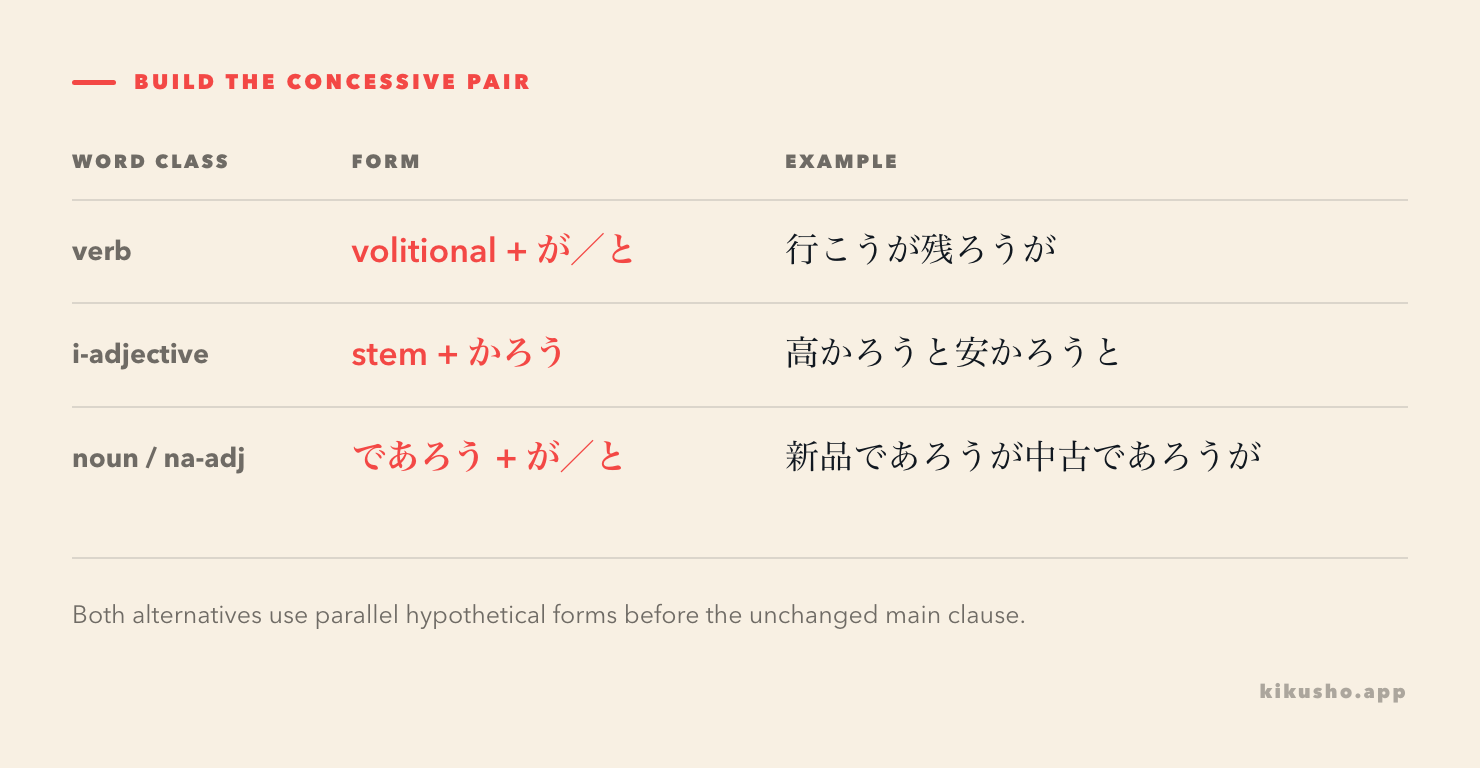
The visible よう in the lesson title comes from a verb's volitional form. Other word classes build the same concessive frame differently.
| Word class | Formation | Example |
|---|---|---|
| verb | volitional + が/と | 行こうが残ろうが |
| i-adjective | stem + かろう + が/と | 高かろうが安かろうが |
| na-adjective | stem + であろう + が/と | 静かであろうとにぎやかであろうと |
| noun | noun + であろう + が/と | 新品であろうが中古であろうが |
値段が高かろうが安かろうが、必要のない物は買わない。
ねだんが たかかろうが やすかろうが、ひつようの ない ものは かわない。
Whether the price is high or low, I do not buy things I do not need.
新品であろうと中古であろうと、保証内容を確認してください。
しんぴんで あろうと ちゅうこで あろうと、ほしょうないようを かくにんして ください。
Whether it is new or used, please check the warranty terms.
These formal forms are useful recognition targets for N1 reading. In everyday conversation, a speaker may choose a simpler frame such as 新品でも中古でも. The longer construction makes the concession and the unchanged conclusion more forceful.
Ask whether the sentence lacks a conclusion or protects one
Compare these nearly parallel examples:
彼の態度は協力的とも非協力的とも言えない。
His attitude cannot be called either cooperative or uncooperative.
彼が協力しようが拒否しようが、期限は延長しない。
Whether he cooperates or refuses, we will not extend the deadline.
The first sentence lacks a firm classification. The second has a very firm conclusion: no extension. Only the conditions vary.
This also separates both patterns from a neutral AかBか question. 参加するかしないか聞いてください asks the person to choose or report an option. 参加するとも参加しないとも言っていない reports the absence of either commitment. 参加しようがしまいが、資料を送る says the material will be sent regardless. The N2 まい and ようか~まいか lesson instead covers a firm negative intention and the speaker's uncertainty about whether to act.
For nominal alternatives that both leave the conclusion unchanged, であれ~であれ is another formal option. The であれ~であれ and いずれにしても comparison shows how those forms express inclusive alternatives without the verb-volitional shape used here.
Practice: unresolved judgment or unchanged result
Complete the entire set, then reveal the single explanation panel below.
Question 1 — classification. Complete: その返事は承諾__拒否__言えない曖昧なものだった。
① しようが / しようが
② とも / とも
③ であろうと / であろうと
④ か / まで
Question 2 — invariant decision. Complete: 周囲に反対され__賛成され__、本人の意思を尊重する。
① ようが / ようが
② とも / とも
③ つつ / つつ
④ たり / たり
Question 3 — noun formation. Choose the natural formal sentence meaning “Whether it is online or in person, registration is required.”
① オンラインとも対面とも、予約が必要だ。
② オンラインであろうと対面であろうと、予約が必要だ。
③ オンラインしようが対面しようが、予約が必要だ。
④ オンラインかろうと対面かろうと、予約が必要だ。
Question 4 — interpretation. In 本人は出席するとも欠席するとも言っていない, does the sentence tell us what the person will do? What does it tell us instead?
Question 5 — volitional form. Why does 雨が降ろうが風が吹こうが use forms that resemble intention even though weather has no intention?
Question 6 — two functions. Supply the four forms that make both sentences coherent: この結果は成功__失敗__判断しにくい。しかし、成功し__失敗し__、記録は公開する。
① ようが / ようが / とも / とも
② とも / とも / ようが / ようが
③ であれ / であれ / か / か
④ かろうが / かろうが / とも / とも
Question 7 — policy writing. Create a two-sentence example about a new policy. In the first, withhold an evaluation with とも~とも言えない. In the second, keep a decision unchanged with ようと~ようと.
Answers and explanations
Verdict 1
Use ② とも / とも: 承諾とも拒否とも言えない. The two nouns are candidate labels for the ambiguous reply, and 言えない refuses to assign either label.
Verdict 2
Use ① ようが / ようが: 反対されようが賛成されようが. The passive verbs take volitional forms, and the following policy of respecting the person's wishes remains valid under both reactions.
Verdict 3
Use ② オンラインであろうと対面であろうと、予約が必要だ. The alternatives are nouns, so each takes であろうと. The reservation requirement is unchanged whichever format applies.
Verdict 4
The sentence does not reveal whether the person will attend. It reports only that the person has made neither commitment: they have not said “I will attend,” and they have not said “I will be absent.” Reality may later settle the question, but the statement is currently missing.
Verdict 5
In this construction, the volitional form creates a hypothetical condition rather than literal willingness. 雨が降ろうが風が吹こうが means that rain and wind are both allowed as possible circumstances, while the main-clause result holds regardless.
Verdict 6
Use ② とも / とも / ようが / ようが. 成功とも失敗とも判断しにくい withholds classification of the result. 成功しようが失敗しようが、記録は公開する declares that publication does not depend on that outcome.
Verdict 7
One model is 新しい方針が公平とも不公平とも、今の情報だけでは言えない。利用者が支持しようと反対しようと、三か月後に効果を検証する. The first sentence suspends evaluation; the second keeps the planned review fixed across both reactions.
Read the main clause before translating “whether”
If the main clause contains 言えない, つかない or another blocked judgment, the sentence is likely refusing to choose a label with とも~とも. If the main clause expresses a policy, fact or decision that survives both alternatives, the concessive ようが~ようが/ようと~ようと fits. The alternatives look parallel in both constructions, but one leaves the conclusion open and the other makes it firm.
An AI agent checked both assigned inventory records, the N1 study label, formation, scope, register, Japanese examples and practice solutions against the cited references. No human Japanese-language editor has reviewed this lesson.
Common questions
What does とも~とも mean in Japanese?
It presents two possible descriptions or statements and says that neither can be confidently affirmed, distinguished or used as a final judgment. It commonly ends with 言えない, つかない or 判断できない.
What does ようが~ようが mean?
It means “whether A or B” or “no matter whether A or B.” Each verb takes the volitional form, and the following decision, evaluation or result remains unchanged under either condition.
Is ようと~ようと different from ようが~ようが?
They share the same core concessive meaning. Both enumerate alternatives that do not affect the following clause; the choice between と and が is often stylistic and depends on the surrounding sentence.
How are とも~とも and ようが~ようが different?
とも~とも withholds a label or commitment because neither alternative can be asserted. ようが~ようが accepts both alternatives as possible conditions and asserts that the conclusion holds in either case.