On this page
ような気がする (you na ki ga suru) means “I have a feeling that…” or “it seems to me that….” Use it when you sense that a statement may be true but do not want to present it as a firm conclusion: 前より静かになったような気がします means “I have the impression that it has become quieter than before.”
The whole statement comes before ような気がする. Its form changes according to the last word in that statement, while 気がする carries the speaker's tentative, subjective stance.
The core pattern presents a tentative impression
Start with a proposition such as 前より静かになった, “it became quieter than before.” Adding ような気がする places a layer of uncertainty around it:
前より静かになったような気がします。
まえより しずかに なった ような きが します。
I have the impression that it has become quieter than before.
The speaker does not deny the change and does not claim to have proved it. The pattern tells the listener how the conclusion feels to the speaker. According to Bunpro's grammar explanation, よう adds uncertainty to the already subjective 気がする and makes the impression less definite.
That makes the expression useful for a memory you cannot quite confirm, a gradual change you have only begun to notice, or a judgment you want to soften:
この本は前にも読んだような気がします。
このほんは まえにも よんだ ような きが します。
I feel as though I have read this book before.
最近、日本語が少し分かるようになったような気がする。
さいきん、にほんごが すこし わかる ように なった ような きが する。
Lately, I feel as if I have started to understand a little Japanese.
The repeated よう in the second sentence has two different jobs. 分かるようになる means “come to be able to understand,” while the final ような気がする makes that whole change a tentative impression.
Attach verbs, adjectives and nouns correctly
Use plain forms before ような. Do not put a polite ます or です form immediately before it.
| Word before the pattern | Form | Example | Meaning |
|---|---|---|---|
| Verb | plain verb + ような気がする | 彼も来るような気がする。 | I have a feeling he will come too. |
| い-adjective | い-adjective + ような気がする | この店は少し高いような気がする。 | This shop feels a little expensive. |
| な-adjective | な-adjective + なような気がする | この町は静かなような気がする。 | This town seems quiet to me. |
| Noun | noun + のような気がする | 今日は日曜日のような気がする。 | Today feels like a Sunday. |
The verb can be affirmative, negative, present or past. Choose the form that belongs inside your impression:
| Form inside the impression | Example | What the speaker senses |
|---|---|---|
| 来る | 田中さんも来るような気がする。 | Tanaka will come |
| 来ない | 今日は来ないような気がする。 | Someone will not come today |
| 間違えた | 道を間違えたような気がします。 | I took the wrong road |
| 忘れていた | 何かを忘れていたような気がした。 | I had forgotten something |
The standard production pattern for an adjectival な-word is なような, as in 静かなような気がする. Some sources and real examples also show のような after words that can behave nominally. At N3, using な after an ordinary な-adjective and の after a noun gives you a dependable distinction.
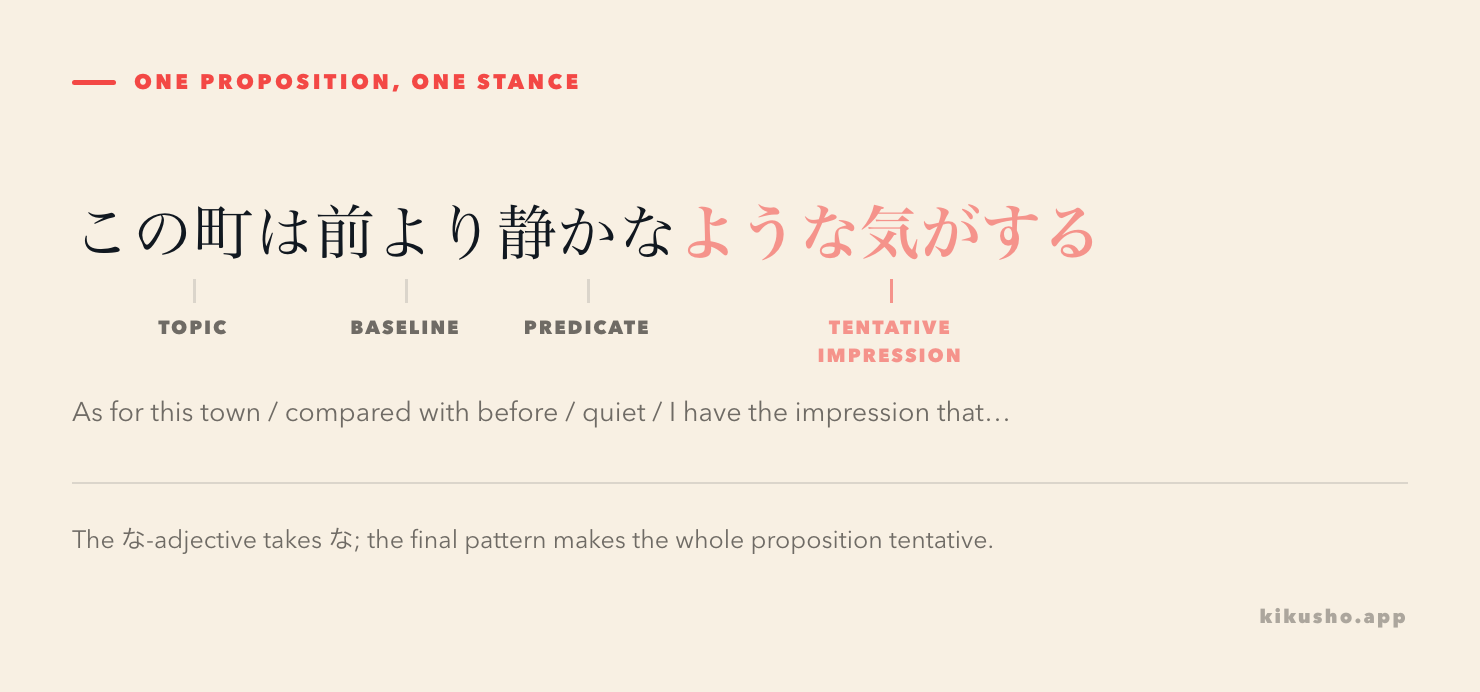
In この町は前より静かなような気がする, 静か is a な-adjective, so it becomes 静かな before よう. The earlier parts can be as detailed as the idea requires. What matters is the final predicate that connects to ような.
Put politeness and time on 気がする
The proposition before ような stays plain. Change the ending of 気がする to place the complete sentence in the right time and register:
| Ending | Use | Example |
|---|---|---|
| 気がする | plain, present impression | 雨が降るような気がする。 |
| 気がします | polite, present impression | 雨が降るような気がします。 |
| 気がした | plain, past impression | 雨が降るような気がした。 |
| 気がしました | polite, past impression | 雨が降るような気がしました。 |
The past ending reports the time when you had the impression. 雨が降ったような気がする is different: the impression exists now, but its content is that rain fell. Compare:
昨日、雨が降るような気がした。
Yesterday, I had a feeling that it would rain.
夜の間に雨が降ったような気がする。
I have a feeling that it rained during the night.
You may also encounter 気がしている or polite 気がしています when the speaker presents an impression as continuing over time. The simple 気がする remains the safest general form.
Compare it with nearby expressions
Several Japanese endings can sound like “I think,” “it seems,” or “probably” in English. They do not present the speaker's stance in the same way.
ような気がする and 気がする
Both can report a hunch. The added ような makes the statement more indirect and less settled. 前にも会った気がする is “I feel I have met them before”; 前にも会ったような気がする adds another degree of hesitation, like “I sort of feel as though I have met them before.” This difference is a tendency, not a mathematical confidence score.
ような気がする and と思う
と思う states what you think or believe. ような気がする foregrounds an intuitive impression that you may not be ready to defend. Compare:
この方法が一番いいと思います。
I think this method is the best.
この方法が一番いいような気がします。
I have the feeling that this method may be the best.
The first can still be tentative in polite conversation, but it presents a clearer judgment. For the larger vocabulary distinction among 思う, 考える and 気がする, see words for thinking.
ような気がする and appearance そうだ
The appearance pattern そうだ often responds to something observable. Dark clouds can lead you to say 雨が降りそうだ, “it looks like it is going to rain.” 雨が降るような気がする presents your subjective hunch; the grounds may be vague or difficult to name. This comparison concerns appearance そう, not the separate hearsay そうだ. The そう・よう・らしい・みたい lesson maps those evidence patterns in detail.
ような気がする, かもしれない and に違いない
かもしれない marks a possibility: 雨が降るかもしれない, “it might rain.” It does not by itself say that you feel an intuitive pull toward that outcome. に違いない makes a strong inference: 雨が降るに違いない, “it is bound to rain.”
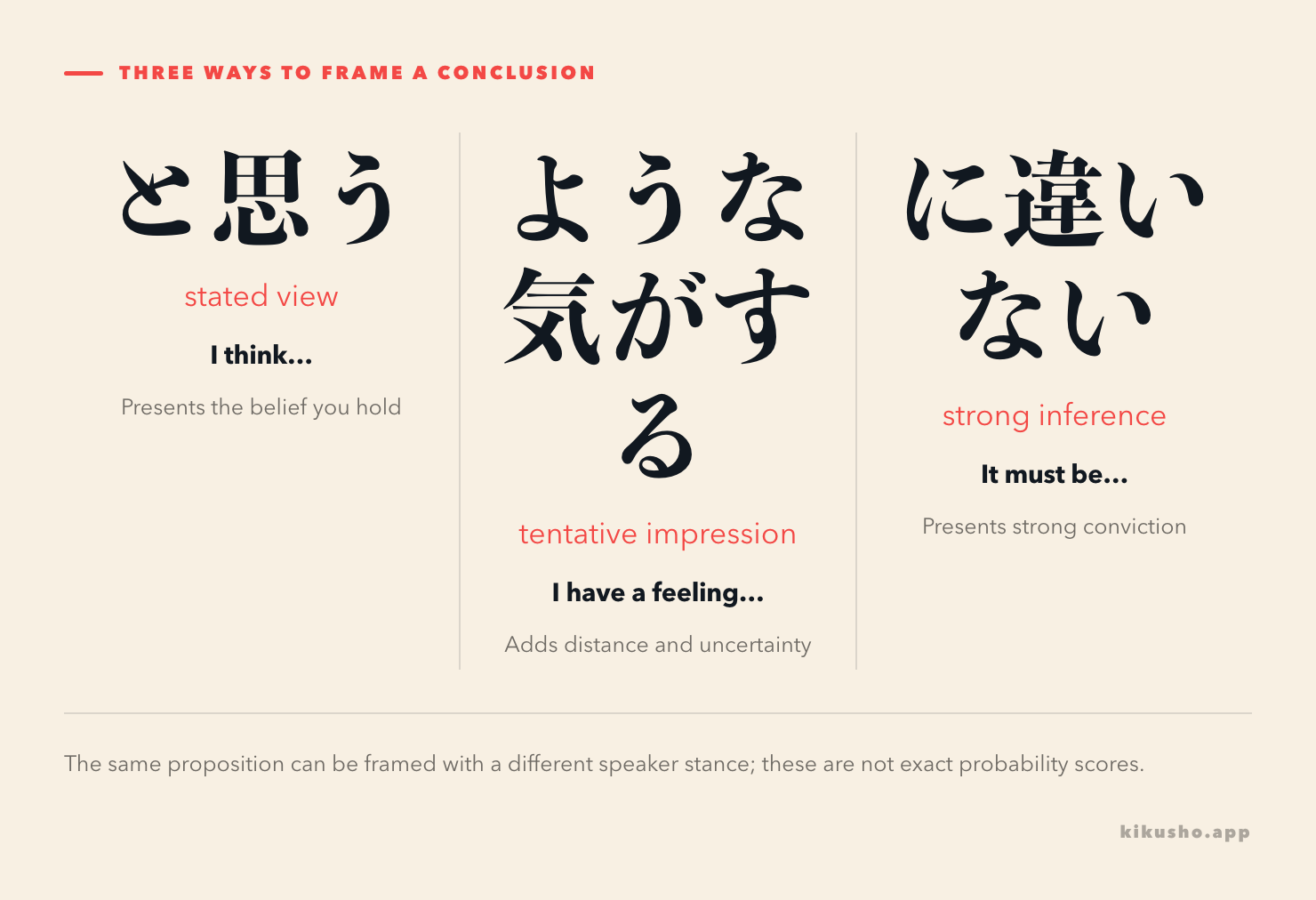
These expressions do not form an exact probability scale. They tell the listener what kind of stance you are taking. The に違いない lesson explains the difference between strong conviction and the limits of a general claim.
Avoid three common mistakes
First, do not place polite forms inside the pattern. Use 来るような気がします, not 来ますような気がします. Politeness belongs at the final します.
Second, keep noun and な-adjective attachment separate. 日曜日 is a noun, so use 日曜日のような. 静か is a な-adjective, so use 静かなような.
Third, do not confuse the full pattern with verb dictionary form + 気, which can describe willingness or inclination in other constructions. 行く気がある means “intend to go” or “be willing to go.” 行くような気がする places 行く, “will go,” inside a tentative impression. When the intended subject is unclear, write it explicitly: 彼も行くような気がする, “I have a feeling he will go too.”
The pattern normally reports the speaker's own inaccessible impression. To report another person's stated feeling, quote them: 彼は道を間違えたような気がすると言った, “He said he felt that he had taken the wrong road.”
The JLPT Sensei reference also records したいような気がする. This can present a desire as only half formed: 海に行きたいような気がする, “I sort of feel like going to the sea.” It is less direct than simply saying 海に行きたい.
Remember the whole proposition in Kikusho
Save a full sentence, because the clause before ような carries the content and the ending carries your uncertainty. A card with only ような気がする = “seems” hides the attachment you need to produce.
For example, save 道を間違えたような気がします together with the situation “the streets look unfamiliar, but I am not certain.” On review, reconstruct both parts: the past plain verb 間違えた before ような and polite します at the end. Then change one element—今日は来ないような気がします—to practise a negative proposition without changing the final pattern.
Six questions on form and nuance
Answer all six before opening the answer block. The questions are original practice; the explanations tell you why the other choices do not fit.
Question 1: attach a noun
Complete the sentence: 今日は日曜日( )気がする。
A. なような · B. だような · C. のような · D. にような
Question 2: attach a な-adjective
Complete the sentence: この町は前より静か( )気がします。
A. なような · B. のような · C. だような · D. でような
Question 3: choose a subjective hunch
You cannot explain why, but you sense that Tanaka will also come. Which sentence best presents that vague impression?
A. 田中さんも来るに違いない。
B. 田中さんも来るような気がする。
C. 田中さんも来るそうだ。
D. 田中さんも来ますような気がする。
Question 4: arrange four chunks
Order these four chunks to say “I have the feeling that I took the wrong road”: 気がします / 道を / ような / 間違えた.
Question 5: choose the strong inference
You have several strong pieces of evidence and want to present a confident inference. Which ending best matches that stance?
A. ような気がする · B. かもしれない · C. 気がしない · D. に違いない
Question 6: complete the short account
Complete this account: 昨日、空を見た時はまだ晴れていました。でも、なぜか( )。そのあと、本当に雨が降りました。
A. 雨が降ったような気がする
B. 雨が降りますような気がした
C. 雨が降るような気がした
D. 雨が降るのような気がする
Answers and explanations
Answer 1: C, のような. 日曜日 is a noun, so it takes の before ような. The sentence says that today feels like a Sunday.
Answer 2: A, なような. 静か is a な-adjective. Use 静かなような before 気がします. の is the regular connector after a noun, and だ does not remain here.
Answer 3: B. ような気がする presents the arrival as a vague subjective impression. A is a strong inference. C, if read as hearsay そうだ, reports information from another source. D incorrectly places the polite 来ます inside the pattern.
Answer 4: 道を間違えたような気がします。 The plain past verb 間違えた gives the content “took the wrong road.” It goes before ような, while the final します makes the whole sentence polite.
Answer 5: D, に違いない. It presents strong conviction or inference. ような気がする is deliberately softer, while かもしれない only marks possibility.
Answer 6: C. 降る is the event that the speaker predicted, so it stays nonpast inside the impression. 気がした puts the act of having that impression in the past and connects with 昨日 and そのあと. A instead says that the speaker now has the impression that rain fell; B incorrectly uses 降ります before ような; D incorrectly inserts の after a verb.
Level note and references
Bunpro and JLPT Sensei place ような気がする at N3. The Tanos/Waller list family places it at N2, so the source lists used by Kikusho disagree. The official JLPT level summary describes the abilities tested at each level but does not publish an exhaustive grammar list. Treat every grammar level as a study aid rather than an official promise about a particular test form.
The attachment rules and contrast with と思う are also described by Iku, a Japanese teacher. MIT OpenCourseWare's Japanese V grammar notes present the pattern as “have a feeling/impression” and contrast it with に違いない. These references support the pattern and distinctions; the explanations and exercises here are original.
Common questions
What does ような気がする mean?
It means that you have a tentative feeling or impression that something is true. It presents the statement before ような as the speaker's subjective, uncertain impression rather than a firm conclusion.
What comes before ような気がする?
Use a plain-form verb or an い-adjective directly, な after a な-adjective, and の after a noun: 来るような, 高いような, 静かなような and 夢のような.
How is ような気がする different from と思う?
と思う states a thought or belief. ような気がする presents a less settled, more intuitive impression and can soften a judgment when the speaker is not confident enough to assert it directly.
Is ような気がする N3 or N2 grammar?
Bunpro and JLPT Sensei place it at N3, while the Tanos/Waller list family places it at N2. The JLPT does not publish an exhaustive official grammar list, so levels assigned by study resources can differ.