On this page
You suddenly remember a school friend while walking: ふと思い出した. You mean to save money but give in and buy another book: つい買ってしまった. Both actions were unplanned, but ふと presents something entering awareness, while つい presents an impulse or lapse that wins.
Use one diagnostic question: Did something simply arise, or did the person fail to resist doing it? Choose ふと for the first viewpoint and つい for the second.
The difference is an unbidden moment versus a lapse
Both words are adverbs, so neither conjugates and neither requires a particle. Put the adverb before the thought, perception or action that it modifies.
| Adverb | Speaker's viewpoint | Frequent partners | Built-in regret? |
|---|---|---|---|
| ふと | A thought, memory, glance, realization or brief action arises without a clear prompt | 思う, 思い出す, 見る, 気づく, 目が覚める | No |
| つい | The person gives in to an impulse, habit or lapse in restraint | 買う, 食べる, 話す, 見る, ~すぎる | Often suggested, but not required |
Compare the two in closely related scenes:
棚の写真をふと見た。
たなのしゃしんをふとみた。
I happened to glance at the photo on the shelf.
通知が気になって、スマホをつい見てしまった。
つうちがきになって、スマホをついみてしまった。
The notification was on my mind, and I gave in and checked my phone.
The glance with ふと simply occurred. The phone check with つい had a temptation behind it, and てしまった frames the completed result as contrary to the person's intention. The same verb 見る can therefore take either adverb when the viewpoint changes.
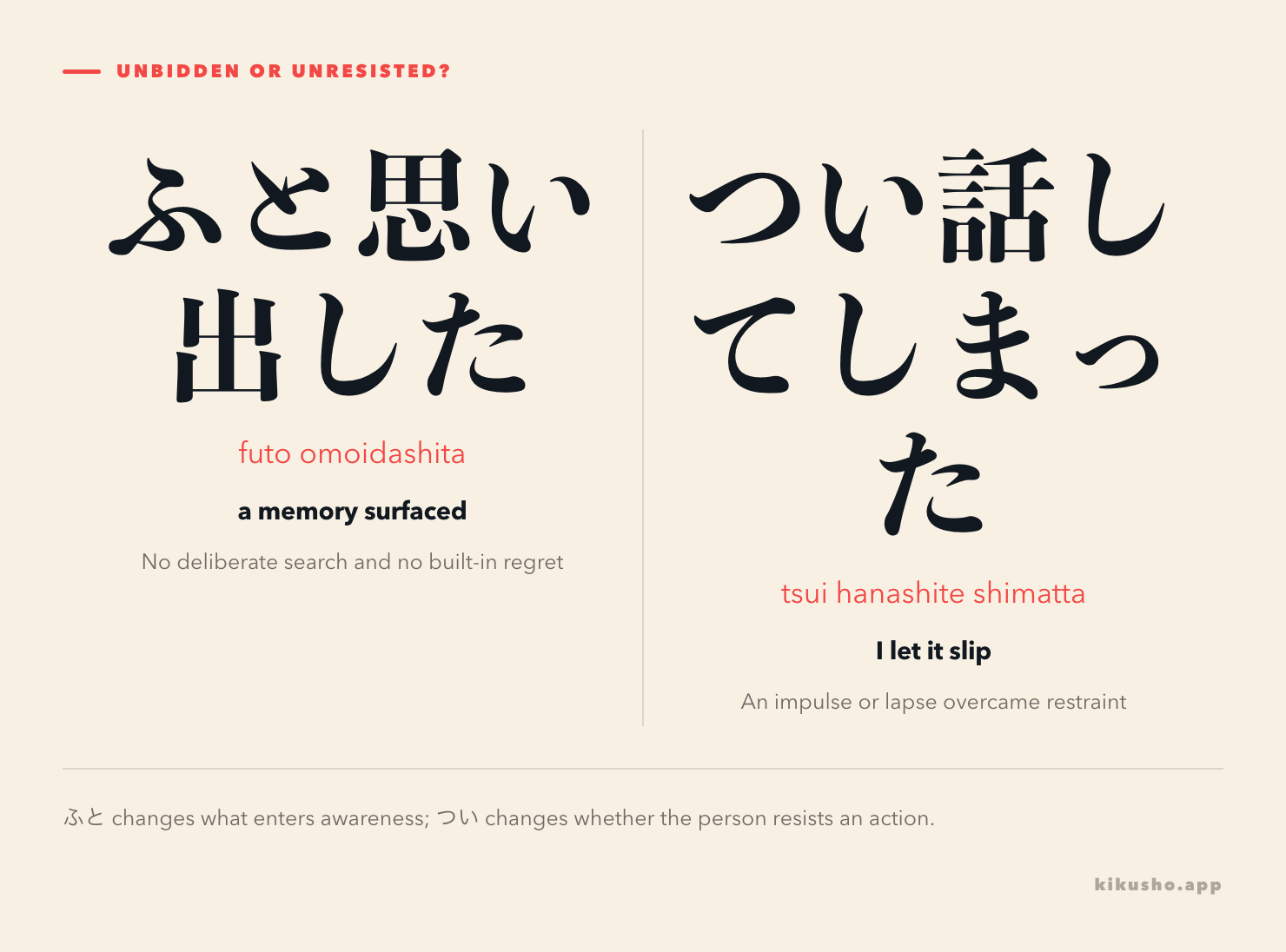
ふと marks something that enters awareness
ふと presents a moment as spontaneous: a memory surfaces, a thought occurs, the eyes move somewhere, or the person notices something. JLPT Sensei's ふと lesson places it at N3 and gives the senses “suddenly,” “by chance” and “unintentionally.” Yatta's N3 account shows its strong association with thoughts, glances and realizations.
駅まで歩いていると、ふと高校時代の友人を思い出した。
えきまであるいていると、ふとこうこうじだいのゆうじんをおもいだした。
While walking to the station, I suddenly remembered a friend from high school.
仕事中、ふと窓の外を見ると、雪が降っていた。
しごとちゅう、ふとまどのそとをみると、ゆきがふっていた。
During work, I happened to look out the window and saw that it was snowing.
夜中にふと目が覚めた。
よなかにふとめがさめた。
I suddenly woke up in the middle of the night.
The word does not claim that the result was bad. ふと友人を思い出した can be pleasant, sad or emotionally neutral. What matters is the lack of a deliberate plan or obvious trigger in the way the speaker presents the moment.
This does not mean that ふと can only modify mental verbs. It can describe a brief physical action such as looking up or stopping. Still, its most useful modern partnerships center on awareness: ふと思う, ふと思い出す, ふと見る and ふと気づく. For a dramatic external change such as rain beginning or a train stopping, 急に is usually the safer choice.
ふとした also appears before nouns in expressions such as ふとしたきっかけ, an unexpected or chance trigger, and ふとした瞬間, an unguarded or passing moment:
ふとしたきっかけで、日本語を勉強し始めた。
ふとしたきっかけで、にほんごをべんきょうしはじめた。
By a chance turn of events, I began studying Japanese.
This neighbouring form shares the sense of something unsought, but learners should first master the adverb directly before a verb.
つい marks an impulse, habit or failure to hold back
With つい, the person performs the action, yet it escapes full control. They know they should stop, intend to act differently, or fall into a familiar habit. JLPT Sensei's つい lesson records the N3 placement and its frequent combination with てしまう. Bunpro describes the action as a lapse or something done against better judgment, while JapaneseNET likewise highlights unconscious or regretted action.
節約中なのに、つい新しい本を買ってしまった。
せつやくちゅうなのに、ついあたらしいほんをかってしまった。
Even though I am trying to save, I gave in and bought a new book.
秘密にすると約束したのに、つい話してしまった。
ひみつにするとやくそくしたのに、ついはなしてしまった。
Although I promised to keep it secret, I let it slip.
てしまう is common because it adds completion and often regret, but it is not required:
緊張すると、つい早口になる。
きんちょうすると、ついはやくちになる。
When I get nervous, I tend to speak too quickly without meaning to.
This last sentence describes a recurring habit. The speaker is not deciding to speak quickly each time, but the action is still their own behaviour. That is why つい fits better than ふと.
つい does not erase responsibility. A speaker can use it to acknowledge that they yielded to an urge, and its apologetic tone depends on context. つい言ってしまった can sound like an explanation, but it does not make the disclosure unavoidable.
Keep similar adverbs in separate boxes
Several nearby expressions translate with “suddenly,” “accidentally” or “just,” but each locates the loss of control differently.
| Form | Core idea | Example |
|---|---|---|
| ふと | something enters awareness without a clear prompt | ふと思い出した |
| つい | impulse or habit overcomes restraint | つい食べすぎた |
| うっかり | carelessness causes an oversight or mistake | うっかり鍵を忘れた |
| 急に | an event or state changes abruptly | 急に雨が降った |
| ついさっき | a separate time use: just moments ago | ついさっき着いた |
| ついに | a separate adverb: finally, at last | ついに完成した |
Use うっかり when the salient cause is inattention: forgetting a key, making a writing mistake or missing a stop. Use つい when temptation, habit or a momentary failure of restraint is central. A speaker who eats a cake despite a diet says つい食べてしまった; one who takes the wrong bag through inattention says うっかり違う鞄を持ってきた.
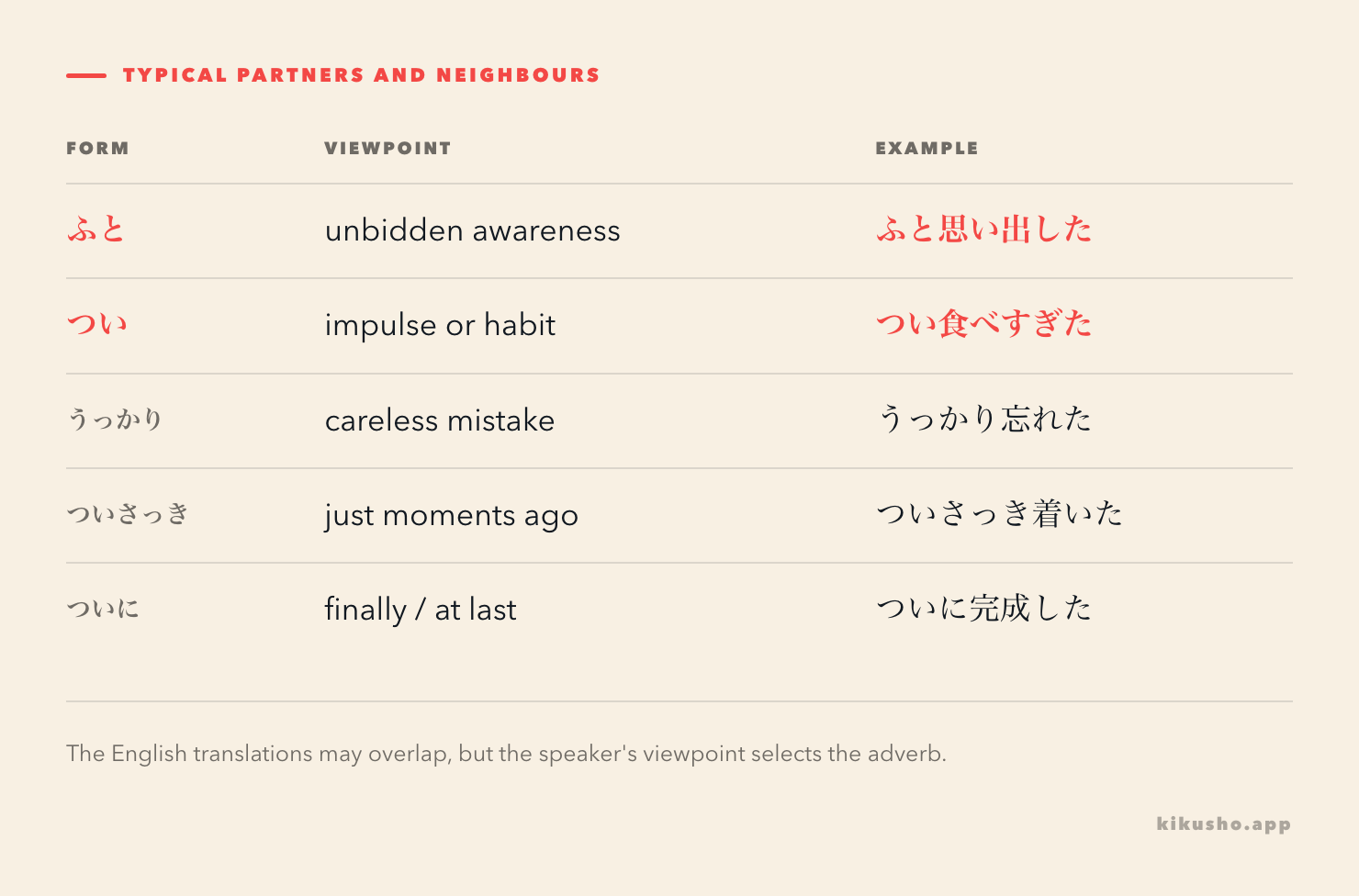
The つい in ついさっき, つい先日 and ついそこ means “just” in time or distance. It is not the lapse-of-restraint use taught here. The 頃, おきに and さっき lesson explains the recent-time expression. ついに, meaning “finally” or “at last,” is a different word in practical use and belongs with event-unfolding adverbs rather than impulse.
Choose the viewpoint before translating
English “without thinking” can hide the distinction. Suppose a name enters your mind with no visible cause. ふと名前を思い出した fits because the memory surfaced. Suppose you reveal the name although you meant to keep it secret. つい名前を言ってしまった fits because restraint failed.
The surrounding clause often exposes the choice:
- ~と、ふと… sets up a passing moment in which something enters awareness.
- ~のに、つい…てしまう sets an intention or rule against the action that wins.
- ~と、つい… can describe a habitual trigger, as in speaking quickly whenever nervous.
These are common frames, not mandatory formulas. The decisive evidence is the speaker's viewpoint, not the presence of one conjunction.
When saving either form in Kikusho, keep the adverb with its verb and the clause that reveals the trigger. A card containing only つい loses the contrast between ついさっき and つい買ってしまった. Save 節約中なのに、つい買ってしまった or 歩いていると、ふと思い出した, then mark the nuance as “impulse” or “unbidden awareness.”
Practice: decide what escaped deliberate control
Complete all seven questions before consulting the explanations. Every answer appears together below Question 7.
Question 1 — grammar choice. While walking, a memory arises for no stated reason. Complete 駅まで歩いていると、__昔の友人を思い出した.
- ア. ついに
- イ. ふと
- ウ. ついさっき
- エ. うっかり
Question 2 — grammar choice. You intended not to buy sweets, but temptation won. Complete 買わないつもりだったのに、__買ってしまった.
- ア. ふと
- イ. 急に
- ウ. つい
- エ. ついに
Question 3 — meaning in context. In 会議中、ふと窓の外を見た, does ふと suggest a deliberate inspection or a passing, unplanned glance?
Question 4 — sentence composition. Arrange these four chunks into “When I get nervous, I unintentionally speak too quickly.” Use each chunk exactly once.
- 緊張すると
- つい
- 早口に
- なってしまう
Question 5 — neighbouring form. You took the wrong umbrella because you failed to pay attention. Which is the clearest completion for __別の人の傘を持って帰った?
- ア. うっかり
- イ. ふと
- ウ. ついに
- エ. ついさっき
Question 6 — grammar choice. Which sentence uses temporal つい rather than the impulse use?
- ア. つい余計なことを言った。
- イ. ついお菓子を食べすぎた。
- ウ. ついさっき駅に着いた。
- エ. ついスマホを見てしまう。
Question 7 — text grammar. Read the passage and choose the two adverbs in order.
本棚を整理していると、古い写真が出てきた。写真を見て、( )高校時代の友人を思い出した。連絡しようと思ったが、先に片づけるつもりだった。それでも、( )スマホを手に取ってしまった。
- ア. つい/ふと
- イ. ふと/つい
- ウ. うっかり/ついに
- エ. ついに/ついさっき
Answers and explanations
Answer 1. イ, ふと. The memory enters awareness during the walk without a stated temptation or mistake. ふと思い出した is a typical partnership. うっかり would frame an error caused by carelessness, while the other choices have separate meanings.
Answer 2. ウ, つい. The intention not to buy creates a restraint, and つい買ってしまった says that the speaker yielded. てしまった reinforces the completed, unwanted result, although つい can also occur without it.
Answer 3. It suggests a passing, unplanned glance. The sentence presents the eyes turning to the window without a deliberate inspection. It does not imply that looking outside was regrettable.
Answer 4. 緊張すると、つい早口になってしまう. The conditional clause names a recurring trigger, and つい marks the uncontrolled habit. なってしまう presents the resulting fast speech as contrary to the speaker's preference.
Answer 5. ア, うっかり. Taking another person's umbrella is an oversight caused by inattention. つい would be more suitable if the speaker knowingly gave in to an urge, while ふと would present a spontaneous thought or glance.
Answer 6. ウ, ついさっき駅に着いた. Here つい narrows さっき to “just moments ago.” ア, イ and エ all present actions as impulses, habits or lapses in restraint.
Answer 7. イ, ふと/つい. Seeing the old photo makes the friend surface in memory, so ふと思い出した fits. The speaker then gives in and picks up the phone despite intending to finish tidying first, so つい手に取ってしまった fits.
Why these adverbs belong in the N3 sequence
JLPT Sensei places both ふと and つい at N3. Bunpro and JapaneseNET independently place つい at N3, while Yatta gives ふと the same study placement. The curriculum inventory records no level disagreement for either item.
These labels guide study order rather than reproduce an official grammar syllabus. The JLPT FAQ explains that the test does not publish an exhaustive current vocabulary, kanji and grammar list. The useful assessable skill is precise: identify whether awareness changed spontaneously, an impulse overcame restraint, carelessness caused an error, or time is merely recent.
An AI review by OpenAI Codex checked both adverbs, every Japanese example, the translations, all answer choices and the seven explanations. No human reviewer took part.
Common questions
What is the difference between ふと and つい?
ふと presents a thought, memory, glance or realization as arising without a clear prompt. つい presents an action as a lapse or impulse that the person did not fully resist, often despite knowing better.
Does つい always need てしまう?
No. つい often appears with てしまう because both fit an unintended or regretted result, but forms such as つい早口になる and つい買いすぎる are natural without it.
Can ふと and つい both mean accidentally?
English translations overlap, but their viewpoints differ. ふと focuses on something entering awareness or happening without a clear cause; つい focuses on giving in to an impulse, habit or lapse in restraint.
Is ついさっき the same grammar as impulse つい?
No. In ついさっき, つい narrows a time or distance to “just” or “only.” It does not express a lapse, and ついに is another separate adverb meaning “finally” or “at last.”