On this page
The train stops 急に, the doors なかなか開かない, and after several minutes they やっと開く. The three adverbs can describe one episode, but each points to a different place on its timeline: abrupt onset, an expected result that is still delayed, or the moment that result finally arrives.
The test that decides
Ask what the sentence is doing with time.
| Question to ask | Form | Core claim |
|---|---|---|
| Did the event begin or change without warning? | 急に + event | it happened suddenly |
| Is an expected result still hard to reach? | なかなか + negative predicate | it does not happen readily |
| Was the delayed or difficult result reached? | やっと + result | it finally happened |
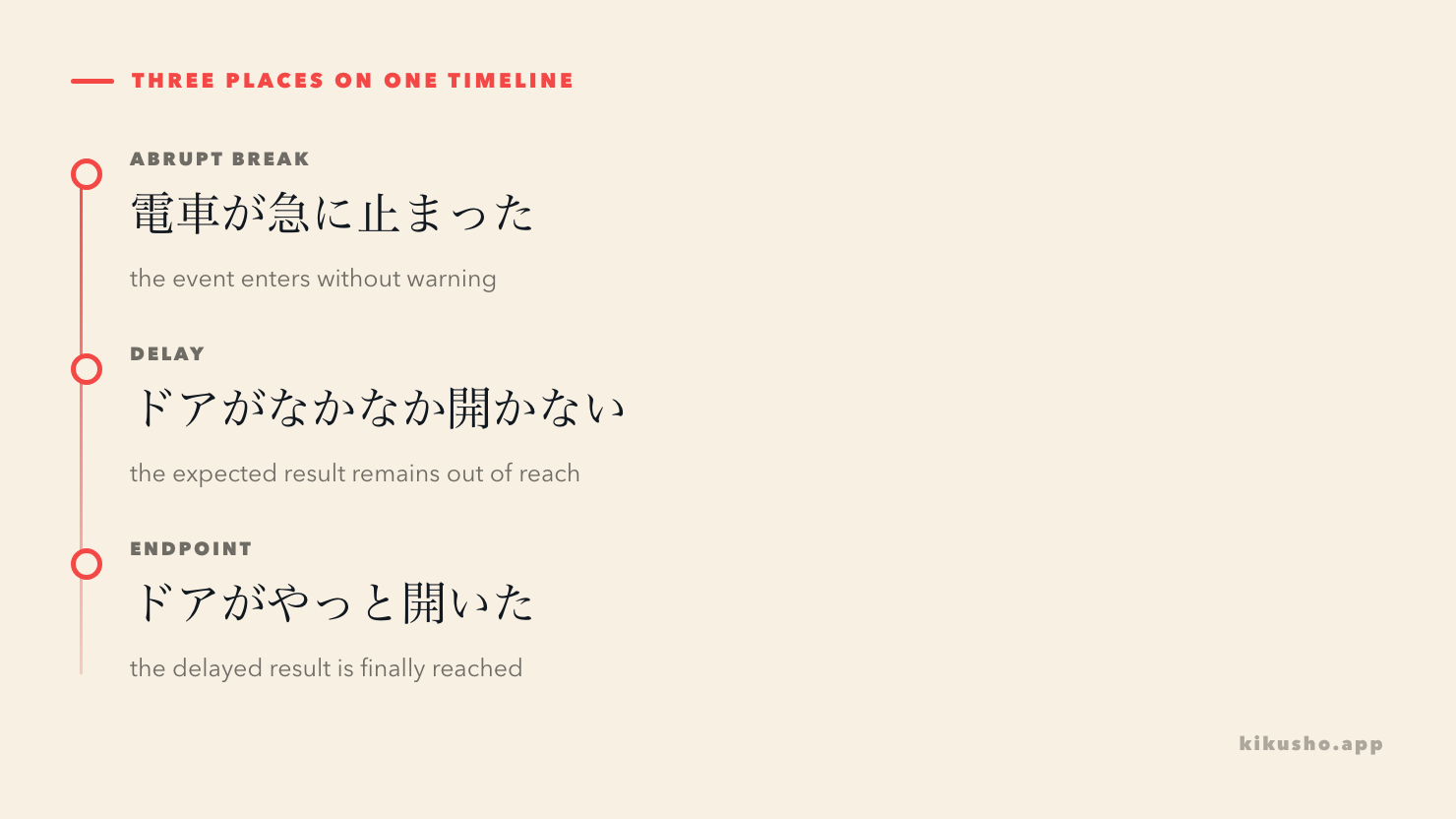
The English word “finally” cannot replace all three. Nor does every long event take なかなか. Choose the stage first, then the adverb.
急に marks the break in what was happening
急に(きゅうに) modifies an action or change that feels abrupt, unexpected or insufficiently prepared for.
会議の時間が急に変わりました。+> かいぎの じかんが きゅうに かわりました。+> The meeting time suddenly changed.
電車が急に止まったので、びっくりしました。+> でんしゃが きゅうに とまったので、びっくりしました。+> I was startled because the train stopped suddenly.
The adverb says how the event entered the situation. It says nothing about how long the event lasted or whether it produced a good result. A sudden rain shower can end quickly or continue all afternoon.
JLPT Sensei's 急に reference lists abrupt changes such as rain beginning, a car turning and the weather becoming cooler. The action-phase lesson shows a related distinction: 降り始める neutrally starts the rain, while 降り出す foregrounds its onset. Adding 急に makes the abrupt timing explicit.
急に is not simply すぐに
Both may be translated with a word such as “quickly,” but their questions differ.
| Sentence | What matters |
|---|---|
| 予定が急に変わった | the change came unexpectedly |
| メールにすぐに返事した | the reply followed with little delay |
急に looks back at the break from the previous situation. すぐに measures the short interval before the next action. A reply can come すぐに without surprising anyone, and a plan can change 急に even if the new plan begins next week.
なかなか~ない keeps the expected result out of reach
Put なかなか before a phrase whose predicate is negative. The negative can be plain or polite, and it may be a potential form.
| Shape | Example | Natural reading |
|---|---|---|
| なかなか + Vない | バスがなかなか来ない | the bus just does not come |
| なかなか + Vません | 問題がなかなか解決しません | the problem is not easily resolved |
| なかなか + potential negative | 名前がなかなか覚えられない | I cannot seem to remember the name |
この漢字は、何回書いてもなかなか覚えられません。+> この かんじは、なんかい かいても なかなか おぼえられません。+> No matter how many times I write this kanji, I cannot seem to remember it.
The speaker expected remembering, arrival or improvement to be possible. Reality has resisted that expectation. Nihongo Net describes the pattern as difficulty or delay against an anticipated result, and gives both plain and polite negative forms.
This is not the same as a bare negative. バスが来ない reports that the bus does not come. バスがなかなか来ない adds waiting, expectation or impatience. It also does not mean “never.” The bus may arrive in the next sentence.
The negative belongs to the predicate, not to なかなか itself:
一時間待ちましたが、店はなかなか開きませんでした。+> いちじかん まちましたが、みせは なかなか あきませんでした。+> I waited for an hour, but the shop did not open for a long time.
The past negative describes the stretch in which the expected opening failed to happen. Without later context, it does not tell us whether the shop eventually opened.
やっと stands at the reached endpoint
Use やっと when waiting, effort or difficulty leads to a result that is now real.
三回目の試験で、やっと合格しました。+> さんかいめの しけんで、やっと ごうかくしました。+> I finally passed on my third attempt.
一時間待って、料理がやっと来ました。+> いちじかん まって、りょうりが やっと きました。+> After waiting an hour, the food finally arrived.
The delay may come from work, repeated attempts, bad conditions or simple waiting. What matters is the endpoint. JLPT Sensei's やっと reference supports the common “at last” use with completed work, an ended speech, acquired ability and an order that arrives after a long wait.
やっと can also mean barely when the result is only just possible: この給料でやっと生活できます, “I can barely live on this salary.” That use still places the result at a limit. Context decides whether the speaker means “finally achieved” or “only just enough.”
One event can move through all three
The forms are not rival translations for one static fact. A speaker can change forms as the situation develops.
パソコンが急に動かなくなりました。再起動しても、なかなか動きませんでした。でも、設定を直したら、やっと動きました。+> パソコンが きゅうに うごかなく なりました。さいきどうしても、なかなか うごきませんでした。でも、せっていを なおしたら、やっと うごきました。+> The computer suddenly stopped working. Even after restarting it, it would not work for a while. But after I fixed the settings, it finally worked.
Here 急に marks the break from working to not working. なかなか~ない holds the desired recovery off despite an attempt. やっと announces that the recovery has been achieved.
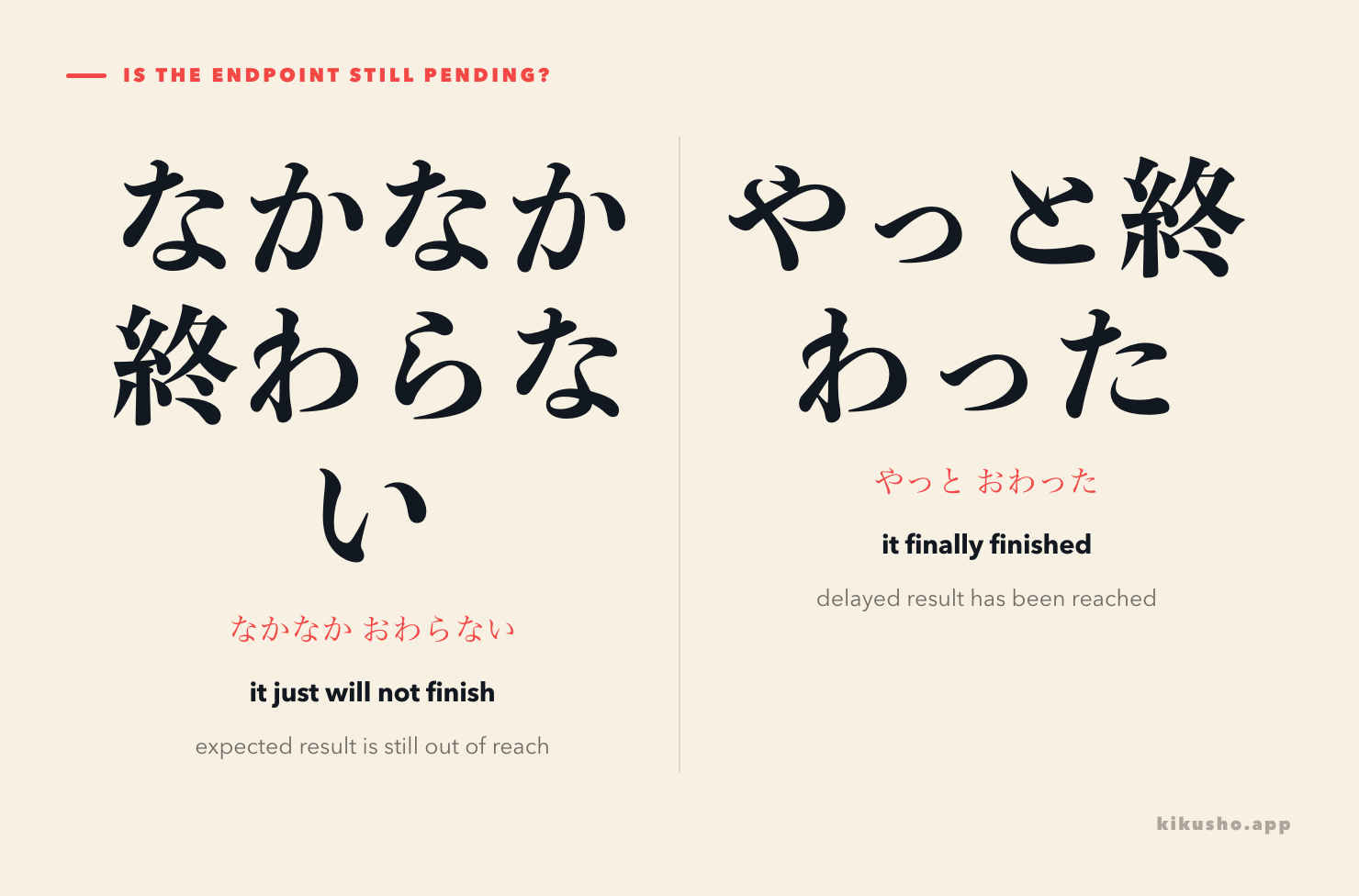
This sequence also exposes a common error. やっと動きませんでした does not mean “it still would not work.” やっと expects an attained or barely possible result in this use. If the endpoint remains unreached, use なかなか動きませんでした.
When you hear a phrase such as なかなか動かない, capture the full phrase in Kikusho rather than saving 動く alone. The adverb and negative ending carry the expectation and delay. Review the drafted reading, meaning and example before saving the editable card; keeping the whole sentence preserves the timeline you will need to retrieve.
Positive なかなか belongs to another reading
なかなか can appear with a positive expression, but then it often means “quite,” “considerably” or “surprisingly.”
この映画はなかなか面白かったです。+> この えいがは なかなか おもしろかったです。+> This film was quite interesting.
That is not a shortened version of なかなか~ない. Compare the shapes directly:
| Form | Meaning |
|---|---|
| なかなか面白い | quite interesting |
| なかなか理解できない | cannot readily understand |
Bunpro makes this positive-versus-negative split explicit. In ordinary contemporary writing, hiragana なかなか is the safest learner spelling; 中々 also occurs.
JLPT Sensei and Nihongo Net place なかなか~ない at N4, while Bunpro places the same surface pattern at N3 and the Tanos-derived comparison inventory records it at N2. 急に and やっと are placed at N4 by JLPT Sensei. These are publisher study levels, not an official item list: the JLPT does not publish an exhaustive grammar syllabus.
Check yourself
Question 1: grammar choice. After waiting forty minutes, the bus finally arrives. Complete: 四十分待って、バスが__来ました。
- A. 急に
- B. やっと
- C. なかなか
- D. あまり
Question 2: meaning. What does 予定が急に変わりました emphasize?
- A. The new plan took a long time to complete.
- B. The plan changed every week.
- C. The change came abruptly or unexpectedly.
- D. The speaker barely accepted the plan.
Question 3: negative attachment. Which sentence naturally means “I cannot seem to remember this name”?
- A. この名前がやっと覚えません。
- B. この名前が急に覚えません。
- C. この名前がなかなか覚えられません。
- D. この名前がなかなか覚えました。
Question 4: sentence composition. Write “The medicine is not working readily” using 薬, 効く, and なかなか~ない.
Question 5: 急に or すぐに. Choose the sentence for “When I received the message, I replied immediately,” where the short delay matters more than surprise.
- A. メッセージを受け取って、急に返事しました。
- B. メッセージを受け取って、すぐに返事しました。
Question 6: positive なかなか. What does この問題はなかなか難しい most naturally mean without a negative predicate?
- A. This problem is quite difficult.
- B. This problem never becomes difficult.
- C. This problem was finally difficult.
- D. This problem suddenly disappeared.
Question 7: text grammar. Read: 朝、電車が急に止まりました。しばらく待っても、なかなか動きませんでしたが、十分後にやっと動き出しました。 Which account matches the text?
- A. The train slowly stopped, moved easily, and then stopped again.
- B. The train stopped without warning, remained unable to move for a while, and finally started moving ten minutes later.
- C. The train arrived early and moved only narrowly.
- D. The train never moved again.
Answers and explanations
Answer 1. B, やっと. The forty-minute wait creates a delayed endpoint, and 来ました says the expected arrival is now real. なかなか would require a negative predicate for the “not readily” pattern.
Answer 2. C. 急に presents the change as abrupt or unexpected. It does not state how long the new plan lasts or whether the change is welcome.
Answer 3. C, この名前がなかなか覚えられません. The potential negative 覚えられません supplies the unreached result. やっと normally presents attainment or bare possibility, and D is positive.
Answer 4. 薬がなかなか効きません。 The medicine is the subject, and polite negative 効きません completes the delayed-result pattern. Plain 薬がなかなか効かない is also correct.
Answer 5. B, すぐに返事しました. すぐに measures the short interval after receiving the message. 急に would frame the reply itself as abrupt or unexpected.
Answer 6. A. With a positive adjective, なかなか often means “quite” or “surprisingly.” The assigned なかなか~ない pattern needs a negative predicate and instead describes difficulty or delay.
Answer 7. B. 急に marks the unexpected stop, なかなか動きませんでした describes the unreached movement during the wait, and やっと動き出しました marks the eventual onset of movement.
Read the predicate with the adverb. 急に changes how an event begins, なかなか~ない keeps its expected result pending, and やっと places you at the endpoint that has now been reached.
Common questions
What is the difference between 急に, やっと and なかなか~ない?
急に marks an abrupt or unexpected event. なかなか~ない says an expected result is not arriving easily. やっと marks the point when a long-awaited or difficult result is finally reached.
Does なかなか~ない mean never?
No. It says something does not happen readily or is taking longer than expected. The sentence may describe a delay still in progress, and it does not by itself say whether the event will eventually happen.
Can なかなか be used without a negative verb?
Yes, but the meaning changes. Positive なかなか often means quite or surprisingly, as in なかなか面白い. The N4 pattern taught here is なかなか followed by a negative predicate.