On this page
Use VてはV when one action leads into another again and again: 原稿を書いては直し、書いては直した, “I kept writing and revising the draft.” Double or mirror the pattern when you want the reader to feel the cycle: 出ては入り、入っては出る, “go out and come in, come in and go out.”
The important idea is recurrence with an internal order. Ordinary VてV can report one sequence, while VてはV asks the reader to see the first action and what repeatedly follows it.
This lesson covers inventory item g-5c679c3fd0d1, ては~ては. JLPT Sensei, Bunpro and J-nihongo place the pattern at N2. 絵でわかる日本語 teaches it as a useful pattern outside its fixed JLPT list. These labels describe teaching sequences; the JLPT does not publish an exhaustive grammar syllabus.
One marker can describe a recurring pair
The smallest useful shape is:
| Part | Role | Example |
|---|---|---|
| V1ては | action that repeatedly occurs first | 時計を見ては |
| V2 | what repeatedly follows | ため息をついた |
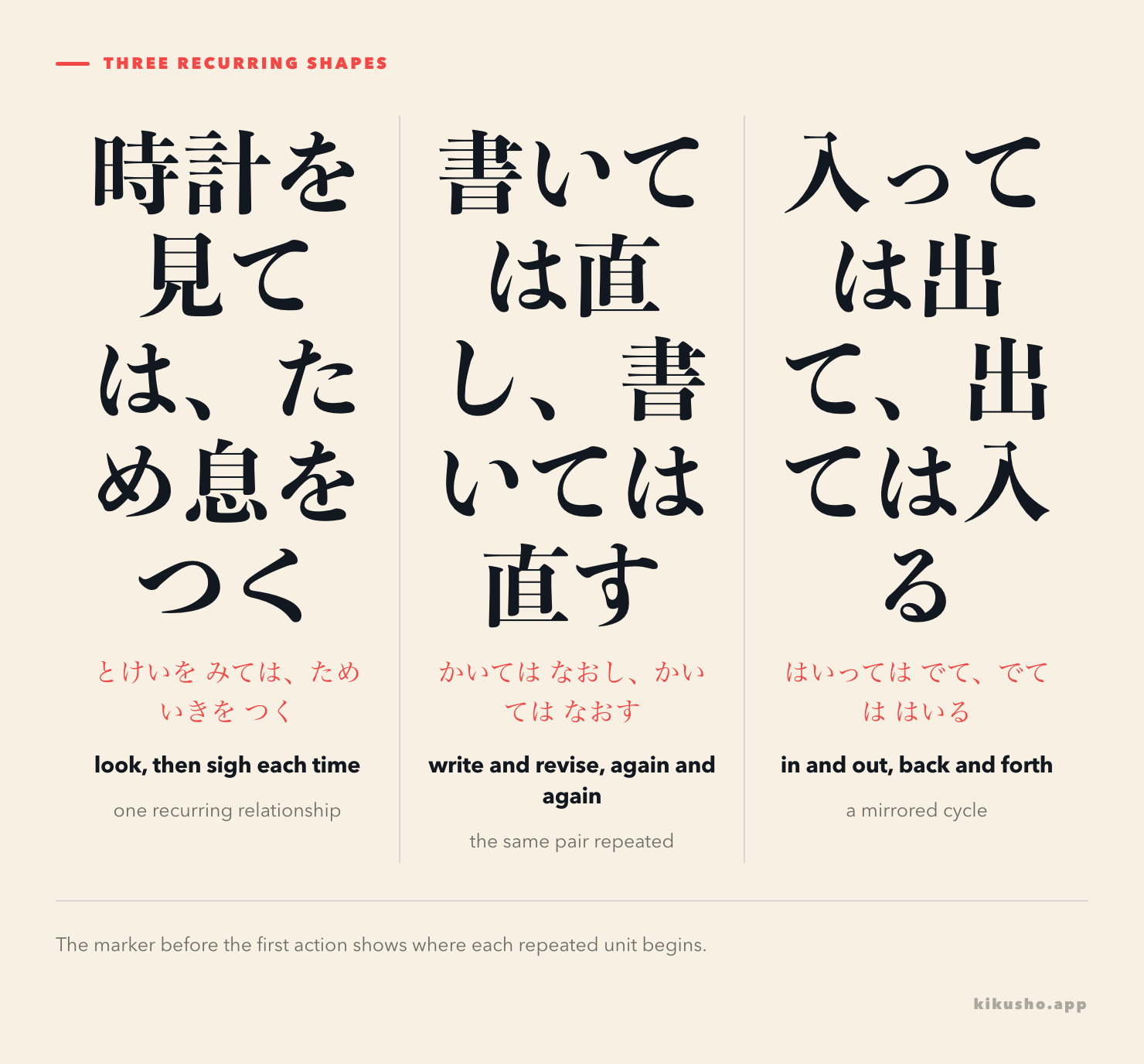
彼は時計を見ては、ため息をついた。
かれは とけいを みては、ためいきを ついた。
He kept looking at the clock and sighing.
This does not describe one look followed by one sigh. Each look starts another small instance of the same relationship. A time expression or the wider scene may make the repetition even clearer:
返事を待つ間、通知が来ていないか確認しては、画面を閉じた。
へんじを まつ あいだ、つうちが きていないか かくにんしては、がめんを とじた。
While waiting for a reply, I repeatedly checked for a notification and closed the screen.
The second verb carries the tense and politeness when it ends the sentence. 見てはため息をつく is nonpast; 見てはため息をついた is past. The ては portion itself does not mark tense.
Repeating the shape makes the cycle visible
The construction expands in two common ways.
Repeat the same pair
企画書を書いては直し、書いては直して、ようやく提出した。
きかくしょを かいては なおし、かいては なおして、ようやく ていしゅつした。
I wrote and revised the proposal again and again, then finally submitted it.
The repeated 書いては直し dwells on the work before the final submission. The first 直し is the continuative stem because the sentence keeps moving. 直して then connects the final repeated pair to 提出した. The larger sentence decides the form of the second verb; there is no special “ては conjugation” for it.
Reverse the pair
猫は箱に入っては出て、出てはまた入った。
ねこは はこに はいっては でて、でては また はいった。
The cat kept getting into the box and coming out, then going out and getting back in.
Here the second action becomes the first action of the next half. This mirrored form suits back-and-forth movement, starting and stopping, opening and closing, remembering and forgetting.
Build ては from the verb's て-form
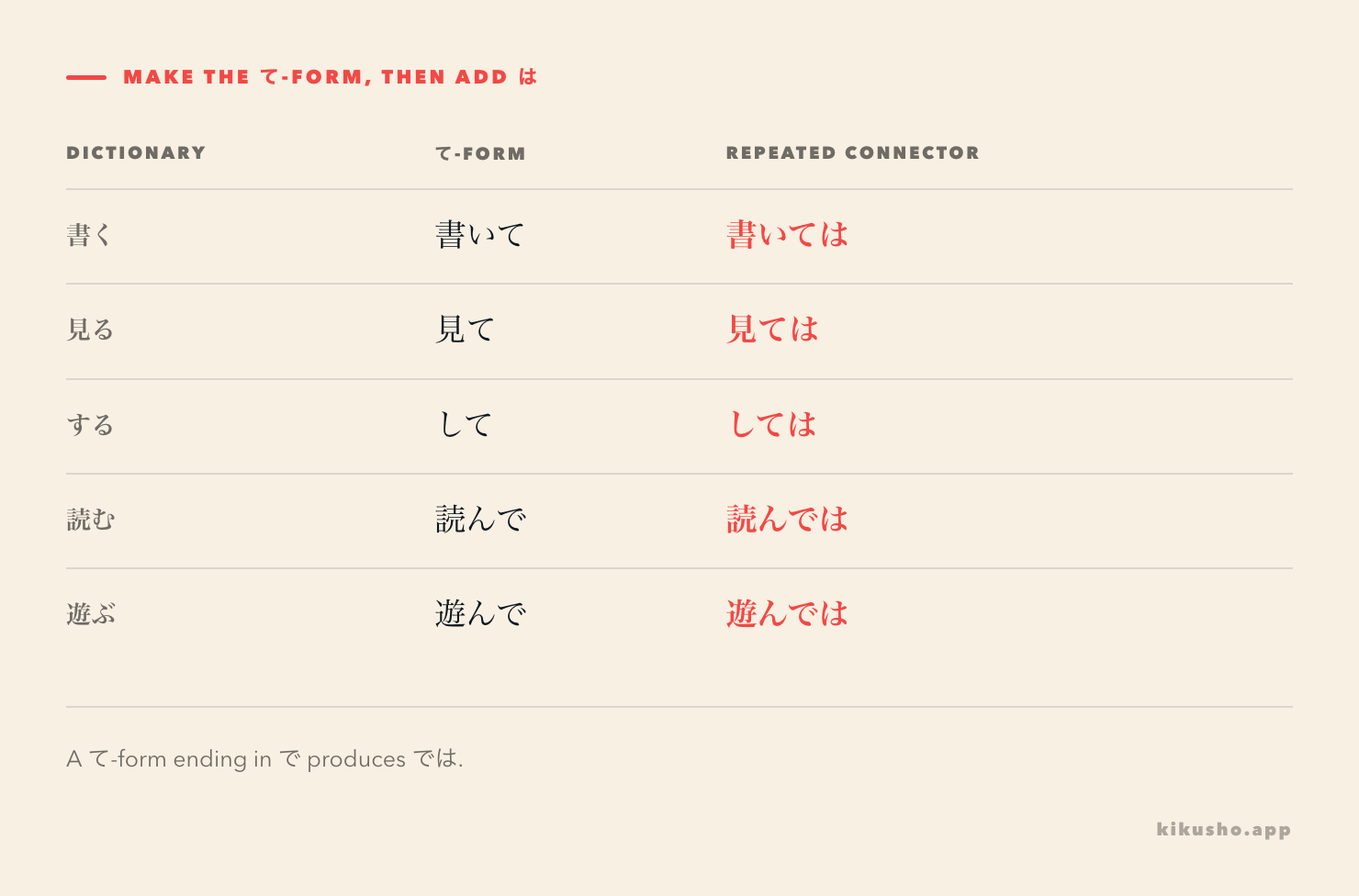
Make the ordinary て-form first, then add は. When the て-form ends in で, the result is written では.
| Dictionary form | て-form | Before the repeated sequence |
|---|---|---|
| 書く | 書いて | 書いては |
| 見る | 見て | 見ては |
| する | して | しては |
| 読む | 読んで | 読んでは |
| 遊ぶ | 遊んで | 遊んでは |
The では in 読んでは is not a noun plus では. It is simply 読んで + は. The voiced で comes from the verb's て-form.
地図を読んでは歩き、歩いてはまた地図を読んだ。
ちずを よんでは あるき、あるいては また ちずを よんだ。
I alternated between reading the map and walking, then walking and checking the map again.
In casual speech, ては and では may contract to ちゃ and じゃ, but the full form keeps this already compact sequence easier to parse. It is also the form to expect in careful writing and JLPT study.
Ordinary て-form sequence reports; ては repeats
Compare one completed chain with a recurring pattern:
ドアを開けて、部屋に入った。
ドアを あけて、へやに はいった。
I opened the door and entered the room.
ドアを開けては閉め、開けては閉めた。
ドアを あけては しめ、あけては しめた。
I kept opening and closing the door.
The first sentence can describe a single sequence. The second builds repeated units: open, close; open, close. Context can make ordinary て-form actions habitual, but ては marks the recurring relationship directly.
This distinction assumes you already know how the Japanese て-form connects actions. The new work at N2 is recognizing that は turns the first action into the recurring point from which the next action follows.
たり~たり lists examples rather than a fixed cycle
VたりVたりする gives representative actions. They may happen repeatedly, but their order is not the central claim.
休みの日は、本を読んだり映画を見たりする。
やすみの ひは、ほんを よんだり えいがを みたりする。
On days off, I do things like read books and watch films.
休みの日は、本を読んでは眠り、起きてはまた続きを読んだ。
やすみの ひは、ほんを よんでは ねむり、おきては また つづきを よんだ。
On days off, I would read and fall asleep, then wake and resume reading, over and over.
The たり sentence samples activities from the day. The ては sentence traces a recurring order. If switching the listed actions leaves your meaning intact, たり~たり may be enough. If A repeatedly gives way to B, ては shows more.
Conditional ては points toward a consequence
The same written sequence Vては can introduce a condition instead of a recurring action. Read the clause after it.
この薬を二錠飲んではいけない。
この くすりを にじょう のんでは いけない。
You must not take two tablets of this medicine.
雨が降ってはやみ、降ってはやんだ。
あめが ふっては やみ、ふっては やんだ。
The rain kept starting and stopping.
In the first sentence, 飲んでは feeds into the prohibition いけない. There is no pair of narrated actions. In the second, rain starts and stops repeatedly, so the recurring reading is unavoidable.
The conditional ては lesson covers warnings, prohibitions and unwanted results. A still narrower form, Vていては, asks what will go wrong if an ongoing habit continues; the ていては comparison separates that warning from an evaluation with ようでは.
Keep the whole cycle on one study card
An isolated front such as 書いては does not preserve enough information. Save the pair 企画書を書いては直す or the mirrored cycle 書いては消し、消しては書く. The action after ては is what proves that you are reading recurrence rather than a condition.
With Kikusho, capture the full sentence and edit the gloss around the relationship: “write, revise, and repeat” or “look, then sigh each time.” During review, hide the ending and recall what regularly follows. That tests the sequence the grammar contributes, instead of treating ては as a detachable translation.
Practice
1. Form the repeated-action connector
Complete 本を読__休み、また読んでは休んだ。
ア. みては イ. んでは ウ. むでは
2. Choose the sentence that clearly describes repetition
ア. 窓を開けて、外を見た。
イ. 窓を開けては閉め、開けては閉めた。
3. Complete the same-pair cycle
企画書を__、書いては直して、ようやく完成させた。
ア. 書いたり直したり
イ. 書いては直し
ウ. 書いて直したので
4. Choose the representative list
Which sentence means “On weekends I do things like cook and go for walks,” without presenting a fixed recurring order?
ア. 週末は料理をしては散歩する。
イ. 週末は料理をしたり散歩したりする。
5. Put the recurring sequence in order
Use all three pieces to say that the child repeatedly stood and then sat.
ア. 座った イ. 子どもは ウ. 立っては
6. Match each sentence to its structure
- 写真を見ては、旅の日々を思い出した。
- 入っては出て、出ては入る。
ア. one recurring trigger-and-response pair
イ. a mirrored back-and-forth cycle
7. Finish the editing narrative
締め切りの前夜、私は文章を__、なかなか最後の一文を決められなかった。
ア. 書いては消し、消しては書き
イ. 書いて消したから
ウ. 書いたり消したりしないで
Answers and explanations
- イ. んでは. 読む has the て-form 読んで. Adding は gives 読んでは. ア incorrectly treats 読む like a verb whose て-form is 読みて, and ウ attaches では to the dictionary form.
- イ. 窓を開けては閉め、開けては閉めた. The repeated 開けては閉め explicitly builds multiple open-close cycles. ア can report one completed sequence.
- イ. 書いては直し. It matches the following 書いては直して and presents the same pair repeatedly. ア lists representative actions; ウ gives a reason and does not build the cycle.
- イ. 週末は料理をしたり散歩したりする. たり~たり samples weekend activities without requiring cooking to lead to walking every time. ア presents that ordered relationship as recurring.
- イ–ウ–ア: 子どもは立っては座った. 立っては presents standing as the repeatedly first action, and 座った gives what followed. The past final verb places the described repetitions in the past.
- 1–ア; 2–イ. Sentence 1 uses one ては to connect each viewing with remembering. Sentence 2 reverses the actions, making the back-and-forth movement visible.
- ア. 書いては消し、消しては書き. The mirrored cycle suits prolonged indecision while editing. イ describes a completed cause, and ウ tells someone not to alternate between writing and deleting.
The exact query returns several N2 explanations, but most stop after translating the pattern as “repeatedly.” The practical reading skill is to locate the recurring unit: the action before ては, the action that follows it, and whether the writer repeats the same pair or reverses it.
This lesson was reviewed for て-form attachment, て/で + は, tense on the final predicate, single and doubled shapes, mirrored cycles, and the boundaries with ordinary sequence, たり~たり and conditional ては. AI-assisted comparison and editing were used to check each example and make every exercise resolve to one intended answer.
Common questions
What does ては~ては mean?
It presents an action followed by another action as a recurring sequence. The pair may repeat in the same order, or two contrasting actions may alternate back and forth.
Does ては have to appear twice?
No. One ては can mark a recurring trigger-and-response relationship when the context makes repetition clear. Repeating the pair gives the cycle more weight and duration.
What is the difference between ては~ては and たり~たり?
ては~ては traces a recurring sequence, so the order and relationship between actions matter. たり~たり gives representative examples of what happens and does not itself require an ordered cycle.
Is repeated-action ては the same as conditional ては?
No. Repeated-action ては narrates what happens again and again. Conditional ては presents an action or state as a condition, often before a warning, prohibition or unwanted result.