On this page
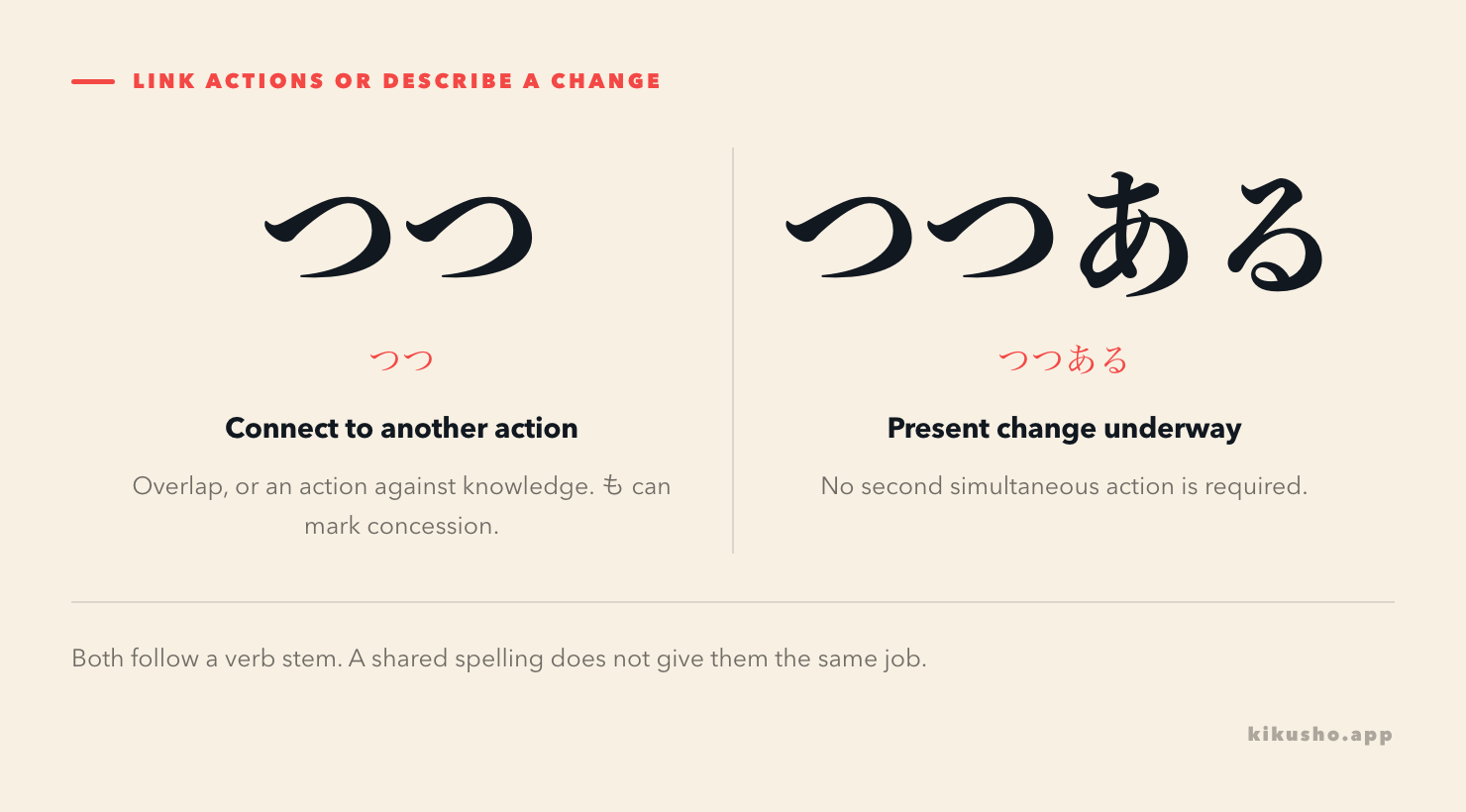
つつ links actions that overlap, or an action that conflicts with someone's knowledge or intention. つつある describes a change underway. Both attach to a verb's ます-stem; the shared spelling does not give them the same job.
The test is whether you are linking actions or describing change
This N2 grammar lesson covers つつ, including concessive つつも, and つつある. Ask what the sentence is doing after the stem: connecting it to another action, admitting a contradiction, or presenting a developing situation.
| Construction | Job | Example fragment | Translation |
|---|---|---|---|
| Stem + つつ | Overlapping actions | 読みつつ考える | Think while reading |
| Stem + つつ / つつも | Concession | 知りつつも印刷する | Print despite knowing |
| Stem + つつある | Ongoing change | 増えつつある | Be increasing |
The second row needs context: knowing what makes printing contradictory? You cannot decide from つつ alone. By contrast, 増えつつある can be the predicate of a complete sentence without another action alongside it. Nihongo no Sato's paired explanation distinguishes these three readings.
Both forms start with the ます-stem
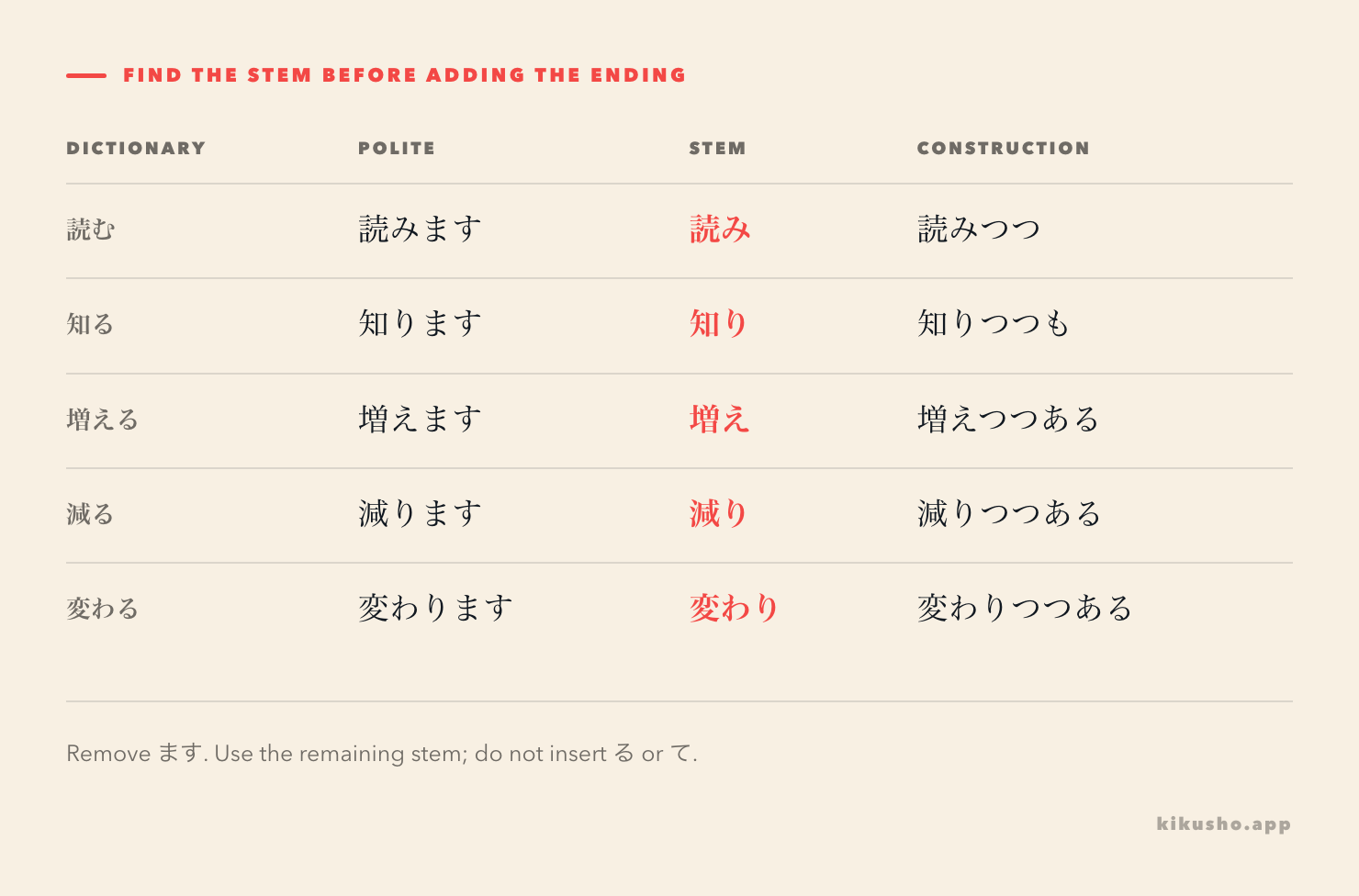
Take away ます from the polite verb form. Keep the remaining stem intact before either ending. This attachment is given in the JLPT Sensei つつ reference and its つつある reference.
| Dictionary form | Polite form | Stem | Constructed form |
|---|---|---|---|
| 読む(よむ), read | 読みます | 読み | 読みつつ |
| 知る(しる), know | 知ります | 知り | 知りつつも |
| 増える(ふえる), increase | 増えます | 増え | 増えつつある |
| 減る(へる), decrease | 減ります | 減り | 減りつつある |
| 変わる(かわる), change | 変わります | 変わり | 変わりつつある |
Forms such as 増えるつつある and 増えてつつある do not follow this pattern. The dictionary form and the て-form each leave material that the construction does not take.
The final ある also changes with tense or politeness: 変わりつつあります is polite, and 変わりつつあった looks back at a change then underway. Do not add ます inside the stem to make 変わりますつつある. The Bunpro explanation of つつある includes present and past uses; Sensei supplies the polite ending.
Simultaneous つつ keeps the actions with the same actor
資料を読みつつ、説明の順番を考えた。
しりょうを よみつつ、せつめいの じゅんばんを かんがえた。
“I thought about the order of the explanation while reading the materials.”
The person reading is also the person thinking. The English “I” is supplied from a possible context; Japanese leaves that actor unstated. Reading and planning overlap here, rather than one finishing before the other begins. Mainichi Nonbiri's simultaneous つつ lesson explicitly requires the clauses to share a subject.
You may recognise the structure from ながら and two actions. In this sentence, 資料を読みながら、説明の順番を考えた is also possible. つつ tends toward a more formal or written presentation. That register difference does not ban physical actions, and it does not mean つつ is forbidden in speech. Bunpro's つつ page discusses the tendency toward writing, alongside action examples.
Do not use this basic simultaneous pattern to make one person read while an unrelated person does the thinking. State the two actors in separate clauses using a construction that allows different subjects.
Concessive つつ admits knowledge that the action goes against
不要だと知りつつも、同じ資料を印刷してしまった。
ふようだと しりつつも、おなじ しりょうを いんさつしてしまった。
“I printed the same materials despite knowing it was unnecessary.”
Here 不要(ふよう) means unnecessary, and 印刷(いんさつ) means printing. Knowledge and action coexist, but the useful reading is “despite,” because the action conflicts with that knowledge. してしまった adds the sense of an action completed, regrettably in this context; the concession itself comes from 知りつつも.
知りつつ、同じ資料を印刷してしまった can retain the same concession. も is optional in this use. Japanese NET's つつ lesson teaches both simultaneous and concessive meanings, including concession without も. Bunpro's つつも lesson explains the conflict between the clauses.
A following action matters more than an English gloss memorised for the ending. Knowing a document is unnecessary but printing it anyway gives you a contradiction; reading it while planning an explanation gives you overlap. The related ながらも concession lesson explores another way to hold such conflicting facts together.
つつある puts a change in progress, without promising its speed
会員の数が増えつつある。
かいいんの かずが ふえつつある。
“The number of members is increasing.”
This is a fictional example of a trend, not a claim about any service's membership. One quantity is developing over time; there is no second activity for it to happen alongside. 数(かず) is the number or count, and 会員(かいいん) means a member of an organisation or service.
Gradual developments are a common setting, which explains translations such as “gradually becoming.” But 会員の数は急速に増えつつある can describe a rapid increase: 急速に(きゅうそくに) supplies “rapidly.” Nihongo no Sato includes an example combining つつある with rapid progress. Slow speed is not a requirement of the form.
Nor does it promise that the change will reach completion. 橋は完成しつつある means the bridge is approaching completion; 完成(かんせい) is completion. 橋は完成している describes it as completed. Mainichi Nonbiri's つつある explanation contrasts a developing change with a resulting state. A report can describe construction as nearing completion and later report that work stopped.
For a routine “I'm reading now,” 今、資料を読んでいます is the neutral choice. Do not mechanically replace every English “-ing” with つつある. The latter foregrounds a developing process and tends toward formal exposition; it is not the default ending for every current activity. Tae Kim's section on つつ distinguishes the ongoing-change pattern from the use linking two actions.
If a report gives you unfamiliar nouns such as 会員 or 完成, paste that passage into Kikusho's text capture and inspect the proposed cards. Check that the example and meaning express the passage's ongoing change before saving. The noun alone will not preserve the distinction between “nearing completion” and “completed.”
These N2 estimates do not include the alternating N1 pattern
Bunpro, Japanese NET, Nihongo no Sato and the consulted Sensei lessons place the uses taught here at N2. These are teaching estimates, not an official exhaustive JLPT syllabus.
Bunpro also lists つ~つ at N1. That is a different arrangement: a verb stem plus つ, followed by another verb stem plus つ, expressing alternation. Do not treat its N1 label as evidence that single つつ here was misclassified.
You need verb stems and basic clause reading for this page; ながら is a useful prerequisite comparison. For a neighbouring N2 question about the stance of a written claim, compare に過ぎない and にほかならない.
Practice questions
Attempt all six before reaching the solutions. Questions 3 and 4 require four fragments in order; choose the fragment that occupies ★, the third position.
Question 1
Choose the correctly formed predicate for “The number of members is increasing.”
会員の数が( )。
A. 増えるつつある
B. 増えつつある
C. 増えてつつある
D. 増えますつつある
Question 2
Choose the ending that conveys despite knowing it is unnecessary.
不要だと知り( )、印刷してしまった。
A. つつある
B. ている
C. ます
D. つつも
Question 3
資料を _ _ ★ _。
A. 順番を
B. 考えた
C. つつ
D. 読み
Question 4
会員の数は _ _ ★ _。
A. ある
B. 少しずつ
C. つつ
D. 増え
Question 5
Read the passage. Which account of the knowledge and action fits it?
同じ資料が棚にあると知りつつ、もう一部印刷してしまった。印刷する必要はなかった。
棚(たな): shelf; 一部(いちぶ): one copy here.
A. The person only discovered the existing materials after printing.
B. Knowing and printing are presented as separate steps with no conflict.
C. The person had no knowledge of the materials on the shelf.
D. The person printed while already knowing the same materials were available.
Question 6
Read this fictional project update. Which interpretation fits the two sentences?
改装工事は完成しつつある。しかし、入口の工事はまだ終わっていない。
改装工事(かいそうこうじ): renovation work; 入口(いりぐち): entrance.
A. All renovation work is already finished.
B. The renovation is nearing completion, with entrance work still unfinished.
C. Two workers are doing unrelated actions at the same time.
D. The renovation must be progressing very slowly.
For each composition, account for every supplied fragment once. For the passages, connect your choice to both sentences before consulting the explanations.
Answers and explanations
Answer 1. B. 増える → 増えます → 増え supplies the stem in 増えつつある. A uses the dictionary ending る; C inserts て; D retains ます. None of those three gives the required stem attachment.
Answer 2. D. 知りつつも supplies the requested concession: the printing goes against what the person knows. A would present knowing as a developing process, rather than directly mark that contradiction. B would require 知っている, not 知りている. C creates 知ります, which does not express the requested “despite.” 知りつつ without も could also work, but it was not offered as a competing option.
Answer 3. A. The order is 読み / つつ / 順番を / 考えた: 資料を読みつつ順番を考えた, “I thought about the order while reading the materials.” 順番を occupies the third slot. 読み must join つつ, and the object 順番を precedes 考えた. The other placements break those units.
Answer 4. C. Arrange 少しずつ / 増え / つつ / ある: 会員の数は少しずつ増えつつある, “The number of members is increasing little by little.” Third-position つつ connects the stem 増え to final ある. 少しずつ(すこしずつ) supplies the gradual pace in this particular sentence; the grammar ending alone does not require it.
Answer 5. D. 知りつつ keeps the knowledge present during the action. Printing another copy conflicts with knowing that the same materials are already available; the second sentence confirms the lack of need. The concessive reading remains without も. A moves the discovery after printing, B removes both the overlap and the conflict, and C denies the knowledge explicitly expressed by 知り. None preserves the passage's relationship between the clauses.
Answer 6. B. 完成しつつある presents completion as approaching. The unfinished entrance confirms that reading. A erases the ongoing stage; C imports the separate simultaneous-action use into つつある; D invents a speed requirement that the update does not state. There is also no promise here that the remaining work will finish by a particular date.
Common questions
How do つつ and つつある differ?
Verb stem plus つつ connects overlapping actions, or contrasts an action with knowledge or intention. Verb stem plus つつある describes a change underway. The second construction does not need a second simultaneous action.
Must つつある describe a slow change?
Gradual trends are common contexts, but slow speed is not compulsory. A sentence can combine 急速に with 増えつつある. The construction presents the increase as continuing; 急速に supplies its speed.
Is も required for the concessive meaning of つつ?
No. Both 知りつつ and 知りつつも can mean despite knowing when the following action runs against that knowledge. Adding も makes the contrast explicit, but the relationship between the clauses still matters.