On this page
もしも~たら presents a situation as a deliberate “what if,” while ~としたら asks you to accept a whole statement as a premise and reason from it. The two can even appear together: もしも一つだけ選ぶとしたら、どれにしますか, “If you had to choose just one, which would you choose?”
The difficult comparison is not simply “which word means if.” It is whether you are naming a condition or temporarily treating a proposition as true.
The same plan can be a condition or an assumed premise
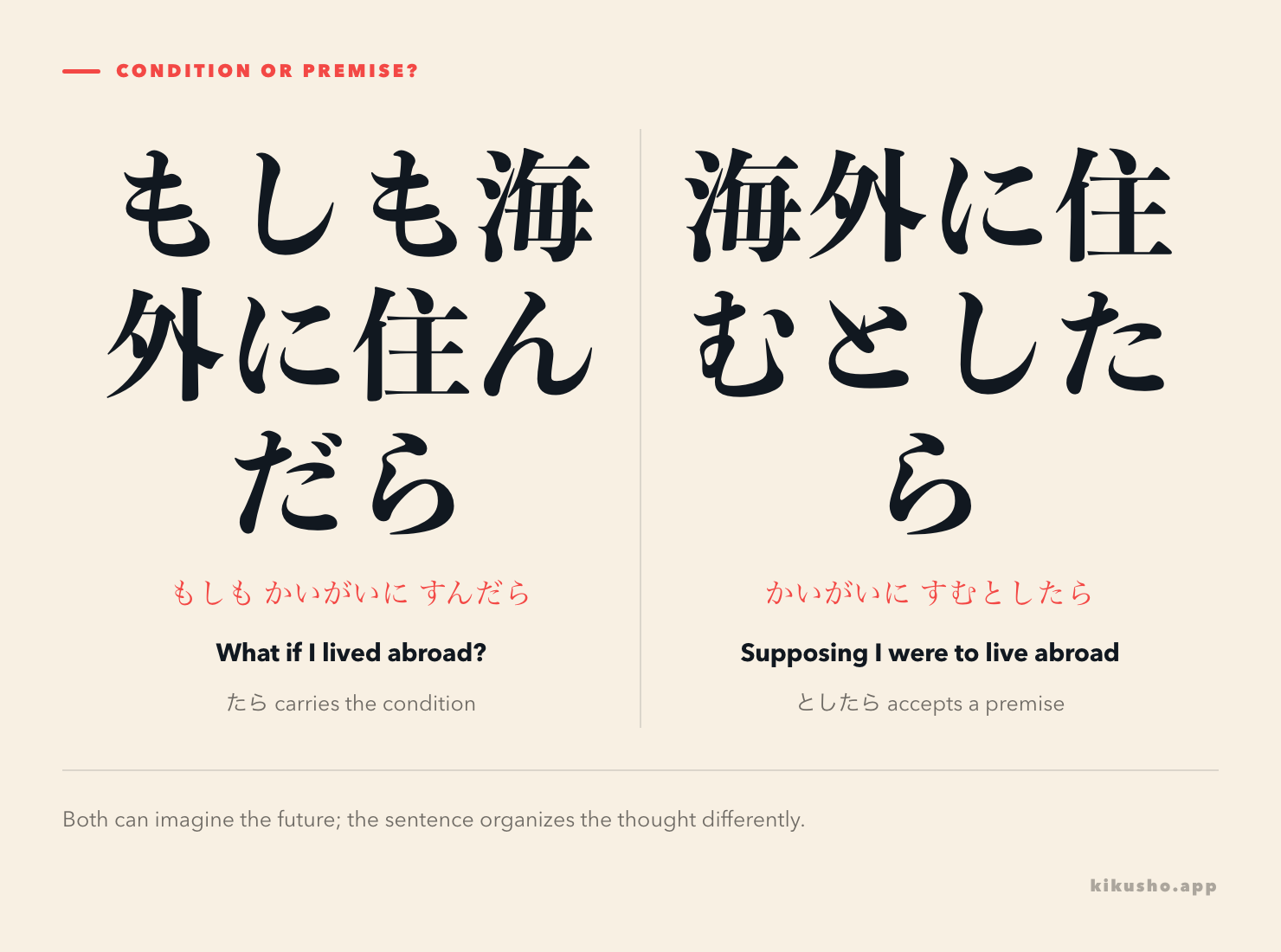
Compare two questions about living abroad.
もしも海外に住んだら、何をしたいですか。
もしも かいがいに すんだら、なにを したいですか。
If you lived abroad, what would you want to do?
海外に住むとしたら、どの国を選びますか。
かいがいに すむとしたら、どの くにを えらびますか。
Supposing you were to live abroad, which country would you choose?
The first opens a hypothetical condition with もしも and closes it with たら. The second quotes the complete idea 海外に住む, adds とする, then puts する into したら. That extra structure gives the speaker a premise to examine.
| Shape | What it foregrounds | Typical result |
|---|---|---|
| もしも A~たら、B | a clearly imagined condition | wish, request, plan, warning, result |
| A~としたら、B | accepting A as an assumption | personal choice, reaction, question |
| A~とすれば、B | reasoning from A | estimate, judgment, implication |
| A~とすると、B | treating A as the basis of a consequence | calculation, deduction, likely result |
These are tendencies, not four sealed boxes. The three とする variants overlap heavily. Their value lies in the stance they make easiest to hear.
もしも points to the hypothesis; たら carries the grammar
もしも is an adverb. It does not conjugate the word that follows. The conditional ending still comes from たら:
| Predicate | たら form | Example |
|---|---|---|
| verb 行く | 行ったら | もしも日本へ行ったら |
| negative verb 行かない | 行かなかったら | もしも日本へ行かなかったら |
| い-adjective 安い | 安かったら | もしももっと安かったら |
| な-adjective 静かだ | 静かだったら | もしも町が静かだったら |
| noun 休みだ | 休みだったら | もしも明日が休みだったら |
JLPT Sensei's もしも~たら page gives the N3 placement and the central “supposing” meaning. The conjugation itself is the ordinary たら pattern taught earlier in the と and たら comparison.
もしも時間があったら、島を一周したい。
もしも じかんが あったら、しまを いっしゅうしたい。
If I had time, I would like to travel around the island.
もしもあの電車に乗っていたら、事故に巻き込まれていたかもしれない。
もしも あの でんしゃに のっていたら、じこに まきこまれていたかもしれない。
If I had taken that train, I might have been caught in the accident.
The second sentence is counterfactual: the speaker did not take the train. The past-looking ていたら establishes that unreal earlier condition; もしも makes the hypothetical frame explicit.
毎日のんびり日本語教師's comparison of もし and もしも treats もしも as the more subjective, emphatic form and notes its ease with remote or counterfactual situations. That is a usage tendency. A realistic emergency instruction such as もしも地震が起きたら、机の下に入ってください is still natural.
としたら quotes a complete statement
The structure is easier to remember when you keep its parts visible:
plain statement + と + する + conditional ending
The particle と quotes the statement. する means “take it as such” here. Then したら, すれば, or すると tells us how the reasoning continues.
| Predicate type | Statement before と | Resulting form |
|---|---|---|
| verb 留学する | 留学する | 留学するとしたら |
| negative verb 来ない | 来ない | 来ないとすれば |
| い-adjective 高い | 高い | 高いとすると |
| な-adjective 必要だ | 必要だ | 必要だとしたら |
| noun 事実だ | 事実だ | 事実だとすれば |
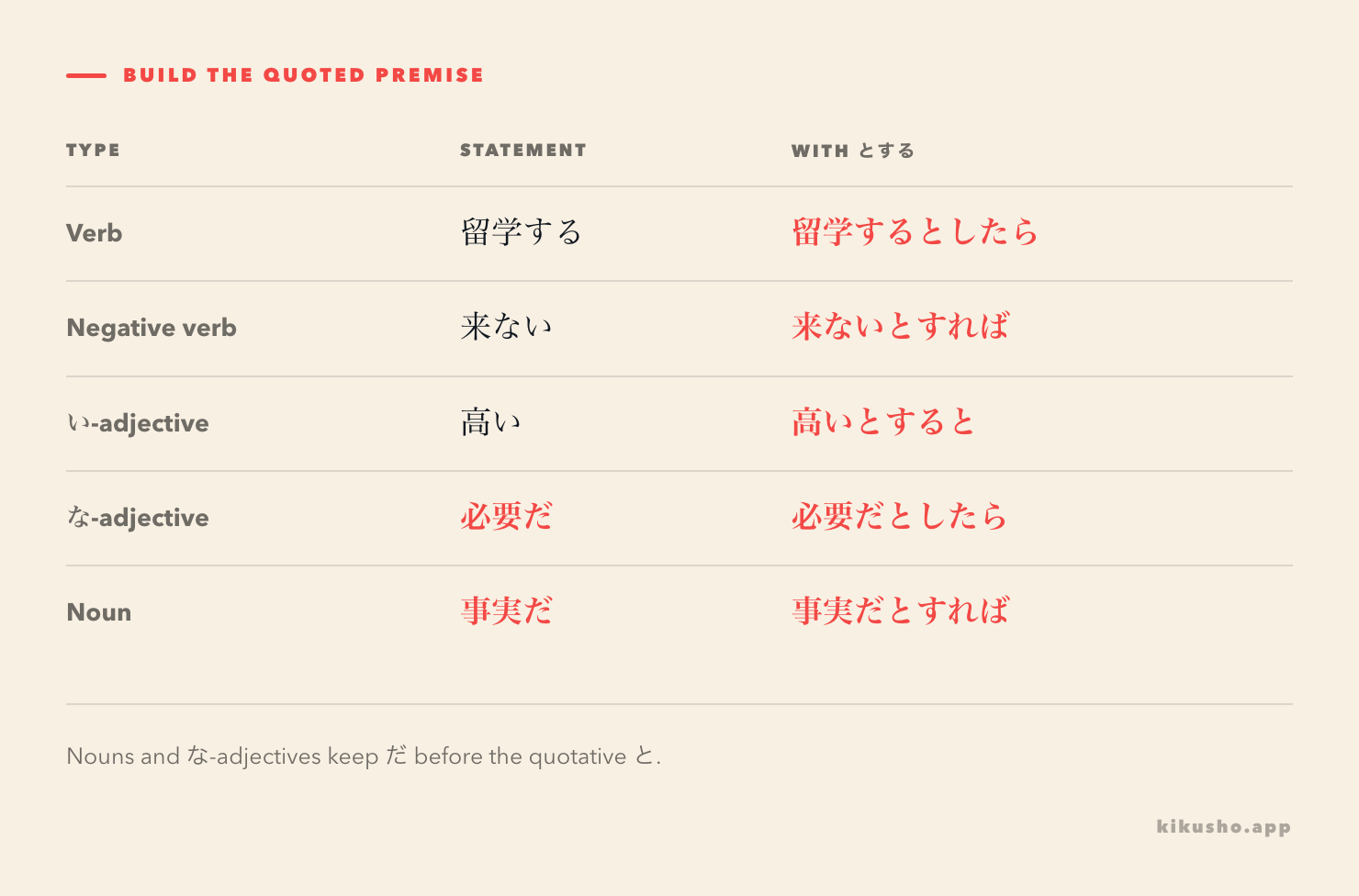
The common mistake is dropping だ after a noun or な-adjective. 彼が学生としたら can be read as “if we made him a student,” because 学生とする can mean “designate him as a student.” For the premise “if he is a student,” use 彼が学生だとしたら.
J-nihongo's N3 account gives the same attachment across verbs, both adjective classes and nouns. It defines the pattern as assuming something to be true and stating the judgment or inference derived from that premise.
Choose the ending by the kind of next thought
としたら: an imagined choice or personal response
としたら is especially comfortable in conversation, open questions and personal decisions.
一つだけ持って行くとしたら、この辞書を選びます。
ひとつだけ もっていくとしたら、この じしょを えらびます。
If I had to take only one thing, I would choose this dictionary.
彼の話が本当だとしたら、少し怖い。
かれの はなしが ほんとうだとしたら、すこし こわい。
If his story is true, that is a little frightening.
とすれば: a considered judgment
とすれば often sounds more analytical. The speaker accepts A and evaluates what follows.
徒歩で行くとすれば、四十分はかかるだろう。
とほで いくとすれば、よんじゅっぷんは かかるだろう。
Assuming we go on foot, it will probably take at least forty minutes.
締め切りが金曜日だとすれば、今日中に資料が必要だ。
しめきりが きんようびだとすれば、きょうじゅうに しりょうが ひつようだ。
If the deadline is Friday, we need the materials by the end of today.
とすると: the consequence that follows
とすると readily leads into a calculation, deduction or result presented as less dependent on the speaker's choice.
一日に十ページ読むとすると、読み終わるまで二週間かかる。
いちにちに じゅっページ よむとすると、よみおわるまで にしゅうかん かかる。
If we assume ten pages a day, it will take two weeks to finish.
彼が犯人だとすると、動機は何だろう。
かれが はんにんだとすると、どうきは なんだろう。
If he is the culprit, what could the motive be?
The Japanese-teacher comparison at Tanosuke describes としたら as the most conversational and hypothesis-friendly of the three, とすれば as conducive to judgment, and とすると as favorable to an objective consequence. It also cautions that many contexts allow substitution. Do not turn these preferences into mechanical bans.
One useful boundary remains: a freely chosen intention sits most easily after としたら. 日本へ行くとしたら、京都にも行きたい sounds natural. With とすると, the listener expects a consequence or deduction, so the same 行きたい ending feels poorly matched.
Plain たら moves the situation forward; としたら pauses to inspect it
The ordinary conditional can lead directly to what happens next:
駅に着いたら、電話してください。
When you arrive at the station, please call.
Nothing is being debated. Arrival is the condition for a later request.
The quoted-premise form steps back from the event:
駅まで歩くとしたら、何分かかりますか。
Supposing we walk to the station, how many minutes will it take?
Now “walking to the station” is one possible plan being evaluated. This is why replacing every としたら with たら loses more than form. A plain condition advances the timeline; an assumed premise invites comparison, judgment or deduction.
The distinction also separates もしも from もしかしたら. もしも announces a hypothetical condition. もしかしたら means “perhaps” and raises uncertainty about whether a proposition is true. The 一体, まさか and もしかしたら lesson develops that probability reading.
Save the whole inference in Kikusho rather than clipping the expression around とする. A card showing only とすると cannot preserve whether the speaker was calculating a duration, testing an alibi or imagining a different life. The second clause is the evidence for the choice.
The premise may be imaginary, uncertain or newly accepted
The pattern is not limited to fantasy. A speaker can reason from information that may already be true:
一時間待っても来ないのだとしたら、約束を忘れたのかもしれない。
いちじかん まっても こないのだとしたら、やくそくを わすれたのかもしれない。
If it is the case that they have not come even after an hour, they may have forgotten the appointment.
Here the waiting is real. The speaker accepts a reading of the evidence, 来ないのだ, and draws an uncertain inference. もしも is less suitable because the clause is not being introduced as a remote what-if.
Linguistic descriptions therefore divide とすれば/としたら/とすると into more than one use, including hypothetical and established-premise readings. The practical N3 test is simpler: identify the complete proposition before と, then ask what reasoning becomes possible once it is treated as true.
N3 is the curriculum placement, with an N2 disagreement
JLPT Sensei and J-nihongo teach these target forms at N3. Tanosuke places the three とする variants under N2. The JLPT publishes no exhaustive official grammar list, so Kikusho records that disagreement and retains N3 as the study placement supported by two independent teaching references.
The basic たら, ば, と and なら conditionals are prerequisites. This lesson credits only もしも~たら and とすれば/としたら/とすると. It does not claim that every sentence with もし or とする belongs to those two inventory units.
Practice: condition, premise and consequence
Attempt all seven questions before reading the answer section.
Question 1 — grammar choice. Complete the explicit what-if: __時間があったら、何を勉強したいですか。
A. もしも
B. もしかしたら
C. とすると
D. としたら
Question 2 — attachment. Choose the correct form for “If that story is true”: その話が__、計画を見直す必要がある。
A. 本当としたら
B. 本当だとしたら
C. 本当なとしたら
D. 本当だったとする
Question 3 — nuance. You are asking a friend which country they would personally choose in an imagined move abroad. Which opening is the best fit?
A. 海外に住むとしたら
B. 海外に住むとすると
C. 海外に住むと
D. 海外に住んだので
Question 4 — consequence. Choose the best ending for a neutral calculation: 一日に十ページ読む__、二週間で読み終わる。
A. もしも
B. とすると
C. たらどう
D. かもしれない
Question 5 — sentence composition. Arrange every chunk to say “If the deadline is Friday, we need the materials today”: 資料が必要だ/締め切りが金曜日だ/今日中に/とすれば
Question 6 — explain the contrast. What changes between もしも海外に住んだら and 海外に住むとしたら?
Question 7 — connected text. Choose the sequence that first opens an unlikely what-if, then reasons from a report as a premise.
__明日雪が降ったら、試合は中止です。天気予報が正しい__、今夜から準備が必要です。
I — もしも/とすれば
II — もしかしたら/たら
III — とすると/もしも
IV — としたら/もしかしたら
Answers and explanations
Answer 1. A. もしも. The sentence already contains the たら conditional 時間があったら. もしも announces that condition as an explicit what-if. もしかしたら means “perhaps,” while C and D cannot stand alone before this clause.
Answer 2. B. 本当だとしたら. 本当 is a な-adjective stem, so the quoted statement needs the copula: 本当だ. The pattern then adds としたら.
Answer 3. A. 海外に住むとしたら. A personal imagined choice and a conversational question favor としたら. B would lean toward a consequence or deduction, C states a regular or automatic relation, and D gives a reason.
Answer 4. B. とすると. The speaker sets a daily reading rate and states the calculated duration that follows. とすると is well suited to that consequence.
Answer 5. 締め切りが金曜日だとすれば、今日中に資料が必要だ。 The complete statement 締め切りが金曜日だ comes before the quotative と. とすれば then licenses the judgment in the second clause.
Answer 6. もしも海外に住んだら presents living abroad as the condition in a what-if. 海外に住むとしたら asks the listener to accept “living abroad” as a premise and reason about a choice, requirement or consequence from it. Both can describe an unreal future, but they organize the thought differently.
Answer 7. I, もしも/とすれば. The first sentence explicitly imagines tomorrow's snow. The second accepts the forecast as a premise and derives the need to prepare. The other sequences either express probability rather than a condition or do not fit the surrounding grammar.
OpenAI Codex reviewed this lesson for language and curriculum coverage; it has not received human Japanese review.
Common questions
What is the difference between もしも~たら and としたら?
もしも marks the following たら clause as an explicit what-if. としたら packages a complete statement as an assumption, then asks what choice, judgment or result follows if that premise is accepted.
What is the difference between としたら, とすれば, and とすると?
They overlap, but としたら is the most conversational and flexible for imagined choices. とすれば often supports a reasoned judgment. とすると often introduces an objective or natural consequence and resists a freely chosen intention in the result.
Do nouns need だ before としたら?
Yes. A noun or な-adjective normally forms a complete plain statement with だ before the quoted-premise pattern: 学生だとしたら and 静かだとすれば. Verbs and い-adjectives attach in their plain forms.
Can もしも be used with としたら?
Yes. もしも一つだけ選ぶとしたら is natural: もしも announces the what-if, while としたら tells the listener to accept “choosing one” as the premise.