On this page
うちに入らない means “does not count as” or “cannot really be regarded as.” The speaker places a case beside a category, judges its degree or substance insufficient, and denies it membership in that category.
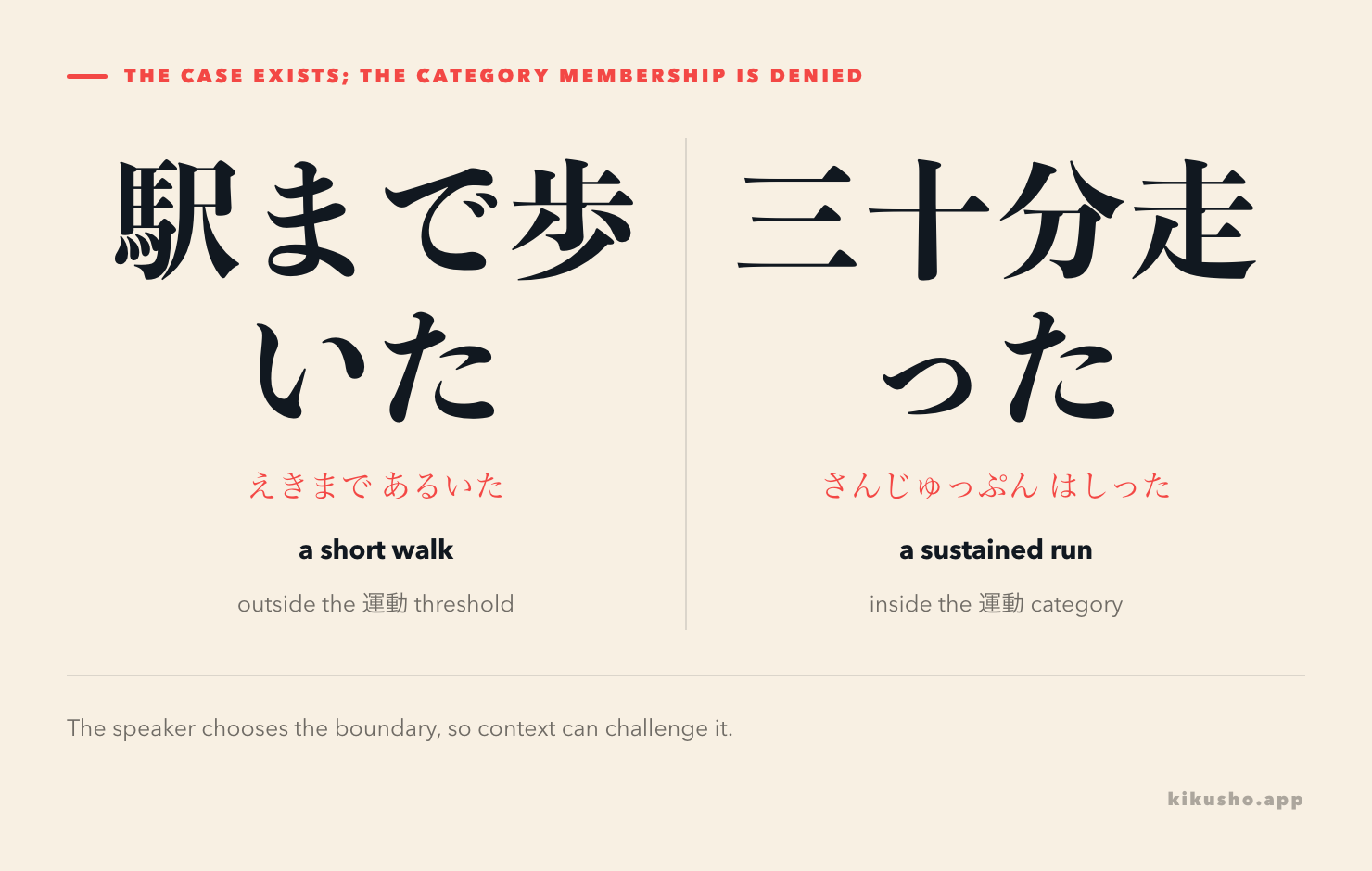
駅まで歩いたくらいでは、運動のうちに入らない。
えきまで あるいた くらいでは、うんどうの うちに はいらない。
Walking only as far as the station does not count as exercise.
The sentence does not deny that walking occurred. It denies that this amount of walking reaches the speaker’s standard for 運動.
This lesson verifies inventory item g-c225cdfc31a1, うちに入らない(うちにはいらない). JLPT Sensei places the construction at N1 and gives noun, verb and adjective attachments. 日本語教師のまる得 independently defines it as insufficient for inclusion in a range and notes the emphatic うちには入らない variant. 絵でわかる日本語 supports the paraphrase ~だとは言えない and its common conversational use.
The category threshold is the meaning
Here うち means a set, range or class. Imagine a boundary around all cases that qualify as 運動, 旅行, 失敗 or 苦労. The speaker puts the current case outside it.
インスタント食品を温めただけでは、料理のうちに入らない。
インスタントしょくひんを あたためただけでは、りょうりの うちに はいらない。
Merely heating instant food does not count as cooking.
一泊しただけでは、私には旅行のうちに入らない。
いっぱくしただけでは、わたしには りょこうの うちに はいらない。
For me, staying one night does not count as a trip.
この程度の間違いは失敗のうちに入らないよ。
この ていどの まちがいは しっぱいの うちに はいらないよ。
A mistake this small does not count as a failure.
The threshold comes from context or the speaker’s standard. One night may be a trip for another person; the grammar does not establish an objective definition of travel.
A category noun takes の
The most useful and transparent frame is:
case + は/では + category noun + のうちに入らない
| Category | Complete phrase | Reading |
|---|---|---|
| 運動 | 運動のうちに入らない | うんどうの うちに はいらない |
| 料理 | 料理のうちに入らない | りょうりの うちに はいらない |
| 旅行 | 旅行のうちに入らない | りょこうの うちに はいらない |
| 苦労 | 苦労のうちに入らない | くろうの うちに はいらない |
Because うち is a noun, another noun links to it with の. These are incorrect for the target meaning:
✕ 運動うちに入らない
✕ 運動なうちに入らない
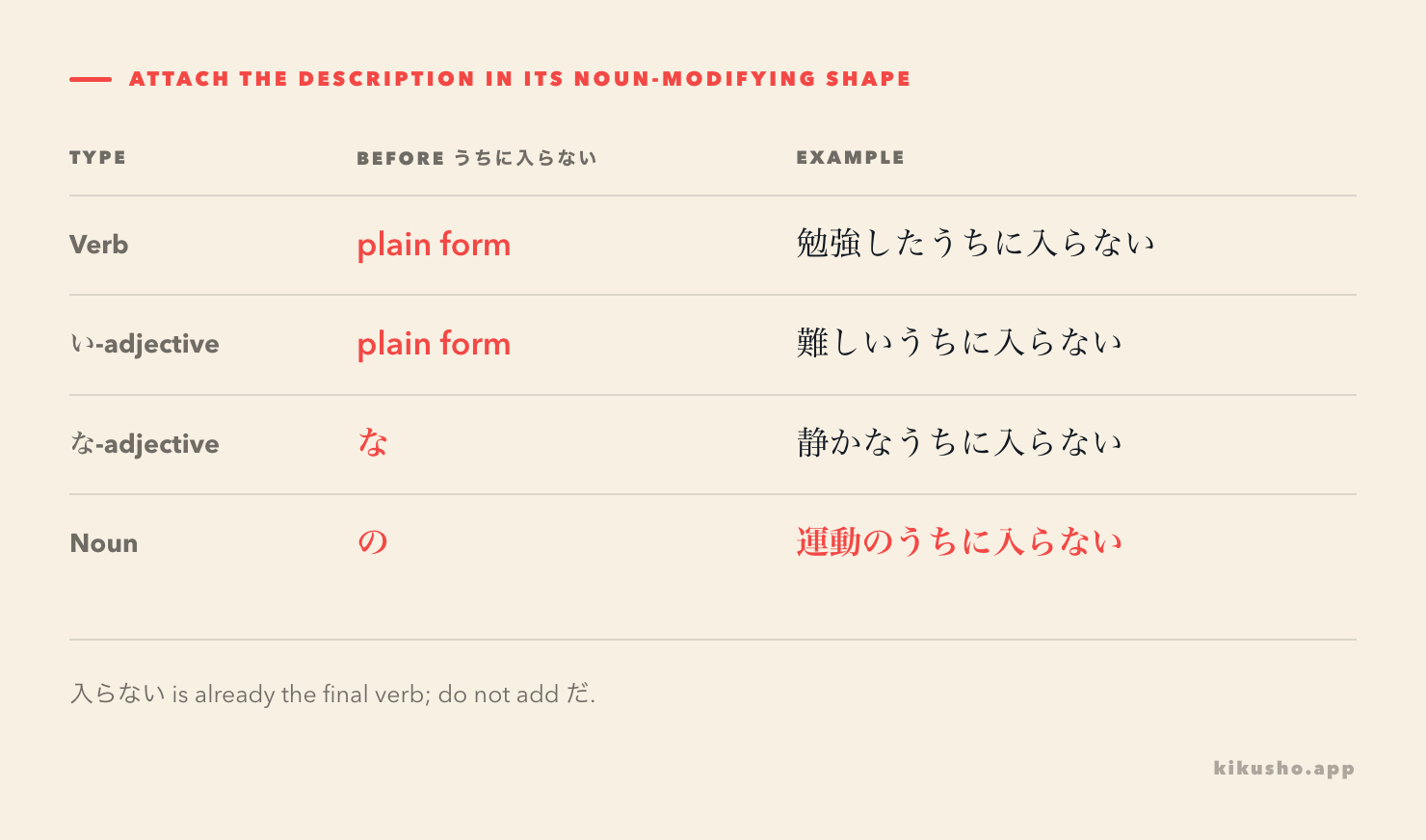
Use 運動のうちに入らない. The final 入らない is already a verb, so do not add a copula:
✕ 運動のうちに入らないだ
○ 運動のうちに入らない
Verbs and adjectives can name the rejected description
The construction also follows an informal predicate:
| Preceding type | Attachment | Example |
|---|---|---|
| verb | plain form + うちに入らない | 勉強したうちに入らない |
| い-adjective | plain form + うちに入らない | 難しいうちに入らない |
| な-adjective | な + うちに入らない | 静かなうちに入らない |
| noun | の + うちに入らない | 運動のうちに入らない |
10分読んだだけでは、勉強したうちに入らない。
じゅっぷん よんだだけでは、べんきょうした うちに はいらない。
Reading for only ten minutes does not count as having studied.
この問題は、まだ難しいうちに入らない。
この もんだいは、まだ むずかしい うちに はいらない。
This problem does not yet count as difficult.
駅前だから、この部屋は静かなうちに入らない。
えきまえだから、この へやは しずかな うちに はいらない。
Since it is by the station, this room does not count as quiet.
The predicate use evaluates whether an action or quality deserves its description. In production, a clear category noun often makes the logic easiest to hear: 勉強のうちに入らない, 難問のうちに入らない, 静かな場所のうちに入らない.
は makes the exclusion more contrastive
Both forms are possible:
これくらいは苦労のうちに入らない。
これくらいは くろうの うちに はいらない。
This much does not count as hardship.
これくらいは苦労のうちには入らない。
これくらいは くろうの うちには はいらない。
This much certainly does not fall into the category of hardship.
The inserted は marks the category boundary contrastively. It can suggest “it may be something, but it does not count as that.” The surrounding wording and voice decide how emphatic it sounds.
Do not confuse this には with a new attachment after the category noun. The structure is still 苦労のうち + に + は + 入らない. The category noun continues to require の.
うち is a conceptual set; 中 is a physical interior
The two readings share the verb 入る, but they answer different questions:
この箱は棚の中に入らない。
この はこは たなの なかに はいらない。
This box does not fit inside the shelf.
この程度の作業は仕事のうちに入らない。
この ていどの さぎょうは しごとの うちに はいらない。
Work at this level does not count as a job.
中に入らない locates an object relative to an interior. うちに入らない classifies an event, quality or thing relative to an abstract set. For a bag, room or container, use 中 when actual space is meant.
This target is also separate from temporal うちに:
暗くならないうちに帰ろう。
くらく ならない うちに かえろう。
Let’s go home before it gets dark.
Temporal うちに identifies a window during which something should happen. It has no 入らない and makes no category judgment.
ほどではない measures degree without naming a category
Sometimes a sentence only says that a degree does not reach a threshold:
熱はあるが、仕事を休むほどではない。
ねつは あるが、しごとを やすむ ほどでは ない。
I have a fever, but not enough to miss work.
The standard here is the action 仕事を休む, not membership in a category such as 病気. Forcing うちに入らない after 休む would change the structure and the intended test.
Compare:
この痛みは、仕事を休むほどではない。
This pain is not severe enough to miss work.
この程度の痛みは、重い症状のうちに入らない。
This level of pain does not count as a serious symptom.
The first measures degree against a consequence. The second names an abstract class and refuses membership. Similar sufficiency judgments appear in the に値する, に足る and に足らない lesson, but those forms evaluate worthiness or sufficiency for an action rather than category membership.
A grammatically correct sentence can dismiss someone
Calling something too small to count is an evaluation. That can reassure:
そんな小さなミスは失敗のうちに入らないよ。気にしないで。
そんな ちいさな ミスは しっぱいの うちに はいらないよ。きにしないで。
A small mistake like that does not count as failure. Don’t worry.
It can also belittle:
君の苦労なんて苦労のうちに入らない。
This tells the listener that their hardship fails the speaker’s standard. A polite ending such as 入りません does not remove that judgment. When discussing another person’s pain, labor or achievement, prefer a factual comparison or acknowledgment unless deliberate dismissal is intended.
Self-comparison is often safer:
彼女が経験したことに比べれば、私の苦労など苦労のうちに入らない。
かのじょが けいけんした ことに くらべれば、わたしの くろうなど くろうの うちに はいらない。
Compared with what she experienced, my hardship hardly counts as hardship.
The speaker lowers their own case rather than imposing a standard on the other person.
The reading is はいらない
Read 入らない here as はいらない, the negative of 入る(はいる). The kanji 入 also appears in 入る(いる) in limited compounds and expressions, but うちに入らない does not use that reading.
The entire phrase is:
うちに入らない
うちに はいらない
The pronunciation matters because the category image still rests on the ordinary verb “enter”: the case does not enter the set.
Practice: find the rejected category
Keep the answer panel closed until you have identified the category or threshold in all seven prompts.
Question 1 — noun attachment. Complete: 五分歩いただけでは、運動__うちに入らない。
① な
② の
③ で
④ を
Question 2 — category judgment. Which sentence means “Heating instant food does not count as cooking”?
① インスタント食品を温めたら、料理の中に入らない。
② インスタント食品を温めただけでは、料理のうちに入らない。
③ インスタント食品は料理を入れない。
④ インスタント食品を温めるうちに料理した。
Question 3 — physical interior. Choose the natural expression: この大きな箱は棚__入らない。
① のうちに
② のうちには
③ の中に
④ したうちに
Question 4 — contrastive は. What extra emphasis does 旅行のうちには入らない add compared with 旅行のうちに入らない?
Question 5 — degree or category. Choose the better form: 少し熱はあるが、仕事を休む__。
① うちに入らない
② の中に入らない
③ ほどではない
④ のうちにはいらないだ
Question 6 — social meaning. Why might あなたの苦労は苦労のうちに入りません sound insulting despite its polite ending?
Question 7 — sentence creation. Write one sentence with Nのうちに入らない. Name the case, the category and the reason it falls short.
Answers and explanations
Boundary 1
Use ② の: 五分歩いただけでは、運動のうちに入らない. 運動 is the category noun, and a noun attaches to うち with の.
Boundary 2
Use ②. The act of heating occurred, but だけでは presents it as insufficient for the category 料理. Option ① changes the category set to a physical interior by using 中.
Boundary 3
Use ③ の中に: この大きな箱は棚の中に入らない. The sentence concerns physical fit inside a shelf, not whether the box qualifies for an abstract category.
Boundary 4
The inserted は contrastively emphasizes this category boundary: whatever else the one-night stay may be, the speaker rejects calling it a trip. Context may make the rejection sound firmer.
Boundary 5
Use ③ ほどではない. The fever’s degree is measured against the consequence of missing work. No category noun is being proposed for membership.
Boundary 6
The content denies that the listener’s hardship qualifies as hardship at all. 入りません makes the verb polite but leaves the dismissive judgment intact, so the sentence can sound deliberately belittling.
Boundary 7
One model answer is 近所を一周しただけでは、ジョギングのうちに入らない: “Going once around the neighborhood does not count as jogging.” The short circuit is the case, ジョギング is the category, and だけでは signals why it falls below the speaker’s threshold.
The hidden standard is open to challenge
When someone says 旅行のうちに入らない, the grammar supplies a boundary but not its justification. “How many nights count?” and “according to whom?” remain negotiable. That makes the expression useful in arguments, teasing and self-assessment: it packages a standard as a category line, while the conversation can still dispute where that line belongs.
Review covered noun, verb and adjective attachment, optional contrastive は, the reading はいらない, abstract category membership, physical 中, temporal うちに, degree with ほどではない and the social effect of dismissing another person’s experience. Codex performed the language and practice audit; a human Japanese editor did not review this lesson.
Common questions
What does うちに入らない mean in Japanese?
It means that something does not qualify for a named category or falls below the threshold for being counted as that category.
How does うちに入らない attach to a noun?
Put の after the category noun: Nのうちに入らない, as in 運動のうちに入らない, “does not count as exercise.”
What is the difference between うちに入らない and 中に入らない?
うちに入らない denies category membership. 中に入らない describes something that does not go or fit inside a physical or spatial interior.
What does the は in うちには入らない do?
Contrastive は emphasizes that the case does not meet this particular category or standard, often making the rejection sound stronger.