On this page
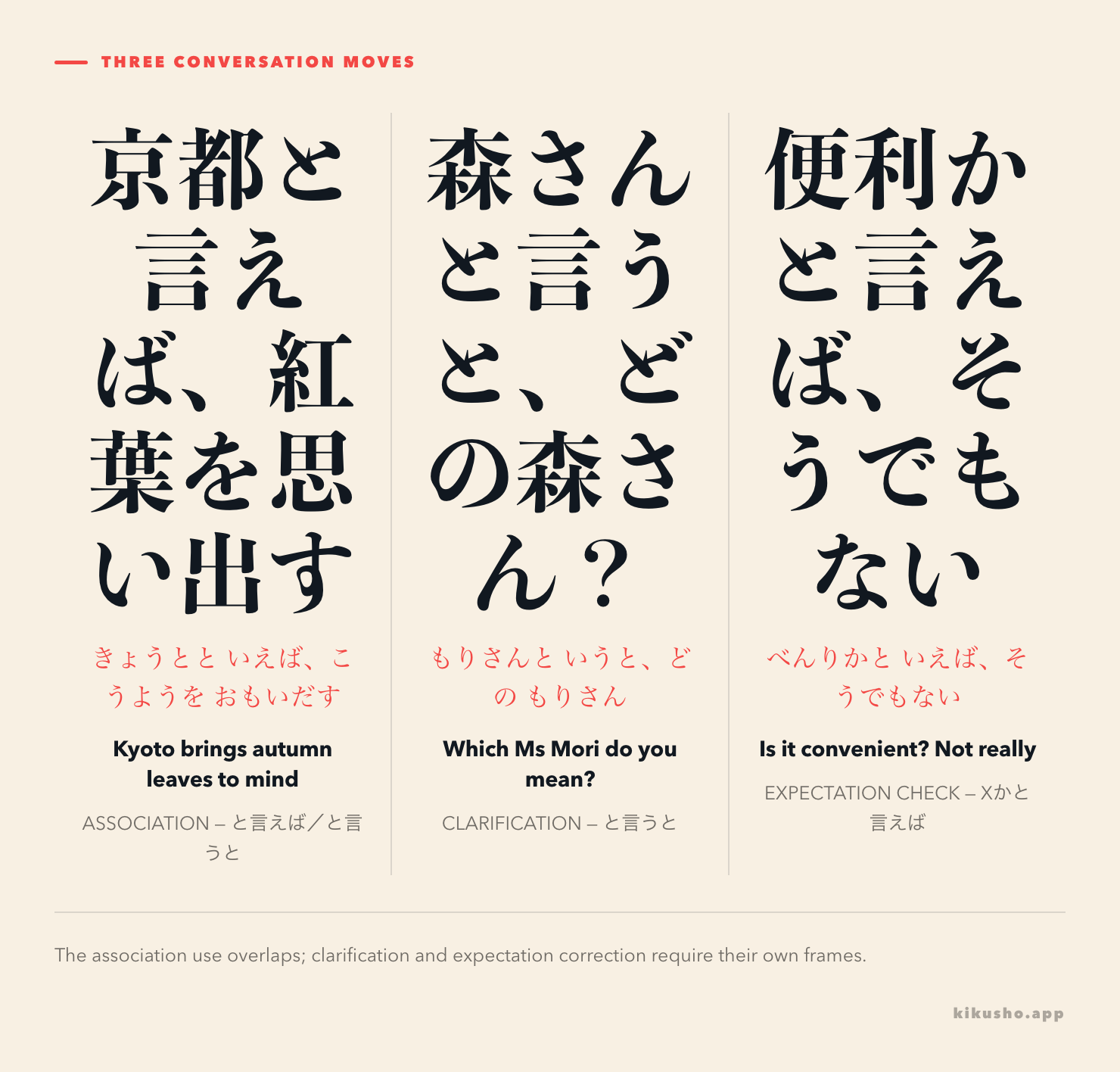
Use Nと言えば or Nと言うと to pick up a topic and say what it brings to mind. In that shared use, both can mean “speaking of N” or “when it comes to N,” but と言うと also has a useful clarification job: it can ask which particular person or thing the speaker means.
日本の春と言えば、桜を思い浮かべます。
にほんの はると いえば、さくらを おもいうかべます。
Speaking of spring in Japan, cherry blossoms come to mind.
森さんと言うと、デザイン会社の森さんですか。
もりさんと いうと、デザインがいしゃの もりさんですか。
By Ms Mori, do you mean the Ms Mori from the design company?
The first sentence offers an association. The second identifies a referent. That difference is more dependable than trying to assign one English translation to each form.
This lesson teaches inventory item g-4f5d729e5a3d, と言えば, and revisits g-6169d2370ae7, topic-association と言うと, from the earlier broad という lesson. JLPT Sensei and Bunpro place と言えば at N3; independently authored references also group と言うと with N3 material. These are study labels because the JLPT publishes no exhaustive grammar syllabus.
The shared pattern turns one noun into the next topic
The core attachment is short.
| Topic | With と言えば | With と言うと |
|---|---|---|
| 京都 | 京都と言えば | 京都と言うと |
| 夏の思い出 | 夏の思い出と言えば | 夏の思い出と言うと |
| 日本の山 | 日本の山と言えば | 日本の山と言うと |
The clause that follows gives an association, a representative example, a characteristic or a related fact.
京都と言えば、古い寺を思い浮かべる人が多いでしょう。
きょうとと いえば、ふるい てらを おもいうかべる ひとが おおいでしょう。
Speaking of Kyoto, many people probably picture old temples.
子どもの頃の夏休みと言うと、祖父の家で食べたスイカを思い出します。
こどもの ころの なつやすみと いうと、そふの いえで たべた スイカを おもいだします。
When I think of childhood summer holidays, I remember the watermelon I ate at my grandfather's house.
The topic does not have to be new. Often it has just appeared in the conversation, and the pattern uses it as a bridge to another fact. Bunpro describes both forms as standard-register ways to react to a previously mentioned topic. Hedgehog Japanese likewise treats と言えば, と言うと and と言ったら as overlapping in the association use.
Representative examples answer “what stands for this topic?”
These patterns often introduce the example that feels most typical or famous.
日本の山と言えば、富士山です。
にほんの やまと いえば、ふじさんです。
When it comes to Japanese mountains, Mount Fuji is the obvious example.
この町の祭りと言うと、秋祭りが一番有名です。
この まちの まつりと いうと、あきまつりが いちばん ゆうめいです。
When it comes to festivals in this town, the autumn festival is the most famous.
The first noun sets the domain; the following clause selects or describes a representative member. This is why questions such as イタリア料理と言えば、何を思い浮かべますか work: the speaker asks the listener to supply the association.
Do not mistake “representative” for “objectively unique.” 日本の春と言えば桜 reports a conventional association. Another speaker may answer 花粉 or 入学式. The construction presents the link as salient in this conversation; it does not prove that everyone shares it.
と言うと can check which referent the speaker means
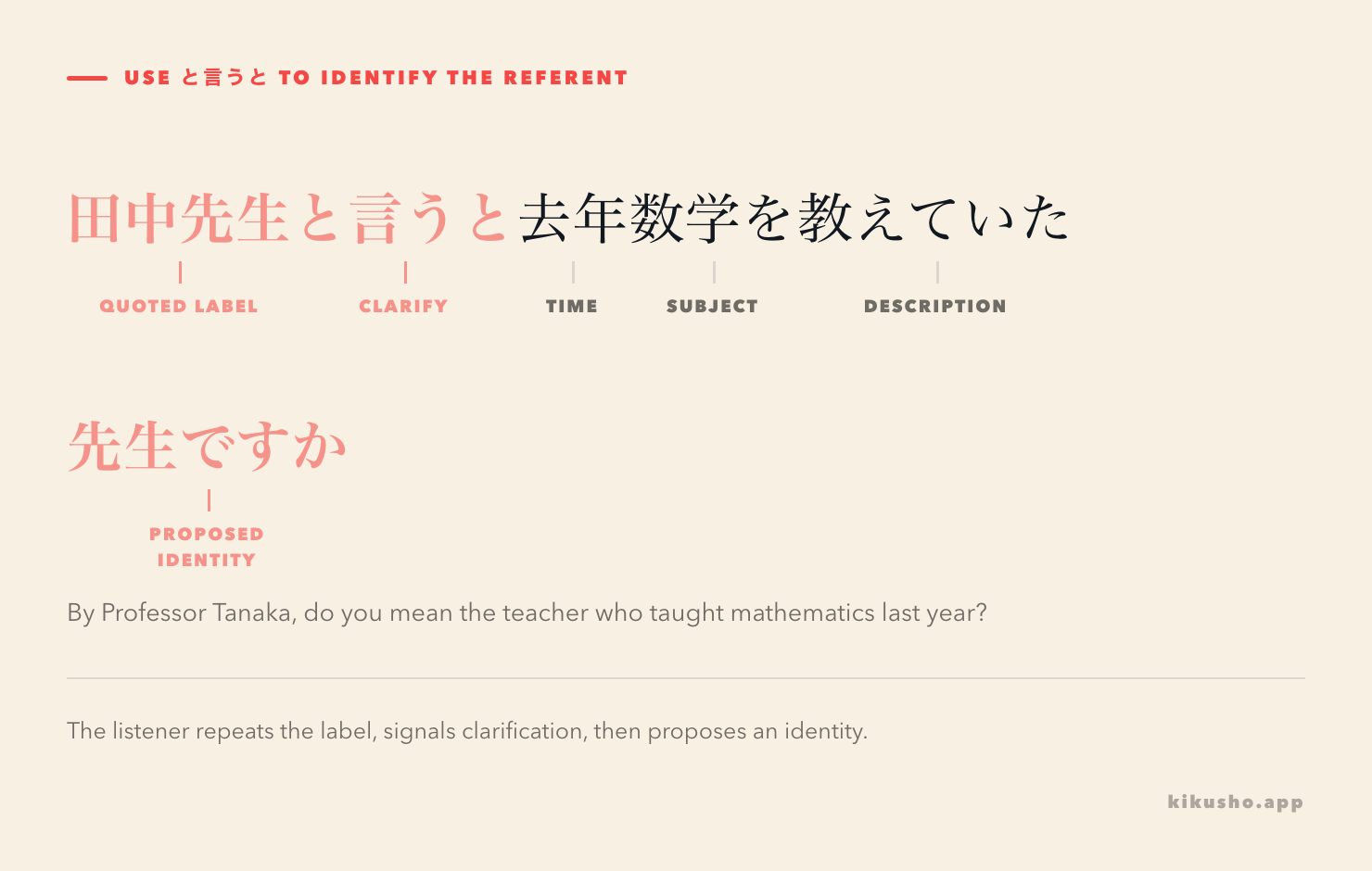
When a name or label could point to more than one thing, と言うと can ask for identification.
田中先生と言うと、去年数学を教えていた先生ですか。
たなかせんせいと いうと、きょねん すうがくを おしえていた せんせいですか。
By Professor Tanaka, do you mean the teacher who taught mathematics last year?
新しい駅と言うと、川の近くにできた駅のことですか。
あたらしい えきと いうと、かわの ちかくに できた えきの ことですか。
By the new station, do you mean the one built near the river?
MaruMori's N3 reference distinguishes this “by X, do you mean Y?” use from the shared association use. Here the speaker is not volunteering what the topic evokes. They are checking the identity behind another person's words.
Do not force と言えば into this neutral clarification question. 田中先生と言えば… normally sounds as though the speaker is about to add a memory, characteristic or related fact about Professor Tanaka. と言うと keeps open the question of which Tanaka is meant.
Xかと言えば reopens a claim instead of changing the subject
と言えば also appears after an embedded question with か. The speaker asks, in effect, “If you ask whether X is true…” and then gives a qualified answer.
この町は便利かと言えば、そうでもない。
この まちは べんりかと いえば、そうでもない。
If you ask whether this town is convenient, not really.
毎日忙しいかと言えば、必ずしもそうではない。
まいにち いそがしいかと いえば、かならずしも そうではない。
If you ask whether I am busy every day, that is not necessarily so.
The clause before か is a complete plain-form question: 便利だ → 便利か, 忙しい → 忙しいか, 行く → 行くか. A noun predicate also uses か directly: 専門家かと言えば、そうではない.
This frame often answers with そうでもない, 必ずしもそうではない, or a more limited description. It does not simply mean “speaking of convenience.” J-nihongo's N3 account separates the noun-association use from the 文(普通形)+ といえば frame that reconsiders an evaluation.
Similar strings perform different conversation moves
The verb 言う appears in several N3 expressions. The material after it decides the move.
| Form | Conversation move | Example opening |
|---|---|---|
| Nと言えば/Nと言うと | pick up a topic | 夏と言えば… |
| Nと言うと…ですか | clarify a referent | 森さんと言うと… |
| Xかと言えば | reconsider whether X applies | 便利かと言えば… |
| Xと言っても | accept X, then limit the expectation | 旅行と言っても… |
| Xということは | infer a consequence from X | 店が閉まっている。ということは… |
| そう言えば | recall something prompted by the moment | そう言えば、明日は休みだ |
旅行と言えば、京都を思い出す moves from “travel” to an association. 旅行と言っても、日帰りです corrects the grand expectation created by “travel”: it was only a day trip. The といっても and というより lesson shows when that correction keeps the first label and when a better label replaces it. The reporting-views lesson also separates と言っても from the longer assessment form と言ってもいい.
ということは works from evidence toward a conclusion. If the lights are off and the door is locked, ということは、もう閉店したんですね means “That means it has already closed.” と言えば does not perform that inference.
Preserve the trigger and the association together
A lone card reading と言えば = speaking of hides what the construction connects. In Kikusho, keep the entire bridge: 秋と言えば、何を思い浮かべますか or 森さんと言うと、どの森さんですか. The topic on the left and the response on the right make the grammar recoverable during review.
For a photographed sentence, highlight the noun together with と言えば when the boundary is unclear. Kikusho can draft the reading and explanation, and you can correct the editable card before saving it. The review then tests the connection you met in context rather than an English label shared by several patterns.
Practice: follow the conversation move
Write all six responses before continuing to the explanations.
Question 1 — choose the form. A friend mentions Kyoto, and you add a related memory. Complete 京都__、去年見た紅葉を思い出します.
- A. と言えば
- B. と言っても
- C. ということは
- D. かと言えば
Question 2 — referent check. Complete the neutral clarification: 佐藤さん__、受付にいる佐藤さんですか.
- A. と言っても
- B. と言えば
- C. と言うと
- D. ということは
Question 3 — build the sentence. Order the chunks to say “Speaking of Japanese winter, hot pot comes to mind.”
鍋を思い浮かべます/日本の冬/と言えば
Question 4 — two conversation moves. State what each opening does in its conversation.
- 旅行と言えば、京都を思い出します。
- 旅行と言っても、日帰りでした。
Question 5 — dialogue. Select the combination that makes both turns coherent.
A:森さんが来ました。
B:森さん( )、研究室の森さんですか。
A:はい。その森さん( )、来月から大阪で働くらしいですよ。
- A. と言うと/と言えば
- B. と言えば/と言っても
- C. ということは/と言うと
- D. かと言えば/ということは
Question 6 — expectation check. Complete この仕事は簡単__、決してそうではありません.
- と言うと
- と言っても
- かと言えば
- ということは
Answers and explanations
Answer 1. A, と言えば. Kyoto is already available as a topic, and the speaker adds an associated memory. と言っても would require a correction to the expectations created by the label, while ということは would draw a conclusion.
Answer 2. C, と言うと. The speaker asks which Sato the name identifies. と言えば would more naturally lead to a characteristic, memory or related fact rather than a neutral referent check.
Answer 3. 日本の冬と言えば、鍋を思い浮かべます。 The noun phrase 日本の冬 supplies the topic, と言えば picks it up, and the following clause states the association.
Answer 4. Sentence 1 uses “travel” as a bridge to the associated topic Kyoto. Sentence 2 grants the label “travel” but narrows the picture it may create: the trip lasted only one day. The first expands the conversation; the second corrects an expectation.
Answer 5. A, と言うと/と言えば. B first clarifies which Mori A means. Once that identity is shared, A uses the same person as a bridge to related news about working in Osaka.
Answer 6. 3, かと言えば. 簡単か embeds the question “Is this work easy?” and the following clause rejects that assessment. 決してそうではありません supplies the strong qualified answer expected by this frame.
A topic bridge can reveal what the speaker considers typical
When someone says 日本の春と言えば桜, the grammar is simple but the choice of 桜 is informative. Another speaker might choose graduation, pollen or a first day at school. These forms expose the path from a shared word to one person's memory or one community's conventional example. Learning the pattern therefore means listening to the association, not only recognizing the connector.
OpenAI Codex performed the language and exercise check for this saved version. It compared the Japanese forms, readings, translations, boundaries and six solutions with the sources linked above. A person did not review this lesson.
Common questions
What does と言えば mean in Japanese?
After a noun, と言えば picks up that topic and introduces a representative example, association or related fact: 日本の春と言えば、桜です means “Speaking of spring in Japan, it is cherry blossoms.”
What is the difference between と言えば and と言うと?
They overlap when stating what a topic brings to mind. と言うと can also ask which specific person or thing a name refers to, while と言えば is natural in the frame Xかと言えば to reconsider whether a description really applies.
Can と言えば and と言うと follow a noun?
Yes. Noun plus と言えば or と言うと is the central association pattern. The clause after it supplies the example, memory, characteristic or related fact.
Is と言えば the same as と言っても?
No. と言えば brings a topic to the foreground. と言っても accepts a label and then limits the expectation it creates, as in 旅行と言っても、日帰りです.