On this page
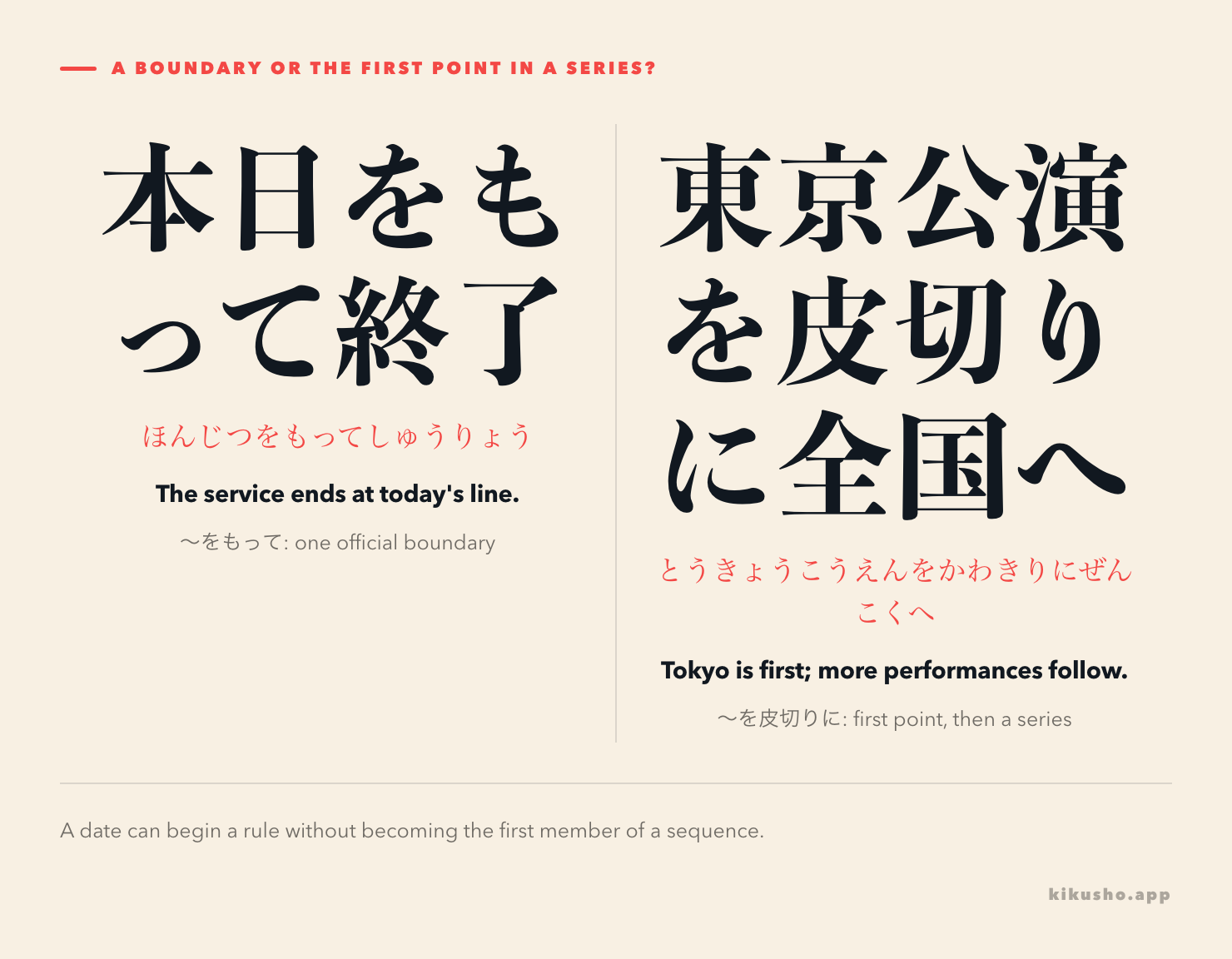
~をもって marks a formal boundary: 本日をもって受付を終了します sets today as the cutoff for applications. ~を皮切りに marks the first member of a continuing series: 東京公演を皮切りに全国を回ります makes the Tokyo performance the beginning of a national tour.
Both may be translated with “starting” or “as of,” but they answer different questions. をもって asks where the official line falls. を皮切りに asks which event comes first before more events follow.
Put a line after をもって and an arrow after を皮切りに
| Form | Attachment | Core job | What must the rest of the sentence supply? |
|---|---|---|---|
| N + をもって | a date, time, period, event, これ or 以上 | fix an official boundary | what ends or becomes effective there |
| N + をもちまして | the same nouns | state that boundary more politely | a formal announcement or conclusion |
| N + を皮切りに(して) | the first event, place or person | select the first member of a series | later members, spread or continued development |
| N + を皮切りとして | the same starting member | written variant of the series pattern | what follows from that first point |
| Vた + の + を皮切りに | a whole event nominalised with の | treat that event as the first development | further related developments |
The を belongs to each construction. Do not add another particle between the noun and the pattern: 三月末をもって, not 三月末にをもって; 大阪公演を皮切りに, not 大阪公演からを皮切りに.
The JLPT publishes no exhaustive official grammar syllabus. Kikusho's September 2026 reference inventory places both constructions at N1, and Bunpro also labels each N1. A current Benri Japan lesson instead places を皮切りに at N2. Those labels are study estimates, not proof of an official boundary between levels; this article retains the curriculum's N1 placement and records the disagreement.
~をもって fixes the cutoff in an official statement
The boundary use of をもって follows a time expression or an event that can function as a clear dividing point:
当サービスは三月三十一日をもって終了いたします。
とうサービスは さんがつさんじゅういちにちをもって しゅうりょういたします。
This service will end as of March 31.
The service exists before the named date and does not continue beyond the announced boundary. The form sounds at home in company notices, administrative messages, speeches and news reports. In an ordinary conversation, 三月三十一日に終わります conveys the date without the institutional tone.
MLC Japanese Language School describes this use as formal and businesslike, usually marking an ending or deadline. It also notes that a beginning is possible but less common. That exception matters:
新制度は四月一日をもって施行されます。
しんせいどは しがつついたちをもって しこうされます。
The new system will take effect on April 1.
Here April 1 is still a line: the new system applies on one side of it. The sentence does not promise a second system, a third system or geographic expansion. English “effective from” can sound like an opening, but the Japanese construction still organises the statement around a boundary.
The polite variant をもちまして does not move that line:
以上をもちまして、本日の説明会を終了いたします。
いじょうをもちまして、ほんじつのせつめいかいをしゅうりょういたします。
With that, we conclude today's information session.
これ and 以上 can stand for the point reached in a speech or programme. をもちまして raises the service tone; it is not the past form 持ちました, “held” or “had.”
The same spelling has a separate “by means of” use
をもって also has a formal means or manner sense: 誠意をもって対応する, “respond with sincerity.” JLPT Sensei lists the means use separately from the time-boundary use.
The noun tells you which reading of the grammar is likely:
- 本日をもって終了する: 本日 is a time boundary.
- 以上をもって閉会する: 以上 is the point reached in the proceedings.
- 責任をもって対応する: 責任 is the manner or stance brought to the response.
This lesson tests the boundary construction assigned by the curriculum. Recognising the means use prevents a learner from translating every をもって as “as of.”
~を皮切りに needs more than one event
皮切り(かわきり) means the beginning or outset. The grammar chooses one event as the first point from which related events continue, multiply or spread.
大阪での講演を皮切りに、全国八都市でセミナーを開く。
おおさかでのこうえんをかわきりに、ぜんこくはちとしでセミナーをひらく。
Starting with the lecture in Osaka, seminars will be held in eight cities nationwide.
Osaka is one member of the tour, and seven other cities follow. Remove that continuation and 大阪で講演を皮切りにした does not simply become a fancy way to say “The lecture began in Osaka.” The construction sets up a series, so the reader expects the sentence or surrounding text to reveal it.
Bunpro explains the pattern as a starting point followed by expansion or continuation, while Nihon no Kotoba to Bunka describes events developing one after another. Neither description requires the series to be a tour. Releases, resignations, branches, performances and a run of media appearances can all form the sequence.
The starting point may be a whole event:
最初の記事が注目されたのを皮切りに、取材の依頼が相次いだ。
さいしょのきじがちゅうもくされたのをかわきりに、しゅざいのいらいがあいついだ。
Beginning with the first article attracting attention, interview requests followed one after another.
注目された is a clause. の turns it into an event that を can mark. The past form belongs inside the nominalised event: Vた + の + を皮切りに. Do not attach the construction directly to a finite verb as 注目されたを皮切りに.
A boundary may start a rule without becoming the first member of a series
The difficult cases use a date and an English translation with start:
四月一日をもって新料金を適用します。
New rates take effect on April 1.
四月の東京店を皮切りに、各地で新店舗を開業します。
Starting with the Tokyo shop in April, new shops will open in different regions.
The first statement draws one legal or administrative line between the old rate and the new rate. The second makes the Tokyo shop the first unit in an expansion. A beginning on the calendar is not automatically a series.
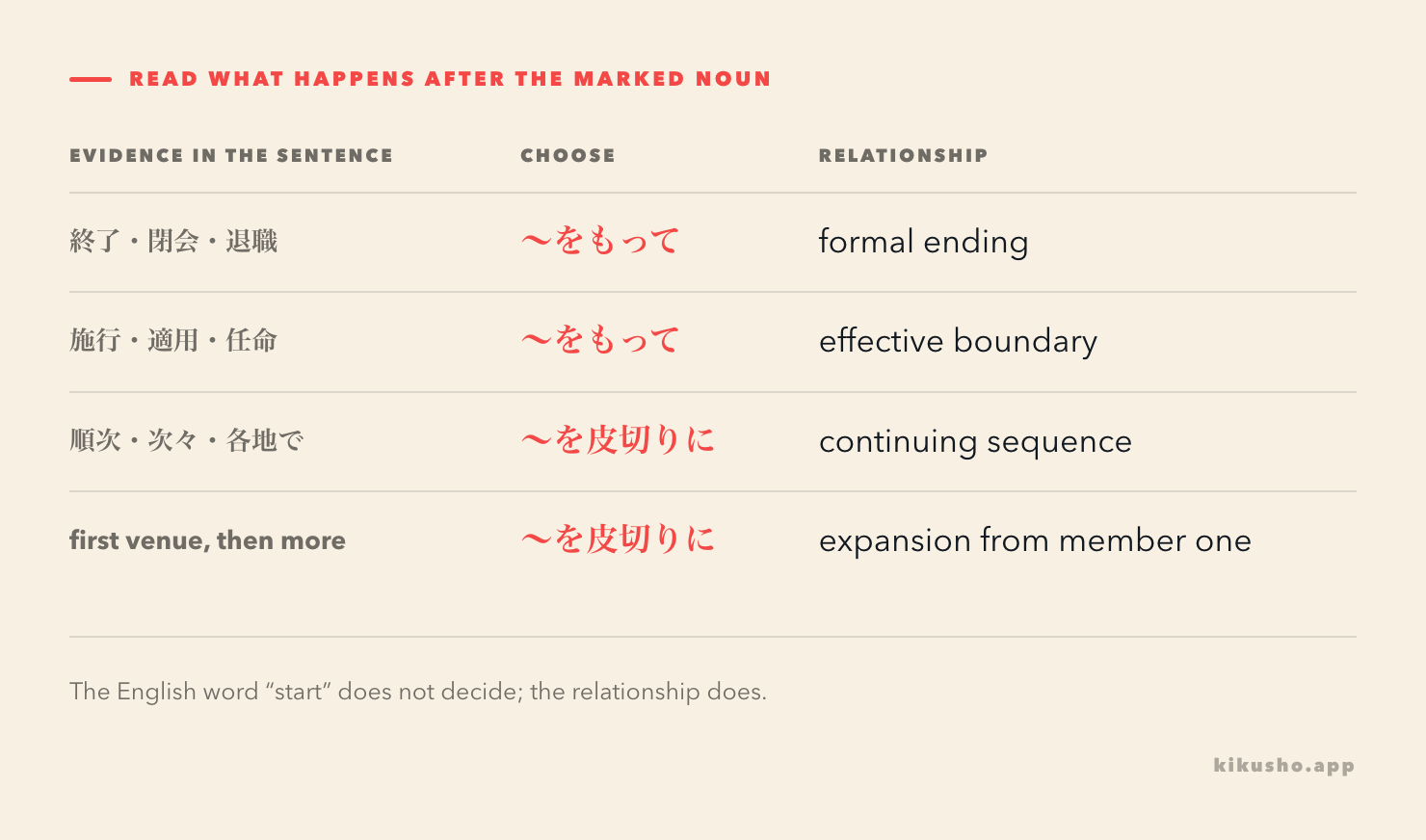
Use these questions in order:
- Is the noun a date, time, period or point in proceedings?
- Does the predicate end something, make something effective, appoint someone or declare a change at that point?
- If not, is the noun the first member of several related events?
- Does the following clause show continuation, expansion, repeated action or successive members?
Questions 1 and 2 lead toward をもって. Questions 3 and 4 lead toward を皮切りに. A sentence that supplies neither relationship may need an ordinary particle such as に, から or で instead.
The earlier lesson on から and まで marks ordinary starts and endpoints in schedules and routes. The にあたって and に際して lesson instead locates preparation or action around a significant occasion. Those constructions can share a date with をもって, but they do not make the same formal cutoff claim.
Register follows the communicative job
Both target forms occur readily in written reports, notices and prepared speech. Their formality comes from the work they perform: one declares an institutional line, and the other summarises a development across multiple events.
That does not mean every sentence containing them must use the most elaborate honorific predicate. 全国ツアーは東京公演を皮切りに始まる is a concise report. 本日をもちまして営業を終了させていただきます layers a polite boundary form with service-language phrasing. Choose the predicate for the speaker and setting; do not treat をもちまして as a command to inflate every other word.
When capturing an announcement in Kikusho, keep the predicate after the form. 三月末をもって alone cannot tell you whether a contract ends, a person retires or a policy takes effect. For を皮切りに, preserve at least one later member of the series. The context is what turns a translated “start” into the right relationship.
Practice
Answer all seven questions before reading the explanations.
Question 1
A company notice says that customer support will end on September 30. Choose the natural form:
お客様相談窓口は九月三十日( )終了いたします。
A. を皮切りに
B. をもって
C. にかかわらず
D. を問わず
Question 2
A band begins in Fukuoka and will then perform in six more cities. Choose the natural form:
福岡公演( )、全国七都市を回る。
A. をもって
B. に際して
C. を皮切りに
D. まで
Question 3
Build a formal closing sentence from all four pieces:
本日の式典を / 以上 / 終了いたします / をもちまして
Question 4
Read the two notices:
A:本契約は十二月末をもって終了します。
B:京都店を皮切りに、来年は五店舗を順次開業します。
Which description is accurate?
A. A begins a series of contracts; B closes the Kyoto shop.
B. Both forms merely replace から.
C. A fixes a contract boundary; B names the first shop in an expansion.
D. Both sentences describe preparation before an occasion.
Question 5
Complete the nominalised-event pattern:
最初の研究成果が海外で報道された( )を皮切りに、問い合わせが相次いだ。
A. の
B. ことに
C. ので
D. ものの
Question 6
Which sentence uses をもって in its separate means or manner sense?
A. 今月末をもって会員サービスを終了します。
B. 以上をもちまして会議を閉会します。
C. 責任をもって対応します。
D. 大阪公演を皮切りに全国を回ります。
Question 7
Read the report:
市は十月一日をもって新制度を施行する。まず中央区での説明会を皮切りに、各区で順次説明会を開く予定だ。
Which statement is supported?
A. The new system is one of several systems launched in sequence.
B. October 1 is the formal effective boundary, and the Chuo event begins a series of briefings.
C. Every briefing must finish on October 1.
D. The Chuo event is the point at which the old system ends.
Answers and explanations
Answer 1
B. をもって. September 30 is the formal cutoff for the service, and 終了いたします names what ends there. を皮切りに would require later related events in a series. The other two choices express “regardless of” and do not mark a boundary.
Answer 2
C. を皮切りに. Fukuoka is the first performance in a seven-city tour. The following phrase supplies the continuing series. をもって could mark an official cutoff or effective point, but it would not make Fukuoka the first member of the tour.
Answer 3
以上をもちまして、本日の式典を終了いたします。 以上 names the point reached in the programme, をもちまして states the boundary politely, and the object 本日の式典を remains attached to 終了いたします. をもちまして is one unit; it is not divided around the ceremony noun.
Answer 4
C. In A, December's end divides the active contract from the period after termination. In B, the Kyoto shop is the first of five shops opening in sequence. English may use “as of” or “starting with,” but the Japanese relationships differ.
Answer 5
A. の. The clause 最初の研究成果が海外で報道された describes a complete event. の nominalises that event so を can mark it as the first development. ので introduces a reason, ものの a concession, and ことに belongs to other constructions.
Answer 6
C. 責任をもって対応します means “We will respond responsibly” or “with responsibility.” 責任 is the stance or manner, not a date. A and B use the formal boundary sense; D uses the separate を皮切りに series pattern.
Answer 7
B. The city makes the system effective on October 1 with をもって. It then names the Chuo briefing as the first in a sequence across the wards with を皮切りに and 順次. The two forms organise different parts of the plan, so neither marked point automatically inherits the other's function.
Common questions
What is the main difference between ~をもって and ~を皮切りに?
~をもって marks a formal time or event boundary, usually where something ends. ~を皮切りに names the first event or member of a series that then continues or expands. The latter therefore requires a sequence beyond its starting point.
Is ~をもちまして different from ~をもって?
It expresses the same boundary in a more polite form and is common in announcements and service language. 本日をもちまして受付を終了します marks today as the cutoff for accepting applications.
Can ~をもって ever mark a beginning?
Yes. An appointment or rule can become effective on a stated date. However, the construction still fixes an official boundary; it does not imply that similar events will follow. That continuing-series meaning belongs to ~を皮切りに.