On this page
In Japanese, 暗示 is what a message hints at, 意図 is what a person aims to do, and 趣旨 is the purpose or main point they can state. 建前 and 本音 then let you distinguish a public position from a privately held view.
Five words for five layers of a message
These nouns answer different questions. What does the evidence suggest? What did the speaker intend? What is the stated purpose? What position is maintained publicly? What does the person really feel? Keeping the questions separate prevents a translation such as “meaning” or “intention” from flattening the whole set.
All five are N1 in the study inventories used by this curriculum, with no level disagreement in those inventories. Two of the lists descend from the same Waller source family, so they do not count as independent confirmation. The JLPT does not publish an exhaustive official vocabulary list; N1 here is a study placement, not a promise that a word will appear on a particular test.
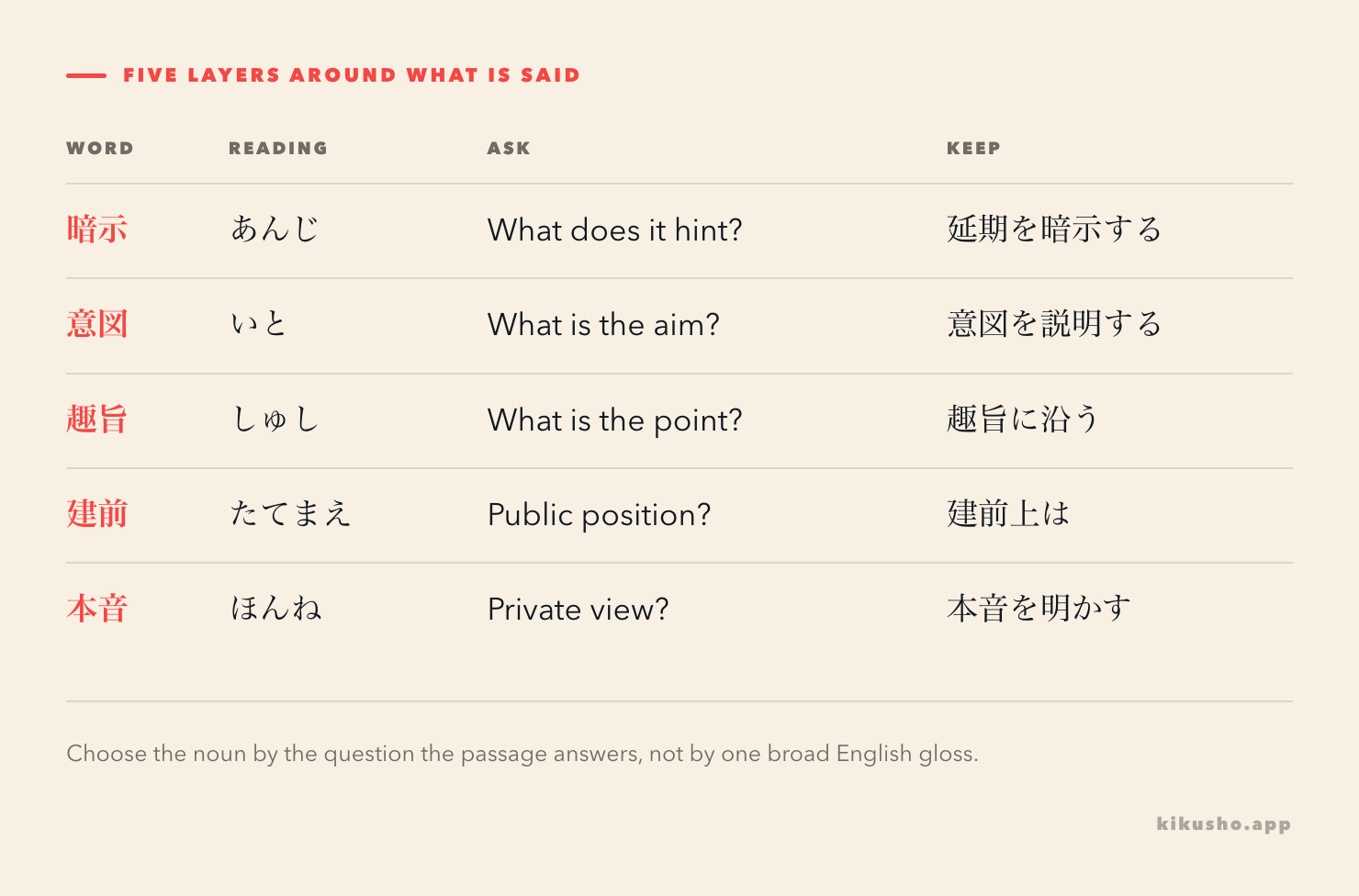
| Word and reading | Word class | Sense in this lesson | Phrase to keep with it |
|---|---|---|---|
| 暗示(あんじ) | Noun / する-verb | Indirect hint or suggestion | 延期を暗示する |
| 意図(いと) | Noun / する-verb | Aim or purpose held by an actor | 発言の意図を説明する |
| 趣旨(しゅし) | Noun | Stated purpose, main point or rationale | 制度の趣旨に沿う |
| 建前(たてまえ) | Noun | Publicly maintained principle or official position | 建前上は認めない |
| 本音(ほんね) | Noun | Sincere feeling or privately held view | 本音を明かす |
Learn the phrase as well as the headword. 意図する and 暗示する work as verbs, while 趣旨, 建前 and 本音 normally enter a sentence through patterns such as 趣旨を説明する or 本音を語る.
暗示 is in the clue; 意図 is in the actor
暗示 points indirectly. The listener or reader infers something that was not stated outright.
彼の発言は、計画の延期を暗示していた。
かれの はつげんは、けいかくの えんきを あんじしていた。
His remarks hinted that the plan would be postponed.
Kanjipedia's 暗示 entry contrasts indirect suggestion with 明示, explicit indication. It also records the psychological sense of “suggestion.” The example above uses the communication sense.
意図 belongs to a person or group: it is the aim behind an utterance or action.
私は、その表現を選んだ意図を説明した。
わたしは、その ひょうげんを えらんだ いとを せつめいした。
I explained my intention in choosing that expression.
Shogakukan's 意図 entry gives both the planned aim and the act of planning toward it. Common phrases include 意図をくむ, “grasp or respect someone's intention,” and 意図的に, “deliberately.”
The contrast matters because an implication does not always prove an intention. この結果は問題の存在を暗示している means that the result suggests a problem; it does not claim that the data deliberately tried to send a hint.
趣旨 is the purpose or point presented
趣旨 identifies what a proposal, system, event or explanation is for, or the main point it advances. It is something that can normally be stated, summarized and followed.
担当者は、制度改正の趣旨を説明した。
たんとうしゃは、せいどかいせいの しゅしを せつめいした。
The person in charge explained the purpose of the system reform.
The reform has a 趣旨 that can guide implementation: 趣旨に沿う means to act in accordance with that purpose. An individual official may also have an 意図, but the words put the focus in a different place. 意図 asks what that actor aims to achieve; 趣旨 asks what purpose or central point the proposal presents. An editorial comparison of 趣旨 and 意図 makes the same practical distinction, while Shogakukan's usage guide separates 趣旨, purpose or intent, from 主旨, the main content.
That boundary is useful rather than absolute. A sentence can discuss 発言の趣旨 when it summarizes the point of a statement, and 発言の意図 when it investigates why the speaker made it. The noun after の does not settle the answer by itself; the question being asked does.
建前 and 本音 locate public and private positions
建前 is a principle, rule or stance maintained in public. 本音 is what a person sincerely feels or thinks. The pair becomes especially useful when the two differ, but difference is not built into every use.
建前上は全員の意見を聞くことになっているが、実際には時間がない。
たてまえじょうは ぜんいんの いけんを きくことに なっているが、じっさいには じかんが ない。
Officially, everyone's opinion is supposed to be heard, but in practice there is no time.
会議の後で、彼女は計画についての本音を明かした。
かいぎの あとで、かのじょは けいかくについての ほんねを あかした。
After the meeting, she revealed how she really felt about the plan.
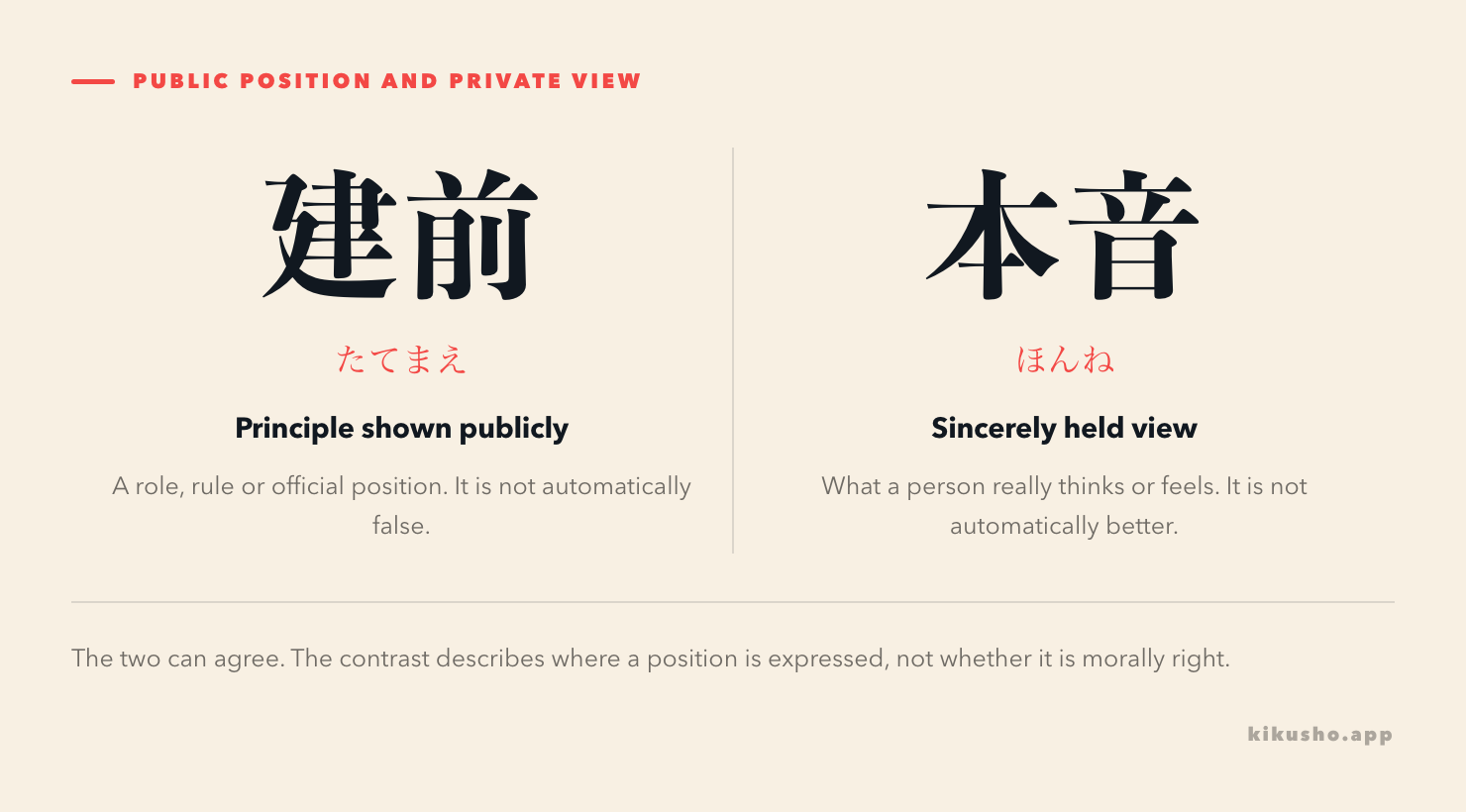
JapanDict's 本音と建前 entry confirms both readings and the familiar contrast. Shogakukan's encyclopedia discussion also warns against treating the distinction as a uniquely Japanese national trait. People everywhere manage public roles and private feelings.
Do not automatically translate 建前 as “lie.” A workplace can sincerely maintain fairness as a public principle even when individual preferences differ. Do not assume 本音 is morally superior either: a spontaneous private opinion may be honest and still be poorly informed.
Choose by the question the passage answers
When two translations look possible, replace the English label with a question:
| Ask this | Choose |
|---|---|
| What does the wording or evidence indirectly point to? | 暗示 |
| What outcome does the actor aim for? | 意図 |
| What purpose or central point is presented? | 趣旨 |
| What principle or position is maintained publicly? | 建前 |
| What does the person sincerely think or feel? | 本音 |
This sequence is a reading tool, not a claim that every conversation contains all five layers. A policy notice may state a 趣旨 without hiding a 本音. A novel may reveal a character's 意図 directly, with no 暗示 for the reader to decode.
The distinction between literal content and surrounding tone also appears in N1 words used in prose. For verbs that describe how someone notices, doubts or judges a claim, continue with N2 words for noticing and judgment.
Practice questions
Answer all six before moving to the explanations.
Question 1: read the word
How do you pronounce 趣旨 here?
- ア. しゅじ
- イ. しゅし
- ウ. しゅうし
- エ. しゅみ
Question 2: find the indirect clue
Choose the word that completes the sentence.
売上の急な減少は、市場の変化を( )しているかもしれない。
- ア. 本音
- イ. 建前
- ウ. 暗示
- エ. 趣旨
Question 3: identify the actor's aim
Which question asks about 意図?
- ア. この規則が公に掲げる原則は何か。
- イ. この結果から間接的に何が読み取れるか。
- ウ. この企画で担当者は何を実現しようとしているか。
- エ. この説明の中心的な目的は何か。
Question 4: preserve the main point
Which sentence best paraphrases 説明会の趣旨に沿った質問?
- ア. 説明会の目的や中心的な話題に合った質問
- イ. 説明会では口にしなかった個人的な感情についての質問
- ウ. 説明会が間接的にほのめかした未来についての質問
- エ. 説明会の担当者だけが内心で計画した質問
Question 5: choose the natural phrase
Complete the sentence.
誤解を避けるため、発言の( )をもう一度説明した。
- ア. 意図
- イ. 建前上
- ウ. 本音的
- エ. 暗示上
Question 6: compare public and private positions
Read the exchange.
部長は会議で「残業を減らすべきだ」と話した。後で同僚に「本当は、今月だけは残業が必要だと思う」と語った。
Which interpretation is best?
- ア. 公の立場は建前で、後の発言は本音として読める。
- イ. 会議の発言は暗示で、後の発言は趣旨である。
- ウ. 二つの発言はどちらも単語の読み方を説明している。
- エ. 後の発言には話し手の考えがまったく含まれていない。
Answers and explanations
Answer 1
イ, しゅし. 趣旨 means a purpose, main point or rationale. しゅみ is 趣味, “hobby” or “taste,” and the other choices are not the reading of 趣旨.
Answer 2
ウ, 暗示. The fall in sales indirectly points to a possible market change. The result supplies evidence; the sentence does not assign a personal aim, public position or private feeling to it.
Answer 3
ウ. It asks what the person in charge aims to achieve. ア asks about 建前, イ about 暗示 and エ about 趣旨.
Answer 4
ア. 趣旨 here is the event's purpose and central subject. イ describes 本音, ウ shifts to 暗示, and エ invents a hidden personal plan.
Answer 5
ア, 意図. 発言の意図を説明する is a natural phrase for explaining what the speaker meant to accomplish. The other choices do not form natural expressions in this sentence.
Answer 6
ア. The meeting statement is the position maintained in public, while the later remark presents the manager's private assessment. The labels describe their roles in this exchange; they do not prove that the public policy is dishonest.
Save the contrast, not only the translation
When you meet one of these nouns, record the question it answered. Save 結果が変化を暗示する, 発言の意図を説明する or 制度の趣旨に沿う, rather than a bare English word. Kikusho lets you edit the context before saving a card, then review the reading and example offline.
If the difficulty is following a full argument rather than one message, eight N1 words for academic arguments maps concepts, definitions, standpoints and logic onto a longer reading path.
Common questions
What is the difference between 暗示 and 意図?
暗示 is an indirect clue or suggestion in words, events or evidence. 意図 is the aim held by the person who acts or speaks. A result can 暗示 something even when nobody deliberately intended to hint at it.
What is the difference between 意図 and 趣旨?
意図 focuses on an actor's aim. 趣旨 is the purpose, main point or rationale that a proposal, event or explanation presents. The two can overlap, but they answer different questions.
Are 建前 and 本音 always opposites?
They are often contrasted, but a public principle and a private view do not have to conflict. 建前 is not automatically a lie, and 本音 is not automatically the better position.