Why ん sounds like m in しんぶん and ng in りんご
ん sounds like m in しんぶん and ng in りんご because it has no sound of its own: one beat of nasal that copies whatever comes next. Here is the rule, and why the beat matters.
12 October 2026 KikushoDownload
The Kikusho blog
Practical writing on Japanese, memory and spaced repetition — how vocabulary sticks, why decks die, and what to do about the words you meet every day.
ん sounds like m in しんぶん and ng in りんご because it has no sound of its own: one beat of nasal that copies whatever comes next. Here is the rule, and why the beat matters.
12 October 2026
You can register for JLPT N4 without sitting N5, but the N4 paper assumes N5 and never re-teaches it. Here is the N5 material to lock down first.
11 October 2026
ている isn't always '-ing'. 結婚している means 'is married', not 'getting married': the verb, not the form, decides whether you read action or result.
10 October 2026
友達に会う and 友達と会う are both correct. に means you went to them or ran into them; と means you met up, and the same split decides 話す and 相談する.
9 October 2026
Japanese has no single verb for 'play': you 弾く a piano, 吹く a flute, 叩く a drum, and する a sport. The one body-action rule that picks the right verb.
8 October 2026
A polite refusal in Japanese is a sentence you leave unfinished: a reason, a けど, then silence. Finish it with できません and you sound colder than you meant to.
7 October 2026
Handwritten Japanese uses the same characters as print, drawn the way a pen moves. Learn the small, closed set where the two disagree, and it reads.
6 October 2026
You already run Anki. Whether WaniKani is worth adding comes down to one question: is your bottleneck reading kanji, or keeping the words you actually meet?
5 October 2026
The JLPT stopped publishing its word list in 2010, so every level list is a reconstruction. Here is why some words feel useless, and which ones to skip.
4 October 2026
知る and 分かる both come out as 'know,' but one takes in a fact and the other is understanding dawning. The test that decides, and why 知りません can sound cold.
4 October 2026
Genki I and II get you through N4 grammar but were built for a course, not the exam. Here are the three gaps they leave, and what closes them.
1 October 2026
Google Translate gets you through a sentence but not the word inside it: the reading, register and senses a dictionary keeps and a translation drops.
30 September 2026
ように, ために and のに all translate as 'so that' or 'in order to.' One question about the goal decides which the sentence needs: can you just do it?
29 September 2026
Plain form marks closeness, not disrespect. The real error is matching it to the wrong relationship, and staying polite too long has a cost too.
28 September 2026
Thirteen N1 words for writing and speaking: 記載, 記述, 口述, 提示, 宣言, 発言, 朗読 and more, sorted by the record they make, with readings, senses and practice.
28 September 2026
Eight N1 courtesy words — いたわる, 祝賀, 尊い, 貴い, 尊ぶ, 配慮, 無礼, 詫び — with readings, the 尊い vs 貴い kanji split, collocations and practice with hidden answers.
28 September 2026
Fifteen N1 words for truth, appearance and doubt: 真実 vs 真相, 実態 vs 本質, 明白 read two ways, plus 露骨, 体裁 and 漠然 — and the test that picks each.
28 September 2026
Six N2 mimetic adverbs for manner and texture: ぎっしり, こっそり, さっさと, せっせと, ぴかぴか and ふわふわ, each with the verb it lives on and the sense trap to avoid.
28 September 2026
Five formal N2 Japanese words for social life: 敬う, 謙遜, 慰める, 慶び and 詫びる, with readings, the plainer word each one shadows, and practice with hidden answers.
28 September 2026
Five N3 mimetic adverbs (そっと, たっぷり, のんびり, ばったり, ぴったり) grouped by the manner or state each one pins down, with the collocations and sense traps that matter.
28 September 2026
Nine N3 courtesy words — 感謝, 礼, 喜び, 敬意, 尊敬, 礼儀, 作法, 祝い, 祝う — with readings, which ones take する, natural collocations and practice with hidden answers.
28 September 2026
Nine N3 words for truth, appearance and being wrong: 本当 vs 真理 vs 本物, 誤り vs 間違い, plus 明確, 微妙 and 確かめる — and the distinction that picks the right one.
28 September 2026
Seven everyday N4 courtesy words — 挨拶, お礼, 謝る, 遠慮, 失礼, 親切 and 丁寧 — with readings, word classes, natural collocations and practice with hidden answers.
28 September 2026
Learn ten N1 Japanese words for temperament, individuality, integrity, loyalty, diligence, rashness, stubbornness and innocent behaviour.
27 September 2026
Learn seven N1 Japanese words and marked readings for nephews, siblings, romance, newlyweds, pregnancy and childbirth.
27 September 2026
Learn 20 N1 Japanese words for conflict, threats, defence, public order, crisis response and evacuation through precise contrasts.
27 September 2026
Learn 13 N1 Japanese words for revision, improvement, effort, results, development, decline and collapse through precise contrasts.
27 September 2026
Learn nine N1 Japanese words for aspiration, impatience, jealousy, despair, hatred, pessimism and optimism in connected contexts.
27 September 2026
Learn nine N1 Japanese words for duties, staff, talent, promotion, placement, departments, resignation, retirement and work history.
27 September 2026
Master 17 N1 Japanese words for government, treaties, sanctions, conflict and territory, with precise contrasts, readings and exam practice.
27 September 2026
Learn six N1 Japanese words for convention, cycles, duration and frequency: 慣例, 周期, 持続, 度々, 時折 and 頻繁.
27 September 2026
Learn N1 Japanese for institutional acceptance, donation, granting, allocation, distribution and return, including 受け入れる, 寄贈, 授ける and 返還.
27 September 2026
Learn 14 N1 Japanese law and crime records through precise contrasts for evidence, searches, enforcement, prosecution, defense and punishment.
27 September 2026
Learn 10 N1 Japanese words for materials, strength, surface properties and three-dimensional form, with reading and usage distinctions.
27 September 2026
Learn eleven N1 Japanese words for hygiene, emergency response, professional care, welfare, insurance and anaesthesia, with readings and precise usage.
27 September 2026
Learn twelve N1 Japanese words for planning, agendas, duties, estimates, negotiations, agreements, transactions, task division and project progress.
27 September 2026
Learn four N1 words for foolish judgment, illusion, intellect and premonition, with precise contrasts, collocations and original practice.
27 September 2026
Learn nine advanced Japanese movement words for logistics, falling, submerging, expansion, traced routes and formal relocation through one connected context.
27 September 2026
Learn eleven N1 Japanese words for intentions, viewpoints, objections, decisive choices, adoption, compromise and blame in formal contexts.
27 September 2026
Learn 14 JLPT N1 words for setting priorities, dividing or combining parts, comparing things, and describing relationships with natural Japanese examples.
27 September 2026
Learn ten advanced Japanese words for measures, disposal, readiness, removal, recovery and replenishment through precise N1-level contrasts.
27 September 2026
Learn twelve N1 words for offers, requests, instructions, consent and refusal, including 承諾, 同意, 了解, 了承, 拒否 and 拒絶.
27 September 2026
Learn six JLPT N1 words for subsets, minorities, approximate amounts, trace quantities, low degree and room for revision.
27 September 2026
Learn six N1 Japanese words for provisional claims, principles, persuasion, recognition, grasping information and prejudice in context.
27 September 2026
Learn 12 N1 Japanese words for migration, inequality, households, wealth, poverty, compensation, public service and fundraising.
27 September 2026
Learn 誤差, 比率, 比例 and 密度 through measurement reports, with precise distinctions between error, ratio, proportional change and density.
27 September 2026
Learn ten N1 words for abrupt discontinuation, interruption, abolition, appearance and the limits that remain in formal Japanese reporting.
27 September 2026
Learn nine N1 Japanese words for development, circuits, processing, standards, efficiency, precision, power supplies, patents and departments.
27 September 2026
Learn 13 N1 Japanese economy words for inflation, business cycles, public finance, company funding, returns, losses and distribution.
27 September 2026
Learn nine N2 Japanese words for humility, openness, neglect, strengths, weaknesses, greed and three kinds of social overstepping.
27 September 2026
Learn eight N2 Japanese words for young children, childcare, relatives, spouses, close friends and reconciliation.
27 September 2026
Learn six N2 Japanese words for formal revision, expanding or reducing scope, and evaluating achievements or a track record.
27 September 2026
Learn six N2 Japanese words for admiration, envy, visible dislike, resentment, near misses and hesitation in context.
27 September 2026
Learn seven N2 words for routines, continuation, constant action, repeated occasions, rarity, temporary pauses and starting again.
27 September 2026
Learn seven N2 Japanese words for addressees, full names, receipts, registered and express mail, document copies and telephone receivers.
27 September 2026
Learn 17 N2 Japanese vocabulary records for materials, geometric shapes, orientation and physical properties, with the distinctions that choose the right word.
27 September 2026
Learn five N2 Japanese words for caring for someone ill, disinfection, lifespan, survival and funerals, with readings, collocations and precise usage.
27 September 2026
Learn six N2 Japanese words for arranging meetings, setting schedules, choosing a policy, taking countermeasures and reaching agreements.
27 September 2026
Learn eleven N2 Japanese movement words for relocation, floating, rotation, rolling, entry, carrying and routes through one connected context.
27 September 2026
Learn seven JLPT N2 words for zones, divisions, classification, sequence and discrepancies through a practical Japanese procedure.
27 September 2026
Learn six N2 words for filling gaps, adding resources, arranging systems and choosing between the homophones 解放 and 開放.
27 September 2026
Learn seven JLPT N2 words for leftovers, modest change, allowed limits, broad scope, vast data, countless items and infinity.
27 September 2026
Learn thirteen N2 Japanese words for standards, formulas, statistics, estimation, gravity, acceleration, weight, area, volume and measurement.
27 September 2026
Learn six N2 terms for suspending services, closing acceptance, formal endings, emerging consequences and things that remain or catch the eye.
27 September 2026
Learn ten N2 Japanese words for assembly, disassembly, parts, performance, operation, efficiency, batteries, current, connections and stoppages.
27 September 2026
Learn seven N2 Japanese planning words: 上旬, 中旬, 下旬, 月末, 当日, 年度 and 臨時, with calendar contrasts and contextual practice.
27 September 2026
Learn five N2 Japanese records for sales, foreign exchange, commerce and trading companies, with spelling contrasts and contextual practice.
27 September 2026
Learn eleven N3 Japanese words for personality, inherent traits, careful conduct, honesty, selfishness, meanness and calm behaviour in context.
27 September 2026
Learn 16 N3 Japanese words for stages of life, family relationships, affection, partnership, marriage and divorce.
27 September 2026
Learn 13 N3 Japanese words for conflict, fear, military forces, weapons, attacks, explosions and peace through precise contrasts.
27 September 2026
Learn eleven N3 Japanese words for challenges, correction, improvement, progress, development and making goals real.
27 September 2026
Learn eleven N3 Japanese words for envy, expectation, tension, excitement, boredom, satisfaction, disappointment, regret and reflection in context.
27 September 2026
Learn 12 N3 Japanese words for job hunting, hiring, transfers, branches, responsibility, management and labour.
27 September 2026
Learn 13 N3 Japanese words for countries, elections, political institutions and diplomacy, with readings, precise contrasts and practice.
27 September 2026
Learn seven N3 Japanese words for habits, routines and repetition: 癖, 繰り返す, しばしば, 常に, 日常, 再び and 普段.
27 September 2026
Learn nine N3 Japanese words for entrusting, helping, giving, yielding and sharing, including 預ける, 預かる, 助ける, 助かる and 分ける.
27 September 2026
Learn 11 N3 Japanese words for crime reports, investigations, arrests, harm and supervision, with precise contrasts and original practice.
27 September 2026
Learn nine N3 Japanese words for forms, printing, postal mail, correspondence, electronic data, communication and receiving documents.
27 September 2026
Learn 16 N3 Japanese vocabulary records for materials, shapes and physical properties, including paired readings for 管, 球 and 円.
27 September 2026
Learn nine N3 Japanese words for medical care, rescue, death, disability and older people, with readings, collocations and careful register guidance.
27 September 2026
Learn twelve N3 Japanese words for proposals, goals, contracts, project work, cooperation, progress, implementation, completion, postponement and cancellation.
27 September 2026
Learn sixteen N3 Japanese words for attention, ideas, knowledge, intelligence, imagination and prediction through practical contrasts.
27 September 2026
Learn eight N3 Japanese movement words for moving objects, sinking, passing through, road use and connections, with clear transitivity and particles.
27 September 2026
Learn twelve N3 Japanese words for will, intention, viewpoints, agreement, criticism, reputation, choosing and making decisions in context.
27 September 2026
Learn 14 JLPT N3 words for order, types, scope and comparison, including 順 vs 順番, 対象 vs 対照, and three ways to say things are the same.
27 September 2026
Learn eight N3 Japanese words for storing, paying, organising, preparing for trouble, solving problems and bringing plans together.
27 September 2026
Learn nine N3 Japanese words for giving up, refusing, requesting, ordering, prohibiting, permitting and forgiving through clear contrasts.
27 September 2026
Learn 19 JLPT N3 words for asking, counting, totals, proportions, small and large amounts, capacity limits and spare room.
27 September 2026
Five N3 words for giving meaning a form: 表す, 示す, 表現, 署名 and サイン. Which reading each takes, when 表す beats 示す, and why 署名 is not サイン.
27 September 2026
Learn eight N3 Japanese words for understanding, interpretation, consideration, theories, acceptance, misunderstandings and exceptions.
27 September 2026
Learn 15 N3 Japanese words for rights, duties, fairness, discrimination, social support and compensation through precise contrasts and practice.
27 September 2026
Learn ten N3 Japanese words for chemistry, physics, assumptions, observation, experiments, calculations, accuracy, speed, units and width.
27 September 2026
Learn nine N3 words for launching work, events arising, extending deadlines, cutting a connection and bringing a project to completion.
27 September 2026
Learn ten N3 Japanese words for machines, instruments, functions, design, operation, automation, manufacturing, devices, molds and inventions.
27 September 2026
Learn 13 N3 Japanese time words for past and present, before and since, brief moments, recent periods, centuries, year-round states and permanence.
27 September 2026
Learn six N3 Japanese words for marketplaces, business, stocks, supply, demand and currency with the crucial 市場 reading contrast.
27 September 2026
Learn 7 N4 Japanese words for babies, spouses, children and arguments, with family-reference choices and natural sentence patterns.
27 September 2026
Learn six N4 Japanese words for safety, danger, fear, war and escape, with the difference between 安全 and 安心 and practical context.
27 September 2026
Learn six N4 Japanese words for hard and soft materials, glass and slipping, including the difference among 固い, 堅い and 硬い.
27 September 2026
Learn six N4 Japanese movement verbs for moving, transferring, commuting, falling, carrying and changing residence through clear particle patterns.
27 September 2026
Learn five N4 Japanese words for getting ready, preparing materials, tidying tasks and replacing things through clear everyday contrasts.
27 September 2026
Learn six N4 words for opening, causing, stopping, quitting and reaching the end, including the two readings of 止める.
27 September 2026
Learn five N4 words for lies, shape, certainty, correct answers and mistakes through a school poster competition and its evidence.
27 September 2026
Learn five N5 Japanese words for asking about quantities and prices, describing small amounts, limited degree, remainders and totals.
27 September 2026
Learn four N5 verbs for things opening, people opening them, movement stopping and events beginning, with particles and a complete timeline.
27 September 2026
Relative time words like 今日 and 明日 refuse に. Here is the closed set that skips the particle, and the single test that predicts whether the next time word will too.
27 September 2026
Learn how adjective + 思いをする presents a feeling as an experience, how い- and な-adjectives attach, and how it differs from a plain adjective, と思う, 気がする, and 思いをさせる.
26 September 2026
Compare N1 敢えて and あくまでも: a deliberate choice despite resistance versus a position maintained to the end or a claim kept within strict limits.
26 September 2026
Compare N1 案の定 and あらかじめ on one timeline: prepare beforehand with あらかじめ, then use 案の定 when the result confirms an earlier prediction.
26 September 2026
Learn how ばこそ emphasizes the precise reason for a result, how it attaches, why it sounds formal, and how it differs from からこそ and てこそ.
26 September 2026
Learn how でもあり~でもある presents two roles or qualities as equally true, with noun, adjective, tense and register rules plus N1 practice.
26 September 2026
Learn how でも何でもない and くも何ともない reject a label or quality completely, with attachment rules, register contrasts and N1 practice.
26 September 2026
Learn how が/も~なら、~も~だ repeats nouns to criticise two related parties or aspects, with nuance, contrasts and original N1 practice.
26 September 2026
Compare N1 かつて and もはや: retrieve a former state or a never-before experience, then mark a present change that has already become hard to reverse.
26 September 2026
Compare ことごとく, まるっきり and およそ: exhaust a set, mark total degree, or express an estimate, general rule or emphatic negative.
26 September 2026
Learn how verb-stem + もしないで marks a completely omitted expected action, with attachment rules, tone contrasts and original N1 practice.
26 September 2026
Learn how もので gives a personal or circumstantial reason, with attachment, register, close alternatives and seven original N1 exercises.
26 September 2026
Master 7 N1 Japanese body and sensation words, including rare readings, register contrasts, figurative senses and natural collocations.
26 September 2026
Learn six advanced Japanese words for defilement, fuel, combustion, depletion and disposal, with reading contrasts and original practice.
26 September 2026
Learn eight N1 Japanese travel words for visits, guides, hotel desks, family-run lodging, regional products, passengers, passports and consecutive holidays.
26 September 2026
Master eight N1 Japanese health words, including rare readings of 傷 and 吐く, with usage contrasts, connected examples and original JLPT practice.
26 September 2026
Learn five N1 Japanese geography words: 河川, 崖, 山脈, 地形 and 浜, with correct readings, useful collocations and a source-reading correction.
26 September 2026
Learn six assigned Japanese map and route vocabulary records, including 上下, 側, 角, 遠回り and 曲がる, with reading traps, collocations and N1-level practice.
26 September 2026
Learn 15 N1 Japanese finance words for household balances, wages, savings, loans, interest and price reductions, with readings and practice.
26 September 2026
Learn five N1 Japanese rail words for fares, first departures, timetables, semi-express services and passengers, including the rare reading じょうかく.
26 September 2026
Learn four N1 Japanese hazard words: 雷, 降水, 洪水 and 津波, with precise readings, register, collocations and original practice.
26 September 2026
Learn five N1 Japanese shopping and product words for value, wrapping, inventory, market rates and quality, with readings and contextual practice.
26 September 2026
Master 10 N2 Japanese body and movement words, including posture, skin, nodding, squatting and precise bend-versus-tilt contrasts.
26 September 2026
Learn 10 N2 Japanese words for discussing books and films, with readings, natural collocations and clear distinctions between 名作 and 傑作.
26 September 2026
Learn five N2 Japanese words for halls, local shops, fire stations, public squares and government offices, with precise contrasts and practice.
26 September 2026
Learn six N2 Japanese words for materials, forests, pollution and electric power, with precise contrasts, connected examples and practice.
26 September 2026
Learn six N2 Japanese travel words for routes, cancellations, day trips, holiday homes, famous sights and local specialties: コース, 取り消す, 日帰り, 別荘, 名所 and 名物.
26 September 2026
Learn seven N2 Japanese health words for symptoms, diagnosis, contagion, curing and recuperation, with precise contrasts and original JLPT practice.
26 September 2026
Learn ten N2 Japanese geography words, from 海洋 and 水平線 to 峠, 麓, 平野 and 岬, with readings, contrasts, collocations and practice.
26 September 2026
Learn nine N2 Japanese words for describing map regions, compass axes and route order, including 周辺, 付近, 方角, 道順 and 前後.
26 September 2026
Learn 給与, 紙幣, 特売 and 割引 through workplace pay, banknotes and sale signs, with N2 readings, collocations and original practice.
26 September 2026
Learn fifteen N2 Japanese rail words for tickets, gates, transfers and train operations, including 往復, 改札, 乗車, 停車, 乗換 and 満員.
26 September 2026
Learn five N2 Japanese words for volcanoes, eruptions, bitter cold, rainbows and sunlight, with precise contrasts, readings and practice.
26 September 2026
Learn nine N2 Japanese shopping, products and customer service vocabulary words for sold-out stock, prices, postage, complaints and guest spaces.
26 September 2026
Learn 22 N3 Japanese words for animals, plants and living things, with readings, natural collocations and a seed-to-fruit growth cycle.
26 September 2026
Learn 22 N3 Japanese body, organ, sensation and movement words, with reading traps, natural collocations and original JLPT practice.
26 September 2026
Learn ten N3 Japanese words for urban areas, roads, signals, facilities, markets and towers, with reading contrasts and original practice.
26 September 2026
Learn 17 N3 Japanese words for the environment, energy and resources, with readings, collocations, key contrasts and original practice.
26 September 2026
Learn ten N3 Japanese travel words for sightseeing, leave, lodging, stays, passports, changes and souvenirs, including 宿泊, 滞在, 泊める and 土産.
26 September 2026
Learn 14 N3 Japanese words for symptoms, examinations, treatment, prevention and recovery, with readings, contrasts and realistic clinic examples.
26 September 2026
Learn twelve N3 Japanese geography words, from 泉, 岩 and 谷 to 沖, 岸, 波 and 湾, with readings, contrasts, collocations and practice.
26 September 2026
Learn 14 N3 Japanese words for maps and routes, including 経由, 横断, 方向, 中央, 中心 and 迷う, with readings, contrasts and practice.
26 September 2026
Learn 13 N3 Japanese money words for cash, coins, salary, income, expenses, savings, debt and exchange, with readings and contextual practice.
26 September 2026
Learn eleven N3 Japanese rail words for schedules, platforms, passengers, delays and fares, including ダイヤ, 定期, 遅れ, 混雑 and 発車.
26 September 2026
Learn 19 N3 Japanese words for climate, temperature, humidity, water states and storms, with precise contrasts, readings and practice.
26 September 2026
Learn 16 N3 Japanese shopping words for prices, orders, packaging, delivery, warranties, exchanges and repairs, with readings and practice.
26 September 2026
Learn six N4 Japanese body words with readings, natural collocations and clear boundaries for arms, hair, neck, back, throat, fingers and toes.
26 September 2026
Learn twelve N4 Japanese place words for regions, transport, venues, police and worship, with readings, contrasts and original practice.
26 September 2026
Learn four N4 Japanese travel words for sightseeing, overnight stays, reservations and traditional inns: 見物, 泊まる, 予約 and 旅館.
26 September 2026
Learn eight N4 Japanese landscape words, from stone and sand to forests, lakes, islands and coasts, with readings, contrasts and natural phrases.
26 September 2026
Learn eight N4 Japanese words for giving and following directions: 案内, 表, 裏, 進む, 通り, 途中, 真ん中 and 戻る, with route phrases and practice.
26 September 2026
Learn six N4 Japanese rail words for train types, transfers and delays: 普通, 急行, 特急, 乗り換える, 遅れる and 汽車.
26 September 2026
Learn six N4 Japanese words for seasons, changing weather and natural hazards, with readings, verb contrasts, collocations and contextual practice.
26 September 2026
Learn four N5 Japanese family-life words: 奥さん, 兄弟, 子供 and 誕生日, with readings, relationship context and natural birthday phrases.
26 September 2026
Learn how なんという, なんと and なんて express a remarkable degree, with forms, register contrasts, scope boundaries and original N1 practice.
26 September 2026
Compare 何しろ and とりわけ: foreground the decisive background that explains a judgment, or select one especially remarkable member from a wider set.
26 September 2026
Learn how coordinating に joins noun pairings and accumulating lists, how it differs from と, や, も, and に加えて, and where ordinary case-particle に begins.
26 September 2026
Learn how repeated-noun NというN means every single member without exception, where particles attach, and how it differs from ordinary という, すべて, and というもの.
26 September 2026
Learn how たら/ば/なら~ところだ places you inside an unrealized result, when to use ところだ or ところだった, and how it differs from たところ and たところで.
26 September 2026
Learn how てからというもの marks a lasting change after a turning point, how it differs from てから and て以来, and where the emphasis sounds natural.
26 September 2026
Contrast ~てみせる resolve or demonstration with ~てしかるべきだ justified expectation, including formation, register and original N1 practice.
26 September 2026
Learn how ~てかなわない complains that a situation is unbearable, what は adds, and how the pattern differs from てたまらない, てならない, and lexical 敵わない.
26 September 2026
Compare ~てもどうにもならない with どうにも~ない: explicit futile remedies versus broader impossibility, with formation, nuance and N1 practice.
26 September 2026
Compare ~ても差し支えない with Vずとも: formal permission or acceptability versus saying an action is unnecessary, with formation and N1 practice.
26 September 2026
Compare ~ても知らない with さもないと: a speaker withdrawing responsibility versus an otherwise connector that states the consequence of not acting.
26 September 2026
Compare と相まって with ゆえに: interacting factors that combine into one result versus a formal reason or conclusion.
26 September 2026
Compare とあれば with とあって: a hypothetical special condition that licenses a response versus an actual circumstance that explains an observed result.
26 September 2026
Compare といい~といい with といわず~といわず: two representative aspects that support an evaluation versus examples that erase a boundary across a whole group.
26 September 2026
Compare といったらない and のなんのって through attachment, register, vivid consequences and original N1 practice.
26 September 2026
Learn how というか~というか searches for the right label, while というところだ and といったところだ give a restrained estimate.
26 September 2026
Learn how time-period plus というもの emphasizes an uninterrupted span, while というわけだ states the conclusion that follows from known facts.
26 September 2026
Learn how というわけではない rejects an interpretation without denying every fact, how it attaches, and what the speaker usually says next.
26 September 2026
Learn how ときている adds a decisive fact while ときたら frames a topic for an evaluative comment, with attachment rules and N1 practice.
26 September 2026
Compare とみると and と見るや for actions taken immediately after judging a situation, including attachment, narrative register and N1 practice.
26 September 2026
Learn how となると and となれば turn a proposed situation into practical consequences, with attachment, register and N1 practice.
26 September 2026
Compare ともなく/ともなしに for action without a clear aim with sentence-level ともすれば for an unchecked tendency, with N1 practice.
26 September 2026
Compare とも~とも for an unresolved label with ようが~ようが and ようと~ようと for an outcome unchanged by either alternative.
26 September 2026
Use Nとしたことが for surprise at an uncharacteristic mistake, with the expectation logic, register limits, contrasts and N1 practice.
26 September 2026
Learn how とっさに marks an immediate reaction before deliberation, how とっさの modifies nouns, and how it differs from すぐに, いきなり, and 思わず.
26 September 2026
Compare literary とて for “even N” or “even if” with exclamatory とは for surprise at an unexpected fact, with forms and N1 practice.
26 September 2026
Learn how N1 つ~つ links alternating, opposing or reciprocal actions, which verb pairs sound natural, and how it differs from つつ and たり~たり.
26 September 2026
Compare N1 ~尽くす for doing or using something completely with NにNを重ねて for repeated accumulated effort, with forms and practice.
26 September 2026
Use conversational ってば and ったら to insist on a repeated message or react to a person, and distinguish expressive ったら from conditional たら.
26 September 2026
Learn how N1 うちに入らない says something falls below the threshold for a category, with attachment, tone, contrasts and original practice.
26 September 2026
Compare N1 はどうであれ and はさておき through logic, attachment, register and original practice: an irrelevant variable versus a deferred topic.
26 September 2026
Learn how わ〜わで piles up troublesome facts before a result, why past stories use nonpast forms, and how it differs from たり and だの.
26 September 2026
Compare N1 やしない and ずじまい: strong emotional negation versus an expected action that ended unrealized, with forms, contrasts and practice.
26 September 2026
Compare N1 ようが, ようと and ようと~まいと: one irrelevant condition versus an explicit do-or-not-do pair, with formation, nuance and practice.
26 September 2026
Compare N1 ずにはおかない and ずには済まない: a force that produces a result versus an obligation that cannot be left unsettled, with forms and practice.
26 September 2026
Learn how きっての names a standout member of a group while をおいて~ない excludes every alternative, with N1 examples and practice.
25 September 2026
Learn how 極まる and 極まりない differ from この上ない, この上なく and ことこの上ない through attachment, register and examples.
25 September 2026
Choose こそあれ, こそすれ, or こそ~が by attachment and by whether the second clause concedes, excludes, or qualifies the first.
25 September 2026
Learn when こともあって marks one contributing cause and when formal こととて presents a circumstance as understandable or unavoidable.
25 September 2026
Choose ことなしに after a verb and なしに or なしで after a noun, then use は when the missing action or element is an indispensable condition.
25 September 2026
Use ことのないように for a formal precaution and ないものか for a difficult wish. Learn their attachments, register and opposite communicative goals.
25 September 2026
Learn how までだ limits an action to a fallback or simple explanation, while くらいのものだ limits who, what or how much qualifies.
25 September 2026
Compare N1 suffixes めく and がましい: one forms a verb for taking on an air, while the other forms an adjective with an often critical judgment.
25 September 2026
Use も同然だ for practical near-equivalence and もさることながら to acknowledge one factor before placing stronger emphasis on another.
25 September 2026
Distinguish ものを from だろうに when Japanese looks back at a missed choice or contrasts reality with an expected result.
25 September 2026
Choose ものと思われる for a measured inference and とされる for an established view, rule or classification in formal Japanese.
25 September 2026
Distinguish ものとする, which establishes a formal rule or premise, from ものとして, which carries an assumption into the action that follows.
25 September 2026
Choose んばかりに or とばかりに by deciding whether a scene suggests an unrealized action or communicates an unspoken message.
25 September 2026
Learn eight N1 Japanese words for plant growth, animal care and biological reports, including the deceptive readings 種, 象 and 実.
25 September 2026
Learn eight N2 Japanese culture words with readings and natural phrases, from 演劇 and 稽古 to 鑑賞, 彫刻, 盆 and 催し.
25 September 2026
Learn 15 N3 Japanese storytelling words, from 作家, 著者 and 出版 to 物語, 場面, 役 and the translation pair 訳・訳す.
25 September 2026
Learn four N4 Japanese words for branches, leaves, grass and insects through one garden scene, natural collocations and original practice.
25 September 2026
Learn four N5 Japanese words for using a map and following directions: 地図, 角, 側 and 渡る, with readings, route phrases and practice.
25 September 2026
Learn how ながらに keeps a state in place and ながらの carries that unchanged state into the noun that follows.
25 September 2026
Compare ないとも限らない with 可能性がある: a possibility reopened through double negation versus a neutral assessment, with formation, register and N1 practice.
25 September 2026
Compare なくしては and あっての: a condition whose absence blocks a result versus the foundation that makes a person, achievement or institution possible.
25 September 2026
Distinguish ならでは from ならいざしらず and はいざしらず through attachment, discourse direction and original N1 practice.
25 September 2026
Choose between なり~なり for workable example options and もしくは for explicit alternatives in formal Japanese.
25 September 2026
Use なりに and なりの to judge an action, result or concern within a person's circumstances, ability or degree.
25 September 2026
Choose に値する for merit, に足る for a sufficient standard, and に足りない for what falls short, with safe negative patterns and N1 practice.
25 September 2026
Compare にあって and にして: how formal Japanese frames exceptional circumstances, striking milestones and literary pairings, with original N1 practice.
25 September 2026
Compare に引き換え and にも増して: choose a sharp opposition or a stronger degree beyond a benchmark, with attachment, register and N1 practice.
25 September 2026
Compare に言わせれば for a person’s opinion with にかかっては and its variants for a remarkable result in someone’s hands, with N1 practice.
25 September 2026
Compare に限ったことではない for a phenomenon beyond one case with によらず for a result independent of a criterion, with N1 practice.
25 September 2026
Learn にかかっている for outcomes that hinge on a decisive factor, including noun and question-clause patterns, nuance, contrasts and N1 practice.
25 September 2026
Learn when にかこつけて marks a pretext and when をいいことに marks an exploited situation, with formation, nuance and N1 practice.
25 September 2026
Learn how にかまけて marks what absorbs attention while は・をそっちのけで marks what gets neglected, with formation and N1 practice.
25 September 2026
Learn にまつわる for stories and facts associated with a topic, then contrast it with をめぐる for debate and conflict, with N1 practice.
25 September 2026
Choose に則って for compliance, に即して for real conditions, and に照らして for evaluation against a standard, with N1 practice.
25 September 2026
Choose に先駆けて for action ahead of others and を控えて for a coming event shaping the present, with forms, contrasts and N1 practice.
25 September 2026
Compare にしたところで, としたところで and Vたところで: limited cases, assumed premises and actions that cannot change the result.
25 September 2026
Choose にとどまらず for expansion beyond a boundary and はおろか for a more surprising point on a scale, with N1 forms and practice.
25 September 2026
Use には無理がある for an unrealistic plan or strained claim, and には当たらない when a reaction or evaluation is unwarranted, with N1 practice.
25 September 2026
Choose には及ばない for a measured shortfall and とは比べものにならない for an overwhelming gap, while separating the formal no-need use.
25 September 2026
Use を踏まえて for facts or experience considered in a decision, and を前提として for a condition assumed to hold, with forms and N1 practice.
25 September 2026
Use を経て for a route, period or process passed through, and を機に for an event treated as the occasion for a new action, with N1 practice.
25 September 2026
Compare を顧みず for disregarding something owed attention with をものともせずに for remaining undeterred by adversity, with N1 practice.
25 September 2026
Compare を限りに for the final occurrence of an activity with を境に for a boundary that divides a clear before-and-after change, with N1 practice.
25 September 2026
Learn how を兼ねて lets one main action serve an additional purpose, how it attaches, and where ついでに or がてら changes the relationship.
25 September 2026
Choose を禁じ得ない for an uncontrollable reaction and てやまない for a lasting heartfelt sentiment, with formation, register and practice.
25 September 2026
Choose を押して when someone pushes through resistance and をよそに when they disregard outside concern, opposition or circumstances.
25 September 2026
Use 折に for a formal occasion and 手前 when prior words, a role or another person's gaze constrains what someone can do.
25 September 2026
Use さも to intensify how something appears or is presented and さぞ for a strong, often empathetic supposition about another person's situation.
25 September 2026
Use そばから for a result that repeatedly undoes an action, and たら最後 or たが最後 for a trigger whose unwelcome consequence feels inevitable.
25 September 2026
Use そびれる when the chance to act slips away, and 損なう, 損ねる or 損じる when an intended action is missed or carried out unsuccessfully.
25 September 2026
Use 術がない when no method or means exists, and ようにも~ない when a person wants or tries to act but a circumstance prevents it.
25 September 2026
Use た弾みに for an accidental result carried by momentum or a preceding action, and た拍子に for something that happens at the exact moment another action provides the trigger.
25 September 2026
Compare たことにする, たことになる and たつもりはない: rewrite the record, derive a past conclusion, or deny an attributed intention.
25 September 2026
Compare ただ~のみだ with ば/たらそれまでだ: one narrows what remains to do, while the other marks the condition that ends the value of what came before.
25 September 2026
Learn when Japanese uses たら~たで for a condition's own consequences and ようによっては for results that change with the method or viewpoint.
25 September 2026
Learn how Nたるもの states the conduct expected from a role, how N1たるN2 identifies someone in that capacity, and why the form sounds formal.
25 September 2026
Learn how だけは repeats a verb to say you did what you could, how it separates effort from outcome, and how it differs from plain だけ.
24 September 2026
Learn when sentence-initial だって gives a casual objection or reason, when noun + だって means even or too, and how to avoid hearsay and concessive readings.
24 September 2026
Use であれ~であれ to name alternatives and いずれにしても, いずれにしろ or いずれにせよ when the alternatives are already understood.
24 September 2026
Compare でなくてなんだろう's emphatic label with ではあるまいか's cautious proposition through attachment, register and rhetorical force.
24 September 2026
です sounds like "dess" because Japanese whispers its i and u vowels in two predictable spots: the same rule that turns した into "shta" and 好き into "ski".
24 September 2026
Compare ではあるまいし, which rejects an irrelevant identity, with ともあろうものが, which invokes a real role to criticize conduct beneath it.
24 September 2026
Compare では済まない with て済むことではない: what attaches before each form, how strongly each rejects an inadequate response, and what it does not mean.
24 September 2026
Learn how どうせ marks an outcome the speaker already sees as fixed, from resigned predictions to the constructive どうせ~なら pattern.
24 September 2026
Compare どうやら, 恐らく and 果たして by evidence, probability and question framing, with original N2 practice.
24 September 2026
Compare 再び, とっくに and やがて by time direction, reference point and register, with original N2 practice.
24 September 2026
Learn how ふうに describes a visible manner or an appearance, how it attaches, and when ように or どうやって fits better.
24 September 2026
Choose がてら for a dual-purpose outing, かたがた for a formal courtesy purpose, and かたわら for long-running parallel roles.
24 September 2026
Learn how ~げ turns a limited set of feeling words into observed appearances, how げな and げに work, and why ~そう is more productive.
24 September 2026
Learn how ごとき, ごとく, and ごとし express formal comparison in Japanese, how their sentence roles differ, and when direct noun + ごとき sounds humble or contemptuous.
24 September 2026
Choose ぐるみ for whole-group participation, まみれ for material or figurative contamination, and ずくめ for an all-of-one-kind state in N1 Japanese.
24 September 2026
Use 逆に to reverse an argument's direction and もっとも to accept a point before adding a qualification, with original N2 practice.
24 September 2026
Choose 羽目になる for an imposed unpleasant situation and 始末だ for the critical endpoint of a bad sequence, with N1 formation and practice.
24 September 2026
Choose ほどのことではない when a matter is too minor to warrant an action and までもない when the action itself is unnecessary or excessive.
24 September 2026
Use くらいなら to reject an intolerable option and ほうがましだ to rank the alternative as merely less bad, with N1 forms and practice.
24 September 2026
Learn how 放題 presents unlimited freedom or an unchecked state, while まくる describes an action repeated or pursued with unusual intensity.
24 September 2026
Use 一応 for a provisional or minimally adequate status and わずかに for a very small degree or amount, with original N2 practice.
24 September 2026
Learn how 以上に marks a degree beyond a benchmark, how 以上の modifies a noun, and how this N2 pattern differs from より, numeric 以上 and causal 以上は.
24 September 2026
Choose いかなる before a noun, いかに for formal questions and degree, and いかにも for emphatic agreement or a strongly typical appearance.
24 September 2026
Learn when Japanese needs いきなり, 一気に or 直ちに by separating abrupt surprise, sustained momentum and formal action without delay.
24 September 2026
Learn how いわゆる introduces a commonly recognised label, when its tone is neutral or skeptical, and how it differs from いわば and という.
24 September 2026
Use いよいよ when an anticipated moment arrives and かえって when an action produces the opposite result, with original N2 practice.
24 September 2026
Learn how the Japanese suffix 上 (じょう) marks a standpoint, domain, or practical constraint in N2 grammar, with established collocations and contrasts with 上 (うえ).
24 September 2026
Use か否か for a formal yes-or-no determination, and のやら, ものやら or ことやら when the speaker wonders, hesitates or reacts to uncertainty.
24 September 2026
Learn how かのように, かのような and かのようだ express vivid as-if comparisons in N2 Japanese, with attachment rules and contrasts with ordinary よう.
24 September 2026
Use かと思いきや when reality overturns an expectation, and とは打って変わって when a present state differs sharply from an earlier baseline.
24 September 2026
Choose 限りだ for a strongly felt adjective, の至り for a conventional formal expression, and の極み for the absolute extreme of a quality.
24 September 2026
Learn how 甲斐もなく links an effort to one disappointing result, while ためしがない summarizes a repeated record in which something never happens.
24 September 2026
Use からある for large measurements, からする for high prices and からの before nouns for striking quantities, with clear contrasts and N1 practice.
24 September 2026
Learn how N + からして uses one representative feature or clue to support a wider N2 judgment, with contrasts against からすると and ordinary から.
24 September 2026
Learn how かれ~かれ brackets opposite adjective poles while 並み compares ability, quality or scale with a benchmark, with N1 examples and practice.
24 September 2026
Learn when 切りがない means there is no end and when にもほどがある rebukes behavior that goes too far, with N1 examples and practice.
24 September 2026
Learn how っこない attaches to verb stems, why it sounds emphatic and conversational, which short verbs resist it, and how it differs from わけがない and ようがない.
24 September 2026
Analyse Japanese stories and adaptations with 映像, 原作, 語彙, 主人公 and 描写, then distinguish the historical reading 役(えき).
24 September 2026
Learn seven N2 Japanese sports words with readings, natural collocations and practice, including 勝負, 体操, 跳ぶ, 跳ねる and 引き分け.
24 September 2026
Learn 17 N3 Japanese arts words with readings and natural phrases, from 楽器 and 演奏 to 舞台, 観客, 絵画 and 博物館.
24 September 2026
Learn four N4 Japanese storytelling words with readings and natural phrases: 小説, 漫画, 翻訳 and the reason noun 訳(わけ).
24 September 2026
Learn nine N5 Japanese words for towns, buildings and public facilities through readings, useful collocations and a connected route.
24 September 2026
Learn when 中を marks a route or difficult setting, when 中で locates an action, and how 中では sets a contrastive scope for rules and comparisons.
24 September 2026
Learn how お~願う and ご~願う form polite Japanese requests, where they appear, how 願います differs from 願えますか, and which attachments are natural.
24 September 2026
Learn how 幸いなことに marks a fortunate outcome, how it differs from 幸い, 幸いにも and おかげで, and where this N2 expression fits.
24 September 2026
Learn how せいか marks a suspected cause, how it attaches, and how its uncertainty and negative-result tendency differ from せいで and からか.
24 September 2026
Choose それなのに for an expectation-breaking result and それにしても for a remarkable evaluation after accepting the situation.
24 September 2026
Use そうすると to derive a consequence from a premise and 要するに to compress an explanation into its essential point, with original N2 practice.
24 September 2026
Learn how たまえ forms a direct command, what status relationship it implies, and why modern Japanese often uses なさい or てください instead.
24 September 2026
Learn how てはならない states a formal prohibition, where it appears, and how the single は separates it from feelings and positive obligations.
24 September 2026
Learn how と同時に links simultaneous events, immediate transitions and two coexisting roles, with clear formation and comparison tests.
24 September 2026
Use といった to place representative examples before their category, and distinguish this pattern from という, など and これといった.
24 September 2026
Use というふうに to package a statement as a manner, impression or illustrative pattern, and distinguish it from bare ふうに and direct quotation.
24 September 2026
Use ということは to draw or confirm a conclusion from known information, and distinguish inference from definition, summary and simple proposition topics.
24 September 2026
Use と考えられる for evidence-based conclusions in reports and careful prose, with correct predicate attachment and contrasts with と考える and と考えられている.
24 September 2026
Use とか to relay uncertain hearsay without fully endorsing it, and とかで to turn that report into a background reason for what follows.
24 September 2026
Use とも for a formal ‘even if’ condition whose result will not change, with volitional, negative and adjective forms plus key lookalikes.
24 September 2026
Use として~ない to rule out every exception: choose a minimum unit, keep the predicate negative, and distinguish role として and N1 たりとも.
24 September 2026
Use よほど and conversational よっぽど for an unusually high degree, strong comparison, evidence-based inference or nearly taken action.
24 September 2026
Separate あるいは for alternatives, 及び for formal addition and それなら for a response to a premise, with examples and N2 practice.
23 September 2026
Choose ちなみに for a related aside, なお for a formal supplementary note and そう言えば when the conversation makes you remember something.
23 September 2026
Compare ちっとも~ない, 全く~ない and 少しも~ない by scope, register and speaker attitude, then choose the natural form in N2 contexts.
23 September 2026
Learn how だの~だの quotes complaints while やれ~やれ frames a troublesome list, with attachment rules, contrast and N1 practice.
23 September 2026
Learn how ことだから supports a likely inference from known character, while ことにはならない blocks a conclusion that the premise cannot establish.
23 September 2026
Choose も構わず for a concern someone ignores and ままに for an impulse, wish or instruction that guides how an action unfolds.
23 September 2026
Choose もの/もん, ものか/もんか or ものがある by speaker stance, with checked attachment, register and seven original N2 questions.
23 September 2026
Learn five N1 Japanese arts words—曲, 演出, 衣装, 美術 and 上演—by following a stage work from creative plan to performance.
23 September 2026
Learn nine N2 Japanese words for academic structure and examinations, including 学部, 学科, 実習, 受験, 採点 and 点数.
23 September 2026
Learn ten N3 Japanese sports words, from 競技 and 訓練 to 選手, 審判, 記録, 応援 and 優勝, with readings and practice.
23 September 2026
Learn seven N4 Japanese arts words—音, 踊り, 踊る, お祭り, 展覧会, 美術館 and ピアノ—with readings, collocations and practice.
23 September 2026
Learn the four Japanese seasons—春, 夏, 秋 and 冬—with N5 readings, natural time phrases and practice that keeps every kanji distinct.
23 September 2026
Contrast literary ~ぬ with formal ~ねばならない, build both from the negative stem, and master せぬ, せねば, 来ぬ and 来ねば.
23 September 2026
Use 恐れがある for a formal, evidence-based warning about an unwanted outcome, with attachment rules, contrast with かねない and N2 practice.
23 September 2026
Choose ろくに~ない for an inadequate action and 何も~ない for total absence. Learn the attachment, nuance and N2 no-need extension.
23 September 2026
Learn when せめて expresses a hoped-for minimum and when 少なくとも states a lower bound, with contrasts, natural examples and N2 practice.
23 September 2026
Compare しかも, その上 and おまけに by emphasis, register and speaker attitude, with natural examples, limits and original N2 practice.
23 September 2026
Japanese has four conditionals for one English 'if'. Which one is correct is decided by your main clause. Here is the test that sorts たら, ば, と and なら.
23 September 2026
Learn when てはいられない means you cannot continue and how ばかり adds “cannot just keep doing that,” with N2 examples, contractions and practice.
23 September 2026
Compare ~てでも determination with ~てまで excess. Learn how the main clause reveals willingness, criticism or a limit on extreme means.
23 September 2026
Use ていては for a continuing action that causes trouble and ようでは for a behavior or state judged inadequate, with N2 examples and practice.
23 September 2026
Learn why Aてこそ makes A essential to B, while Aて当然だ judges A an expected result. Compare attachment, stance and natural contexts.
23 September 2026
Learn てたまらない for an unbearable sensation, feeling or desire, including adjective forms, たい desires, viewpoint limits and N2 practice.
23 September 2026
Learn how ては~ては presents recurring pairs and alternating actions, how it differs from たり~たり and conditional ては, with N2 practice.
23 September 2026
Learn how というものだ gives a strong evaluation while というものではない rejects an absolute rule, with attachment, variants and N2 practice.
23 September 2026
Learn how もう少しで and ところだった combine for near misses, how good outcomes differ, and why たところだった means something else.
23 September 2026
Learn how ところに places a second event at a precise moment while ところを見ると turns an observed situation into evidence for an inference.
23 September 2026
Learn how としても grants a hypothetical premise, how it attaches to each predicate, and how it differs from ても, としたら and にしても.
23 September 2026
Choose はもとより to extend an obvious case to another, and はともかく to set one issue aside before emphasizing what matters now.
23 September 2026
Learn how やら~やら lists representative nouns, actions or feelings while suggesting a larger, mixed situation, and how it differs from や and たり.
23 September 2026
Learn how よりほかない marks the only workable course, its particle variants, and how it differs from しかない, ざるを得ない and にほかならない.
23 September 2026
Learn how volitional verbs plus ようではないか create a forceful shared invitation, where the form sounds natural, and how it differs from ましょう.
23 September 2026
Separate だけましだ, which finds one saving feature in a bad situation, from ならまだしも, which accepts A only to reject the worse B.
22 September 2026
Learn how だに narrows to mental triggers and fixed negatives, while すら marks a productive extreme; compare attachment, register and inference.
22 September 2026
Compare Nでしかない with formal のみ: one judges something as nothing more than a noun, while the other restricts people, things or actions.
22 September 2026
Compare どころか and どころではない through expectation, circumstance, attachment and original N2 practice with hidden answers.
22 September 2026
Learn V-stem + 得る and 得ない for formal possibility, including える and うる readings, conjugation, limits and original N2 practice.
22 September 2026
Choose 反面 for opposing facets of one subject and 一方で for wider contrast or coexistence, with attachment rules and six practice questions.
22 September 2026
Compare からには, 以上は and 上は by personal resolve, logical duty and no-turning-back force, with attachment rules and six practice questions.
22 September 2026
Separate surprising reversal with かと思ったら from near-simultaneous timing with か~ないかのうちに, including forms and six practice questions.
22 September 2026
Learn how 限り marks a continuing condition, evidence boundary or maximum extent, and why に限って singles out a particular case instead.
22 September 2026
Learn when 甲斐がある says an effort paid off and when せっかく presents an effort or opportunity that deserves to be used rather than wasted.
22 September 2026
Choose から言うと for a stated criterion, から見ると for an observer or evaluative angle, and からすると for an inference from clues or circumstances.
22 September 2026
Compare からこそ and からと言って: the decisive reason versus a conclusion that does not follow, with attachment rules and original N2 practice.
22 September 2026
Choose がきっかけで, をきっかけに or を契機に by particle, viewpoint and register, with clear limits, examples and six practice questions.
22 September 2026
Choose ことだ for a practical course of action and ものではない for a social admonition, with attachment, tone and original N2 practice.
22 September 2026
Compare ことか and ことに for strong reactions: an exclamatory ending versus an evaluation placed before the event, with N2 practice.
22 September 2026
Choose ことなく for an action that never occurs and 抜きで or 抜きにして for a noun deliberately left out, with N2 contrasts and practice.
22 September 2026
Use まい for a firm decision not to act or a formal negative guess, and ようか~まいか when deciding whether to act, with N2 forms and practice.
22 September 2026
Learn five academic Japanese words: 演習, 教科, 試みる, 修士 and 修了, with readings, precise contrasts, collocations and original N1 practice.
22 September 2026
Learn five N2 Japanese study words: 仮名, 自習, 定規, 大学院 and 百科事典, with readings, natural collocations and original practice.
22 September 2026
Learn fourteen N3 Japanese words for university study, records and qualifications, including 科目, 専攻, 学歴, 資格, 免許 and both readings of 博士.
22 September 2026
Learn nine N4 Japanese sports words with readings, particles and natural phrases for matches, actions, winning and losing.
22 September 2026
Learn four N5 Japanese nature words: 山, 川, 海 and 池. Check their readings, useful place phrases and the difference between sea and beach.
22 September 2026
Use ないではいられない for an action you cannot resist and てならない for a feeling or thought that arises involuntarily, with N2 forms and practice.
22 September 2026
Use ないことには~ない when one missing condition blocks a result. Learn the N2 attachments, negative conclusion, similar forms, and practice.
22 September 2026
Learn how なくはない and なくもない turn a Japanese negative into a guarded yes, with exact formation rules, contrasts and six practice questions.
22 September 2026
Compare なくて済む and ずに済む: how to form each variant, when the register changes, and why both mean an expected burden was avoided.
22 September 2026
Compare に決まっている and に相違ない: the same strong certainty in conversational and formal registers, with exact attachment rules and N2 practice.
22 September 2026
Learn に越したことはない for the ideal or safest choice: exact attachments, negative forms, ば〜ほど phrasing and the difference from に限る.
22 September 2026
Compare に応えて and に向かって: respond to a request or expectation, or direct movement, speech and attention toward a target, with N2 practice.
22 September 2026
Compare に加えて and のみならず: add a parallel item or formally expand the scope, with attachment rules, examples and original N2 practice.
22 September 2026
Compare に基づいて and をもとに: ground a decision in evidence or use a source as material, with N2 forms, examples and original practice.
22 September 2026
Compare に先立ち and て以来: an advance action before an important event or a continuing state since a past point, with N2 practice.
22 September 2026
Use にせよ and にしろ for firm concessions or paired alternatives, compare にしても, and learn the attachments and register with N2 practice.
22 September 2026
Use にしたら, にすれば and にしてみれば to reason from another person's position, without confusing them with ordinary conditionals.
22 September 2026
Choose に沿って for a route or guideline an action follows, and のもとで for the person, authority or conditions under which it happens.
22 September 2026
Distinguish literary につけ from formal につき: recurring reactions, official reasons, units and topic marking with N2 examples.
22 September 2026
Use にわたって to show the full scale of a long duration, wide area, repeated count or broad field, with N2 forms and practice.
22 September 2026
Use にもかかわらず to acknowledge a fact or obstacle before an unexpected result, with N2 attachment, register and contrast practice.
22 September 2026
Distinguish formal にて and より in notices: action place or means versus a starting point in time, space or source.
22 September 2026
Compare のももっともだ and も当然だ for understandable reactions and expected results, with attachment and stance practice.
22 September 2026
Use ~抜く after a verb stem to carry a demanding action through to the end, with attachment, collocation and contrast practice.
22 September 2026
Choose をめぐって for debate around a topic and に関わる for direct relation, involvement or impact, with forms, limits and N2 practice.
22 September 2026
Choose を除いて for an explicit excluded member and 以外 for the broader category outside a reference point, with N2 forms, limits and practice.
22 September 2026
Use つもりで to carry an intention, assumed situation or imagined role into the action that follows. Learn Vる, Vた and Nの attachments.
22 September 2026
Learn why はもちろん adds a second case while ~で有名 names what something is known for, with attachment rules, examples and N3 practice.
22 September 2026
Learn how 割に compares reality with a price, age, effort or other standard, including attachments, 割には, limits and N3 practice.
22 September 2026
Learn when わざと means on purpose and when わざわざ means going out of the way, with nuance, limits, contrasts and original N3 practice.
22 September 2026
N4 feels twice as hard because it stops testing what words mean and starts testing what a sentence does: conditionals, transitivity, and who a favour is for.
22 September 2026
Learn ような気がする for a tentative impression: its N3 forms, nuance, tense, contrasts with と思う and そう, common mistakes and six exercises.
22 September 2026
Learn N3 ようとする and ようとしない: form the volitional, distinguish an attempt from imminent action, express refusal, and avoid nearby patterns.
22 September 2026
Use ~ずに to say that one action stays undone while another happens. Learn the ない-stem, せずに and 来ずに, plus ないで and なくて contrasts.
22 September 2026
Learn when ぶり and emphatic っぷり turn an action into an observable manner, why they differ from 方, and which combinations sound natural.
21 September 2026
Choose だけあって, だけに or だけのことはある by result, emphasis and sentence position, with attachment rules and original N2 practice.
21 September 2026
Learn five advanced Japanese home words: 戸, 箪笥, 天井, 床(とこ) and 浴室, with reading contrasts, collocations and original practice.
21 September 2026
Learn seven N2 Japanese home words, from 家屋 and 住居 to 雨戸, 絨毯, 扇風機, 戸棚 and 枕, with readings, collocations and practice.
21 September 2026
Learn N3 Japanese vocabulary for learning, memory and classroom tools, including 暗記, 学習, 記憶 and the two readings of 文字.
21 September 2026
Learn seven N4 Japanese words for schools, dictionaries, preparation and review, with readings, collocations and original practice.
21 September 2026
Learn seven N5 Japanese words for animals, trees and flowers, with readings, natural collocations, いる versus ある, and original practice.
21 September 2026
Compare に違いない and とは限らない: strong inference versus exceptions, with attachment rules, paired examples and original N3 practice.
21 September 2026
Compare に反して and にしては: attachment, register, the expectation each form overturns, and original N3 practice in connected context.
21 September 2026
Choose に関して, に関する, について, or についての by checking sentence position, register, and how broadly the topic is framed.
21 September 2026
Choose に比べて or に対して by deciding whether the sentence measures against a standard, contrasts two facts, or directs an action toward a target.
21 September 2026
Learn に慣れる with nouns and actions, then distinguish getting used to something from the settled state expressed by 慣れている.
21 September 2026
Use において before a statement and における before a noun. Learn their formal place, period and field meanings, plus when plain で is better.
21 September 2026
Learn when にしたがって and と共に both link two changes, then separate following a rule from accompaniment, simultaneity and paired qualities.
21 September 2026
Use にしても to grant a case without changing the conclusion, and は別として to set one factor aside before judging another.
21 September 2026
Choose にとって for an evaluation from someone's viewpoint and として for the role, capacity, or function in which someone or something acts.
21 September 2026
Use によると and によれば to name the source of reported information, choose a compatible ending, and keep them separate from によって.
21 September 2026
Use verb or noun plus には to frame what is required, helpful, or costly for reaching a goal, and keep it separate from purpose ために.
21 September 2026
Use のでしょうか to ask for an explanation or gently check an inference, with the right verb, adjective and noun attachments.
21 September 2026
Choose を中心に for the organising centre and をはじめ for a representative example, with attachment rules, contrasts and practice.
21 September 2026
Use を込めて to show the feeling, wish or effort carried through an action, with natural nouns, attachment rules and practice.
21 September 2026
Use を通じて and を通して for an intermediary or a whole time span, with attachment rules, register differences and practice.
21 September 2026
Choose っぱなし for a state left unchanged and っぽい for an impression or tendency, with attachment rules, contrasts and N3 practice.
21 September 2026
Use さえ~ば to present one minimum condition as enough, with noun, verb and adjective forms, particle rules, limits and N3 practice.
21 September 2026
Use 際に for a relevant occasion in formal instructions and reports, with attachment rules, time sequence, register limits and N3 practice.
21 September 2026
さらに extends the current point or degree; さて closes one stage and opens another. Learn their positions, register, limits and N3 practice.
21 September 2026
せいぜい sets a contextual maximum; 数量+は often marks a minimum. Compare their scope, tone and position through precise N3 examples and practice.
21 September 2026
しばらく measures an open interval; すでに places a state before a reference time. Compare their positions, limits and N3 use in context.
21 September 2026
しかない leaves one action as the only option; ようがない says no means exist to perform it. Compare their forms, limits and N3 use.
21 September 2026
Skipping an unknown word keeps you reading, but the word is gone for good. The fix is splitting two decisions: which to skip, and which to keep.
21 September 2026
Use それとも to connect alternatives in a Japanese question. Learn its sentence shapes, contrast it with または and それでも, and practise the choice.
21 September 2026
Use そうもない or そうにない for an event unlikely to happen, and ように見える for a visible appearance. Compare their forms and evidence.
21 September 2026
Choose すなわち for a formal equivalent description and つまり for a summary or interpretation. Compare their register, scope and common traps.
21 September 2026
Use Vた+ものだ to recall a past routine and Vる/Vない+つもりだった for an earlier intention. See where the past marker belongs and what each form implies.
21 September 2026
Use 確かに to accept a point as true and 例えば to introduce one case that illustrates a wider claim. Learn the sentence positions and false friends.
21 September 2026
Learn how Japanese ~たて marks a newly completed result, how it attaches to verb stems, and how it differs from ~たばかり and ~たところ.
21 September 2026
Compare casual ~たって with ~ても構わない: form concessions, express acceptance, ask permission, and understand where the two patterns overlap.
21 September 2026
Form ~てごらん from a verb's て-form, use it to encourage someone to try, and choose a safer request when the relationship does not support it.
21 September 2026
Choose ~て初めて when A leads to a new result or realization, and ~てからでないと when A must happen before B becomes possible.
21 September 2026
Use ~てしょうがない for a feeling or state you cannot suppress, and ~ずにはいられない for an action you cannot stop yourself from doing.
21 September 2026
Learn how ~て済む marks an action, cost, duration or consequence as enough to settle a situation, with its negative and transitive neighbours.
21 September 2026
Learn how Japanese 的 turns established noun bases into descriptors, then choose 的な, 的に, 的だ or 的で for the sentence around them.
21 September 2026
Choose ~ても始まらない when an action cannot move things forward, and ~ても仕方がない when it is pointless or an outcome is unavoidable.
21 September 2026
Compare two N3 warnings: prevent an unwanted event with てはいけないから, or reject a current activity with ている場合じゃない.
21 September 2026
Use と言えば and と言うと to pick up a topic and state an association, then learn when と言うと alone asks which person or thing is meant.
21 September 2026
Use といい and たらいい for hoped-for outcomes and possible solutions, with the attachments, particles and limits that keep the two uses clear.
21 September 2026
Learn when といっても keeps a label but narrows its scope, while というより replaces it with a more accurate description.
21 September 2026
Use とみえる and とみえて to draw a conclusion from evidence, attach each predicate correctly, and distinguish logical inference from に見える.
21 September 2026
Separate 途中で and 途中に from とおりに: locate an event inside an unfinished route or process, or follow a model, instruction or expected result.
21 September 2026
Use ところで to open a separate topic and ところが to overturn an expectation. Learn their discourse roles, limits and lookalike patterns.
21 September 2026
Learn why とても~ない means “cannot possibly,” how it differs from “not very,” and which negative forms make the judgment natural.
21 September 2026
Use ついに when a long lead-up reaches its decisive result, including bad outcomes and things that never happened. Compare やっと, とうとう and いよいよ.
21 September 2026
Choose ばいい, ばよかった or ば~のに by time and viewpoint: present advice, past regret, or disappointment about an unrealized alternative.
20 September 2026
Distinguish ばかり, ばかりだ and ばかりか by attachment: approximate amounts, one-way trends, and emphatic not-only-but-also addition.
20 September 2026
Choose 別に~ない for “not particularly” and 決して~ない for a categorical “never” or “by no means,” with forms, register, and N3 practice.
20 September 2026
Separate びる, ぶる and じみた by attachment and intent: a quality that emerges, a pose someone adopts, or a marked resemblance that shows through.
20 September 2026
Use ぶりに for a return after a gap and 中 for time inside, throughout, or before the end of a period, with ちゅう/じゅう readings and N3 practice.
20 September 2026
Choose だけ for an exact or context-defined limit and くらい/ぐらい for an approximation, degree, or minimum expectation, with N3 practice.
20 September 2026
Learn how だけど leaves a conversational opening while じゃない asks someone to recognize a claim, with attachment rules, tone, and N3 practice.
20 September 2026
Compare N3 だらけ, がち, and 気味 by accumulation, repeated tendency, and mild current state, with attachment rules, examples, and practice.
20 September 2026
Compare N3 どんなに, いくら, and たとえ with ても: degree, repeated quantity, and a hypothetical case, with attachment rules and practice.
20 September 2026
Compare どうしても and なるべく: strong determination, unavoidable failure, and practical best effort, with natural N3 examples and practice.
20 September 2026
Separate deliberate ふりをする from resemblance with まるで~ようだ. Learn each attachment, the accusation hidden in pretence, and seven practice questions.
20 September 2026
Separate ふと for an unbidden thought, glance or realization from つい for an impulse or lapse, with natural examples and seven practice questions.
20 September 2026
Learn verb-stem plus がたい for actions that are nearly impossible to accept, believe or carry out, and separate it from everyday にくい.
20 September 2026
Choose ごとに for units, たびに for every triggering event, and ずつ for equal allotments or gradual change, with verified examples and practice.
20 September 2026
Use 一度に for things handled in one batch or at the same time, and ついでに when a main action creates the chance for a secondary one.
20 September 2026
Form 一方だ with a change verb, follow rising or falling trends, and keep this N3 pattern separate from contrastive 一方で and simple continuation.
20 September 2026
Choose 一体 for an urgent question, まさか for disbelief, and もしかしたら for a tentative possibility, with clear N3 examples and practice.
20 September 2026
Learn how Aか何か means “A or something like it,” where particles attach, and how it differs from 何か, AかB, でも and かどうか.
20 September 2026
Compare verb-stem かける, 切る and 切れない: an action left partway, one carried through completely, or one that cannot be completed.
20 September 2026
Separate the approximate range から〜にかけて from the domain expression にかけては, then choose each form from endpoints, context and evaluation.
20 September 2026
Choose 代わりに for substitutes and reciprocal exchange, or に代わって and に代わり for formal role replacement, with clear attachment rules.
20 September 2026
Distinguish 結果, 結局 and そのために by structure: report a result, state the final outcome, or connect a reason or goal to what follows.
20 September 2026
Use きり for an exact limit or a past event after which nothing expected happened. Learn its attachments, っきり variant and key contrasts.
20 September 2026
Use Japanese っけ to retrieve something you once knew and んだって to relay what you heard, with attachment rules and contextual practice.
20 September 2026
Compare Japanese verb-stem + 込む and 通す: inward or absorbed action versus maintaining an action through its full course.
20 September 2026
Use Japanese こそ to single out the very person, time or reason, and さえ to present an unexpected extreme, with particle rules and practice.
20 September 2026
Compare ことから and なぜなら for Japanese reasons: one starts from evidence, while the other states a claim first and then explains why.
20 September 2026
Use ことになっている for rules, schedules and arrangements already in force. Learn its forms and how it differs from ことになる and ことにしている.
20 September 2026
Choose ことは~が or ないことはない for qualified agreement. Learn the repeated form, double negative and the strength of each answer.
20 September 2026
Use sentence-final こと for written Japanese rules and instructions. Learn the positive and negative forms and how they differ from nominalization and ことだ.
20 September 2026
Learn how くせに marks a contradiction with blame, how it attaches, why subjects usually match, and when neutral のに is the safer choice.
20 September 2026
Anki drills a grammar point's form until it is automatic. What it can't teach is the choice to use it in a new sentence, and for grammar that is most of the job.
20 September 2026
Choose めったに~ない for rare events and なかなか~ない for an expected result that does not happen readily, with forms, contrasts and practice.
20 September 2026
Use も~ば~も to balance two facts as both A and B. Learn its verb, adjective and noun forms, negative pattern, limits and natural alternatives.
20 September 2026
Learn when もしも~たら presents a what-if and when としたら, とすれば, or とすると turns a whole statement into a premise for N3 reasoning.
20 September 2026
Learn why 初心者向け means designed for beginners while 初心者向き means suitable for them, with forms, contrasts and seven N3 exercises.
20 September 2026
Use よりも to mark a comparison baseline and むしろ to replace it with a more accurate or preferable choice, with forms and seven N3 exercises.
20 September 2026
Learn six N1 Japanese clothing and textile words: 襟, 裾, 織物, 繊維, 染める and 流行(はやり), with collocations and practice.
20 September 2026
Learn four N2 Japanese clothing words: 編む, 縫う, マフラー and 和服, with readings, natural collocations, usage contrasts and original practice.
20 September 2026
Learn seven N3 Japanese words for housing, architecture, living rooms, furniture, roofs, floors and blankets through connected examples and practice.
20 September 2026
Learn nine N4 Japanese words for mirrors, walls, storage, bedding, lighting, heating and cooling through natural room descriptions and practice.
20 September 2026
Learn five N5 Japanese words for songs, singing, music, pictures and guitar, with readings, natural verb partners and original practice.
20 September 2026
Learn when ないと means “if not,” when it implies “have to,” how to form it, and why context supplies the ending that Japanese leaves unsaid.
20 September 2026
Turn Japanese adjectives into nouns with さ, form 高さ and 便利さ correctly, and distinguish measured degree from み and adjective + の.
20 September 2026
Use ~させてください to ask “please let me do it” in Japanese. Learn the causative attachment, who acts, register choices and common mistakes.
20 September 2026
Choose し, それに or それでも by the relationship you need: list a reason, add support in a new sentence, or continue despite an obstacle.
20 September 2026
Use そんなに for a degree already in the conversation and より for an explicit benchmark. Learn their attachments, limits and seven practice questions.
20 September 2026
Use ~たらどう to suggest an action and ~たらいいですか to ask what action is best. Follow the speaker and listener to choose naturally.
20 September 2026
Use ~てほしい to say you want someone to act. Learn who takes に, how the negatives differ, and when a softer request is better.
20 September 2026
Choose ていく or てくる by direction: away or toward the viewpoint, from now onward or up to now. Learn motion, change and onset uses.
20 September 2026
Connect a cause to its natural result with verb ~て, adjective ~くて or ~で, and noun ~で. Learn when から or ので is the better choice.
20 September 2026
Use てすみません to apologize for an event and てよかった to express relief. Learn negative forms, register and the contrast with ばよかった.
20 September 2026
Choose と言ってもいい for the speaker's assessment and と言われている for a circulating view. Learn attachment, register and common lookalikes.
20 September 2026
Use と聞いた for information from another source and と思う for your own judgment. Learn one quotation pattern, attachment rules and seven exercises.
20 September 2026
Form Japanese verbs with ~直す, distinguish corrective redoing from simple repetition, and learn when compounds such as 見直す have extended meanings.
20 September 2026
Use Aは〜が、Bは… to compare two people, things or situations. Learn contrastive は, particle replacement, omission and seven N4 exercises.
20 September 2026
Use 予定だ for scheduled actions and arrangements. Learn verb and noun attachment, past and negative forms, and how it differs from つもり.
20 September 2026
Use ようにする for deliberate effort, routines, and making sure a result happens. Learn its forms and how it differs from ようになる, ことにする, and てみる.
20 September 2026
Choose あげく or 末に by the result and speaker stance, with attachment rules, contrasting examples and original N2 practice.
19 September 2026
Learn あまりにも for an excessive degree, contrast it with ほど, and test the difference in seven original N3 grammar questions.
19 September 2026
Learn how 場合は frames a possible case and its response. Check noun-like attachment, verb timing, register, limits and seven original exercises.
19 September 2026
Learn how べからず prohibits, べくもない rules out possibility, and べくして marks an inevitable outcome in formal N1 Japanese.
19 September 2026
Learn how だけで marks what alone is enough and how の中で sets a place, circumstance, or comparison group, with N4 examples and practice.
19 September 2026
Choose でしょう or だろう by purpose and register. Learn inference, confirmation, plain-form attachment, intonation and seven original exercises.
19 September 2026
Use または for named alternatives, Nでも for one loose suggestion, とか for conversational examples, and など for a neutral representative list.
19 September 2026
Learn sentence-opening でも for contrast and noun + をください for requesting things, then separate them from two lookalike beginner patterns.
19 September 2026
Use ではないか for formal confirmation and じゃないか in casual speech. Learn how context turns the same shape into a check, reminder, surprise, or invitation.
19 September 2026
Use Nが必要 for a needed thing and Vる必要がある for a necessary action. Learn the particles, negative forms, tense, and difference from obligation.
19 September 2026
Use Nがする to report a sound, smell, taste or bodily sensation. Learn the noun slot, source with から, tense, and differences from active sensing.
19 September 2026
Learn when がる shows an observed feeling, がり names a tendency, and たがる reports another person's wish, with forms, limits and practice.
19 September 2026
Choose 始める for a neutral start, 出す for sudden onset, 続ける for continuation, and 終わる for completion. Learn the shared N4 attachment rule.
19 September 2026
Choose お or ご before Japanese words with a reliable origin rule, then learn the fixed exceptions, three functions and mistakes beginners should avoid.
19 September 2026
Choose がほしい for a wanted thing and ~たい for an action you want to do, then change the wish for tense, negation and context.
19 September 2026
Learn how 一緒に marks a shared action and いつも marks frequency, where each adverb sits, and how both can describe the same N5 sentence.
19 September 2026
Use かどうか to place a yes-or-no question inside a Japanese sentence. Learn its plain-form attachment, noun and adjective rules, and common limits.
19 September 2026
Choose かな, かしら or かい by asking who the question is for. Learn their attachment, register and limits through seven N4 exercises.
19 September 2026
Learn when Japanese uses から or で for what something is made from, with active and passive patterns, nuance, and seven N4 exercises.
19 September 2026
Choose けど, けれど or けれども by register, attach each form correctly, and recognize when it softens a request instead of meaning ‘but’.
19 September 2026
Separate きっと, ぜひ and さすが by belief, desire and expectation. Learn the main patterns, limits and nuances through seven N4 exercises.
19 September 2026
Choose 頃 or ごろ for an approximate time, おきに for a repeating interval, and さっき for the recent past, with readings and natural examples.
19 September 2026
Use nonpast ことがある for occasional events, distinguish it from past experience, and learn negative clauses, こともある and natural frequency limits.
19 September 2026
Learn how こと and の turn Japanese verb clauses into noun-like topics, and how のは~です identifies who, when, where or why with clear contrasts.
19 September 2026
Choose 急に, やっと or なかなか~ない by locating the event on a timeline: sudden onset, delayed progress or a result finally reached.
19 September 2026
Use までに for a deadline: attach it to a time or a nonpast event, separate it from duration まで, and choose a precise cutoff.
19 September 2026
Use まま when a state stays unchanged: learn its verb, adjective and noun forms, its neutral tone, and the contrasts that prevent common mistakes.
19 September 2026
Learn when ~ものなら frames an unlikely condition and when ~ものだから gives an explanatory reason, with forms, limits and N2 practice.
19 September 2026
Choose もう or まだ by whether a change has happened, form まだ~ていません correctly, and answer completion questions without changing the timeline.
19 September 2026
Learn four advanced food words: rare 甘い(うまい), 生(き) for undiluted, 酸っぱい for sour, and 調理 for food preparation.
19 September 2026
Learn 差し支える, 取り組む, 控える and 踏まえる through particles, collocations and contrasting senses, then answer seven original questions.
19 September 2026
Learn five N2 meal words through planning, seasoning and digestion. Check readings, correct a bad source entry, then answer seven original questions.
19 September 2026
Learn twelve N3 Japanese words for fabric, patterns, fit and fashion, including 柄 and 綿 reading pairs, with original practice and explanations.
19 September 2026
Learn 絹, 着物, 毛, 下着, スーツ and 手袋 through readings, material phrases, clothing contrasts and seven original N4 vocabulary questions.
19 September 2026
Learn eleven N5 Japanese words for school, homework, notebooks and study actions, with readings, collocations and original practice.
19 September 2026
Use dictionary-form + な for a blunt prohibition and verb-stem + なさい for an authoritative instruction; learn the polarity, attachment and register.
19 September 2026
Choose なあ, ね or よ by who holds the information, attach each ending naturally, and hear when intonation turns agreement into pressure or reflection.
19 September 2026
Use ないで for doing one thing without another, and ないでください to ask someone not to act. Build both from the ない-form and avoid なくて.
19 September 2026
Build なくてもいい from the ない-form to say an action is optional. Compare permission, obligation and prohibition, then practise natural replies.
19 September 2026
Use なる for a new state and にする for a choice or caused change. Compare noun and adjective forms, particles and natural N5 examples.
19 September 2026
Use んです and のです to connect a statement to its situation. Learn the plain-form attachment, な insertion, questions and spoken or written register.
19 September 2026
Learn how に至る reaches an endpoint, に至って marks a late reaction, and まで, も, は reshape the N1 family with examples and practice.
19 September 2026
Use に気がつく for a noticed thing or realized fact, and に見える for a visual appearance; learn each attachment, evidence type and common boundary.
19 September 2026
Learn when に堪えない rejects unbearable quality or intensifies emotion, and when に忍びない means compassion makes an action too painful.
19 September 2026
Use verb dictionary form + のに to describe what a tool serves, what an action requires, or how much time and money it takes.
19 September 2026
Use number + counter + も to mark a quantity as strikingly high, then contrast it with neutral counts, lower bounds, しか and negative not-even forms.
19 September 2026
Tell verb-stem 次第, noun 次第で and adverb 次第に apart by attachment, timing and outcome, then practise the three patterns in seven questions.
19 September 2026
Choose しかし, それから or そして by the relationship between two sentences: contrast, chronological sequence or a continuing addition.
19 September 2026
Use とても for a high degree and ~すぎる when something exceeds a useful or acceptable limit, with forms for verbs and both adjective classes.
19 September 2026
Use ~たほうがいい for what someone should do and ~ないほうがいい for what they should avoid, with clear form, strength and N5 practice.
19 September 2026
Use ~てから to complete one action before the next or mark a starting point in time, with forms, contrasts and original practice.
19 September 2026
てもいい asks permission at any register, but てはいけない sounds like a posted sign. Here is when natives swap it for だめ, ないで, or a softer request.
19 September 2026
Choose といえども or であろうと by whether you grant a fact or ignore a condition, with attachment, register, and N1 practice.
19 September 2026
Learn when Japanese つもり states a chosen plan and when はどうですか offers an option, with forms, examples, contrasts, and JLPT N5 practice.
19 September 2026
Build ~方(かた) from a Japanese verb’s ます-stem to say how to do something, then use it as a noun with the right particles.
19 September 2026
Compare formal ~をもって boundaries with ~を皮切りに sequences. Learn the variants, read realistic notices and solve seven original N1 questions.
19 September 2026
Attach やすい, にくい and づらい to a verb stem, then choose between ease, practical difficulty and a burden the speaker personally feels.
19 September 2026
Read five formal Japanese expressions: 拝啓, 敬具, ご無沙汰, 賜る and 拝借. Learn letter conventions, who gives or receives, and practise without spoilers.
18 September 2026
Compare verb-stem 上げる for a finished result with 合う for mutual action. Learn the forms, limits and six exercises, with all answers kept together.
18 September 2026
Compare あまり~ない with 全然~ない: not very versus not at all, negative verb and adjective forms, polite endings, and six original practice questions.
18 September 2026
Learn how だけでなく and ばかりでなく add information, attach to nouns and predicates, and differ in register. Try six original grammar exercises.
18 September 2026
Learn N5 だけ for only, with nouns, verbs and adjectives. Check what it limits, distinguish しか, and try six exercises with answers below.
18 September 2026
Use が好き, が上手 and が下手 for preferences and skills. Learn noun and verb + のが patterns, then try six exercises with answers below.
18 September 2026
Learn N1 いかんによらず and the 如何 family: noun attachment, depending-on versus regardless meanings, formal use and eight original exercises.
18 September 2026
Compare two things with より and のほうが, then name the cheapest in a group with いちばん. Learn four N5 sentence frames and try eight original questions.
18 September 2026
Read sentence-final さ, わ, ぞ and ぜ with their attachments, stance and register. Distinguish spoken voice from formal prose and try eight original tasks.
18 September 2026
Compare 達成, 遂げる, 果たす, 施す, 催す and 損なう through their nouns and senses. Learn the readings and limits, then try eight original questions.
18 September 2026
Compare かもしれない and でしょう through possibility, prediction and confirmation. Check plain forms, past and negatives, then try six original exercises.
18 September 2026
Compare kango and wago through 購入, 購買, 雇用, 採用 and 討議: readings, meaning, register, native alternatives and six exercises with separate answers.
18 September 2026
Use から for a starting point and まで for an endpoint. Read time ranges and routes, separate causal から, and practise with six original questions.
18 September 2026
Katakana can mark a native word, a technical label or emphasis. Learn seven borrowed comparison words and practise reading their meanings in context.
18 September 2026
Choose ことにする or ことになる for decisions and arrangements. Learn verb forms, negative choices and timing, then practise with six original questions.
18 September 2026
Compare ことはない and 必要はない: reassurance, unnecessary actions, polite endings and the limits of no need. Try six original grammar exercises.
18 September 2026
Use dictionary forms before 前に and ta-forms before 後で. Compare past and future plans, noun phrases, and six original questions with explained answers.
18 September 2026
Read 厳密, 支持 and 適宜 through their sentence roles: precision, backing a proposal and acting as needed. Compare usage, then try six original questions.
18 September 2026
Learn eight Japanese noun–verb collocations with eleven headwords, readings and examples. Practise six N2 vocabulary formats, with answers below.
18 September 2026
Learn Japanese ingredients and cooking verbs for N3 study. Compare frying, boiling and steaming, check tricky readings, then try eight original questions.
18 September 2026
Learn seven N3 Japanese verbs through their collocations: 当たる, 当てる, 切れる, 通す, 張る, 向く and 向ける. Compare senses, forms and eight exercises.
18 September 2026
Learn five N4 Japanese kitchen words: 味, 米, 苦い, 味噌 and 焼く. Check readings, food meanings and useful phrases, then try eight original questions.
18 September 2026
Learn ten Japanese home words with readings, useful phrases and eight N5 exercises. Distinguish keys, doors, lights and furniture; answers below.
18 September 2026
Read ないものでもない and と言えなくもない as qualified affirmations. Learn how the two negatives work, where each form attaches, and practise with six questions.
18 September 2026
Build に行く from a Japanese verb’s ます-stem to say why you are going somewhere. Separate destination, object and purpose, then try six original exercises.
18 September 2026
Compare N2 にかかわらず and を問わず: conditions, categories, attachment and formal use. Learn their overlap through eight original exercises and explanations.
18 September 2026
Read によって as a method, cause, changing factor or passive agent. Learn noun attachment, による, and six exercises with answers kept together below.
18 September 2026
Compare おかげで and せいで: helpful causes, blame, verb and adjective attachment, polite endings and supported irony, with six original exercises.
18 September 2026
Compare 最中に and たとたん in N3 Japanese: an event during an activity or at its boundary. Check forms, nuance and eight original practice questions.
18 September 2026
Read 畳, 艘, 通, 滴 and 泊 in rooms, boats, correspondence, liquids and travel. Learn their number readings and practise choosing what each unit counts.
18 September 2026
Choose Japanese ても or のに by the speaker’s stance. Learn their forms, factual overlap and limits, then try eight exercises before the answer block.
18 September 2026
Choose とき for the time of a situation and 間 for continuity through a period. Check attachment, relative tense, overlap and original exercises.
18 September 2026
Learn N1 ~ところを for considerate requests, apologies and thanks, with attachment, spoken examples, contrasting uses and eight original practice tasks.
18 September 2026
Compare た上で, dictionary-form 上で and additive 上に by attachment, meaning and minimal contrasts, then practise all three in seven questions.
18 September 2026
Compare や否や, が早いか and なり: verb forms, immediate reactions, overlapping uses and other meanings of なり, with original practice and separate answers.
18 September 2026
Use ようになる to report an acquired ability or a new routine. Check verb forms, tense, negative changes, and the boundary with decisions.
18 September 2026
Compare ~ばかりに and ~あまり through causes, degree and attachment. Try six original N2 grammar questions, with every answer below the full exercise.
17 September 2026
Compare がんばる, 努力 and 我慢 by focus and grammar. Learn 苦労, 真剣 and 勇気, then try six original questions with all answers kept below the exercises.
17 September 2026
Compare 必ずしも, たとえ, どうか and まさか: partial negation, even-if clauses, requests, wishes and surprise, with readings and original practice.
17 September 2026
Learn seven Japanese compounds with 足, 手 and 目. Check readings, meanings and phrases for footprints, upkeep, procedures, landmarks and rough standards.
17 September 2026
Compare ten Japanese words for certainty, guesses and forecasts. Learn their readings, collocations and limits, then try six original vocabulary questions.
17 September 2026
Learn 飛び出す, 申し込む and 横切る with readings, particles and past forms. See why 出す, 込む and 切る do not each supply one fixed meaning, then practise.
17 September 2026
Learn six Japanese emotion words, their readings and particle patterns, with natural examples and eight exercises whose answers appear together at the end.
17 September 2026
Learn seven N3 Japanese words used in forms and work messages, with readings, everyday paraphrases, useful constructions and practice without spoilers.
17 September 2026
From いつも to めったに, Japanese frequency adverbs sit on one scale. ときどき and たまに are not the same "sometimes," and four of them require a negative verb.
17 September 2026
Read six N1 study words for rules, public administration and courts: 規定, 規約, 行政, 訴訟, 判決 and 法案, with phrases and six original exercises.
17 September 2026
Learn すっきり, どきどき and にこにこ through refreshed states, a pounding heart and cheerful smiles. Use their sentence patterns and try six questions.
17 September 2026
Learn what Japanese ながらも means, how it attaches to verbs, adjectives and nouns, and why も is optional in some concessions. Try original practice.
17 September 2026
Read Japanese business and news sentences with six N3 words: 企業, 消費, 商品, 政府, 地域 and 販売. Learn readings, noun patterns and explained practice.
17 September 2026
Read five N3 notice words for application periods, deadlines, proof, documents and submission, with readings, useful forms and original practice.
17 September 2026
Learn 18 Japanese politics and economics words with readings, collocations and examples. Compare budgets, costs and assets, then try six vocabulary questions.
17 September 2026
Learn seven N3 words for whole and part, degree, averages, suitability, shortage and extra amounts, with readings, useful forms and original practice.
17 September 2026
Learn eleven Japanese relationship nouns, from 親友 and 親戚 to 同僚 and 相手. Compare friendship, workplace roles and allegiance with readings and practice.
17 September 2026
Learn 以降, 以後, 直前 and 直後 with readings and original examples. Compare time periods with moments just before or after, then try six questions.
17 September 2026
Learn Japanese という for names and clause content, plus ということ, って, ということだ, というのは and というと. Try original questions with answers below.
17 September 2026
Compare 聞く, 尋ねる, 問う, 伺う, 承る, 言う, 申す and 参る. Learn meanings, readings and humble speech with six original questions and separate answers.
17 September 2026
Use 無, 最, 超, 再 and 未 to recognise eight Japanese words. Check whole-word readings, meanings and sentence patterns, then practise forming compounds.
17 September 2026
Learn four uses of ものだ, the ものではない warning, checked verb and adjective endings, and six original questions with explanations below them.
17 September 2026
Learn eight N4 shopping and service words, their readings and collocations, then practise notices, prices, payment and change with explained answers.
17 September 2026
Learn twenty N5 clothing words, readings and collocations, including 着る, はく and かぶる, then try original questions with answers below.
17 September 2026
Compare ないまでも and なりとも: conceding a higher degree or accepting a modest minimum. Learn their forms and limits, then try six original questions.
17 September 2026
Compare に限る, に限り, に限らず and に限って: recommendations, restrictions, wider scope and unexpected exceptions, with six original practice questions.
17 September 2026
Learn にかたくない with 想像 and 察する: formal ways to call an inference easy. Check its forms, limits and meaning, then try six original exercises.
17 September 2026
Compare N2 に過ぎない and にほかならない: limiting a quantity or claim, asserting identity or cause, checked attachment forms, and original practice.
17 September 2026
Compare に伴って, に応じて and につれて: gradual change, related events and condition-matched response, with checked forms and six original exercises.
17 September 2026
Use Japanese ~たり~たりする to list example actions. Build たり and だり forms, place tense at the ending, and practise before checking the answers.
17 September 2026
Learn 消極的 with the Japanese adjective suffix ~的: its reading, meanings, な and に forms, limits, and six N2 vocabulary exercises with delayed answers.
17 September 2026
Ask permission with ~てもいい and state a prohibition with ~てはいけない. Learn verb forms, spoken ちゃ/じゃ, register and six original exercises.
17 September 2026
Learn conditional tewa and dewa in Japanese warnings, compare tara, and separate prohibitions from repeated actions with seven explained exercises.
17 September 2026
Compare N2 つつ and つつある: overlapping actions, concessive contrast, ongoing change, checked verb stems, and six original practice questions.
17 September 2026
Compare Japanese うちに and 間に: a chance before change, an event within an interval, and overlap. Learn forms, then try questions with answers below.
17 September 2026
Learn わけにはいかない and ないわけにはいかない: duty rather than lack of ability, verb forms, register, disputed N3/N2 placement, and original practice.
17 September 2026
Use N1 ~を余儀なくされる with event nouns, tense and explicit causes. Compare the forcing perspective and try six original questions before the answer block.
17 September 2026
あげる, くれる and もらう describe one favour from three seats, and the subject moves with the verb. Choose the seat first: examples, figures and practice.
16 September 2026
Compare Japanese bakari forms: restricted choices, recent completion and repeated activity, with bakari de connections and seven explained exercises.
16 September 2026
Read nine Japanese nouns for cause, evidence, impact and conclusion. Learn their readings, meanings and fixed combinations for N2-level texts.
16 September 2026
Learn when Japanese uses です, だ or neither: noun and adjective rules, polite versus plain register, common mistakes and practice.
16 September 2026
Learn how to make the Japanese て-form from every verb group, including 行く, then use it for sequences, requests and the patterns that follow.
16 September 2026
Choose ある or いる for Japanese existence sentences, build location and possession patterns, and practise plants, people, objects and context-dependent robots.
16 September 2026
A practical N4 reference for twelve Japanese counters: what each noun takes, how compounds are read, and where similar-looking forms mislead.
16 September 2026
Compare Japanese i-adjectives and na-adjectives before nouns, in negative and past forms, and as adverbs. Practise with all answers below the questions.
16 September 2026
Read eight N4-listed keigo forms in service speech and requests: ございます, いらっしゃる, お~になる, いたします and ~ていただけませんか.
16 September 2026
Build Japanese negative verbs with ない and ません, then make them past. Compare noun negation with じゃない and practise before reading the answers.
16 September 2026
Make the Japanese た-form using the て-form pattern. Check ichidan, godan and irregular verbs, compare ました, then practise before viewing the answers.
16 September 2026
Build Japanese ~たい from the ます-stem, use を or が with its object, and learn negative and past forms with seven exercises and separate answers.
16 September 2026
Learn where Japanese を belongs, how direct objects differ from subjects and places, and when conversation leaves the particle unspoken, with practice.
16 September 2026
Learn why ~かねます politely declines an action while ~かねません warns that it may happen. Compare both ます-stem forms in a realistic N2 notice and practise choosing them.
16 September 2026
Learn the difference between から and ので, including だから and なので, polite endings and context. Try seven original questions with explained answers.
16 September 2026
Use ~きらいがある to criticise an unwelcome tendency. Learn its forms, register, limits, and differences from ~がち and 傾向がある.
16 September 2026
Compare polite Japanese invitations with ませんか, suggestions with ましょう, and offers with ましょうか. Learn the stems and practise with explained answers.
16 September 2026
Learn how と names a complete relevant list, や gives examples and も adds also or either. Includes と for with and seven questions with answers below.
16 September 2026
Read seven N3 words with 不, 未, 化 and 的: learn their meanings and readings, then test where a word-building pattern stops.
16 September 2026
Learn eight Japanese health words with readings, useful phrases and nurse terminology. Compare hospital admission and discharge, then try eight exercises.
16 September 2026
Learn nine N5 Japanese food words for beef, pork, chicken, egg, butter, fruit and taste, with readings, useful phrases and practice.
16 September 2026
Choose に, で or へ for existence, an action or a destination. Learn why に and へ overlap, then try seven questions with all answers below.
16 September 2026
Learn five N1 words for what a message hints, intends and presents: 暗示, 意図, 趣旨, 建前 and 本音, with readings and context.
16 September 2026
Use the Japanese ta-form plus koto ga aru for experience. Compare a specific past event, polite endings and never, with seven questions before the answers.
16 September 2026
Use ~てください for polite Japanese requests, instructions and invitations. Learn its attachment and register, then practise with explained answers.
16 September 2026
Compare toka, nante, nanka and nado in Japanese: example lists, modesty, dismissal and surprise, with seven exercises and explanations below.
16 September 2026
Use 〜ところ to say an action is about to begin, underway, or just complete. A four-form chart explains ていた and the limits of each reading.
16 September 2026
Read eight N1 words for defining a concept, comparing claims and following an academic argument, with readings, natural phrases and original practice.
15 September 2026
Learn when であれ means regardless of the case and when たりとも means not even one unit. Compare their N1 forms, limits and original exercises.
15 September 2026
Learn sixteen N5 body and health words with readings and natural phrases. Say what hurts with が痛い, then choose verbs for washing, medicine, and care.
15 September 2026
Build the Japanese causative form and read who acts, who causes it, and why に or を cannot alone tell you whether someone was made or allowed to act.
15 September 2026
Form the Japanese causative-passive, compare full and shorter godan endings, and distinguish being made to act from reflective 考えさせられる.
15 September 2026
Learn 13 N5 Japanese colour words as nouns or い-adjectives. Use 青い服, 緑のかばん and 赤です correctly, with readings and context tests.
15 September 2026
Read Japanese dates from the 1st through the 31st: learn the first ten special forms, the 14th, 20th and 24th, and 一日 as a date or a day.
15 September 2026
Learn sixteen N5 こそあど forms as four rows: things, noun modifiers, places, and courteous directions, with the speaker and listener as your guide.
15 September 2026
Learn 14 N5 family words with their readings and the contexts that choose 父 or お父さん, including direct address and practice.
15 September 2026
Learn 17 Japanese food and drink words for a first meal: readings, menu uses, ordering examples, and practice with answers after every question.
15 September 2026
Learn 19 N5 Japanese words for rooms, furniture and study materials. Read 玄関, 机 and 鉛筆 in context, then test the words without spoilers.
15 September 2026
Learn Japanese location nouns with 駅の前 and 机の下, plus direction readings and the two meanings of 外 that beginner lists often blur.
15 September 2026
Ask and answer N5 Japanese questions with か, か〜か, どんな, どうして and どうやって. Learn where each form goes and practise short replies.
15 September 2026
Form Japanese ~ながら from the ます-stem, keep one actor in both actions, and choose which action the sentence treats as its main point.
15 September 2026
Build Japanese must-do forms from the negative verb stem, compare なければならない with なきゃ and なくちゃ, and choose the right register.
15 September 2026
Learn 16 N5 Japanese i-adjectives in eight opposite pairs, with readings and natural noun phrases. See where high/low and expensive/cheap diverge.
15 September 2026
Build Japanese passive endings and distinguish direct action, affected possessions and indirect trouble, including when an intransitive verb becomes passive.
15 September 2026
Learn thirteen beginner action nouns from 勉強 to 旅行, how they pair with する, when を stays before する, and which meanings change with context.
15 September 2026
Form ~てみる from the verb て- or で-form, use it to try something and see, and distinguish a trial carried out from an action only attempted.
15 September 2026
Build ~ておく from the て-form, hear ~とく and ~どく in casual speech, and tell advance preparation from temporary action or an unchanged state.
15 September 2026
Learn 19 common N5 time words with readings and useful phrases, then choose when a Japanese time expression needs に, leaves it out, or allows both.
15 September 2026
Choose が消える or を消す, 始まる or 始める, and 落ちる or 落とす by following the changing subject or affected object, without guessing blame.
15 September 2026
Learn 14 N5 Japanese transport words with readings and natural phrases. Compare 電車に乗る, 電車を降りる and 駅に着く, then test yourself.
15 September 2026
Learn the N4 volitional form and ~ようと思う: build each verb ending, distinguish a new decision from a continuing plan, and avoid prediction errors.
15 September 2026
Learn thirteen N5 weather words with readings and useful phrases. See when 天気 means fair weather, and tell a sky condition from a change or a sensation.
15 September 2026
Choose 語る, 叫ぶ, 主張する, 述べる, or 報告する by deciding whether someone narrates, shouts, asserts, states, or reports.
15 September 2026
Use けれど, すると, それで, それに, and だから by matching each connector to contrast, sequence, result, addition, or conclusion.
15 September 2026
住む takes に and 働く takes で because the particle follows the verb, not the place. Here is the test that decides, and the verbs that fall on each side.
15 September 2026
Compare Japanese words for seeing, noticing, overlooking, doubting and judging, with useful particles, collocations and a tricky second reading of 認める.
15 September 2026
Form Japanese potential verbs and ことができる, then see why が and を can both follow an ability claim but do different jobs in the longer pattern.
15 September 2026
Distinguish Japanese そう, よう, らしい and みたい by how they attach, what evidence they use, and when they describe likeness.
15 September 2026
Choose ように or ために by checking whether the first clause names a deliberate objective, a desired result, an ability, or something to avoid.
15 September 2026
Learn how ~ざるを得ない is formed, why it means ‘have no choice but,’ when it sounds natural, and how it differs from other obligations.
15 September 2026
Build Japanese comparisons with ば~ほど, distinguish degree from ほど~ない, and try five original N3 grammar questions before checking the answer block.
14 September 2026
なら takes up a condition someone already raised; ば supplies its own. The test that tells them apart, and why ば can't carry a request.
14 September 2026
Use しっかり, すっかり, すっと, どんどん, はっきり and びっくり in everyday Japanese. Learn meanings, sentence patterns and the differences that matter.
14 September 2026
Read formal Japanese with six useful connectors: したがって, なお, ただし, すなわち, 及び and 並びに. Compare their roles and try six exercises.
14 September 2026
Learn あげる, くれる, もらう and their respectful counterparts. Follow the giver, receiver and gift through six verbs, clear examples and practice questions.
14 September 2026
Choose 変わる, 変える, 上がる, 下げる, and 増える by asking what changes, in which direction, and whether someone causes it.
14 September 2026
Learn eight Japanese time words, from 最近 and しばらく to そろそろ and もうすぐ. Compare meanings, readings and everyday examples, then practise.
14 September 2026
Learn five common Japanese verb families through the particles and nouns they take, including 会う, 合う, 入る, 入れる, 出る, 出す, 付ける and 付く.
14 September 2026
Learn how まじき condemns an action and ずして means without doing. Compare their verb forms, formal register and limits, then try five exercises.
14 September 2026
Compare ものの and とはいえ in written Japanese, check noun and adjective endings, and practise concession with all answers after the questions.
14 September 2026
Read 趣, 赴く, 懐く, 空しい and 憂鬱 in context. Learn their readings, sentence patterns and register, then test five words in six original exercises.
14 September 2026
At JLPT N2, Japanese stops being written for the learner. Here is what the level actually adds over N3, and why more vocabulary alone will not close it.
14 September 2026
Learn ten N4 kanji compounds through their on-reading sound blocks, long vowels, and one small-tsu sound change, with natural sentence patterns and practice.
14 September 2026
Japanese counts with two sets of numbers, and you need both from week one. Every reading for 1 to 10,000, why 4, 7 and 9 have two, and how a price is read.
14 September 2026
の links one noun to another, and possession is only its most famous job. How it attaches, the relationships it carries, and the one place it never goes.
14 September 2026
Choose 思う, 考える or 気がする for an opinion, a decision or a hunch. Learn six N4 words, natural sentence patterns and five exercises with explained answers.
14 September 2026
Learn eleven Japanese words for school and work, with readings, useful phrases, job-title distinctions, and N4 practice with answers grouped below.
14 September 2026
Choose between たぶん, おそらく and きっと by register and conviction. Learn 確実 and もしかすると, then try five questions before reading the answers.
14 September 2026
べく and んがため both mean 'in order to' in formal Japanese. Each hangs off a different verb stem, and that stem is how you tell them, and せん, apart.
13 September 2026
N4 degree adverbs hide a grammar rule: 全然 and ちっとも force the verb negative, ほとんど flips its meaning with it, and 最も means most, not extremely.
13 September 2026
Duolingo runs spaced repetition, but only over its own course. Here is the gap it leaves, and whether you need Anki for the words you meet elsewhere.
13 September 2026
Both ~はず and ~べき turn into "should" in English, but one is a prediction and the other a judgement. The one test that tells them apart, with N3 examples.
13 September 2026
At N1 the kanji look easy and the reading is the trap. 玄人, 仲人 and 土産 read nothing like they look. How to recognise them, and why the reading is the test.
13 September 2026
N3 vocabulary turns abstract, and nearly every new noun is two kanji welded together: learn to read the pieces instead of memorizing eight new sounds.
13 September 2026
取材, 発表, 発行 and 報道 look interchangeable in a dictionary. In an actual newsroom they name four different steps, and 世論 carries a spelling reform inside its two readings.
13 September 2026
にあたって marks the run-up to a milestone; に際して marks the moment itself. Same dictionary translation, and a different sentence each time you pick wrong.
13 September 2026
Five N4 words share one mechanism: fuse a verb stem to a second verb, and the second one carries every bit of the conjugating.
12 September 2026
Nineteen N5 verbs that carry one ordinary day: get up, wait, work, eat, sleep, each paired with the object or particle it actually takes, not a-i-u-e-o order.
12 September 2026
Come back to hundreds of overdue Anki cards? A week away doesn't erase your progress. Cap how many you clear a day and the backlog drains fast.
12 September 2026
Both mean the window is open. てある says someone opened it on purpose; ている just reports the state — and you commit to which one word early, at the verb.
12 September 2026
と names a result nobody had to choose; たら names what happened once something became true, including a plan. The test that tells them apart.
12 September 2026
A verb's dictionary form decides how it conjugates. The test that separates the two groups, the exceptions that break it, and how each becomes ます.
12 September 2026
わけ marks a conclusion implied by context: だ affirms it, ではない denies it partly, がない denies it could ever hold. Mixing up the last two changes what you claim.
12 September 2026
〜てしまう marks an action as finished and past undoing. The regret everyone teaches is a consequence of that, not a second meaning to learn.
11 September 2026
A review session is as long as the cards you owe today — usually about ten minutes. Why you don't set that length, and why a weekly marathon backfires.
10 September 2026
Nearly all manga prints furigana over every kanji, so the character count is not what stops you. The real wall is dialogue written the way people talk.
10 September 2026
Handwriting a word feels like it lodges it, but the pen was never the reason it stuck. What actually fixes a word in memory, and why typing does it too.
8 September 2026
Highlighting a word marks it; it doesn't teach it. What builds the memory is recalling the word later from nothing — and a highlight quietly prevents that.
7 September 2026
The same word turns up in kanji one place and kana another. For most words that is a register-and-readability choice, not a right answer — here is how to read it.
6 September 2026
Everyone says learn words in sentences. Here is what the sentence actually carries — the particle, the words it travels with, the register — that a lone word can't.
6 September 2026
Japanese drops the subject because the sentence already encodes who: giving verbs, feeling words and honorifics all point to a person. Here is how to read them.
4 September 2026
You know the word, then it vanishes the moment you need to say it. Understanding and producing are two different skills, and most study trains only one.
3 September 2026
A downloaded deck teaches someone else's words in someone else's order, anchored to nothing you lived. Why that fails — and what to build instead.
2 September 2026
The four review buttons aren't a difficulty score — they tell the scheduler how fast a memory is fading, and that is what really sets when you see the card next.
31 August 2026
Japanese groups digits by four, not three, so a million is 百万 — a hundred ten-thousands. Why big numbers stall you, and the comma trick that fixes it.
30 August 2026
Stroke order matters for handwriting and dictionary lookup, not for reading or typing. How much to learn if you capture and review instead of writing by hand.
30 August 2026
Textbook Japanese sounds stiff because it teaches the one register that's safe to teach: explicit and fully polite. What sounds natural is mostly what natives leave out.
29 August 2026
Japanese has no spaces because it doesn't need them: the switch between kanji, hiragana and katakana marks every word boundary. Why, and how to read it.
28 August 2026
The same study hours split across days beat one long session, because the forgetting between sittings is the mechanism that installs the memory.
25 August 2026
You know every word, yet the sentence blurs past. Spoken Japanese drops the gaps, wears down the vowels and fuses whole phrases — and that is what to train.
24 August 2026
There is no magic number. Seeing a word again barely installs it; the recall you do later, not the sighting, is what makes it stick.
21 August 2026
You can read the katakana perfectly and still not get the word. Japanese rebuilds a loanword's sound, cuts its length, and often moves its meaning.
19 August 2026
Look-alike kanji stop competing the moment you meet them inside a word. Why the pairs confuse, and why studying them side by side makes it worse.
18 August 2026
Most shōnen manga prints the reading above every kanji, so the character count is not the wall. What stops you is the spoken register underneath.
17 August 2026
Japanese first-person words are nouns, not pronouns, so each says something about you. The commonest choice of all is to leave the word out.
17 August 2026
A deck becomes a chore when cards only ever arrive. Here is what should be leaving it, when a card is safe to retire, and how to run the pass.
16 August 2026
Japanese has hundreds of counters and you will use about six. Which ones matter, why the numbers reshape them, and what to say when one escapes you.
16 August 2026
Pitch distinguishes fewer words than the famous pairs suggest, and context settles most of them. What it costs, what it buys, and when to start.
14 August 2026
は marks what you and your listener already share; が introduces what they do not yet know. The rule that settles the cases a textbook leaves ambiguous.
13 August 2026
A kanji carries a borrowed Chinese sound and a native Japanese word, sometimes several of each. Where they came from, and how to tell which one applies.
12 August 2026
Five to fifteen a day suits most people, but the ceiling is not attention span: it is the review load today's new cards create three weeks from now.
11 August 2026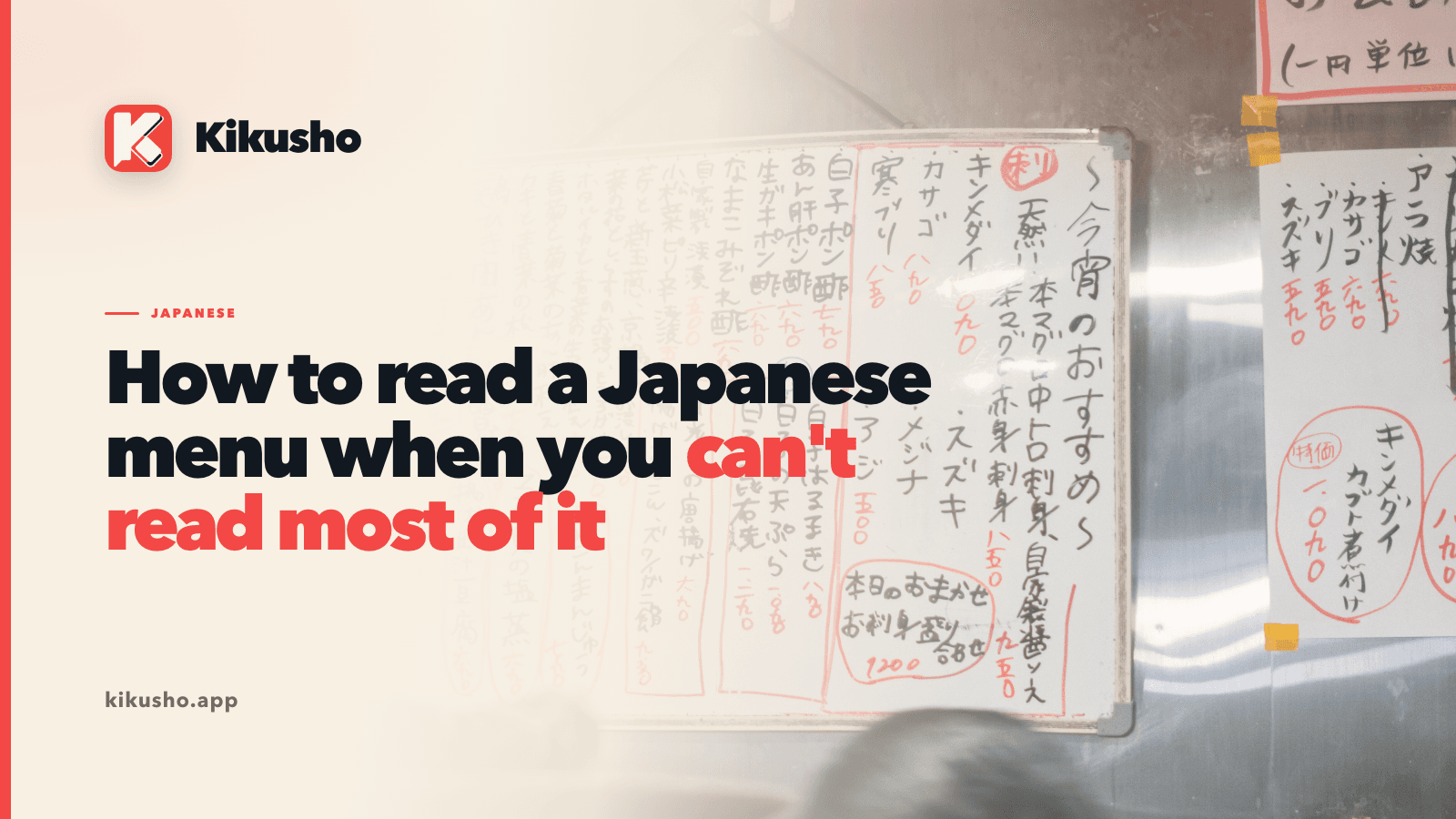
You don't need to read the whole menu: the price, a short list of repeating words, and a way to hold onto the one word that stops you.
11 August 2026
Keigo is not a second vocabulary. It is three levels, two productive patterns and about eight irregular verbs — here is how they fit together.
10 August 2026
The Japanese on signs, menus and in conversation is the vocabulary most worth keeping. Here is how to hold on to it without a study session.
10 August 2026
You forget new words because memory decays on a schedule, and because nothing brought you back at the right moment. Here is what changes that.
10 August 2026Sections
Kanji, readings, politeness levels and the practical mechanics of keeping Japanese vocabulary you meet in the wild.
33 articles →Every level, grammar and vocabulary apart: what each point does, where it stops, and which of two forms the sentence in front of you wants.
709 articles →Spaced repetition, memory, immersion and the habits that decide whether a word survives the week you met it.
15 articles →