On this page
まじき condemns something as unacceptable, especially in phrases such as あるまじき行為, “an inadmissible act”; ずして links an absent action to what follows, meaning “without doing.” Their classical ancestry explains the unfamiliar shapes, but the modern reading task is practical: find the noun being judged or the action left undone.
This is an N1 grammar lesson centred on まじき, classified at N1 by Bunpro and JapaneseTest4You. The accompanying ずして is a related formal reading pattern; the references inspected here establish its construction, without establishing a separate consensus JLPT level. These are study classifications, not an official exhaustive exam syllabus.
One form modifies a noun; the other leads into a clause
A writer who calls an action 研究者にあるまじき行為(けんきゅうしゃに あるまじき こうい)measures it against the standards expected of a researcher. The action may already be a fact. The writer's objection is that it should not be acceptable.
In 確認せずして判断する(かくにんせずして はんだんする), the relationship is different: someone judges without checking. Whether the writer approves, disapproves or simply describes that situation depends on the rest of the passage.
| Reading frame | What to look for |
|---|---|
| Role + にあるまじき + noun | The role whose standards are invoked, then the conduct or quality being judged |
| Role + としてあるまじき + noun | The same kind of judgment, explicitly framed as “in the capacity of” that role |
| 許すまじき + noun | An act or matter described as unforgivable |
| Verb stem + ずして + clause | What is absent, followed by the outcome or claim |
The dictionary entry for あるまじき treats it as a noun-modifying expression of inadmissibility. It is not a substitute for every English “cannot.”
Build each expression from the right form
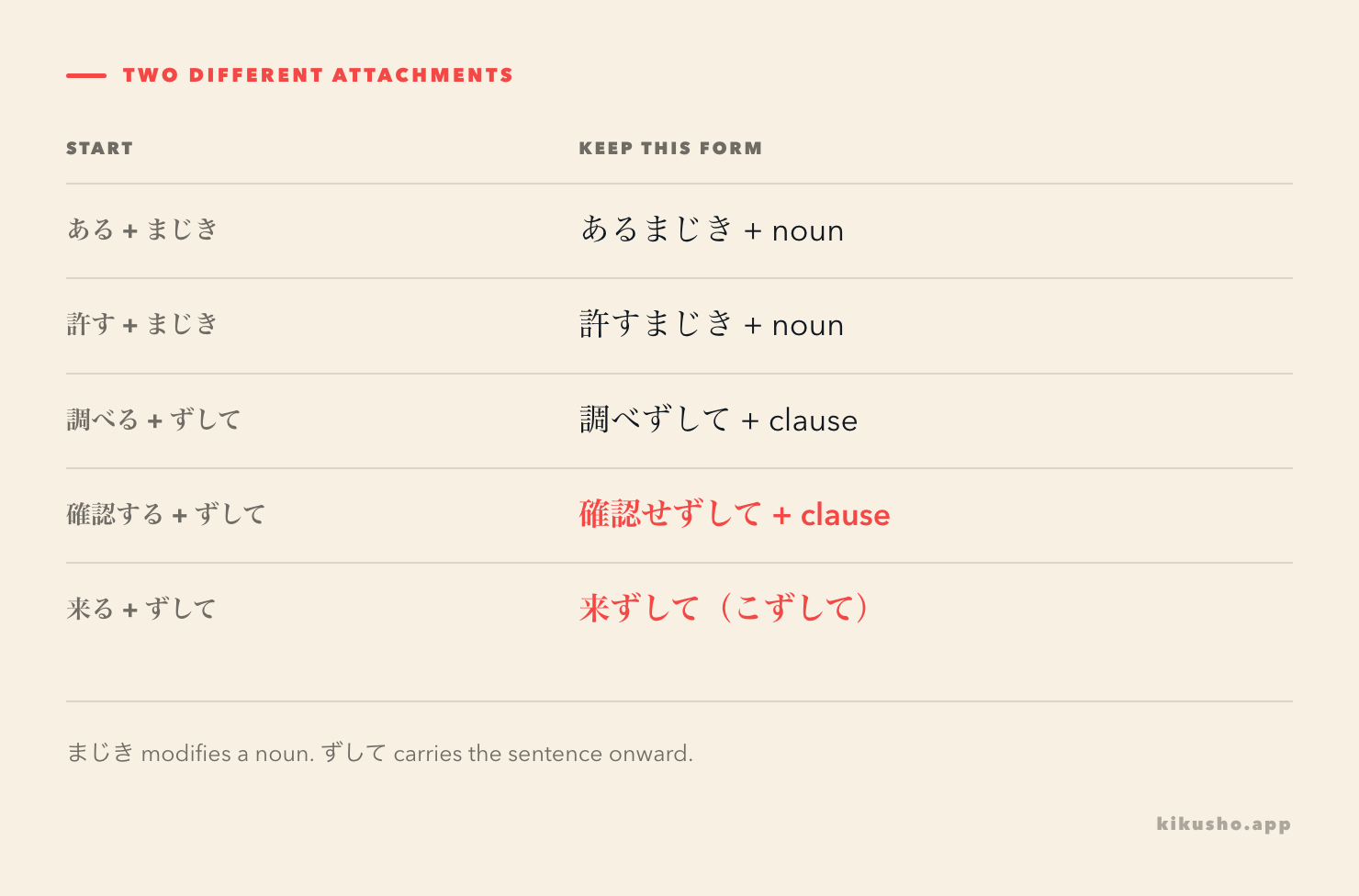
Keep ある in あるまじき
The dependable modern patterns are あるまじき and 許すまじき(ゆるすまじき). The verbs remain ある and 許す; you do not build these expressions by first making ない or the ます-stem.
| Starting material | Result | Reading |
|---|---|---|
| 研究者 + に + ある | 研究者にあるまじき行為 | けんきゅうしゃに あるまじき こうい |
| 責任者 + として + ある | 責任者としてあるまじき態度 | せきにんしゃとして あるまじき たいど |
| 許す | 許すまじき行為 | ゆるすまじき こうい |
Here まじき is the noun-modifying form of the classical auxiliary まじ. That explains why a noun follows it. Daijisen's historical entry records several meanings and inflected forms of まじ, including negative expectation and intention. This lesson teaches the surviving judgment construction, not the entire classical auxiliary system.
A learner reference may give the broad formula “dictionary-form verb + まじき.” Start with the established expressions above instead of attaching it freely to every verb in your vocabulary. The formula tells you something about attachment; it does not guarantee a natural modern collocation.
For ずして, identify the negative stem
For regular verbs, a useful route is to form the ない negative, remove ない, and add ずして. The stem itself is not negative: ず supplies the negation. With する, use せ, not the し of しない.
| Verb | Modern negative for reference | ~ずして |
|---|---|---|
| 読む(よむ) | 読まない | 読まずして(よまずして) |
| 買う(かう) | 買わない | 買わずして(かわずして) |
| 調べる(しらべる) | 調べない | 調べずして(しらべずして) |
| 確認する(かくにんする) | 確認しない | 確認せずして(かくにんせずして) |
| 来る(くる) | 来ない(こない) | 来ずして(こずして) |
The same ず stems appear in MIT's Japanese V notes, page 13, which explicitly distinguish せず and 来ず(こず). In ずして, the following して is connective; it does not undo the negative or mean that the missing action happened. The classical construction combines negative ず with connective して, as described in the dictionary entry.
Read the judgment in its situation
データを都合よく書き換えるのは、研究者にあるまじき行為だ。
データを つごうよく かきかえるのは、けんきゅうしゃに あるまじき こういだ。
Altering data to suit oneself is conduct unworthy of a researcher.
The role matters. A researcher has a responsibility toward evidence, and the sentence invokes that responsibility to condemn the act. Translating the phrase as “an act a researcher cannot do” would blur the distinction between capability and standards.
他人の作品を自分の作品として発表するのは、許すまじき行為だ。
たにんのさくひんを じぶんのさくひんとして はっぴょうするのは、ゆるすまじき こういだ。
Presenting someone else's work as one's own is an unforgivable act.
This second pattern condemns the act without naming a professional role. The noun still completes the expression. 行為 means “act” or “conduct”; 態度 in the formation table means “attitude.” They are natural kinds of noun for an evaluation of behaviour.
These are strong judgments. A minor preference about lunch does not normally call for the same language as a public denunciation. If a character uses it over something trivial, that exaggeration may be part of the joke or the character's manner.
Read both sides of ずして before deciding what happened
A negative continuation can state a necessary step
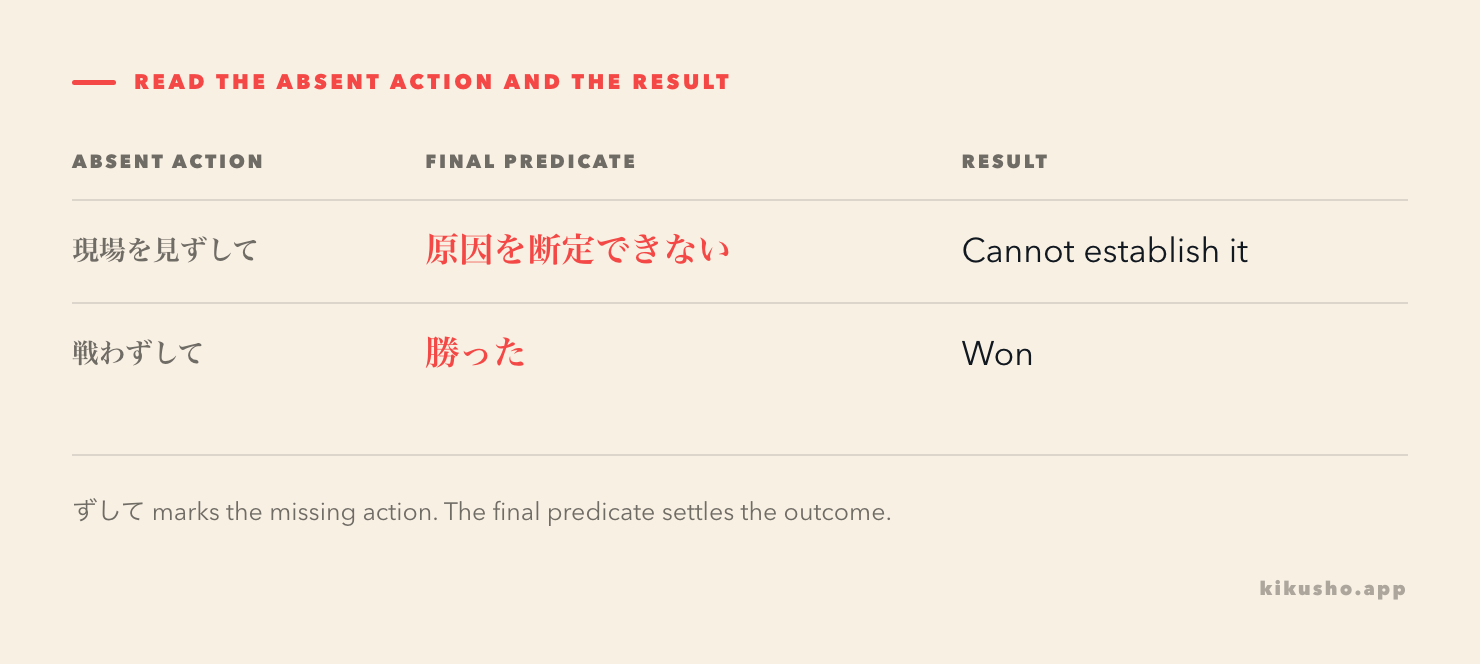
現場を見ずして、原因を断定することはできない。
げんばを みずして、げんいんを だんていすることは できない。
We cannot establish the cause definitively without seeing the site.
The absent action is seeing the site. The final できない supplies the inability to establish the cause. Together, the clauses say that inspection is necessary for the conclusion being claimed. They do not guarantee that an inspection will be sufficient: further evidence might still be needed.
Adding は after ずして can make the missing prerequisite more explicit as the condition under discussion: 現場を見ずしては、原因を断定することはできない。 IMABI's discussion of negative patterns notes the formal ずして(は) construction and distinguishes negative and affirmative contexts.
An affirmative continuation can report an outcome
相手が試合を辞退したため、私たちは戦わずして勝った。
あいてが しあいを じたいしたため、わたしたちは たたかわずして かった。
Because our opponents withdrew from the match, we won without competing.
Here the win occurred. 戦わずして says that the competition did not. Replacing “won” with “could not win” would reverse the result, even though the negative ず remains unchanged.
The distinction is visible in the two sentence endings below. There is no requirement for ずして itself to turn the entire sentence negative.
Formal weight is different from a polite ending
Both patterns suit literary or deliberate formal expression. They can occur in a written argument or a prepared speech; being formal does not make them impossible to say aloud. Nor does putting です after the noun make a condemnation gentle. あるまじき行為です still describes conduct as unacceptable.
For an ordinary explanation, you can paraphrase the first example as 研究者としてふさわしくない行為だ, “conduct inappropriate for a researcher.” 許すまじき行為 can become 許されない行為, “an act that cannot be excused.” The judgment survives even when you remove the classical ending.
For “without checking,” everyday 確認しないで conveys the missing action without the literary shape of 確認せずして. Keep the surrounding clause: “without checking” alone does not say whether the outcome happened, failed or should be avoided.
Related classical forms can point in a different direction altogether. べく and んがため mark purpose. Recognising an old-looking ending is only the beginning; you still have to identify its job in the sentence.
Two substitutions expose the common mistakes
A noun needs to follow まじき in the construction taught here. The completed predicate is あるまじき行為だ. Dropping 行為 to write あるまじきだ loses the noun that まじき modifies. Do not treat the ending as an ordinary な-adjective.
The する exception belongs before ず. 確認しずして is malformed; the required expression is 確認せずして. Read the whole unit before dividing it into familiar pieces. The して at the end is not a second positive action such as “check and then do.”
When a sentence feels severe, check whether the severity is in the judgment itself or simply in its register. The lesson on はず and べき separates expectation from obligation; that distinction also helps prevent reading every formal negative as a claim of impossibility.
For a phrase saved in Kikusho, retain the judged noun after まじき or the final predicate after ずして in the editable example. A text capture that stops halfway through either construction removes the part that settles its interpretation. Reviewing the complete example gives the ending a job to remember, alongside its register note.
Practice: five short decisions
Attempt all five questions before opening the shared answer section below.
Question 1: complete the noun modifier
The writer is condemning a responsible official's attitude. Fill the blank.
責任者にある( )態度だ。
- A. まじく
- B. まじき
- C. まじきな
- D. まじきの
Question 2: form the negative connection
Complete the formal expression using 確認する.
内容を確認( )、正しいとは言えない。
- A. しずしては
- B. するずしては
- C. せずしては
- D. したずしては
Question 3: reconstruct the sentence
Put all four parts into the blanks. Which part belongs in the starred position?
これは、__ __ ★ __だ。
- A. 行為
- B. あるまじき
- C. として
- D. 研究者
Question 4: follow the argument
筆者は調査の不足を指摘している。現場を見ずして、原因を断定することはできないという。したがって、まず現場で事実を確かめる必要がある。
Which continuation agrees with the writer?
- A. 原因を断定する前に、現場を見る必要がある。
- B. 現場を見なくても、原因を断定できる。
- C. 現場を見れば、必ず原因が分かる。
- D. 原因を調べること自体が禁止されている。
Question 5: keep the reported outcome
相手が試合を辞退した。その結果、私たちは戦わずして勝った。
Which reading fits the passage?
- A. We fought and lost.
- B. We refused to win.
- C. We had to compete before winning.
- D. We won although we did not compete.
Answers and explanations
Answer 1
B: まじき. The noun 態度(たいど), “attitude,” follows the noun-modifying form directly. Neither な nor の belongs between them, and まじく is not the required attributive form. The full sentence describes an attitude unworthy of a person in charge; 責任者 is せきにんしゃ.
Answer 2
C: せずしては. 確認する becomes 確認せずして, with は setting up the condition: without checking the contents, one cannot say that they are correct. None of し, する or した supplies the required stem before ず. 内容 is ないよう.
Answer 3
B belongs at ★. The sequence is D → C → B → A: これは、研究者としてあるまじき行為だ。 “This is conduct unworthy of a researcher.” として connects the role to あるまじき; 行為 is the noun being judged. The final だ completes the noun predicate.
Answer 4
A. The writer calls for seeing the site before making a definitive judgment about the cause. B removes the stated prerequisite. C overstates it: necessary does not mean sufficient. D invents a prohibition on investigation. The passage criticises insufficient investigation, not investigation itself. Read 調査 as ちょうさ, 不足 as ふそく and 事実 as じじつ.
Answer 5
D. The opponents withdrew, and the writer's side won without competing. 戦わずして identifies the action that did not happen; 勝った identifies the result that did. Nothing in the passage reports a loss, a refusal to win or a requirement to compete first. 辞退 is じたい, “withdrawal” here.
Common questions
Does まじき mean that something cannot physically happen?
In expressions such as 研究者にあるまじき行為, it judges conduct as unacceptable for someone in that role. It can condemn an action that has already happened. That is different from denying the possibility of an event.
Must ずして always be followed by a negative ending?
No. It marks an action or state that is absent. A negative continuation can make that absence a barrier to an outcome, while an affirmative continuation can say that the outcome occurred without the action.
Why does する become せずして?
The negative auxiliary ず takes the stem せ with する. Therefore 確認する becomes 確認せずして. The regular shortcut of removing ない from the modern negative would incorrectly produce し here.