On this page
The three connectors answer three different questions. あるいは asks which alternative applies, 及び(および) joins items that all apply, and それなら turns something already said into the premise for a reply.
郵送、あるいはメールで提出してください。
Please submit it by post or by email.
氏名及び住所を記入してください。
Please enter your name and address.
A: 午後は雨らしいよ。 B: それなら、午前中に出かけよう。
A: Apparently it will rain this afternoon. B: In that case, let's go out in the morning.
English may call all three “connections,” but the logic is alternative, addition or response.
Identify the relationship before choosing the word
Look at what stands on each side of the connector.
| Relationship | Connector | Basic shape | Core question |
|---|---|---|---|
| choice or possibility | あるいは | A、あるいはB | Which one might apply? |
| formal addition | 及び | A及びB | Which items both apply? |
| reaction to a premise | それなら | statement。それなら、response | What follows if that is true? |
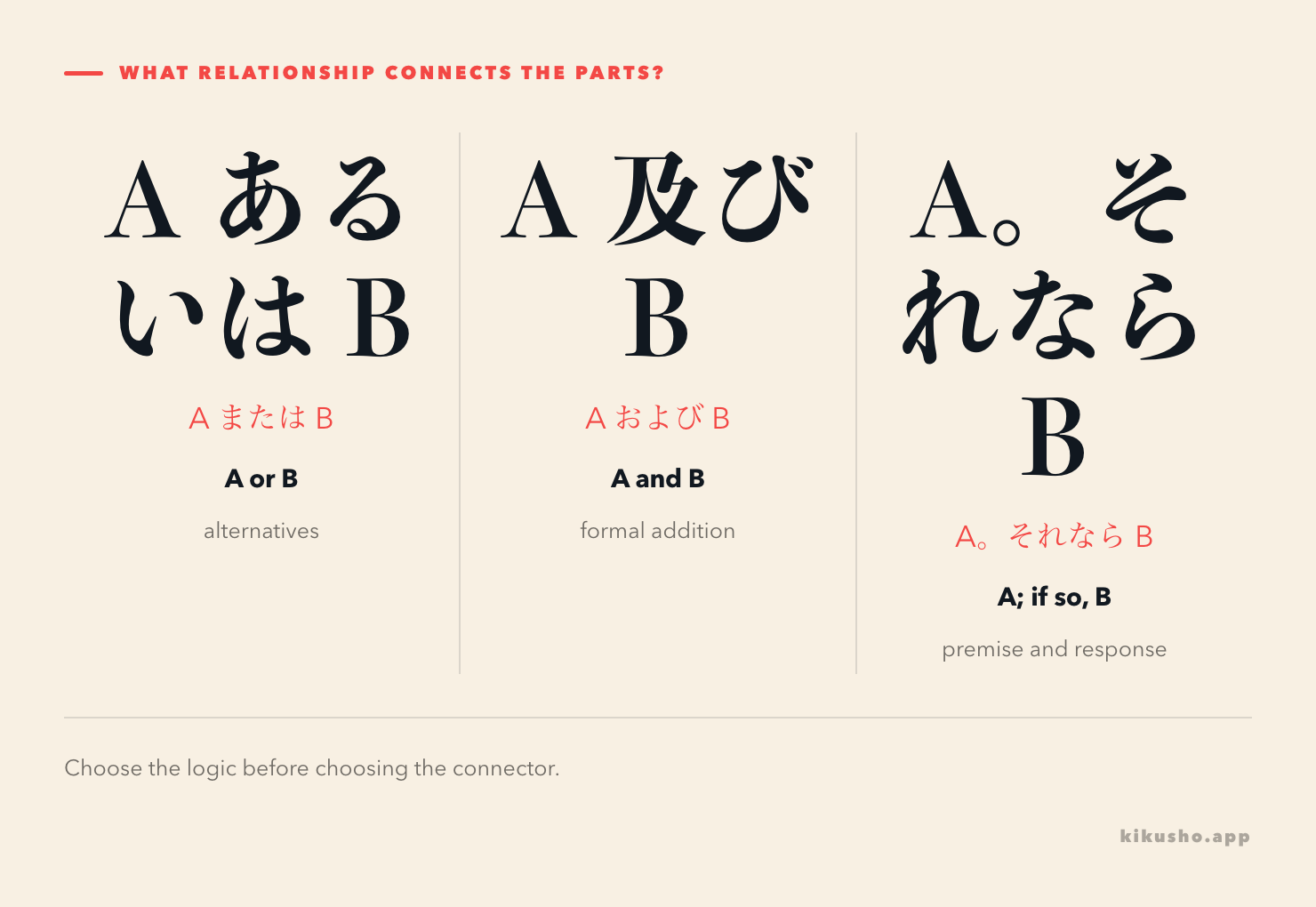
This test prevents a common translation error. 及び and あるいは can both sit between noun phrases in formal writing, but one includes both and the other offers a choice. それなら does not coordinate the phrases at all; it reaches back to a complete situation.
あるいは opens another possibility
As a conjunction, あるいは corresponds to “or” and presents B as an alternative to A.
申請書は窓口、あるいはウェブサイトから入手できます。
You can obtain the application form at the counter or from the website.
The alternatives can be nouns, phrases or clauses:
| Shape | Example | Meaning |
|---|---|---|
| N、あるいはN | 電話、あるいはメール | by phone or email |
| Vか、あるいはVか | 残るか、あるいは帰るか | whether to stay or go home |
| sentence。あるいは、sentence | 明日伺います。あるいは、来週でも構いません。 | I will visit tomorrow. Alternatively, next week is also fine. |
The register is more written and deliberate than the simple particle か. In ordinary conversation, コーヒーか紅茶 is lighter than コーヒー、あるいは紅茶. Formal instructions, explanations and careful proposals make the longer connector feel at home.
あるいは also has an adverbial use meaning “perhaps” or “possibly”:
あるいは、私の理解が間違っているかもしれない。
Perhaps my understanding is mistaken.
Here there is no visible A-or-B list. The alternative is a possibility the speaker introduces for consideration. An ending such as かもしれない often makes that reading clear.
Digital Daijisen's あるいは entry records both the choice use and the separate “perhaps” use. Its synonym comparison notes that または, もしくは and あるいは are literary alternatives to conversational か. JLPT Sensei places both uses at N2, while Bunpro lists the form at N3. That is a sequencing disagreement, not a difference in meaning.
及び keeps every listed item
及び(および) is formal “and.” It joins items that belong to the same list and are all included.
参加者の氏名及び連絡先を記入してください。
Please enter each participant's name and contact details.
No choice is offered: both the name and contact information are required.
本規則は職員及び契約者に適用されます。
These rules apply to employees and contractors.
You will meet 及び in forms, regulations, contracts, official notices, academic prose and formal invitations. In everyday speech, と, も or a て-form usually sounds more natural.
For three or more items, punctuation carries the earlier members and 及び commonly precedes the final one:
氏名、住所及び電話番号を記入してください。
Please enter your name, address and telephone number.
The spelling および is also common, especially under publication style guides that prefer hiragana for conjunctions. The kanji does not change the reading or logic.
Legal drafting sometimes uses 及び for smaller coordinate groups and 並びに for a larger grouping. That convention matters when reading statutes, but it should not be projected onto every ordinary notice. The formal written connectors guide shows that hierarchy with diagrams and also covers なお, ただし and すなわち. Shogakukan's dictionary entry for 及び confirms its coordinating use and broad formal range.
それなら turns prior information into a premise
それなら literally combines それ, pointing to what was just mentioned, with conditional なら. The following sentence is a conclusion, suggestion, decision or judgment made on that basis.
A: この道は工事中です。
B: それなら、別の道を通りましょう。
A: This road is under construction.
B: In that case, let's take another road.
The road closure is not one item in a list. B receives it as new information and adjusts the plan.
Common responses after それなら include:
| Response type | Example |
|---|---|
| suggestion | それなら、少し休んだほうがいい。 |
| decision | それなら、今回は参加しません。 |
| invitation | それなら、一緒に行きませんか。 |
| inference | それなら、まだ間に合うはずだ。 |
The expression is especially natural in dialogue because a second speaker can point straight back at the first speaker's news. One speaker can also use it across two sentences while revising a plan.
会議は延期になった。それなら、今日は資料を整理しよう。
The meeting has been postponed. In that case, I will organise the materials today.
Do not replace it with あるいは. The latter would introduce another possible option, while それなら accepts the postponement and tells us what follows from it.
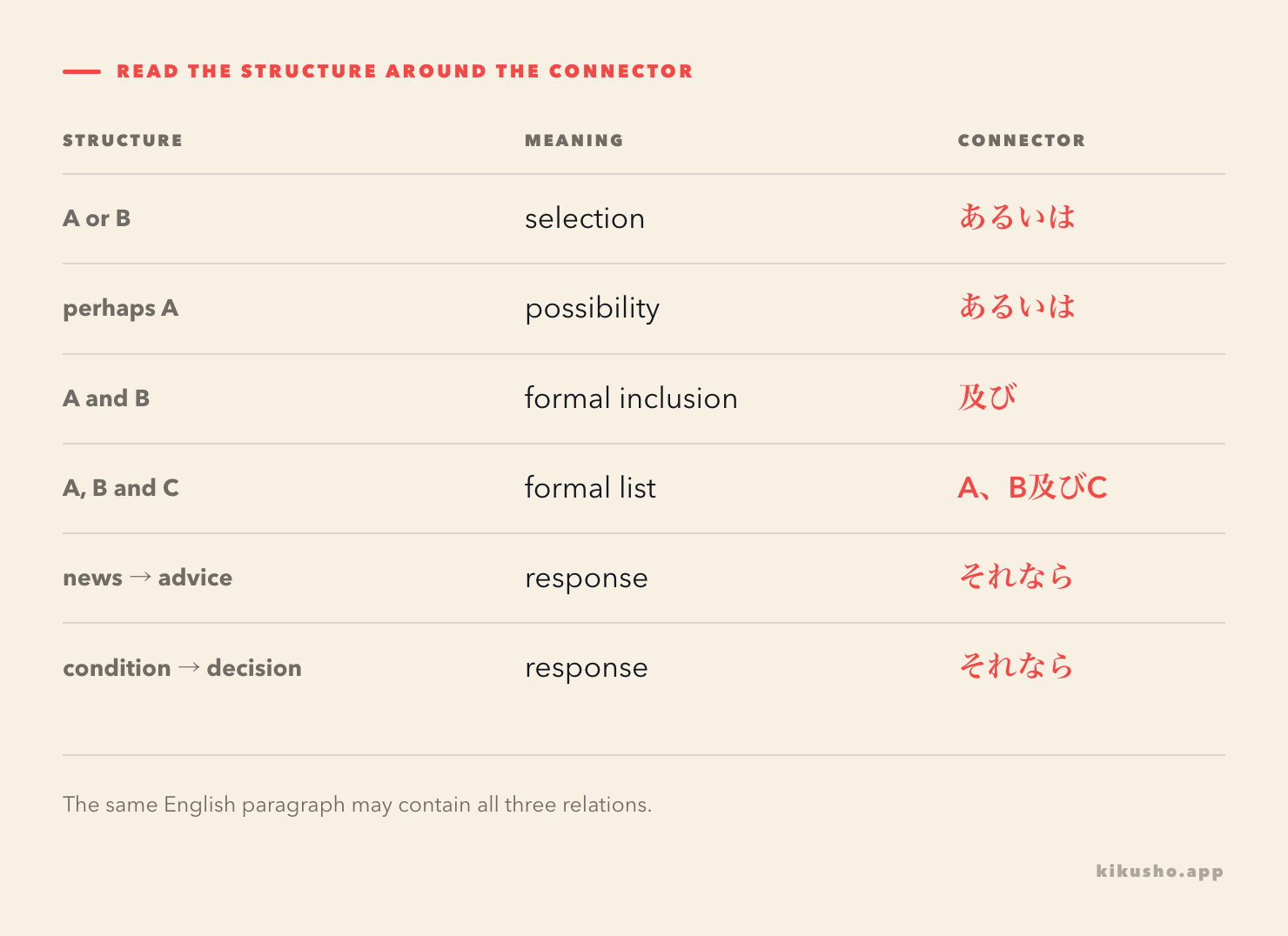
Bunpro's それなら entry describes this response to a specific previous condition and its frequent use before suggestions or considerations. JLPT Sensei independently places “if that is the case” at N2.
Do not confuse the connector with the attached conditional
Plain なら attaches directly to a topic or condition:
京都へ行くなら、秋がおすすめです。
If you are going to Kyoto, autumn is recommended.
それなら replaces that explicit condition with a pointer to the preceding discourse:
A: 秋に京都へ行くつもりです。
B: それなら、早めに宿を予約したほうがいいですよ。
A: I plan to go to Kyoto in autumn.
B: In that case, you should reserve accommodation early.
The ば and なら lesson explains why なら is good at responding to a condition already raised. それなら packages that same contextual logic as a sentence-opening connector.
The neighbouring alternatives also deserve clean boundaries. または is a common formal “or”; それとも normally links alternatives inside a question; conversational か joins compact choices. The でも, または, とか and など comparison separates a real choice from suggestions and representative examples.
When you save one of these in Kikusho, preserve enough context to reconstruct the relationship. A lone card reading それなら、帰ります cannot tell you what premise caused the decision. Keeping the preceding line turns the connector from a translation into a usable response.
Practice: follow the logical link
Question 1 — alternative or addition
The form accepts either online or postal submission. Choose the connector.
申請書はオンライン、__郵送で提出できます。
ア) 及び
イ) あるいは
ウ) それなら
エ) その上で
Question 2 — inclusive formal list
Both items are required on an official form.
氏名__住所を記入してください。
ア) あるいは
イ) それなら
ウ) 及び
エ) それとも
Question 3 — response to new information
A: バスはもう終わりました。
B: __、タクシーで帰りましょう。
ア) 及び
イ) あるいは
ウ) それなら
エ) なお
Question 4 — sentence composition
Arrange the chunks to say, “Perhaps my calculation is wrong.”
- 間違っている
- あるいは
- かもしれない
- 私の計算が
- 。
Question 5 — interpret the relationship
Which sentence requires both documents rather than offering a choice?
ア) パスポート、あるいは在留カードを提示してください。
イ) パスポート及び在留カードを提示してください。
ウ) パスポートです。それなら在留カードです。
エ) パスポートかもしれません。あるいは在留カードです。
Question 6 — connected text
Choose the pair that preserves both relationships.
受付には学生証( ① )本人確認書類をお持ちください。学生証をなくしたのですか。( ② )、先に事務室で再発行の手続きをしてください。
ア) ①及び ②それなら
イ) ①あるいは ②及び
ウ) ①それなら ②あるいは
エ) ①及び ②あるいは
Answers and explanations
Answer 1
イ) あるいは. Online and postal submission are alternatives; the applicant may use either route. 及び would state that both routes apply together.
Answer 2
ウ) 及び. The formal list requires a name and an address. Neither item replaces the other.
Answer 3
ウ) それなら. The end of bus service becomes the premise for suggesting a taxi. The connector points back to the other speaker's news.
Answer 4
2 → 4 → 1 → 3 → 5. あるいは、私の計算が間違っているかもしれない。 With no A-or-B list, sentence-initial あるいは introduces a possibility.
Answer 5
イ. 及び includes both the passport and residence card. Choice ア offers either document as an alternative.
Answer 6
ア) ①及び ②それなら. The reception requirement formally includes both kinds of identification. The loss of the student card then becomes the premise for advice about reissuance.
Common questions
What is the difference between あるいは, 及び and それなら?
あるいは presents alternatives, 及び formally joins items that all apply, and それなら accepts a previous statement as the premise for a response.
Can あるいは mean “perhaps” as well as “or”?
Yes. Between A and B it means “or.” Before a whole possibility, often with かもしれない, it can mean “perhaps” or “possibly.”
Is 及び used in conversation?
It can be understood, but it belongs mainly to formal lists in notices, forms, rules and official prose. Conversation normally uses と or も.
How is それなら different from なら?
なら attaches to a stated noun or clause. それなら stands at the beginning of a response and points back to the whole situation just mentioned.