On this page
VるだけはVた says that someone at least carried out the action, usually as far as they could, while treating the outcome as a separate question. In やるだけはやった, the repeated verb confirms the effort: “I did what I could,” often before an unstated or explicit “but.”
やるだけはやった。あとは結果を待とう。
やるだけは やった。あとは けっかを まとう。
I did what I could. Now let us wait for the result.
This N2 use is narrower than every phrase containing noun + だけは. これだけは覚えてください, “please remember at least this,” uses the ordinary limiting particle だけ plus contrastive は. The construction taught here repeats one verb around だけは and evaluates whether the action itself was done.
The action is secured; the result is not
The pattern divides a situation into two parts:
- Was the action carried out? Yes.
- Did it produce the desired result? That remains separate.
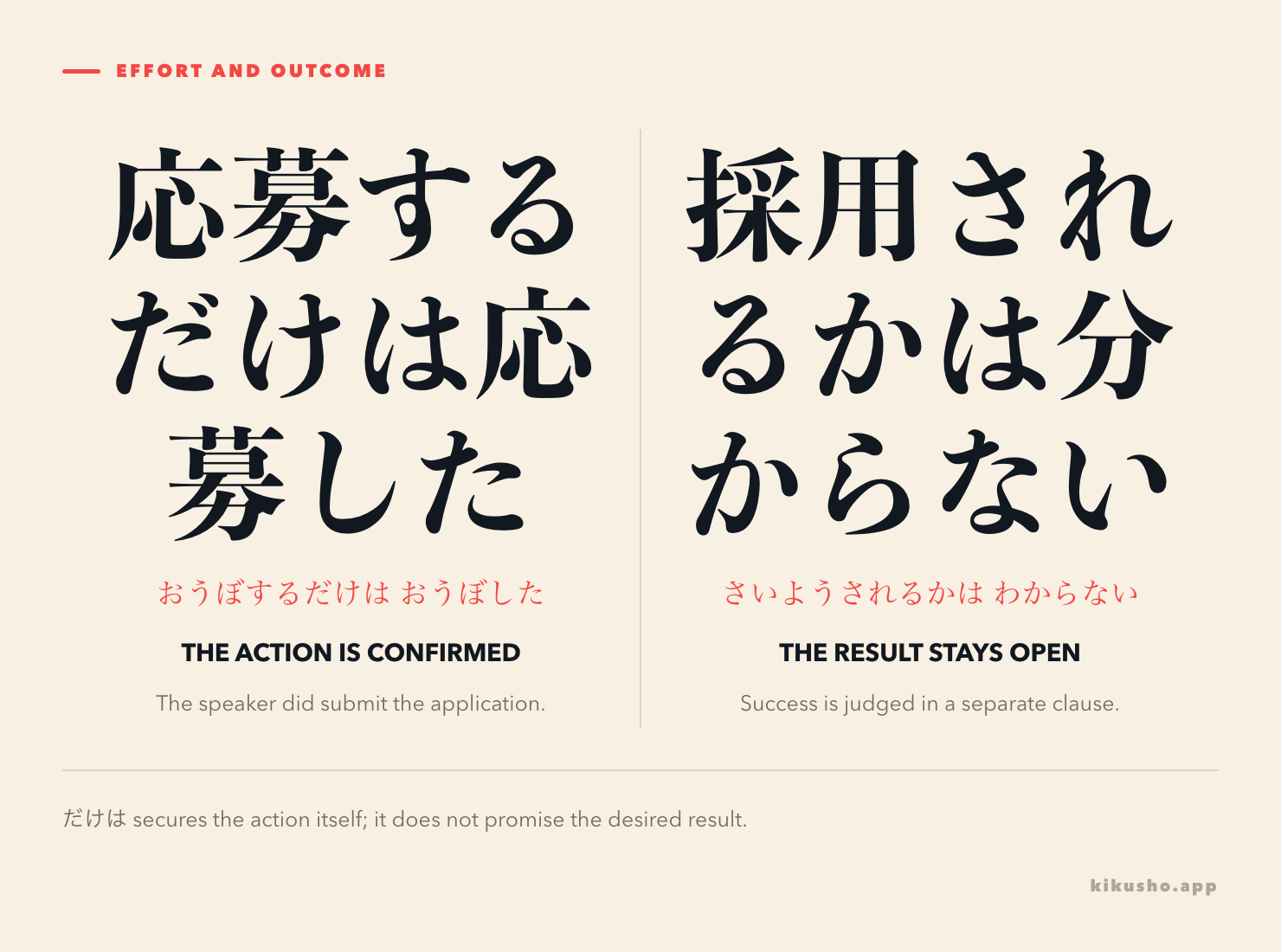
応募するだけは応募したが、採用されるかどうかは分からない。
おうぼするだけは おうぼしたが、さいようされるかどうかは わからない。
I did at least apply, but I do not know whether I will be hired.
The application is complete. The hiring decision is outside the speaker's control. This is why が, けれど and sentences expressing doubt, failure or waiting often follow the construction. They are natural companions, not required endings.
必要な資料は調べるだけは調べたので、後悔はない。
ひつような しりょうは しらべるだけは しらべたので、こうかいは ない。
I researched the necessary material as far as I could, so I have no regrets.
Here the second half is positive. The speaker still separates their effort from any later verdict, but does not announce a bad result. The construction does not itself mean failure, reluctant action or regret.
Build the repeated-verb form
The reliable shape is:
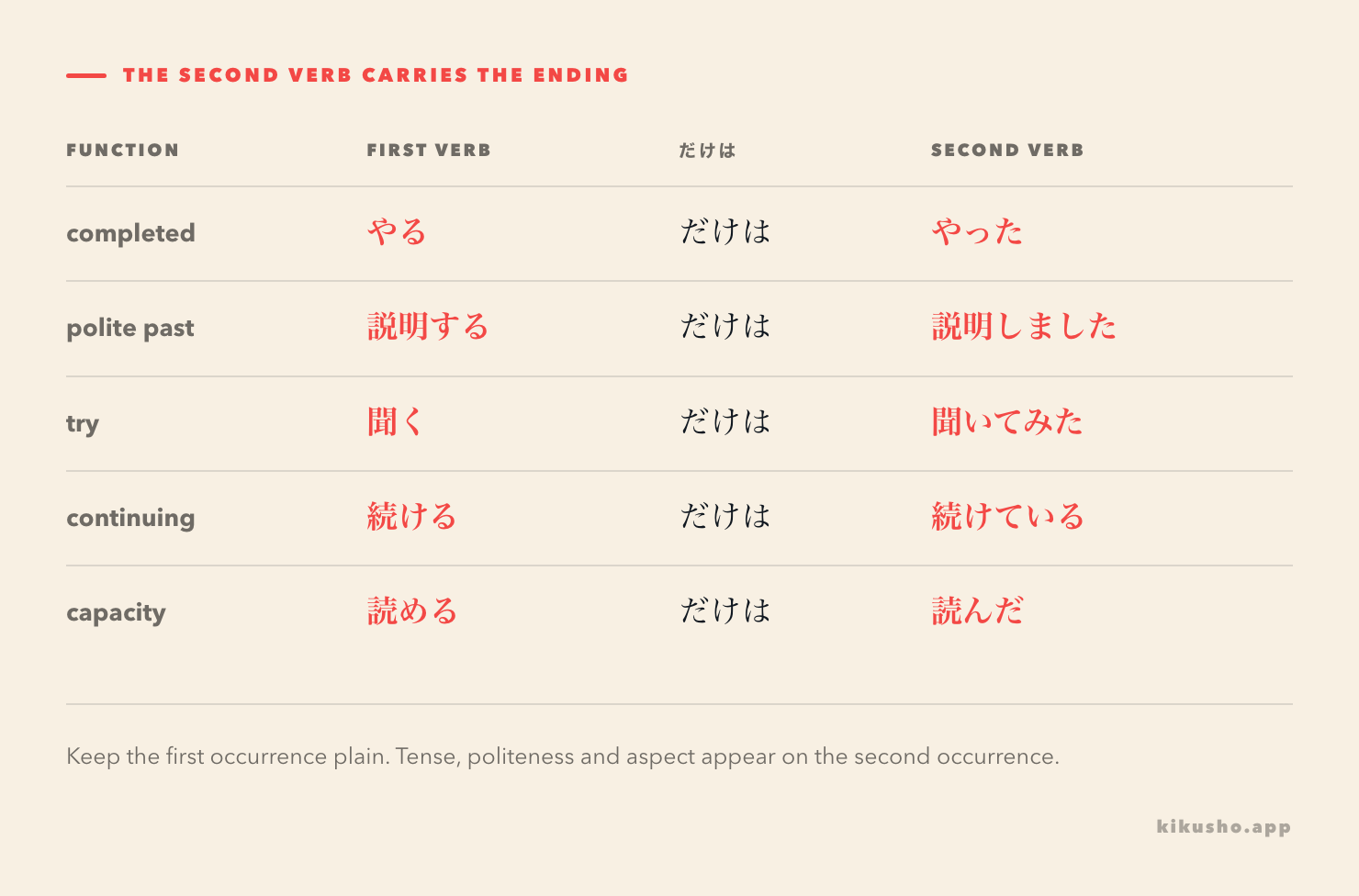
plain verb + だけは + the same verb carrying the sentence ending
| First part | Second part | Complete example | What is asserted |
|---|---|---|---|
| やる | やった | やるだけはやった | the doing was completed |
| 読む | 読んだ | 読むだけは読んだ | the reading was completed |
| 聞く | 聞いてみた | 聞くだけは聞いてみた | an attempt to ask was made |
| 続ける | 続けている | 続けるだけは続けている | the action is still being maintained |
| 食べられる | 食べた | 食べられるだけは食べた | the person ate as much as they could |
The first verb does not become polite. Put tense, politeness and aspect on the second occurrence:
説明するだけは説明しましたが、納得してもらえませんでした。
せつめいするだけは せつめいしましたが、なっとくして もらえませんでした。
I explained it as fully as I could, but I could not persuade them.
説明しますだけは説明しました is not the target form. The first 説明する modifies だけ, so it stays plain. The final 説明しました makes the sentence polite and past.
The repeated words must describe the same action. 探すだけは調べた does not instantiate this pattern, even though searching and investigating are related. Use 探すだけは探した or choose a different sentence.
Potential verbs make the upper limit explicit
A potential form before だけは states the person's actual capacity:
読めるだけは読んだが、専門用語が多くて半分しか理解できなかった。
よめるだけは よんだが、せんもんようごが おおくて はんぶんしか りかいできなかった。
I read as much as I could, but there were so many technical terms that I understood only half.
読める sets the upper boundary of what the person could manage; 読んだ reports the action. The second verb does not have to repeat the potential form. The contrast then judges comprehension, a different result.
Without a potential form, context supplies the scale. 探すだけは探した may mean that the speaker made the search that could reasonably be expected, not that every conceivable place in the world was checked. Avoid treating the expression as mathematical proof of maximum effort.
A verbal noun can appear in a shorter shape such as 準備だけはした, “I at least prepared.” That can fit the same effort-versus-result logic, but structurally it also resembles ordinary noun + だけは. The fully repeated form 準備するだけは準備した makes the N2 pattern easiest to identify.
What は adds to plain だけ
Plain だけ can mark the extent allowed by desire, opportunity or ability:
読みたいだけ読んだ。
よみたいだけ よんだ。
I read as much as I wanted.
時間のある間に、読めるだけ読んだ。
じかんの ある あいだに、よめるだけ よんだ。
I read as much as I could while there was time.
Adding は highlights the action as the part that can be affirmed even if something else cannot:
読むだけは読んだが、内容はほとんど覚えていない。
よむだけは よんだが、ないようは ほとんど おぼえていない。
I did read it, but I remember almost none of the content.
The difference is a tendency rather than a mechanical translation rule. VるだけVた can also imply that someone went as far as possible. The contrastive は makes the split between “the action happened” and “what came of it” easier to hear.
This differs from Vるだけだ, which closes a statement with “all that remains is to...” or “all one does is...”:
- 返事を待つだけだ。 All that remains is to wait for the reply.
- 聞くだけは聞いた。 I did at least ask.
The first has one occurrence of 待つ and presents a limited remaining action. The second repeats 聞く and confirms a completed attempt.
できる限り describes a policy, not a completed part
できる限り also means “as far as possible,” but it can state an intention, instruction or general policy without looking back at completed effort.
できる限り早く返事します。
できるかぎり はやく へんじします。
I will reply as soon as possible.
返事をするだけはしたが、相手には届かなかった。
へんじを するだけは したが、あいてには とどかなかった。
I did send a reply, but it did not reach the other person.
The first sentence promises a degree of speed. The second confirms the action and then reports a failed result. Choose by discourse timing: a policy points forward, while the repeated だけは form defends an effort that can already be identified.
The lesson on だけ and くらい explains ordinary limits and degree. だけで marks one input as sufficient for a result. If the point is a minimum the speaker still hopes for, せめて and 少なくとも separates that wish from a factual lower bound.
Level and register
JLPT Sensei and Bunpro both place the repeated-verb construction at N2. Bunpro records the standard register and the common shapes with a past or continuing second verb. The Tokyo University of Foreign Studies grammar module supplies the foundation: だけ can mark a limit or degree, while は adds contrast.
The expression works in conversation and writing. Politeness belongs on the second verb, so 確認するだけは確認しました can fit a workplace report. Its implication still depends on context: it may defend the speaker's effort, calmly separate duty from result, or prepare the listener for disappointing news.
These level labels are editorial teaching placements. The JLPT organisers do not publish an exhaustive current grammar list, so N2 identifies a useful study stage rather than an official guarantee about every appearance of だけ and は.
When you save 聞くだけは聞いてみた in Kikusho, keep both occurrences and the following contrast. A card containing only だけは loses the action being evaluated; a card ending before が、断られた loses the reason the speaker chose this form.
Practice: separate effort from outcome
1 · Complete the effort report
Choose the best completion: 必要な店には電話を__が、空いている部屋はなかった。
A. かけるだけだ
B. かけるだけはかけた
C. かけたいだけかける
D. かけるだけで
2 · Put politeness in the right place
Which sentence uses the target construction correctly in polite speech?
A. 確認しますだけは確認しました。
B. 確認しただけは確認する。
C. 確認するだけは確認しました。
D. 確認するだけ確認はしました。
3 · Read the implied contrast
A colleague says: 資料を読むだけは読みましたが、内容を説明する自信はありません。 What is confirmed?
A. The colleague understood every detail.
B. The colleague did read the material.
C. The colleague refused to read the material.
D. Reading the material guarantees a good explanation.
4 · Choose the expression for a future policy
You want to promise, “I will answer as quickly as possible,” without claiming that an attempt is already complete. Which sentence is best?
A. できる限り早く返事します。
B. 返事するだけは返事した。
C. 早く返事するだけだ。
D. 返事だけは早いです。
5 · Build the repeated form
Use 探す, だけは, and 探した to say: “I did look as thoroughly as I could, but I could not find the key.”
6 · Follow both halves of the passage
Read: 大会の前に練習するだけは練習した。毎朝走り、週末には長い距離も走った。しかし、本番では緊張して、目標の時間を切れなかった。 Which account is accurate?
A. The speaker did no training because the goal looked difficult.
B. The construction proves that the speaker achieved the target time.
C. The speaker confirms substantial practice, then contrasts it with the race result.
D. だけは restricts the speaker to training only on weekends.
Answers and explanations
1 · B, かけるだけはかけた. The same verb appears before and after だけは, and the past second verb confirms the calls. The following が introduces the unsuccessful room search. A says calling is all that remains, C describes an amount desired, and D needs a following result for its sufficient-means reading.
2 · C. The first occurrence stays in the plain form 確認する, while the second carries past politeness as 確認しました. A wrongly places ます before だけは. B reverses the temporal structure. D places は after the second verb and does not form the target pattern.
3 · B. 読むだけは読みました secures the act of reading. The final clause explicitly withholds confidence about explaining the content, so neither full understanding nor a guaranteed result follows.
4 · A. できる限り naturally states a future policy about degree or speed. B looks back at a completed reply, C says replying is the only remaining action, and D describes the reply itself as fast rather than promising maximum speed.
5 · 探すだけは探したが、鍵は見つからなかった。 The plain 探す sets up the action, 探した confirms that the search occurred, and the が clause separates that effort from the failed result. 鍵を見つけられなかった is also natural for the final clause.
6 · C. The repeated 練習するだけは練習した confirms sustained practice, which the next sentence details. しかし then contrasts that effort with missing the target time in the race. The form neither denies the training nor guarantees success.
Read the construction in two beats: first identify the action that the speaker can defend, then look beyond it for the result that is judged separately. That division is the work performed by だけは.
Common questions
What does VるだけはVた mean?
It says that the action was at least carried out, often as fully as the circumstances allowed, while leaving its result open. やるだけはやった means “I did what I could,” with a possible contrast such as “but it failed.”
Why is the verb repeated with だけは?
The first verb names the action as a limited topic, and the second verb asserts what happened to it. The first stays in a plain form; the second carries tense, politeness and additions such as みる.
What is the difference between やるだけはやった and やるだけやった?
Both can describe doing a large or sufficient amount. は gives the action contrastive focus, so やるだけはやった more readily separates completed effort from an uncertain, disappointing or separately judged result.
Is だけは N2 grammar?
JLPT Sensei and Bunpro both place this repeated-verb use at N2. These are study-resource estimates because the JLPT does not publish an exhaustive official grammar list.