On this page
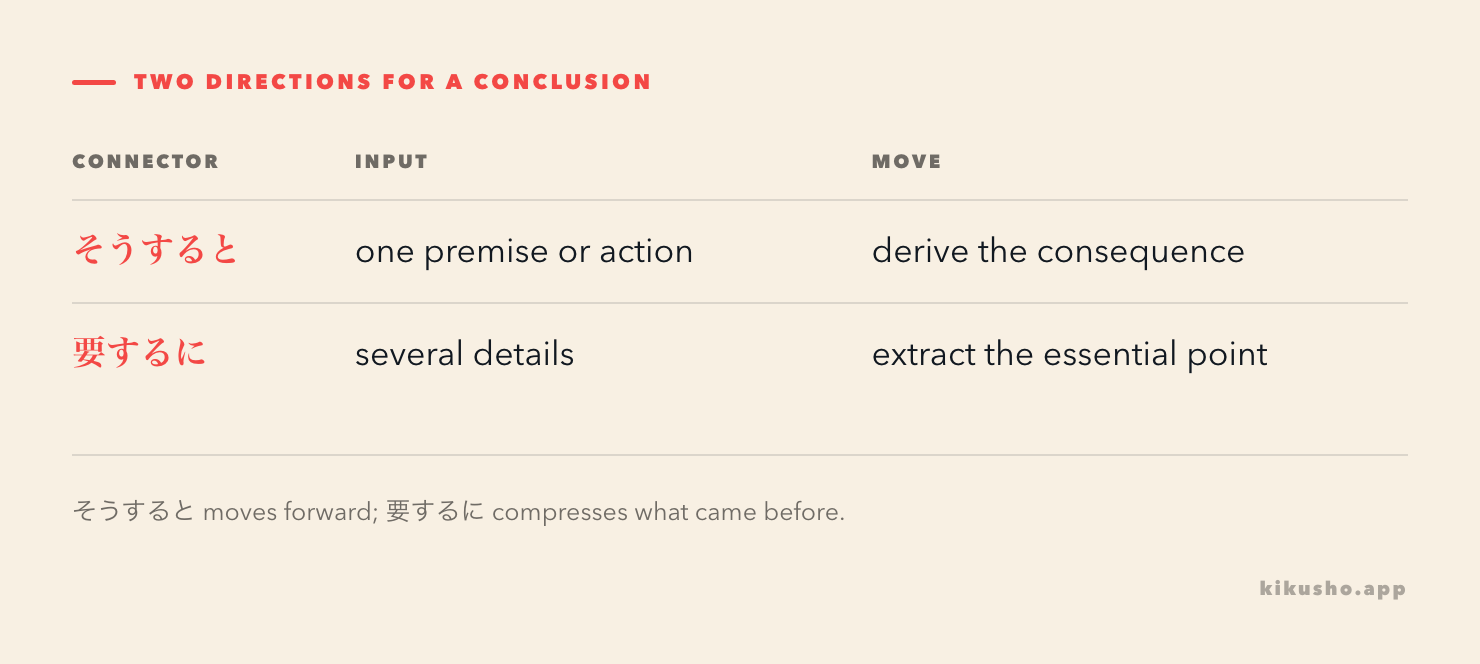
そうすると moves forward from a premise or action to its consequence: “if so,” “then” or “when that was done.” 要するに(ようするに) looks backward across an explanation and extracts its essential point: “in short.” One advances the reasoning; the other compresses it.
最終電車はもう出た。そうすると、今夜はここに泊まることになる。
さいしゅうでんしゃは もう でた。そうすると、こんやは ここに とまることに なる。
The last train has already left. If so, that means we will stay here tonight.
電車もバスもなく、タクシー代も足りない。要するに、今夜は帰れない。
でんしゃも バスも なく、タクシーだいも たりない。ようするに、こんやは かえれない。
There are no trains or buses, and we do not have enough for a taxi. In short, we cannot go home tonight.
The first passage derives a consequence from one fact. The second condenses several facts into the point the speaker wants the listener to retain.
The test: next consequence or essential point?
| Ask about the second statement | Choose | Direction |
|---|---|---|
| What happens or becomes true if the preceding situation holds? | そうすると | premise or action → consequence |
| What do all the preceding details amount to? | 要するに | details → concise takeaway |
Both expressions can open a new sentence and precede a complete phrase:
- A。そうすると、B。
- A、B、C。要するに、D。
Do not choose by translating both as “so.” With そうすると, B depends on A as its result or implication. With 要するに, D says less than the earlier explanation in order to make its main point clearer.
そうすると derives what follows
そうすると is built from そうする, “do so,” and conditional と. As a connector, it accepts the preceding action or situation and presents a result that follows from it.
午前の便に変更します。そうすると、昼までに大阪に着けます。
ごぜんの びんに へんこうします。そうすると、ひるまでに おおさかに つけます。
We will change to the morning service. If we do that, we can reach Osaka by noon.
Reaching Osaka by noon is enabled by the proposed change. The second sentence does not summarize what “changing services” means; it states the consequence of doing it.
The premise may be another person's information rather than an action:
A:田中さんは今日は休みだそうです。
たなかさんは きょうは やすみだそうです。
I hear Tanaka is off today.B:そうすると、会議は三人だけですね。
そうすると、かいぎは さんにんだけですね。
In that case, there will be only three people at the meeting.
B accepts A's information and calculates what follows. This inferential use often appears with ことになる, possibility forms, quantities or other consequences that arise from the premise.
Kotobank records both an event triggered by the preceding situation and a result that follows if the preceding matter is realized. JLPT Sensei likewise gives the sentence-opening そうすると + phrase pattern for “having done that” and “if that is done.”
そうすると can report what happened next
The relation does not have to be a prediction. In a past narrative, the speaker performs an action and then encounters a result or discovery.
窓を開けてみた。そうすると、外から音楽が聞こえてきた。
まどを あけてみた。そうすると、そとから おんがくが きこえてきた。
I tried opening the window. When I did, music came drifting in from outside.
The music is presented as what emerged after the action. This use is close to すると and そうしたら in narrative.
The conditional ancestry still matters. A consequence after そうすると is normally presented as arising naturally from the premise, rather than as the speaker's unrelated decision. Compare:
明日は全員休みです。それなら、私も休みます。
Everyone is off tomorrow. If that is the case, I will take the day off too.
それなら readily introduces a choice made in response. そうすると、私も休みます can sound as though the speaker's absence follows automatically from the others' absence. The exact boundary depends on context, but the useful default is to reserve そうすると for a consequence, inference or resulting event.
要するに extracts the main point
The verb 要する can mean “to require,” but the fixed adverb 要するに has a discourse job: it announces a summary of what has already been said.
この機械は古く、修理に時間がかかり、部品も手に入りにくい。要するに、交換したほうが安い。
この きかいは ふるく、しゅうりに じかんが かかり、ぶひんも てに はいりにくい。ようするに、こうかんしたほうが やすい。
This machine is old, repairs take time, and parts are hard to find. In short, replacing it would be cheaper.
The final sentence is not one event mechanically caused by the last detail. It is the speaker's compressed assessment of the whole explanation.
要するに can also clarify what another person appears to mean:
要するに、期限を延ばしてほしいということですか。
ようするに、きげんを のばしてほしいという ことですか。
In short, are you saying that you want the deadline extended?
The question asks whether the proposed summary captures the essential request. Because 要するに claims to identify the point, it can sound impatient when the other person has been speaking at length. Tone and relationship determine whether it feels helpful or abrupt.
Kotobank defines the expression as summarizing what has been said so far or putting it briefly. Bunpro and JLPT Sensei both give 要するに + phrase with “in short” and “to sum up.”
One meeting, two reasoning moves
Consider a discussion about changing the meeting time:
会議を午前九時に始めよう。そうすると、昼までに終えられる。
かいぎを ごぜんくじに はじめよう。そうすると、ひるまでに おえられる。
Let us start the meeting at nine. Then we can finish by noon.
午後は二人が不在で、会議室も使えない。要するに、午前中に開くしかない。
ごごは ふたりが ふざいで、かいぎしつも つかえない。ようするに、ごぜんちゅうに ひらくしかない。
Two people are absent in the afternoon, and the meeting room is unavailable. In short, we have no choice but to meet in the morning.
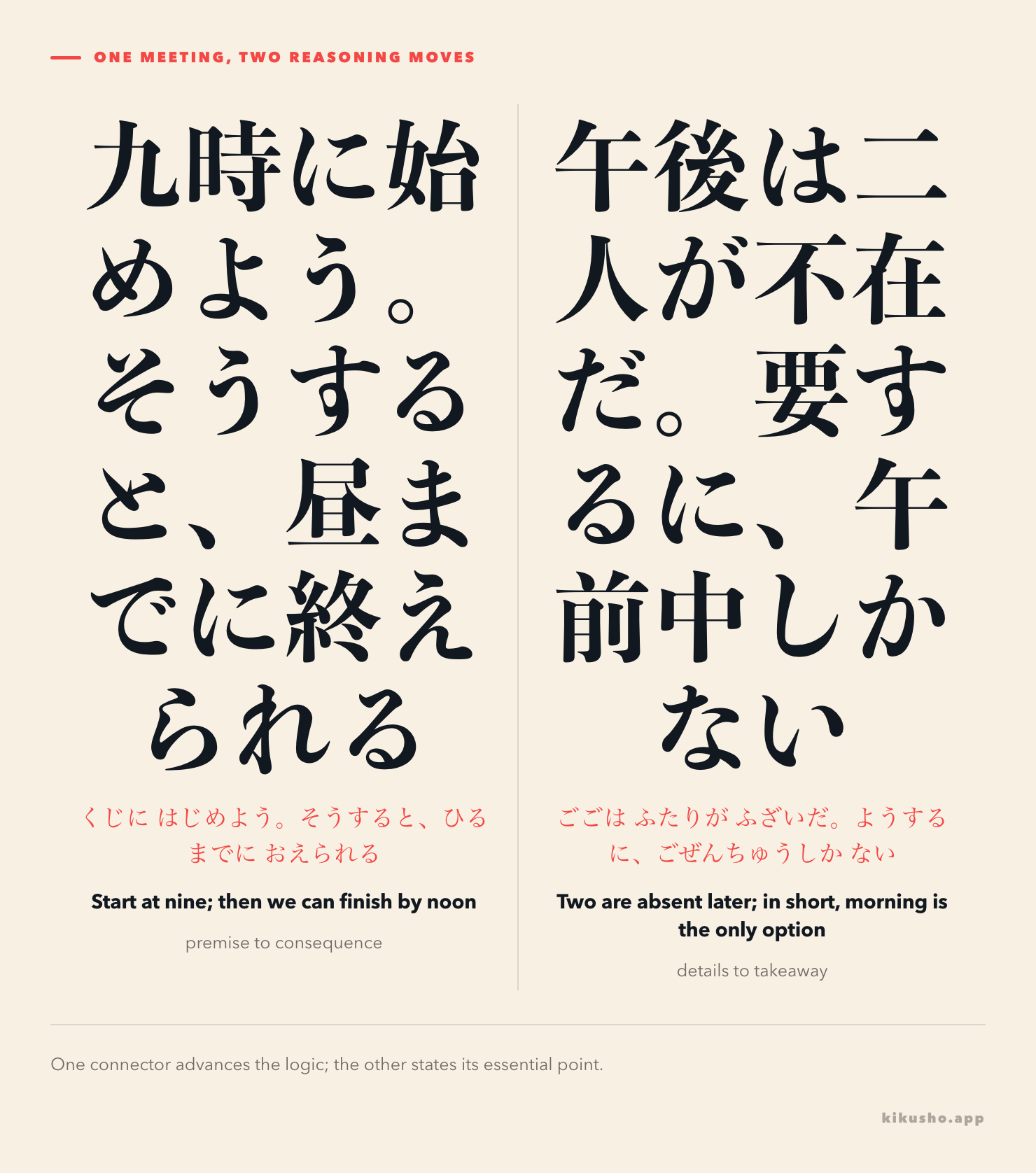
In the first passage, the morning start produces a useful consequence. In the second, the conclusion packages two constraints into the point of the discussion. Replacing そうすると with 要するに would wrongly present “finishing by noon” as a restatement of “starting at nine.” Replacing 要するに with そうすると would make the conclusion seem to follow only from the immediately preceding room problem, rather than summarize both constraints.
Where 要するに and つまり overlap
つまり can summarize earlier facts, so it often fits where 要するに does. The difference is emphasis. 要するに explicitly frames the next statement as the essential point extracted from a longer or more complex explanation. つまり is the wider everyday reformulation marker: it can summarize, interpret or simply restate one expression more clearly.
これは温度計だ。つまり、温度を測るための器具だ。
これは おんどけいだ。つまり、おんどを はかるための きぐだ。
This is a thermometer. In other words, it is an instrument for measuring temperature.
This is a direct reformulation, so つまり is natural. 要するに would suggest that the speaker is reducing a broader explanation to its key point, which is unnecessary after one simple definition. The すなわち and つまり lesson develops reformulation and summary without treating every conclusion as a causal result.
Likewise, その結果 reports an outcome produced by earlier circumstances. Unlike そうすると, it presents that result as established rather than reasoning from an adopted premise in the moment. The 結果, 結局 and そのため lesson places outcome, final outcome and reason-purpose links on separate tracks.
The level labels are study estimates
JLPT Sensei labels そうすると and 要するに as N2. Bunpro likewise labels 要するに N2 but catalogues そうすると under N3. That difference changes when the publishers teach the connector; it does not change its consequence relation.
No public official list settles the level of every grammar construction. Kikusho studies this pair here because longer N2 passages ask readers to see whether a conclusion follows from a premise or distills several details.
Practice: follow the direction of the reasoning
1 · Consequence of a change
Complete: 出発を一時間早めます。__、渋滞が始まる前に市内を出られます。
A. 要するに
B. そうすると
C. もっとも
D. 例えば
2 · Compress the explanation
Complete: 予算が足りず、人手もなく、期限も短い。__、今の計画は実行できない。
A. そうすると
B. その一方で
C. 要するに
D. そういえば
3 · A discovery after an action
Which sentence uses そうすると to introduce what happened after someone acted?
A. 要するに、鍵が必要だ。
B. ドアを押してみた。そうすると、ゆっくり開いた。
C. ドアは重い。もっとも、壊れてはいない。
D. 例えば、裏口から入る方法がある。
4 · Reformulation or summary
Which context most strongly favors つまり over 要するに?
A. One technical term is immediately restated in ordinary words.
B. Five scheduling problems are reduced to one recommendation.
C. A long discussion is condensed into its central disagreement.
D. Several costs are gathered into one final budget judgment.
5 · Build the consequence
Join these ideas with そうすると: “Move the appointment to the morning. Then Ms Sato can attend too.”
6 · Read the whole proposal
Read: 会場を駅の近くに変えよう。そうすると、参加者は歩く時間を減らせる。今の会場は遠く、バスも少なく、雨の日は移動が難しい。要するに、場所を変えるほうが参加しやすい。 Which account is accurate?
A. そうすると summarizes every problem, and 要するに reports an accidental discovery.
B. Both connectors simply rename the venue.
C. そうすると derives a benefit from the change, and 要するに condenses the reasons into a recommendation.
D. 要するに says the venue change automatically causes rain.
Answers and explanations
1 · B, そうすると. Leaving earlier creates the possibility of getting out before congestion. The second statement is a consequence of the proposed change.
2 · C, 要するに. Three constraints are collected into one essential judgment about feasibility. The conclusion summarizes the whole list.
3 · B. Opening the door is the action, and its movement is the event encountered afterward. The other sentences summarize, qualify or illustrate.
4 · A. A simple equivalent expression is ordinary reformulation, a central use of つまり. The other contexts explicitly extract one essential point from several details, which suits 要するに.
5 · 予約を午前中に変更しましょう。そうすると、佐藤さんも参加できます. The morning appointment is the premise, and Sato's ability to attend follows from it. Other natural wording is acceptable if the same consequence remains explicit.
6 · C. The first connector advances from the proposed relocation to one benefit. The second looks back across distance, limited buses and bad-weather difficulty, then states the proposal's essential case.
To read either connector accurately, draw its arrow. そうすると points from what was just accepted toward what follows. 要するに points from a wider stretch of text toward a shorter statement that preserves only its main point.
Common questions
What is the difference between そうすると and 要するに?
そうすると takes a premise, action or situation and introduces what follows from it. 要するに gathers earlier information and states its essential point.
Can そうすると describe a past discovery?
Yes. After a deliberate action, そうすると can introduce the event or discovery that occurred next, much like “when I did that.”
Is 要するに the same as つまり?
They overlap in summaries. 要するに explicitly signals that the speaker is extracting the essential point, while つまり also handles ordinary reformulation and interpretation.
Are そうすると and 要するに both N2 grammar?
JLPT Sensei places both at N2. Bunpro places 要するに at N2 but そうすると at N3, so the teaching order is disputed.