On this page
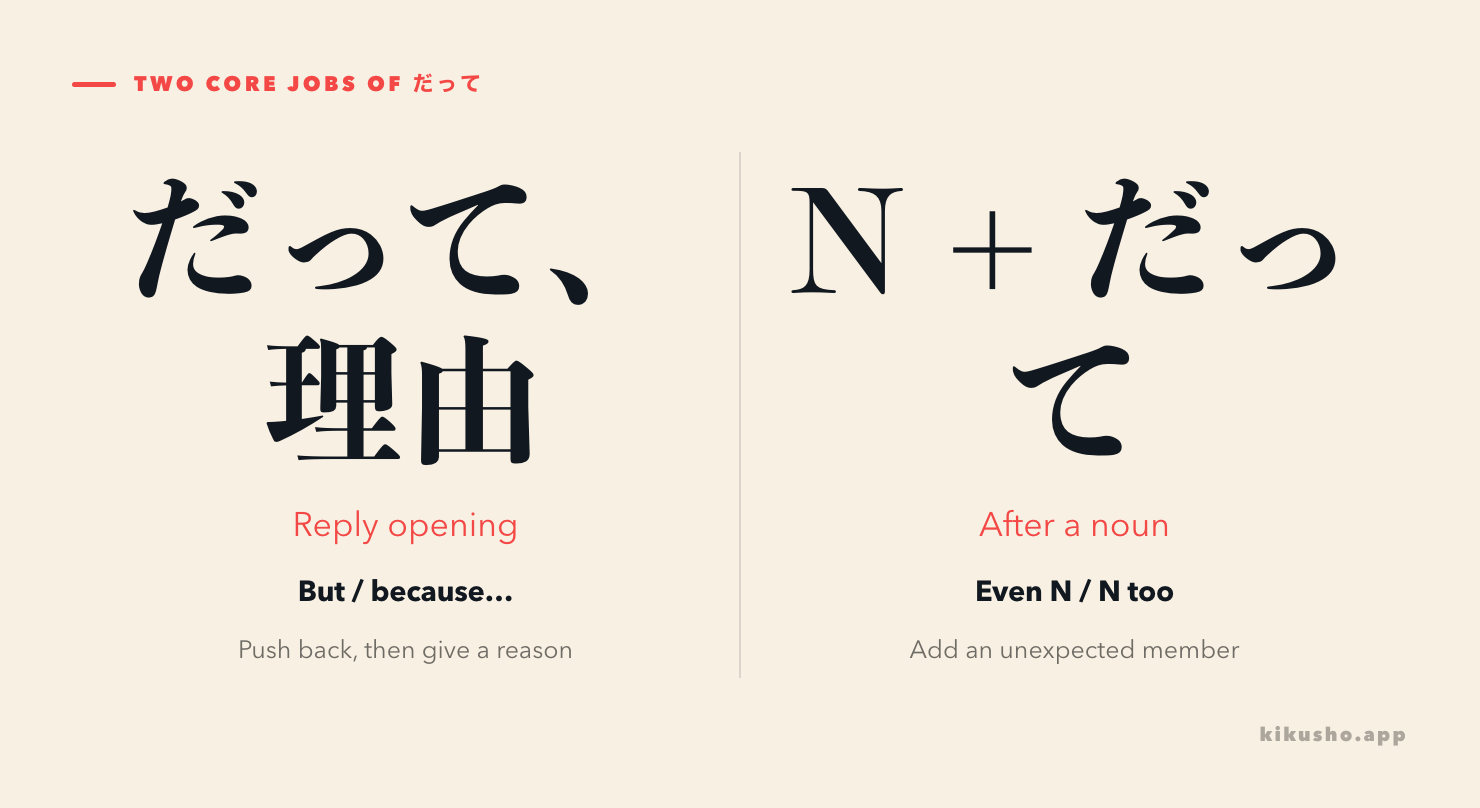
Use だって at the beginning of a reply to introduce a casual objection or justification: だって、時間がなかったんだもん means “But I didn't have time.” Put だって directly after a noun or nominal phrase to include it emphatically: 私だって緊張する means “I get nervous too” or “Even I get nervous.”
Those two positions do different jobs. Sentence-initial だって answers pressure from another speaker; noun + だって pulls one person, thing, place or occasion into a set. The same spelling also appears in hearsay and concession patterns, so position and sentence structure matter more than a single English translation.
JLPT Sensei lists broad だって at N2, while Bunpro places its core conversational entry at N3. That disagreement reflects editorial grouping: the test maker does not provide an exhaustive vocabulary, kanji and grammar list, as the official JLPT FAQ explains. For N2 reading and listening, the practical target is to identify the job だって performs in context.
Position chooses the job
Start by locating だって. If it opens a reply and a reason follows, read it as an objection or justification. If it follows a noun-like expression and the sentence continues to a predicate, read it as emphatic inclusion. If it ends a clause after ん/なん, test a hearsay reading. If it follows a past-shaped verb or adjective and the result remains unchanged, test a concessive “even if” reading.
| Shape | Main job | Example | Natural reading |
|---|---|---|---|
| だって、理由 | objection or justification | だって、知らなかった。 | But I didn't know. |
| N/nominal phrase + だって | emphatic inclusion | 私だってできる。 | I can do it too / Even I can do it. |
| clause + んだって | casual hearsay | 明日は休みなんだって。 | I heard tomorrow is a day off. |
| Vた/Aく + たって | casual concession | 雨が降ったって行く。 | I'll go even if it rains. |
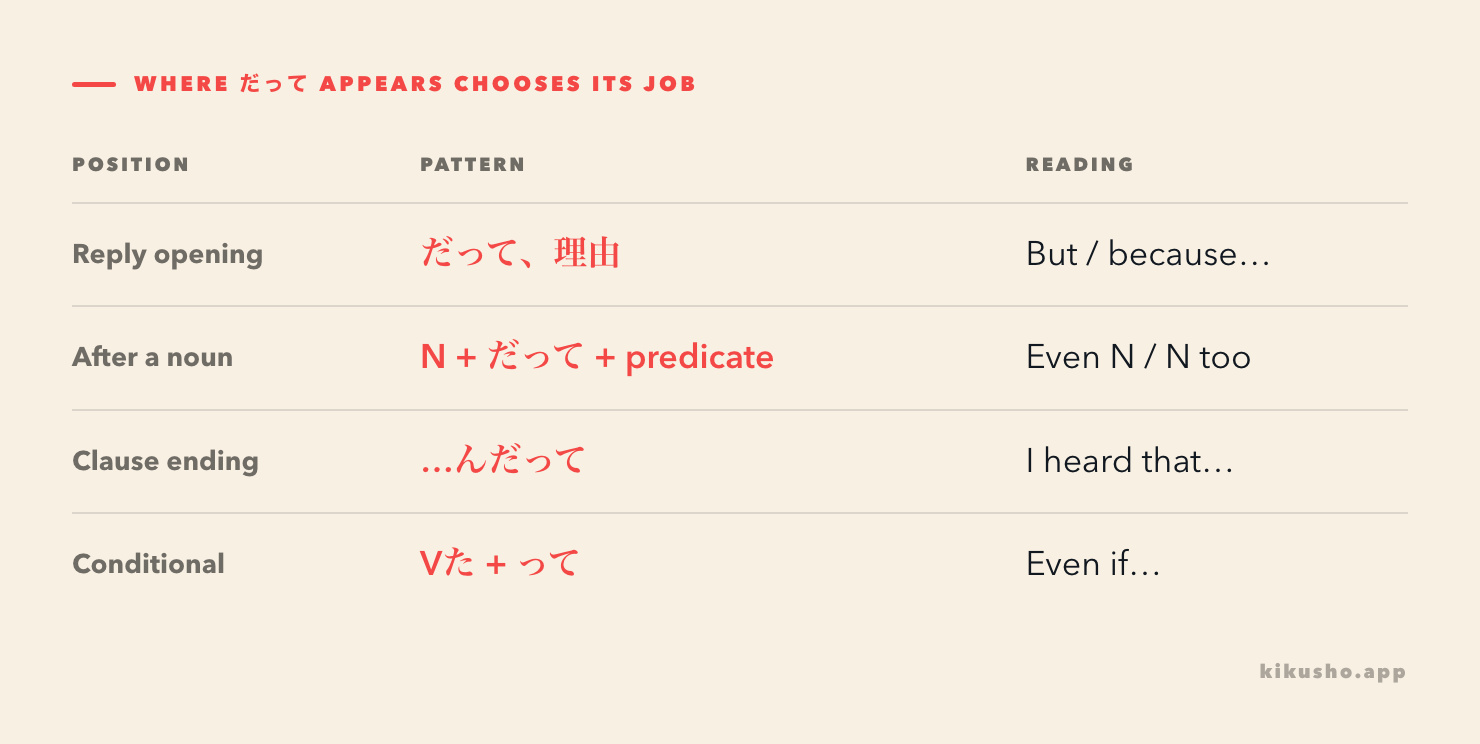
This map is a decision aid rather than a claim that every spoken sentence is mechanically unambiguous. A short line can depend on the previous turn and the speaker's emphasis. Still, locating the form rules out many wrong readings before translation begins.
Sentence-initial だって answers pressure
Sentence-initial だって commonly appears after a question, criticism, request or command. The speaker resists the other person's assumption and supplies a reason or counterpoint. A Japanese dictionary entry on Kotobank describes this conjunction as answering with an objection or giving a reason while anticipating opposition.
A: どうして来なかったの?
Why didn't you come?B: だって、誰も時間を教えてくれなかったんだもん。
But nobody told me the time.
The だって does not merely connect two facts. B reacts to the accusation contained in A's question. The ending んだもん reinforces the personal justification. You can study that stance family in もの, もん, ものか and ものがある.
Another reply can state a practical obstacle:
A: 今から内容を変更できる?
Can you change the content now?B: だって、もう印刷したんだから、難しいよ。
But we've already printed it, so that would be difficult.
Here だって presents “we already printed it” as the reason the request is difficult. English may favor “but,” “because,” or “after all,” depending on how the surrounding turns are translated. The stable Japanese function is a reply that pushes back by introducing the speaker's grounds.
This use is conversational. It can sound defensive, petulant or childlike when the speaker refuses responsibility, especially with もん, but adults also use it in relaxed conversation. Tone and relationship decide the effect. Beginning a client email with だって、予算が足りません would sound abrupt; a neutral explanation such as 予算が不足しているため、対応が難しいです fits formal communication better.
PassJapanese's N2 explanation focuses on this response pattern and notes its frequent pairing with もの/もん and んだから. Learn the whole exchange rather than memorizing だって = because. Outside a response, that one-word translation can lead you to invent unnatural sentences.
Noun + だって brings one member into the set
After a noun or nominal phrase, だって can function like an emphatic でも: it adds the marked item to a set, often against an expectation. Context determines whether English sounds better with “even” or “too.”
私だって緊張する。
I get nervous too. / Even I get nervous.
初心者だって参加できます。
Even beginners can participate.
The first example rejects the idea that the speaker is exempt from nervousness. The second says that beginners belong inside the group of people who can participate. Both share one logic: the noun before だって is included despite an assumption that might leave it out.
The marked phrase can contain a case particle:
ここからだって富士山が見える。
You can see Mount Fuji even from here.
私にだってできる。
Even I can do it.
In ここからだって, から still marks the viewpoint or starting place; だって adds “even from this place.” In 私にだって, に remains part of the phrase selected by できる. Do not delete the case particle merely because だって follows it.
Question words and quantities can remove exceptions
With an interrogative word, だって often produces a no-exception meaning. 誰だって includes every person, いつだって includes every time, and どこでだって includes every place allowed by the predicate.
誰だって失敗する。
Everyone makes mistakes.
困ったときは、いつだって連絡してください。
Contact me anytime when you need help.
この仕事なら、どこでだってできる。
This work can be done anywhere.
Quantities behave similarly, but polarity changes the natural English result:
一度だって約束を忘れたことはない。
I have never forgotten a promise, not even once.
何度だって挑戦する。
I'll try again as many times as it takes.
The negative predicate in the first sentence excludes every possible occasion, including one single time. The positive determination in the second accepts any number of attempts. Instead of memorizing two unrelated translations, read だって as emphatic inclusion and let the question word, number and predicate supply the final interpretation.
Keep the three lookalikes apart
The most useful boundary is between nominal inclusion and clause-final hearsay. Compare:
子どもだって分かる。
Even a child understands.
子どもなんだって。
I heard they are a child. / Apparently, it is a child.
In the first sentence, 子どもだって is followed by the predicate 分かる; the child is included among those who understand. In the second, なんだって closes the report. The explanatory ん, with な after a noun, is the visible hearsay clue. Review that information path in っけ and んだって.
Concessive ~たって creates another overlap:
雨が降ったって行く。
I'll go even if it rains.
高くたって買う。
I'll buy it even if it is expensive.
冗談だって言ってはいけない。
You must not say it, even as a joke. / Even if it is a joke, you must not say it.
The verb 降った and い-adjective 高く reveal the concessive formation. Nouns and な-adjectives can surface as だって, so a line like the third example may allow an inclusion-flavored translation as well. Ask whether the sentence adds a member to a set or grants a condition while keeping the result unchanged. ~たって and ~ても構わない develops that concessive system.
The four-way test is therefore practical: sentence opening plus a reason signals objection; a noun-like phrase followed by a predicate signals inclusion; clause-final んだって/なんだって signals reported information; and a past-shaped or adjective-shaped condition followed by an unchanged decision signals concession.
For a Kikusho card, save one line of context with だって. A bare card reading “だって = but / because / even / too” hides the decision you actually need to make. A two-turn exchange preserves the pressure behind sentence-initial だって, while a complete predicate reveals which set noun + だって is expanding.
Practice: locate the form before choosing a meaning
Commit to a reading for each of the six situations first. Open the key only after you have used position and sentence structure to justify every choice.
Question 1 — grammar choice. A friend asks why you did not call. Which reply most naturally introduces a defensive reason?
- だって、電話番号を知らなかったんだもん。
- 私だって電話番号を知っている。
- 電話番号を知っているんだって。
- 電話番号を知ったって電話しない。
Question 2 — grammar choice. Complete “Even beginners can understand this explanation”: 初心者__この説明が分かります。
- んだって
- だって
- だったって
- だって、
Question 3 — text grammar. Read 田中さんは来週休むんだって。 Is だって introducing an objection, marking emphatic inclusion, or closing a hearsay report? Name the structural clue.
Question 4 — grammar choice. Which sentence means “You can see the stage even from here” while preserving the particle から?
- ここだってから舞台が見える。
- ここからんだって舞台が見える。
- ここからだって舞台が見える。
- だって、ここから舞台が見える。
Question 5 — sentence composition. Arrange 私/だって/緊張する into a natural sentence meaning “I get nervous too.” Then explain what set the marked person joins.
Question 6 — text grammar. Read the exchange: A: もう帰るの? B: だって、明日は六時に起きるんだもん。誰だって少しは寝たいでしょう。 Identify both uses of だって and explain why neither one is hearsay.
Answers and explanations
Answer 1: 1. だって opens B's reply and introduces the reason “I didn't know the phone number.” んだもん reinforces the personal justification. Choice 2 marks 私 for inclusion, choice 3 reports something heard, and choice 4 uses concessive ~たって.
Answer 2: 2, だって. 初心者だってこの説明が分かります includes beginners among the people who can understand, despite a possible expectation that they cannot. No explanatory ん is needed because this is not clause-final hearsay.
Answer 3. It closes a hearsay report: “I heard Tanaka will take next week off.” The clue is 休むんだって at the end of the clause, where the plain verb is followed by explanatory ん and だって.
Answer 4: 3. ここからだって舞台が見える keeps から inside the marked phrase and adds emphatic inclusion: this location is also sufficient, even if it seems unlikely. Choice 4 would instead begin a response with “But…”.
Answer 5. 私だって緊張する。 The marked person 私 joins the set of people who become nervous. Depending on the previous claim, English can say “I get nervous too” or “Even I get nervous.”
Answer 6. The first だって begins B's justification for leaving: B has to wake at six. 誰だって is emphatic inclusion with a question word, producing “everyone” or “anyone”: nobody is exempt from wanting sleep. Neither form ends a reported clause after ん/なん, so hearsay is not the right reading.
Common questions
What does だって mean in Japanese?
At the beginning of a reply, だって can introduce a casual objection or justification, like “but” or “because.” Directly after a noun or nominal phrase, it can mark emphatic inclusion, like “even” or “too.”
What is the difference between だって and んだって?
Sentence-initial だって objects or gives a reason, while noun plus だって includes that noun emphatically. Clause-final んだって or なんだって usually reports something the speaker heard.
Is だって formal Japanese?
No. The objection or justification use is conversational and can sound defensive or childlike in some situations. Emphatic noun plus だって is also common in speech, so neutral formal alternatives are safer in business prose.