On this page
Use どうせ when the speaker already treats an outcome or situation as fixed: 今から出ても、どうせ間に合わない means “Even if we leave now, we won't make it anyway.” When that accepted fact becomes the basis for a better choice, use どうせ~なら/のなら: どうせ待つなら、座って待とう means “If we're waiting anyway, we might as well sit down.”
The English word “anyway” is broader than どうせ. Japanese どうせ adds a judgment: different efforts, routes or objections will not change the relevant fact. That judgment can produce pessimism, but it can also clear the way for a practical decision.
Both JLPT Sensei and Bunpro place どうせ at N2. This agreement is useful evidence for study order, though the JLPT itself does not publish an exhaustive grammar syllabus.
どうせ is an adverb, so there is no conjugation table
どうせ does not attach to one special verb form and does not conjugate. It usually comes before the phrase whose outcome the speaker regards as settled. The following predicate can be plain or polite, affirmative or negative, present or past.
どうせ彼は来ない。
He won't come anyway.
どうせ結果は同じです。
The result will be the same in any case.
何を言っても、どうせ信じてもらえなかった。
Whatever I said, nobody believed me anyway.
The surrounding clause may state the alternatives that fail to change the outcome: 今から出ても, “even if we leave now,” or 何を言っても, “whatever I say.” It may also leave those alternatives unspoken because the conversation has already supplied them.
The Digital Daijisen entry reproduced by Kotobank separates two closely related effects. One accepts that the result is clear regardless of the path; the other adds resignation or a sulky, self-abandoning attitude. The second is common, but it is not the whole word.
A fixed outcome can produce resignation
The most recognizable どうせ sentence predicts an unwanted result as if further effort will not change it.
今から急いでも、どうせ間に合わない。
Even if we hurry now, we won't make it anyway.
応募しても、どうせ選ばれないよ。
Even if I apply, I won't be selected anyway.
私の意見なんて、どうせ誰も聞いてくれない。
Nobody will listen to my opinion anyway.
These sentences do more than predict. They reveal that the speaker has mentally closed the alternatives. 応募しても imagines applying but dismisses its power to change the result. In the third sentence, なんて further devalues the speaker's opinion, so the line can sound hurt or self-pitying.
That emotional force makes どうせ risky when evaluating someone else's attempt. どうせ無理だよ can dismiss the person's effort before it begins: “It'll be impossible anyway.” A neutral forecast could instead name the evidence: 時間が足りないので、今回は難しいと思います. The grammar is standard, but its judgment is personal and often blunt.
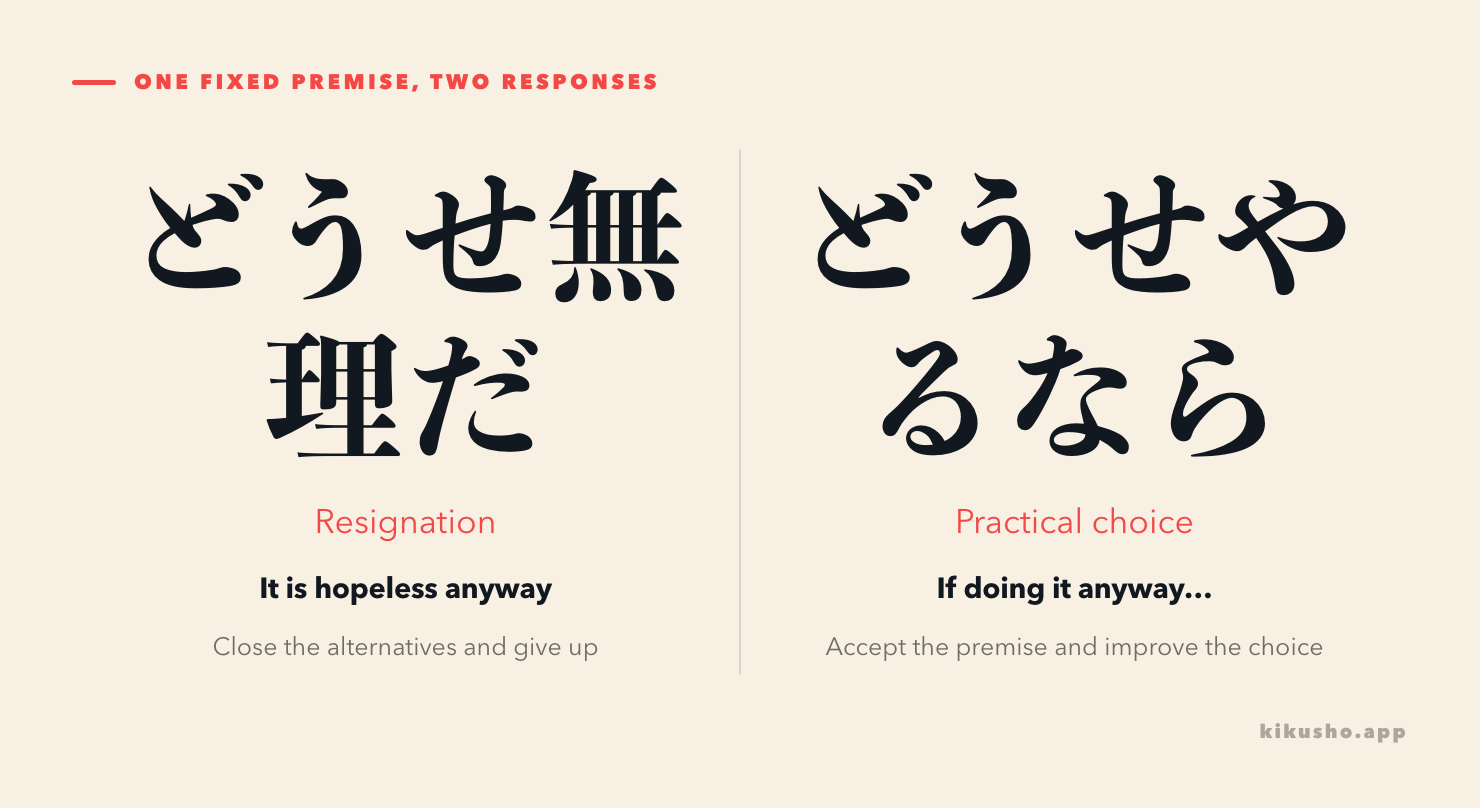
The outcome need not be bad. どうせ勝つんだから、緊張しないで means roughly “We're going to win anyway, so don't be nervous.” The confidence may sound playful, boastful or presumptuous. What remains constant is not negativity but the speaker's assumption that the result is already settled.
どうせ~なら turns acceptance into a better choice
Once the speaker accepts an action or situation, どうせ~なら asks what choice makes the most sense inside it. English often uses “if … anyway” or “might as well.”
どうせ待つなら、座って待とう。
If we're waiting anyway, let's sit down.
どうせ買うなら、長く使えるものを選びたい。
If I am buying one anyway, I want to choose something that will last.
どうせ参加するのなら、事前に資料を読んでおこう。
If we're going to participate anyway, let's read the materials beforehand.
The clause before なら/のなら is treated as accepted or difficult to avoid. The following clause improves how the speaker handles it. This is why どうせ can sound constructive even though resignation is its famous use. The fixed premise has not disappeared; the speaker is making use of it.
With a noun or な-adjective predicate, ordinary なら supplies the conditional: どうせ同じ値段なら、窓側の席がいい means “If it is the same price anyway, I'd prefer a window seat.” With a verb, both Vなら and explanatory Vのなら can occur. のなら makes the adopted circumstance slightly more explicit.
The reason pattern どうせ~のだから/んだから uses the accepted situation as grounds for what follows:
どうせここまで来たんだから、頂上まで行こう。
Since we've come this far anyway, let's go all the way to the summit.
どうせ作るのだから、二人分作ります。
Since I'm making it anyway, I'll make enough for two.
These are not claims that reaching the summit or cooking for two is inevitable. Coming this far or cooking is the settled premise; the following choice makes fuller use of it.
どうせなら can leave the accepted premise unstated
When the situation is obvious from the conversation, どうせなら can stand on its own: “if we're doing this anyway” or “if that's the case, then.”
A: 席はまだ選べます。
You can still choose your seat.B: どうせなら、窓側がいいです。
If I get to choose, I might as well take a window seat.
The omitted premise is something like 席を選ぶなら. The listener recovers it from A's statement. どうせだったら is a casual variant that similarly treats the current situation as given: どうせだったら、みんなで行こう means “If we're doing it anyway, let's all go.” The だったら is the conditional form built from だ; it does not by itself place the proposed group outing in the past.
Do not use bare どうせなら when the listener cannot recover what has been accepted. English “anyway” can merely change the subject or resume a conversation, but どうせなら needs a premise that supports the better-choice conclusion.
Three neighboring adverbs ask different questions
The closest trap is どうしても. Both expressions can suggest that ordinary alternatives do not change something, but the fixed element differs.
どうせ今日中には終わらない。
It won't be finished today anyway.
どうしても今日中に終わらせたい。
I absolutely want to finish it today.
何度やっても、どうしても終わらない。
No matter how many times I try, I simply cannot finish it.
どうせ presents the expected result as settled before the alternatives matter. どうしても keeps the desire, requirement or inability fixed despite obstacles. An affirmative どうしても~たい can therefore express strong determination, the opposite of giving up. The full contrast appears in どうしても and なるべく.
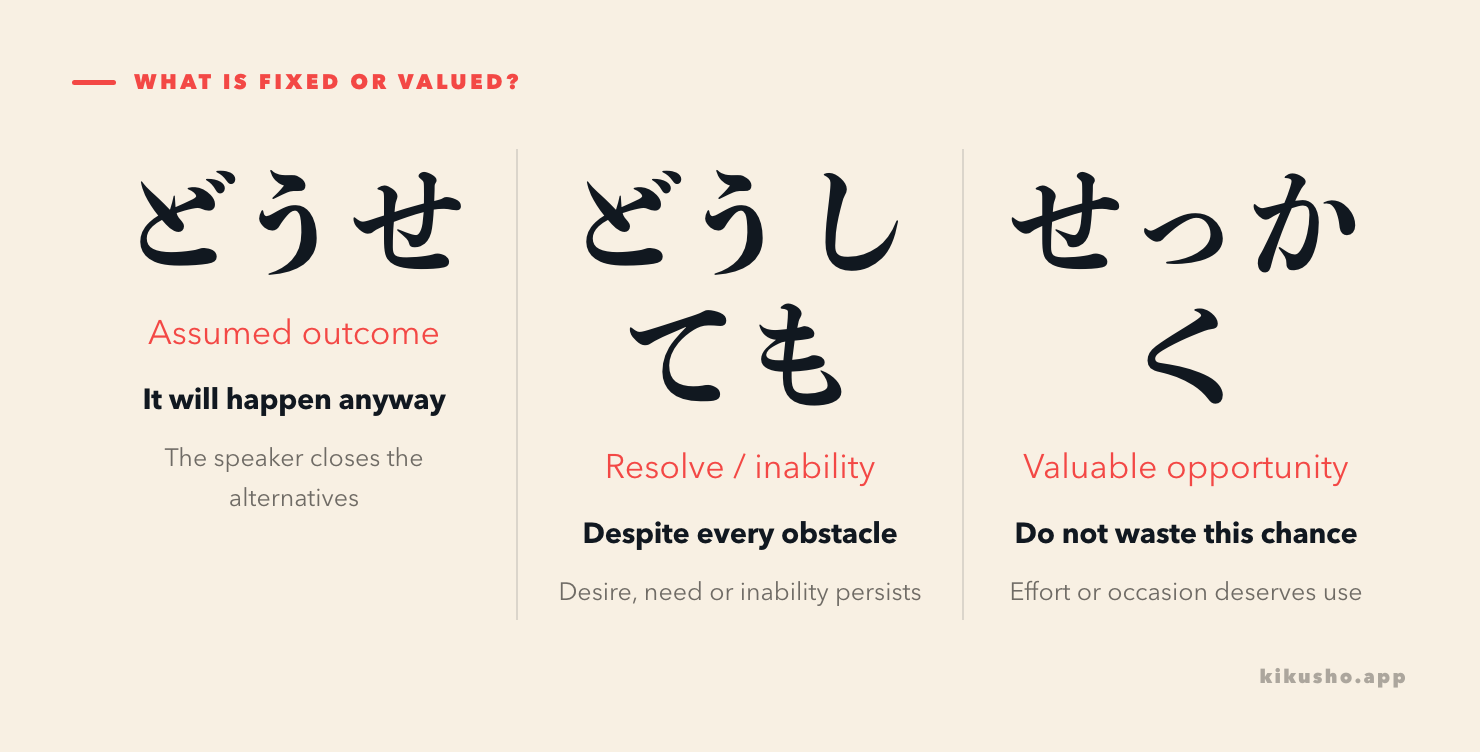
せっかく also supports a positive next step, but it values effort or opportunity rather than accepting inevitability:
どうせ京都まで来たんだから、もう一つ寺を見よう。
Since we're already in Kyoto anyway, let's see one more temple.
せっかく京都まで来たんだから、もう一つ寺を見よう。
Since we've made the special effort to come to Kyoto, let's see one more temple.
The first treats being in Kyoto as the reality to work with. The second protects a trip presented as valuable or hard-won. Review that opportunity logic in 甲斐がある and せっかく.
Finally, 結局 looks toward the final outcome, often after events have unfolded: 結局、電車に間に合わなかった reports “In the end, I missed the train.” どうせ電車には間に合わない projects the speaker's settled judgment, often before the result. A later event can prove the どうせ prediction wrong; 結局 reports what actually happened.
Register follows who is allowed to close the question
どうせ is common in conversation and informal writing. Its pragmatic use with なら can be friendly and efficient. Its resigned use can also sound cynical, self-pitying or dismissive. The crucial social question is whether the speaker has the right evidence and standing to declare the outcome settled.
In a formal report, choose wording that states the logical relation directly. いずれにしても追加の予算が必要です says that every known alternative requires more budget without adding sulky resignation. いずれにしても retrieves multiple possibilities; どうせ adds the speaker's attitude that the relevant fact is already beyond dispute.
For a Kikusho card, keep the premise and the response together. どうせ待つなら、座って待とう records both the accepted wait and the improved choice. A card containing only どうせ = anyway cannot tell you whether the speaker is giving up, optimizing around a fixed fact or merely using an unrelated English discourse marker.
Practice: find what the speaker has already settled
Decide what remains fixed in all six situations, then reveal the shared answer block.
Question 1 — grammar choice. A student assumes that applying will not change the outcome. Which sentence expresses that resignation?
- どうしても応募したい。
- どうせ応募しても、選ばれない。
- せっかく応募したのに、返事がない。
- 結局、応募することにした。
Question 2 — grammar choice. Complete the constructive sentence “If we're going to wait anyway, let's wait inside”: どうせ待つ__、中で待とう。
- ほど
- なら
- ばかり
- ために
Question 3 — text grammar. Read どうせ結果は同じだから、安いほうを選ぼう。 What does the speaker treat as fixed, and what choice follows from that premise?
Question 4 — grammar choice. Which line best expresses determination rather than a resigned prediction?
- どうせ今日中には終わらない。
- どうせなら今日中に終わらない。
- どうしても今日中に終わらせたい。
- 結局、今日中には終わらなかった。
Question 5 — sentence composition. Use どうせ, 買う, なら, and 長く使えるもの to say “If I am buying one anyway, I want to choose something that will last.”
Question 6 — text grammar. A says 席はまだ選べます. B answers どうせなら、窓側がいいです. Supply the omitted premise in your own words and explain why bare どうせなら works here.
Answers and explanations
Answer 1: 2. どうせ応募しても、選ばれない treats non-selection as the settled outcome even if the student applies. Choice 1 expresses persistent desire with どうしても; choice 3 regrets a wasted effort with せっかく; choice 4 reports the final decision with 結局.
Answer 2: 2, なら. どうせ待つなら、中で待とう accepts waiting as the premise and proposes the better way to do it. ために would introduce a purpose, while ほど and ばかり do not build this accepted-premise pattern.
Answer 3. The speaker treats 結果は同じ, “the result will be the same,” as fixed regardless of the option. Because the outcome will not differ, the speaker proposes choosing the cheaper one. The fixed premise produces a practical choice rather than surrender.
Answer 4: 3. どうしても今日中に終わらせたい keeps the desire to finish today firm despite obstacles. Choice 1 assumes failure, choice 4 reports a completed outcome, and choice 2 is incomplete because どうせなら needs a proposal that follows its accepted premise.
Answer 5. One natural answer is どうせ買うなら、長く使えるものを選びたい。 買う is the accepted action, なら marks it as the premise, and the second clause chooses the durable option within that decision.
Answer 6. The omitted premise is 席を選ぶなら or “if I am choosing a seat anyway.” A has just established that choosing remains possible, so B can leave that material unsaid and use どうせなら to state the preferred option. Without A's line or another recoverable situation, the phrase would leave the listener asking “if doing what?”
Common questions
What does どうせ mean in Japanese?
どうせ marks an outcome or situation the speaker already treats as fixed. It can sound like “anyway,” “after all” or “in any case,” often with resignation, but it can also support a practical “might as well” choice.
How do you use どうせ~なら?
Put どうせ before the accepted action or situation and なら after it, then state the better choice: どうせ買うなら、長く使えるものを選びたい means “If I am buying one anyway, I want to choose something that will last.”
What is the difference between どうせ and どうしても?
どうせ presents the speaker's expected outcome as already settled. どうしても says that a desire, need or inability remains despite obstacles, so it can express determination rather than resignation.