On this page
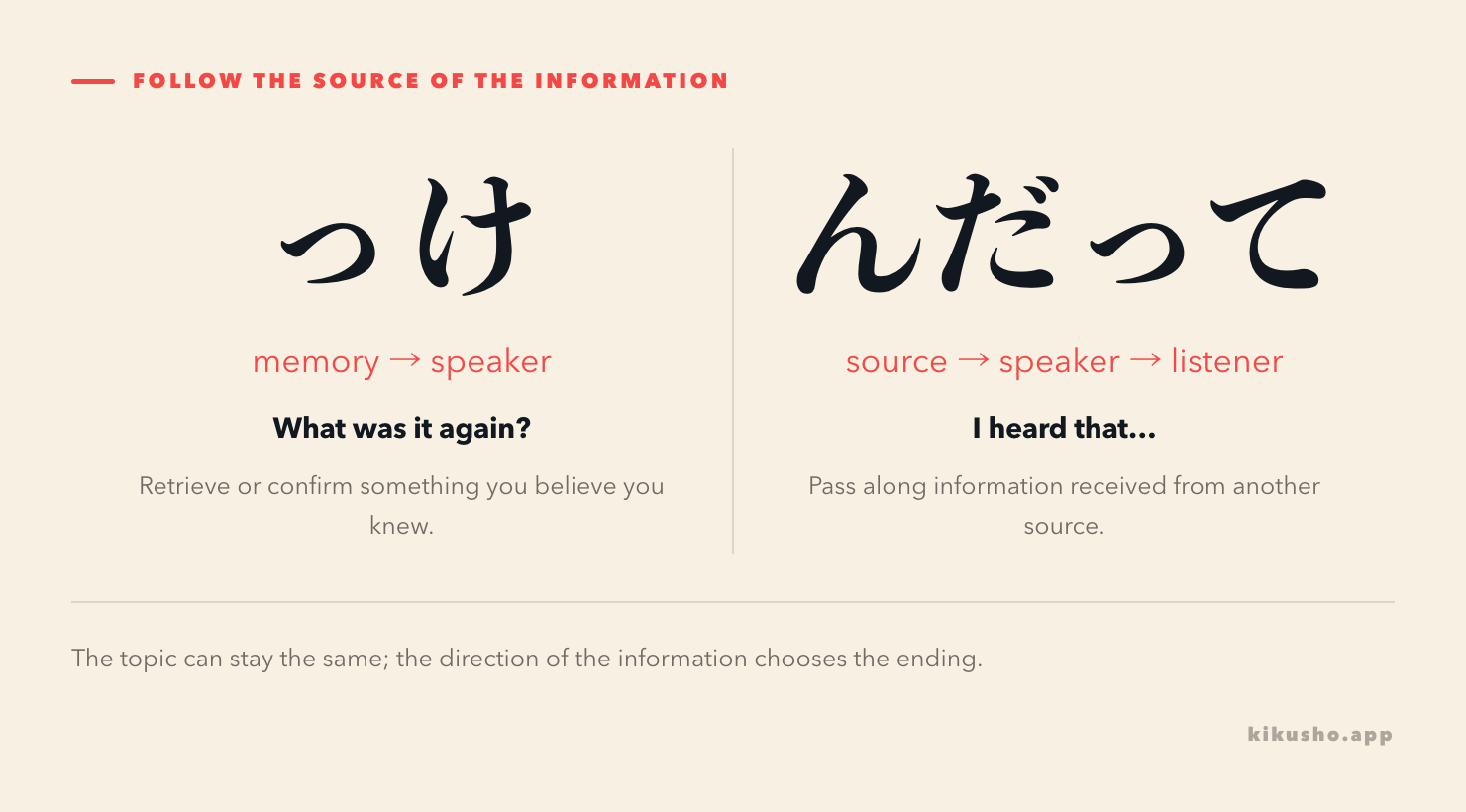
Use っけ when you are trying to retrieve or confirm something you believe you knew before. Use んだって when you pass along information you heard from somebody else: 会議は何時からだっけ? asks “What time did the meeting start again?”, while 会議は三時からなんだって says “I heard the meeting starts at three.”
Both are casual sentence endings, but the information moves in opposite directions. With っけ, the speaker reaches back into their own memory. With んだって, the speaker carries a report from an earlier source to the current listener. JLPT Sensei lists both っけ and んだって at N3, as does Bunpro. Those are editorial level placements: the test maker does not provide a form-by-form grammar syllabus.
っけ marks a search through shared or personal memory
Imagine you have been told the meeting time but cannot retrieve it. 会議は何時からだっけ? (かいぎは なんじから だっけ) means “What time did the meeting start again?” The English “again” often captures the effect: you are not presenting the topic as completely new. You expect the answer to restore information that was available before.
That expectation separates っけ from a neutral question. 会議は何時からですか? simply asks for the time. 会議は何時からでしたっけ? politely asks the listener to remind you. The second question can be gentler because it admits a lapse in the speaker's memory, but it can also sound odd if nobody ever gave you the information. Bunpro describes っけ as casual recall or confirmation, whether you address another person or talk to yourself.
You can check your own past action: 資料、もう送ったっけ? (しりょう、もう おくったっけ) is “Did I send the document already?” You can confirm a remembered plan: 田中さんも来るんだっけ? (たなかさんも くるんだっけ) is “Tanaka is coming too, right?” You can search for a label: あの店の名前、何だっけ? (あのみせの なまえ、なんだっけ) asks “What was that shop called again?” None of these questions asks for knowledge with a blank history; each reopens an earlier mental file.
Past forms are especially common because recollection often concerns something learned or done earlier: 送ったっけ, 何だったっけ, 静かだったっけ. With a present or future verb, explanatory んだ can support the ending: 明日は晴れるんだっけ? means “It is going to be sunny tomorrow, was that right?” In relaxed modern speech you will also hear a plain verb directly before っけ. For reliable production, learn the common frames rather than attaching っけ blindly to every dictionary form.
Polite ましたっけ/でしたっけ is possible: 前にもお会いしましたっけ? asks “Have we met before?” and 締め切りは金曜日でしたっけ? asks “Was the deadline Friday?” The sentence is polite, but the ending still signals recall. In a formal email where you simply need information, an ordinary でしょうか or 教えていただけますか may fit better.
Occasionally っけ closes a nostalgic statement rather than a request: 子どものころ、よくここで遊んだっけ recalls “We used to play here often when we were children.” The context and falling intonation make it a memory resurfacing, not a demand for an answer. This use grows from the same core idea, but questions of forgotten information should be your first production target.
んだって passes a report to the current listener
Now imagine that Yuki told you the meeting time and you tell a colleague. 会議は三時からなんだって (かいぎは さんじから なんだって) means “I heard the meeting starts at three.” The speaker does not claim to have discovered the fact directly. って carries the earlier message as a casual quotation, and んだ presents it as explanatory information.
The source can be a person, a notice, a forecast, or an unspecified “they.” 由紀さんによると、駅前に新しい店ができるんだって means “According to Yuki, I hear a new shop is opening by the station.” 明日は雪になるんだって means “I heard it will snow tomorrow.” 新しい先生は親切なんだって means “I hear the new teacher is kind.” Naming the source with によると is optional, but it makes the information path explicit.
Bunpro's んだって entry gives the pattern a casual register and requires ん/なん for this sentence-final hearsay use. Verbs and い-adjectives take んだって after their plain forms: 引っ越すんだって, “I heard they are moving,” and 安いんだって, “I heard it is cheap.” Nouns and な-adjectives need な before explanatory ん: 休みなんだって, “I heard it is a day off,” and 静かなんだって, “I hear it is quiet.”
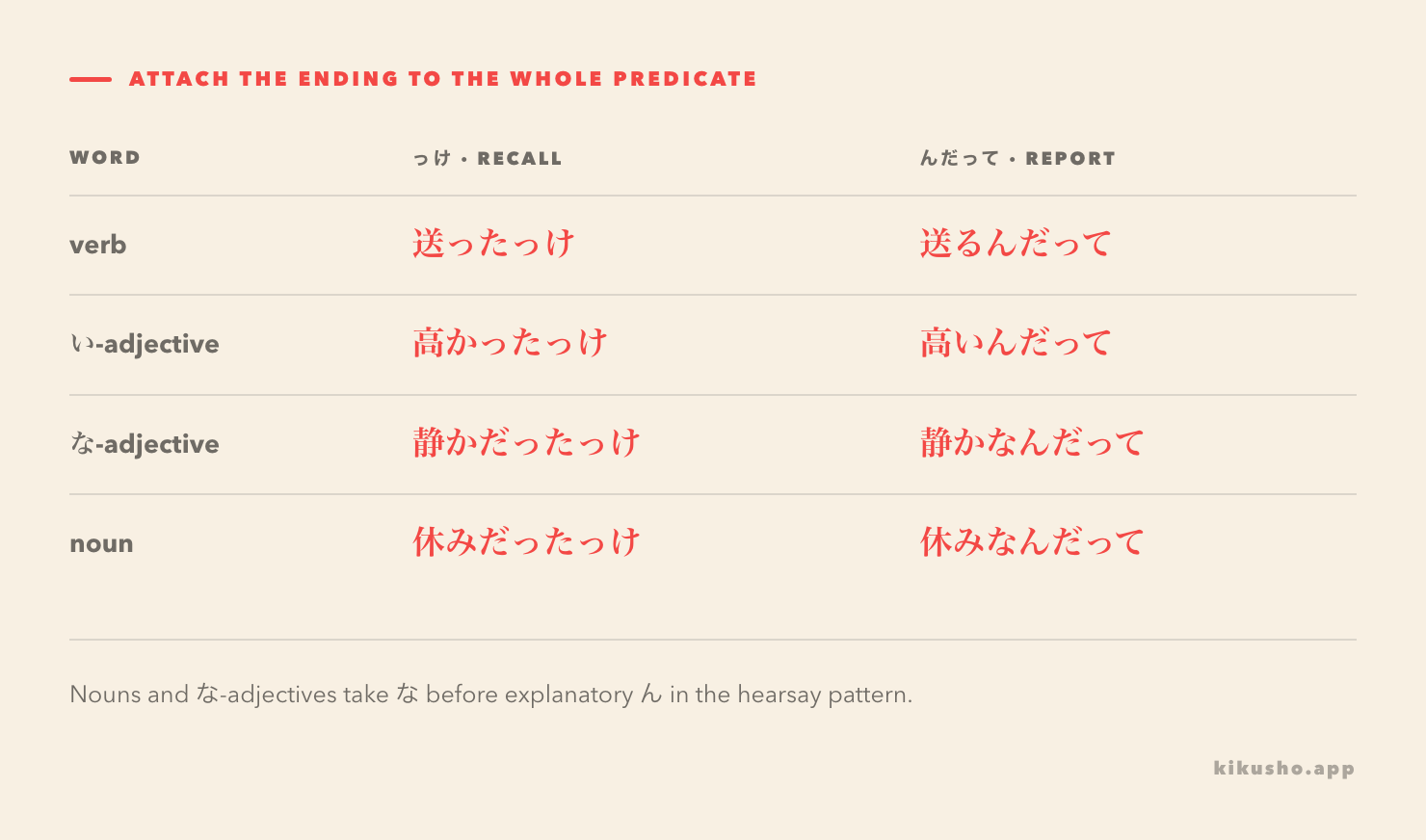
| Word before the ending | Recall with っけ | Report with んだって |
|---|---|---|
| Verb | 送ったっけ/送るんだっけ | 送るんだって |
| い-adjective | 高かったっけ | 高いんだって |
| な-adjective | 静かだったっけ | 静かなんだって |
| Noun | 休みだったっけ/休みだっけ | 休みなんだって |
A rising んだって? can echo a surprising report: 来月、引っ越すんだって? is roughly “I heard you're moving next month—is that true?” It still begins with reported information, whereas 来月、引っ越すんだっけ? asks the speaker's memory to recover whether the move was next month. The punctuation may look equally questioning; the source of the information is different.
Do not translate every だって as hearsay. In 子どもだって分かる, だって means “even”: “Even a child understands.” At the start of a protest, だって、時間がなかったんだもん can mean “But I didn't have time.” Casual quotation can also appear without the explanatory ん, depending on the clause and context. For the N3 hearsay target here, recognize the dependable shapes verb/い-adjective + んだって and noun/な-adjective + なんだって, then verify the surrounding sentence.
The information test chooses the ending
When both endings feel possible, ask one question: “Where is the speaker looking for the information?” If the speaker is checking their own memory, choose っけ. If the speaker is forwarding a previous message, choose んだって.
Suppose Aiko previously told you her birthday. You forget and ask her: 誕生日、いつだっけ? You later tell Ken something you heard from Aiko: 愛子さんの誕生日は十月なんだって. The topic can be identical, but the speech act changes. The first line asks a holder of the information to restore it; the second gives a listener a report.
This also explains why these endings should not be arranged on a certainty scale. っけ does not mean “less certain hearsay,” and んだって does not mean “stronger recollection.” If you need to compare ways of judging and relaying evidence, see そう, よう, らしい and みたい. For neutral information questions without a memory assumption, review Japanese question words and か.
For a Kikusho card, the useful unit is the full exchange rather than the final particle. っけ needs the missing memory around it, and だって needs enough context to separate hearsay from “even” or a protest. Add a short note naming who first supplied the information and who now receives it; that source path makes the correct ending much easier to retrieve during offline review.
Practice: follow the information
Work through the seven new situations in order, then open the explanations below.
Question 1 — choose the ending. You remember hearing the deadline but have forgotten the day. Which question best asks a classmate to remind you?
- A. 締め切りは金曜日なんだって。
- B. 締め切りは金曜日だっけ?
- C. 締め切りは金曜日ですか?
Question 2 — grammar choice. Your colleague says a new employee is very kind. Later, you relay that report. Complete 新しい人は親切__。
- A. なんだって
- B. だっけ
- C. んだっけ
Question 3 — attachment. Complete the casual report “I heard this restaurant is cheap”: この店は安い__。
Question 4 — sentence composition. You cannot remember whether you already sent a document. Make a casual question using 資料, もう, 送る, and っけ.
Question 5 — meaning choice. What does 来月、引っ越すんだって? most naturally do with rising intonation: ask for completely new information, echo a report for confirmation, or recall your own past action?
Question 6 — text grammar. Read the exchange: A: 明日の会議、何時からだっけ? B: 三時からなんだって。 Who is searching memory, and who is relaying a report?
Question 7 — text grammar. In 子どもだって分かる, does だって express hearsay? State the clue that prevents that reading.
Answers and explanations
Answer 1. B, 締め切りは金曜日だっけ? asks “The deadline was Friday, right?” and checks an earlier memory. C is a neutral question and remains possible in real life, but it does not convey “remind me.” A is a statement reporting what somebody said.
Answer 2. A, 新しい人は親切なんだって。 親切 is a な-adjective, so it needs な before explanatory ん. The full sequence is 親切 + な + ん + だ + って. B asks a memory question, while C lacks the connector required after the な-adjective.
Answer 3. この店は安いんだって。 An い-adjective keeps its final い before んだって. 安いなんだって would incorrectly add the noun and な-adjective connector.
Answer 4. A model answer is 資料、もう送ったっけ? (しりょう、もう おくったっけ), “Did I already send the document?” The past form matches the completed action the speaker is trying to recall.
Answer 5. It echoes a report for confirmation: “I heard you're moving next month—is that right?” The hearsay frame んだって remains visible even though rising intonation turns the sentence into a response-seeking question.
Answer 6. A uses っけ to search memory for the meeting time. B uses なんだって to relay the reported three-o'clock time. 三時 is a noun, which accounts for な before ん.
Answer 7. No. 子どもだって means “even a child.” The particle follows the noun directly, without the explanatory ん/なん used by the target hearsay pattern, and the predicate 分かる states what that included person can do.
Common questions
What is the difference between っけ and んだって?
っけ asks your memory to recover or confirm information you believe you knew before. んだって relays information that came from another speaker or source.
Can っけ be used in a polite sentence?
Yes. でしたっけ and ましたっけ let you ask for a polite reminder, although っけ still presents the question as recollection rather than a neutral request for new information.
Does every だって mean “I heard that”?
No. The hearsay pattern taught here is clause + んだって, or noun and な-adjective + なんだって. だって also has unrelated uses such as “even” and conversational “but,” so read the whole sentence.