On this page
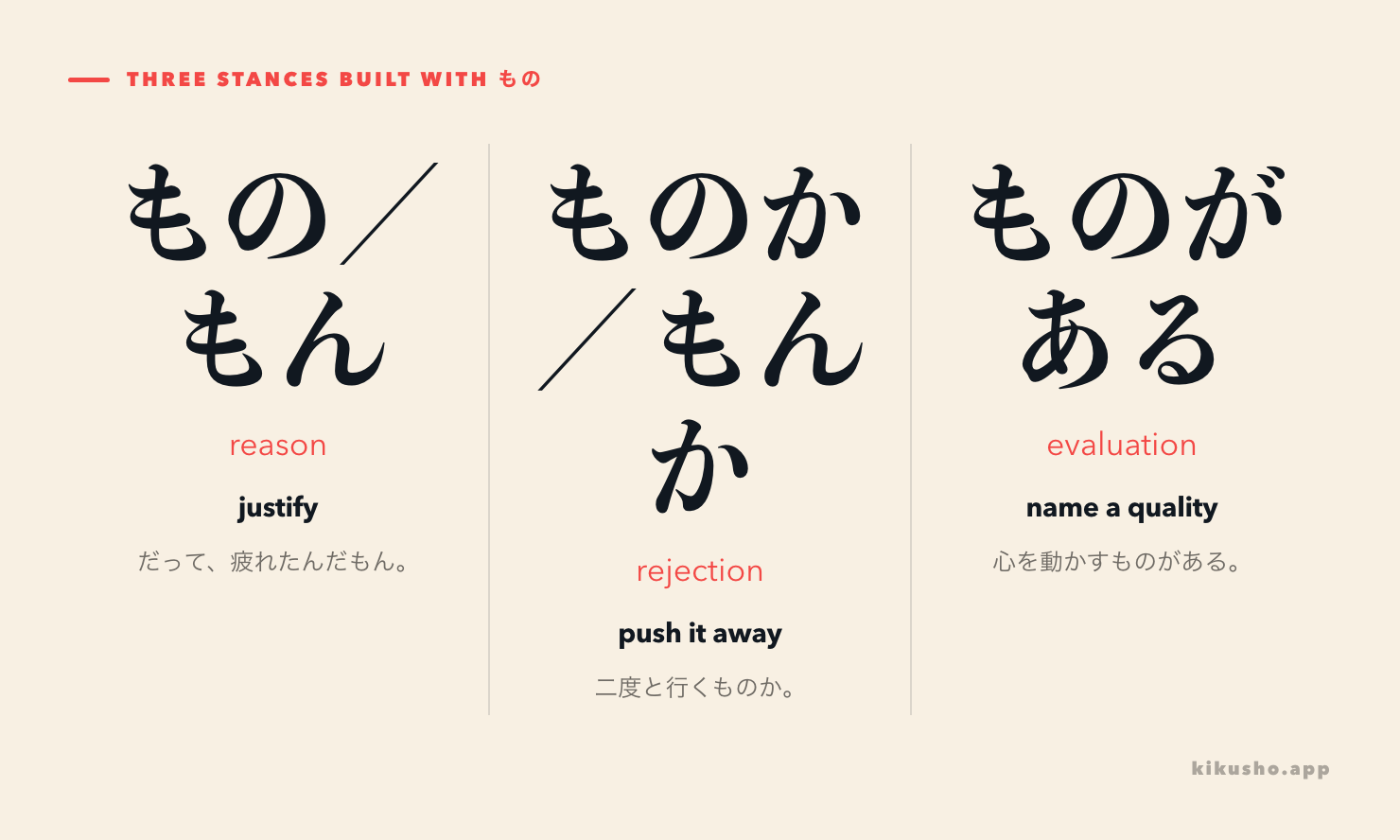
もの/もん, ものか/もんか and ものがある all contain もの, but they perform three different moves. Use sentence-final もの/もん to justify yourself, ものか/もんか to reject a claim or course of action, and ものがある to evaluate a quality you strongly perceive.
The deciding clue is the speaker's stance, not an English translation of もの. “Because,” “no way” and “there is something…” are useful first glosses, but the surrounding exchange tells you whether the speaker is defending a reason, pushing a proposition away or weighing an impression.
Choose the move before you choose the ending
Imagine three reactions to a performance:
だって、前から見たかったんだもん。 だって、まえから みたかったんだもん。 But I had wanted to see it for ages.
こんな大事な公演を忘れるものか。 こんな だいじな こうえんを わすれるものか。 As if I would forget such an important performance.
彼女の演奏には、人を引きつけるものがある。 かのじょの えんそうには、ひとを ひきつけるものがある。 There is something compelling about her performance.
The first speaker supplies a personal reason. The second rejects the idea of forgetting. The third assesses a quality in the performance. That three-way decision remains stable even when the vocabulary changes.
| Form | Speaker's move | Dependable first gloss | Register clue |
|---|---|---|---|
| もの/もん | give a personal reason or self-justification | “because…” | もん is intimate and conversational |
| ものか/もんか | reject a possibility or declare refusal | “no way…” | forceful; もんか is more conversational |
| ものがある | assess a strongly felt quality | “there is something…” | common in reflective evaluation |
These are listed as N2 grammar by JLPT Sensei's もの/もん page, its ものか/もんか page and its ものがある page. Independent Japanese-teacher references describe the same functions. Since the official test does not release a complete grammar inventory, “N2” here records agreement among study references rather than an official item placement.
もの/もん answers “why?” from inside the situation
Sentence-final もの gives the speaker's reason. In conversation, もん is common and can sound intimate, emotional, defensive or childlike.
「どうして先に帰ったの?」 「頭が痛かったんだもの。」 「どうして さきに かえったの?」「あたまが いたかったんだもの。」 “Why did you leave early?” “Because I had a headache.”
The fuller explanatory frames are especially dependable:
| Before the ending | Form | Example |
|---|---|---|
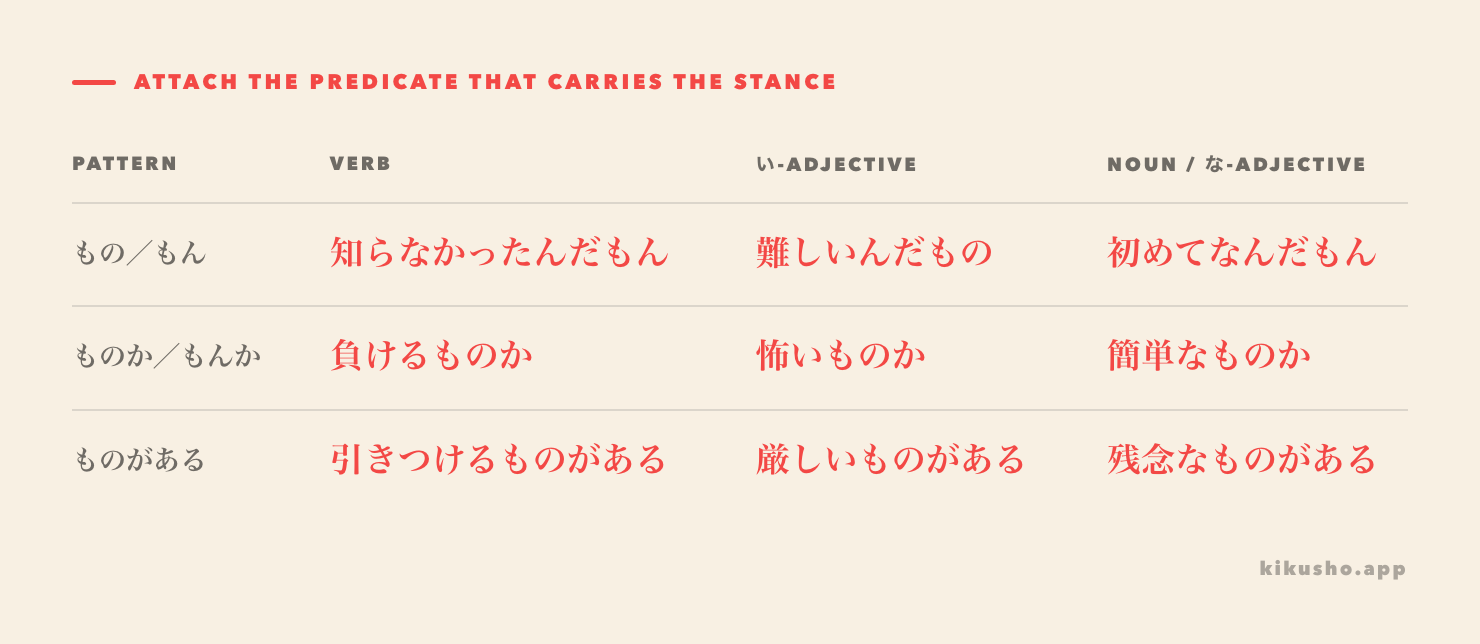
| verb | plain + んだもの/んだもん | 知らなかったんだもん |
| い-adjective | plain + んだもの/んだもん | 難しいんだもの |
| noun or な-adjective | なんだもの/なんだもん | 初めてなんだもん |
Direct plain forms also occur, especially in an emotional assertion: 今日は行かないもん (“I'm not going today”) or まだ子どもだもん (“because [they are] still a child”). The ending does more than attach a neutral cause. It lets the speaker present the reason as personally sufficient.
N1et's overview of the もの family notes both the reason or justification function and the casual, often emotionally direct character of もん. The dedicated JLPT Sensei page likewise shows it after だって and in explanatory んだもの/んだもん frames. This is why 会議があるので帰ります suits a neutral explanation at work, while だって、疲れたんだもん can sound like a protest to someone close.
Do not confuse this sentence-final reason with ものだから, which builds a reason into a larger sentence. The ものなら and ものだから comparison treats that longer construction and its own attachment.
ものか/もんか turns a question shape into a forceful no
In this N2 pattern, か does not normally request information. It creates a rhetorical question whose intended answer is negative.
あの店には二度と行くものか。 あの みせには にどと いくものか。 I will never go to that restaurant again.
この程度の失敗で諦めるもんか。 この ていどの しっぱいで あきらめるもんか。 No way am I giving up over a mistake like this.
The sentence can reject a belief about the world or declare the speaker's refusal. 彼が約束を忘れるものか rejects the possibility that he forgot. 私は諦めるものか rejects giving up as the speaker's next action. Either way, the proposition before ものか is pushed away with conviction.
The productive attachment is:
| Predicate | Form before ものか/もんか | Example |
|---|---|---|
| verb | dictionary form | 負けるものか |
| い-adjective | plain nonpast | 怖いものか |
| な-adjective | な | 簡単なものか |
Verb examples are the most frequent and the safest model for production. Mainichi Nonbiri's N2 explanation confirms dictionary-form verbs, い-adjectives and な-adjective + な, and describes the force as strong rejection. もんか keeps that force while sounding more conversational.
Because the rejection is sharp, use it with care when addressing another person. 分かるものか can be an angry “How could you understand?” rather than a calm statement of uncertainty. A polite-looking ものですか can soften the surface in some contexts, but the underlying rhetorical denial remains.
ものがある names a quality the speaker strongly perceives
ものがある does not mean that a physical object exists. It packages an evaluation: the speaker detects a quality that is striking, moving, difficult or otherwise worth singling out.
この映画には、考えさせられるものがある。 この えいがには、かんがえさせられるものがある。 There is something thought-provoking about this film.
その説明には、納得しにくいものがある。 その せつめいには、なっとくしにくいものがある。 There is something hard to accept about that explanation.
The topic is often marked by には, while the expression before ものがある names the perceived quality. A literal translation can sound vague in English, so a natural version may use “has a certain…,” “is quite…” or “there is something…about it.” The Japanese construction keeps the assessment slightly indirect and reflective.
| Preceding expression | Attachment | Example |
|---|---|---|
| dictionary-form verb | V + ものがある | 人を引きつけるものがある |
| negative verb | Vない + ものがある | 捨てきれないものがある |
| い-adjective | Aい + ものがある | 厳しいものがある |
| な-adjective | Aな + ものがある | 残念なものがある |
Tanosuke's ものがある analysis gives dictionary and negative verbs, い-adjectives, and な-adjective + な, and explains that the form expresses something the speaker feels strongly. Its examples also show frequent pairings with evaluations such as difficulty, regret and an arresting quality.
Do not substitute plain ものだ mechanically. 考えさせられるものがある says the film has a thought-provoking quality. よくここまで考えたものだ reacts with admiration to how far someone thought something through. The four uses of ものだ separates recollection, expectation, advice and admiration from the three forms here.
One exchange can contain all three stances
「どうして、またあの劇を見に行くの?」 「好きなんだもん。あの演出には心に残るものがある。次の公演を見逃すものか。」
「どうして、また あの げきを みにいくの?」「すきなんだもん。あの えんしゅつには こころに のこるものがある。つぎの こうえんを みのがすものか。」
“Why are you going to see that play again?” “Because I love it. There is something memorable about that production. No way will I miss the next performance.”
好きなんだもん defends the choice. 心に残るものがある evaluates the production. 見逃すものか declares refusal. Seeing the forms in one voice makes the boundaries clearer than memorising three unrelated translations.
If you capture one of these endings in Kikusho, keep the previous line on the card. A bare もの cannot tell you whether the speaker is recalling a habit, giving a reason or using it inside a longer construction. The exchange reveals which move the ending performs.
Practice: identify the stance before the form
Question 1
Your friend asks why you will not eat the dessert. Choose the most natural intimate justification.
「どうして食べないの?」「だって、甘すぎる( )。」
- ものがある
- んだもん
- ものか
- ものなら
Question 2
The speaker angrily declares that they will never return. Complete the sentence.
店員の態度があまりに失礼だった。二度と来る( )。
- ものだ
- ものがある
- ものか
- ものだから
Question 3
Choose the form that presents a strongly felt quality in the novel.
この小説には、何度も読み返したくなる( )。
- ものがある
- んだもの
- ものか
- ものなら
Question 4
Put the four fragments in order after the printed topic. Give the letter that fills ★.
彼の話し方には __ __ ★ __。
- A. ものが
- B. 人を
- C. ある
- D. 安心させる
Question 5
Correct the attachment while keeping the intimate reason: 初めてだんだもん、緊張して当然だよ。 Write the corrected first clause.
Question 6
Read the short exchange and identify what ものか rejects.
「もう諦めるの?」 「ここまで準備したのに、諦めるものか。」
Does the second speaker doubt that giving up is possible, ask for permission, or declare a refusal to give up?
Question 7
Write three short reactions to a concert using the prompts. Use each target once.
- personal reason: 前から楽しみにしていた + もの/もん
- evaluation: 胸を打つ + ものがある
- emphatic refusal: 忘れる + ものか/もんか
Answers and explanations
The explanations below follow the same three-step test: reason, rejection or evaluation.
Answer 1. 2, んだもん. 甘すぎるんだもん gives the speaker's personal reason in an intimate, slightly defensive voice. ものか would reject “too sweet,” while ものがある would turn the adjective into an evaluation of a quality rather than answer the friend's why-question.
Answer 2. 3, ものか. 二度と来るものか is a forceful declaration that the speaker will never return. 二度と supports the refusal reading. ものだ has other reflective and normative uses, ものがある evaluates a quality, and ものだから would introduce a cause.
Answer 3. 1, ものがある. 何度も読み返したくなるものがある says the novel has a quality that makes the speaker want to reread it. んだもの would justify an action, and ものか would create an emphatic rejection.
Answer 4. A. The order is B → D → A → C: 彼の話し方には、人を安心させるものがある, “There is something reassuring about his manner of speaking.” 人を is the object of 安心させる, and ものがある packages that quality as the speaker's evaluation. A fills ★.
Answer 5. 初めてなんだもん. A noun before explanatory んだ uses なんだ, so 初めてだんだもん duplicates the copular material in the wrong order. The full sentence means, “It is my first time, so of course I'm nervous.”
Answer 6. The speaker declares a refusal to give up. ここまで準備したのに supplies the emotional basis, and 諦めるものか pushes away giving up as the speaker's own action. It is rhetorical, not a request for permission.
Answer 7. One natural set is 前から楽しみにしていたんだもん, あの演奏には胸を打つものがある, and この夜を忘れるものか. The first justifies attending or feeling excited, the second evaluates the performance, and the third emphatically rejects forgetting the night. もの may replace もん in the first, while もんか may replace ものか in the third when a more conversational voice fits.
When the ending appears in a reading passage, ask what the speaker is doing to the preceding proposition. A reason is owned, a claim is rejected, or a quality is assessed. That single question keeps the three もの patterns from collapsing into one vague word.
Common questions
What is the difference between もの, ものか and ものがある?
Sentence-final もの or もん gives a personal reason or justification. ものか or もんか forcefully rejects a possibility or declares that the speaker will not do something. ものがある evaluates a situation as having a striking or hard-to-name quality.
Is もん just a casual form of もの?
In these patterns, もん is the conversational shortening of もの. It also makes the utterance sound more intimate and can sound emotional, defensive or childlike. That register matters even though the basic grammatical relationship remains.
Does ものか ask a real question?
Usually no. In the N2 pattern, ものか is a rhetorical question whose intended answer is an emphatic no. 二度と行くものか means that the speaker absolutely will not go again, rather than asking whether someone will go.
How does ものがある attach?
It commonly follows a dictionary or negative verb, an i-adjective, or a na-adjective plus な. The preceding expression names the quality the speaker detects, as in 人を引きつけるものがある or 納得しにくいものがある.