On this page
一体 intensifies a question, まさか marks disbelief at something unexpected, and もしかしたら raises an uncertain possibility. All three can appear when you lack an answer, but they reveal three different attitudes toward that missing answer.
The choice depends on what you are doing
Ask one question before choosing: do you want an answer, reject an expectation, or offer a possibility?
| Form | Main job | Usual shape | Natural English cue |
|---|---|---|---|
| 一体(いったい) | Strengthen a real or frustrated question | 一体 + question | what on earth; exactly |
| まさか | React to something hard to believe | まさか + unexpected content; まさか! | surely not; no way |
| もしかしたら | Put forward an uncertain possibility | もしかしたら + clause, often かもしれない | perhaps; maybe |
The same unexplained event makes the contrast visible. You arrive and find a window open.
一体、誰が窓を開けたの?
Ittai, dare ga mado o aketa no?
“Who on earth opened the window?”
The speaker wants the missing person identified.
まさか、猫が開けたの?
Masaka, neko ga aketa no?
“Don't tell me the cat opened it?”
The suggested explanation clashes with what the speaker finds believable.
もしかしたら、風で開いたのかもしれない。
Moshika shitara, kaze de aita no kamoshirenai.
“Maybe it opened because of the wind.”
The speaker offers one possible explanation and leaves room for others.
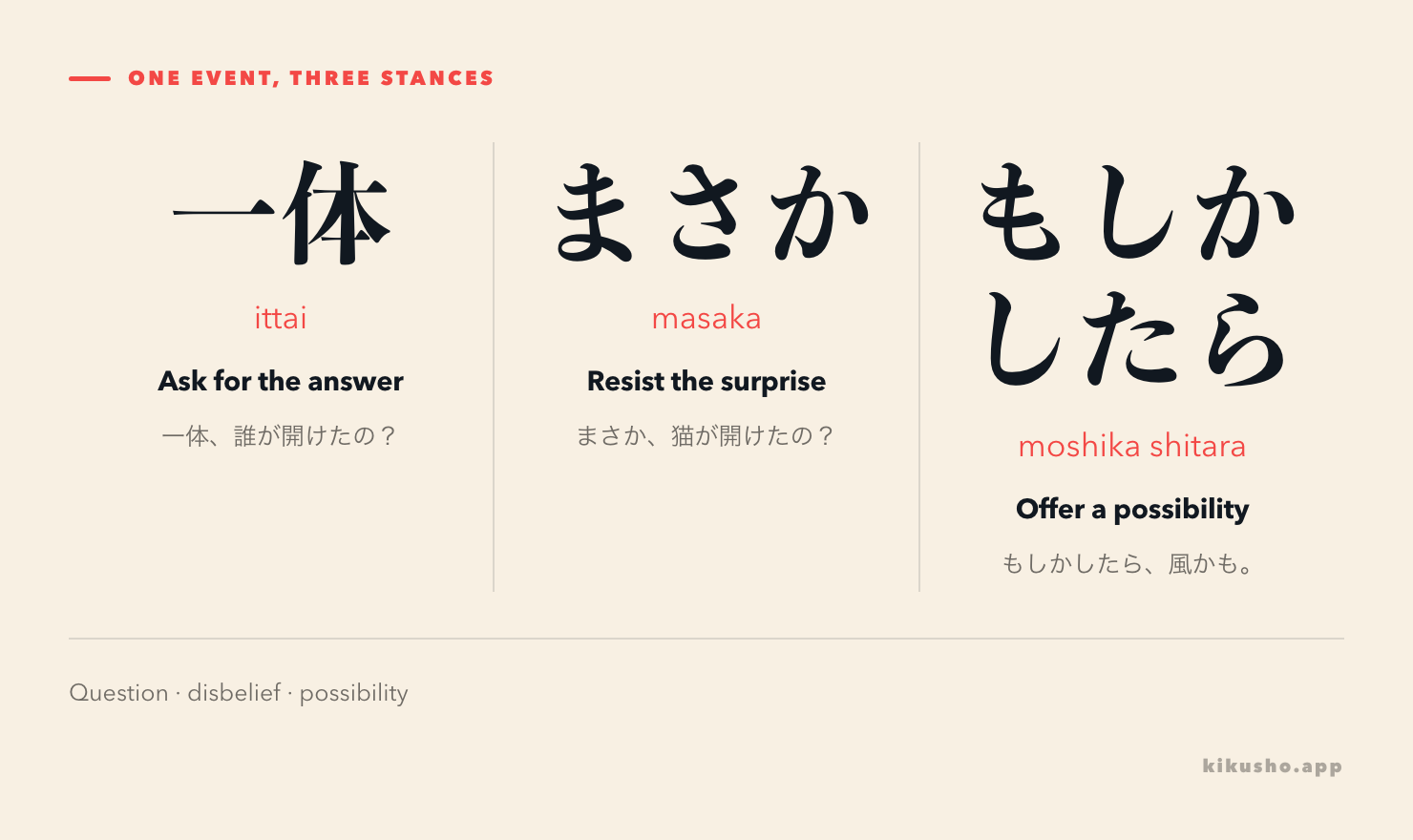
一体 makes the question feel unresolved
The adverbial 一体 commonly sits before an interrogative expression such as 誰, 何, どこ, どう or いつ. It does not supply new facts. It tells the listener that the speaker finds the answer especially puzzling, surprising or frustrating.
この機械は一体どうやって動くのですか。
Kono kikai wa ittai dou yatte ugoku no desu ka.
“How on earth does this machine work?”
彼は一体どこへ行ったのだろう。
Kare wa ittai doko e itta no darou.
“Where in the world could he have gone?”
The question can be polite, as the first example is, but 一体 still adds pressure. In a complaint, that pressure can sound accusatory:
一体いつまで待たせるつもりですか。
Ittai itsu made mataseru tsumori desu ka.
“Just how long do you intend to keep me waiting?”
That tone is not built into the word alone. A curious child can ask 一体どうして? with wonder, while an irritated customer can use the same shape with blame. Kotobank's dictionary entry for 一体 records both strong questioning and reproach. Bunpro likewise treats it as emphasis in genuine questions, rather than as a marker of probability.
Do not confuse this adverb with the noun 一体, “one body” or “one unit,” or with 一体に, “generally.” The reading is the same, but the job in the sentence is different.
まさか pushes against an expectation
まさか marks a gap between what the speaker expected and what is being considered or has just happened. It often comes before a negative, a doubtful question, or an expression such as とは思わなかった.
まさか彼が約束を忘れたのではないでしょうね。
Masaka kare ga yakusoku o wasureta no dewa nai deshou ne.
“Surely he has not forgotten the promise?”
まさか、駅で先生に会うとは思わなかった。
Masaka, eki de sensei ni au to wa omowanakatta.
“I never expected to meet the teacher at the station.”
In the second sentence, the meeting really happened. The negative belongs to 思わなかった, the earlier expectation, rather than to 会う. This is why translating every occurrence as “it is impossible” loses an important use.
The standalone reaction is common too:
「田中さんが優勝したよ。」「まさか!」
“Tanaka-san ga yuushou shita yo.” “Masaka!”
“Tanaka won.” “No way!”
The response expresses shock. It does not certify that the news is false. Kotobank's entry for まさか distinguishes the adverb used with negation or rhetorical force from the independent response. The existing Kikusho lesson on まさか among adverbs with characteristic partners develops that reaction and its とは思わなかった pattern; the present comparison focuses on choosing it against a question or a tentative guess.
もしかしたら keeps a possibility open
もしかしたら introduces something that may be true. It does not say the speaker is shocked, and it does not demand an answer. The common partner かもしれない closes the clause with the same uncertain stance.
もしかしたら、会議はもう終わったかもしれません。
Moshika shitara, kaigi wa mou owatta kamoshiremasen.
“Perhaps the meeting has already ended.”
もしかしたら、あの店は日曜日も開いています。
Moshika shitara, ano mise wa nichiyoubi mo aite imasu.
“Perhaps that shop is open on Sundays too.”
The first sentence displays the frequent pairing. The second shows that かもしれない is not mechanically required, though an ending that preserves uncertainty is usually the natural choice. In conversation, もしかして is compact and common; もしかすると has the same core possibility meaning.
The Tokyo University of Foreign Studies grammar module notes that もしかすると often accompanies かもしれない when the possibility is judged low. Bunpro groups もしかしたら, もしかして and もしかすると as sentence-opening adverbs and also treats the final かもしれない as frequent rather than compulsory. For a wider confidence comparison, see たぶん, おそらく and きっと.
One piece of news can move through all three stances
Imagine that Aya has not arrived. The fact stays the same; the speaker's action changes.
| Sentence | What the speaker does |
|---|---|
| 彩さんは一体どこにいるの? | asks urgently where Aya is |
| まさか、道に迷ったの? | reacts to an alarming suggestion |
| もしかしたら、電車が遅れているのかもしれない。 | offers a tentative explanation |
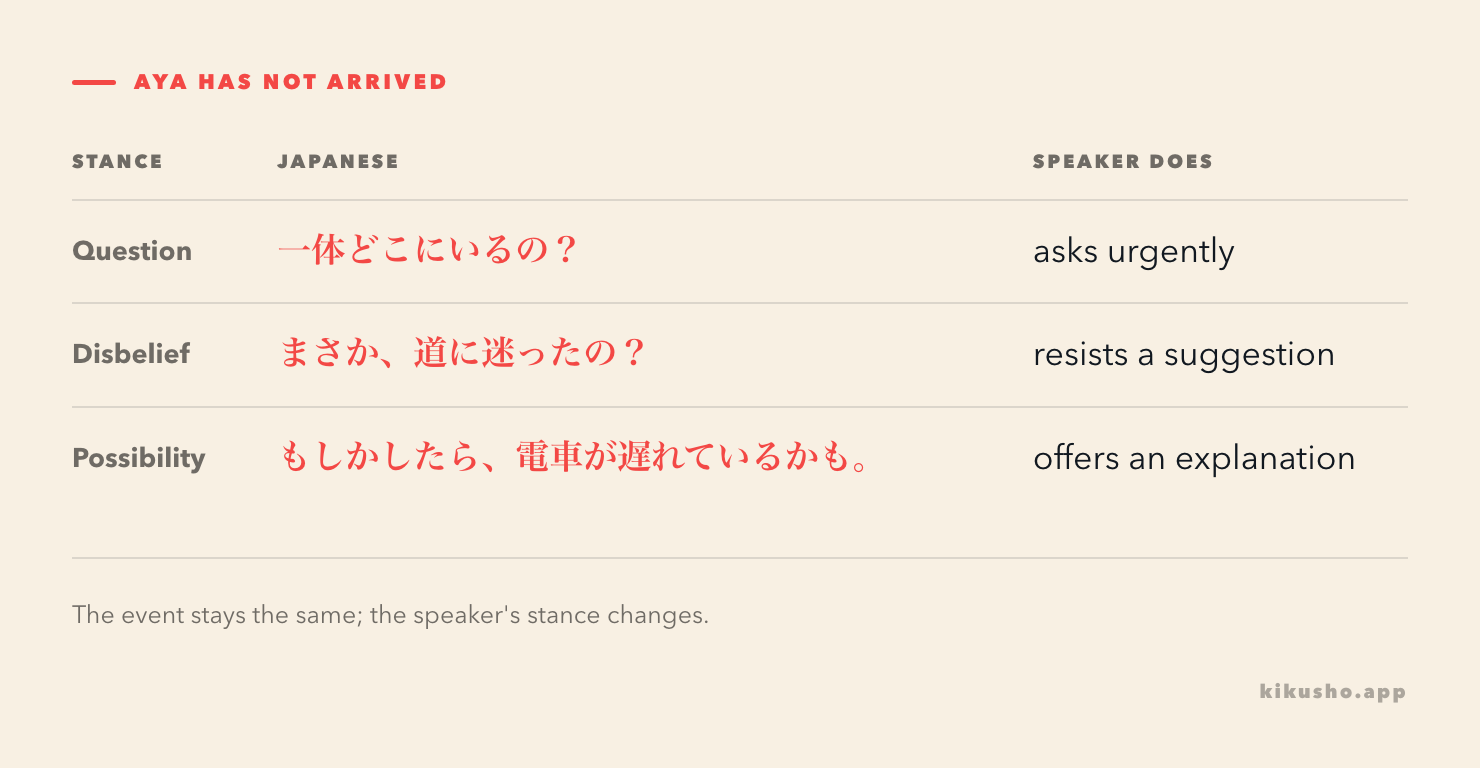
These forms can even appear near one another because their roles do not overlap completely:
一体何があったの? まさか事故? もしかしたら、電車が止まっているのかもしれない。
Ittai nani ga atta no? Masaka jiko? Moshika shitara, densha ga tomatte iru no kamoshirenai.
“What on earth happened? Surely it was not an accident? Maybe the train has stopped.”
The sequence moves from missing information, to a resisted possibility, to a calmer hypothesis. English “maybe” cannot preserve all three movements by itself.
The wrong choice changes the speaker's commitment
Replacing one form with another does more than change intensity.
- 一体、彼は来るの? asks, with impatience or puzzlement, whether he is coming.
- まさか、彼が来るの? treats his coming as contrary to expectation.
- もしかしたら、彼は来るかもしれない。 presents his coming as one live possibility.
With 一体, the listener is expected to help resolve a question. With まさか, the speaker signals resistance or shock. With もしかしたら, the speaker contributes a hypothesis while withholding certainty.
This also explains a common learner mistake. 一体雨が降るかもしれない does not naturally mean “maybe it will rain,” because 一体 does not grade probability. A question such as 一体、雨はいつ降るのだろう works because the unknown time is being pressed. Conversely, もしかしたら誰が来たの? mixes a possibility opener with a direct request for identity. Ask 一体誰が来たの?, or state a hypothesis such as もしかしたら田中さんが来たのかもしれない.
If one of these expressions catches your ear, save enough of the sentence to keep its stance. In Kikusho, capture the line by voice, photo or text, inspect the generated card, and retain the question word, negative expectation or uncertainty ending. A card containing only “まさか = no way” cannot remind you whether the speaker rejected a possibility or reacted after the surprising fact became real.
N3 is a publisher placement
The Kikusho reference inventory, JLPT Sensei and Bunpro place 一体, まさか and もしかしたら at N3. Tanos also records まさか at N3, and no placement disagreement is stored for these three entries. These labels are study estimates: the JLPT does not publish an exhaustive current list of grammar points.
The prerequisite かもしれない is commonly taught earlier and already has its own comparison with でしょう. This lesson credits only the three assigned N3 expressions. Related forms such as もしかすると, もしかして, なんて and とは clarify usage but receive no additional inventory credit.
Practice: identify the speaker's stance
Attempt all seven questions before opening the answer section.
Question 1 — grammar choice. Choose the best sequence.
__誰がこのファイルを消したの? __部長? __操作を間違えただけかもしれない。
A. まさか/一体/もしかしたら
B. 一体/まさか/もしかしたら
C. もしかしたら/まさか/一体
D. 一体/もしかしたら/まさか
Question 2 — meaning in context. In まさか、ここで雪が降るとは思わなかった, did the snow fall, or is the speaker saying that snow is impossible? Explain the role of the negative.
Question 3 — sentence composition. Arrange every chunk to say “Maybe the key is inside the bag.”
かもしれない/もしかしたら/かばんの中に/鍵が/ある
Question 4 — question force. Which sentence asks for a missing reason with extra frustration?
A. 一体どうして予定を変えたのですか。
B. まさか予定を変えたのですか。
C. もしかしたら予定を変えたかもしれません。
D. 予定を変えました。
Question 5 — standalone response. A friend says 来月、会社を辞めるよ. You reply まさか! What does your reply communicate, and what does it leave undecided?
Question 6 — repair the sentence. The writer means “Who on earth called at midnight?” Repair もしかしたら誰が夜中に電話したの? by changing only the opening expression.
Question 7 — connected text. Choose the sequence that moves from an urgent question, to disbelief, to a tentative explanation.
鍵がない。__どこに置いたんだろう。__電車に忘れた? でも、__受付に預けたのかもしれない。
Alpha — 一体/まさか/もしかしたら
Beta — まさか/もしかしたら/一体
Gamma — もしかしたら/一体/まさか
Delta — 一体/もしかしたら/まさか
Answers and explanations
Answer 1. B, 一体/まさか/もしかしたら. The first blank strengthens a direct 誰 question. The second reacts to the surprising suggestion that the manager did it. The third offers an uncertain alternative and pairs naturally with かもしれない.
Answer 2. The snow did fall. とは思わなかった negates the speaker's earlier expectation: “I did not think that it would snow here.” まさか highlights how unexpected the realised event was; it does not negate 雪が降る.
Answer 3. もしかしたら、鍵がかばんの中にあるかもしれない。 もしかしたら opens the possibility, and かもしれない closes the proposition whose truth remains uncertain.
Answer 4. A. 一体 intensifies the question どうして, so the speaker presses for the reason. B treats the schedule change as surprising, C proposes that it may have changed, and D simply reports the change.
Answer 5. It communicates disbelief or shock: “No way!” It does not decide whether your friend is joking, mistaken or telling the truth. The next turn must supply that evidence.
Answer 6. 一体誰が夜中に電話したの? 誰 requests an identity, and 一体 strengthens that unresolved question. もしかしたら would instead need a proposed person or another proposition that may be true.
Answer 7. Alpha, 一体/まさか/もしかしたら. どこ is the urgent unknown, leaving the key on the train is the resisted possibility, and leaving it at reception is the tentative explanation. The other sequences assign the wrong stance to at least one clause.
This lesson received an AI language and curriculum review. No human Japanese review is claimed.
Common questions
What is the difference between 一体 and まさか?
一体 strengthens a question when the answer is hard to understand: “what on earth?” まさか reacts to a possibility or fact that conflicts with the speaker's expectations: “surely not” or “no way.”
Does もしかしたら need かもしれない?
Not grammatically, but the pairing is very common. もしかしたら introduces an uncertain possibility, while かもしれない marks that uncertainty at the end of the clause.
Can まさか be used by itself?
Yes. まさか! is a complete reaction meaning “No way!” or “You cannot be serious.” It expresses disbelief, but does not prove that the news is false.
Is 一体 always angry?
No. It can show surprise, confusion, impatience or frustration. The wording and tone decide whether a strengthened question sounds confrontational.