On this page
A teacher folds the paper once, holds it up and says こんなふうに折ってください: “Fold it like this.” ふうに turns a shown, described or imagined manner into the way the next action happens; after a clause, it can also describe an outward impression, as in 何も知らないふうに話した, “He spoke as if he knew nothing.”
The small word ふう is noun-like and means a manner, style or air. に makes that manner adverbial. This is why the form usually answers “in what way?” and why the following verb matters more than a one-word English gloss.
JLPT Sensei and Bunpro both place ふうに at N2. They also agree on its core demonstrative shapes and its standard register. The level is a reference-based study placement; the JLPT authority does not publish an exhaustive form-by-form grammar syllabus.
The に turns a manner into how something happens
Treat ふう as the name of a manner. At the end of a statement, こんなふうだ can mean “it is like this.” Before another noun, ふうな/ふうの can describe a type or style. In the target pattern, に connects that manner to an action, change or appearance.
| Material before ふうに | Pattern | Example |
|---|---|---|
| demonstrative | こんな/そんな/あんな/どんな + ふうに + V | こんなふうに書く |
| いう demonstrative | こういう/そういう/ああいう/どういう + ふうに + V | どういうふうに考える |
| plain clause | plain clause + ふうに + V | 知っているふうに話す |
| contrast | ~ふうには + negative or contrastive predicate | そんなふうには考えない |
The first two rows point to a manner. The clause pattern often describes behavior that creates an impression: the person acts, speaks or appears in a way that suggests the clause is true. It does not guarantee that the suggested state is true.
The spelling 風に is possible, but hiragana is common for the productive grammar pattern. Do not confuse it with established style words such as 和風 (わふう, Japanese-style), 洋風 (ようふう, Western-style) and 現代風 (げんだいふう, modern-style). They use the same underlying idea of style, but function as lexical compounds.
Four demonstratives locate the manner
こんな, そんな, あんな and どんな do more than fill a memorized chart. They tell the listener where to retrieve the manner.
まず、紙を半分に折ります。こんなふうに折ってください。
First, fold the paper in half. Fold it like this.
The speaker is demonstrating the fold now, so こんなふうに points to the present example.
そんなふうに言わないで。
Don't say it like that.
そんなふうに can point to the listener's words or to a manner just mentioned. Depending on tone, it may criticize how something was said rather than the factual content.
私もあんなふうに落ち着いて話したい。
I want to speak calmly like that too.
あんなふうに points to a more distant or shared example, perhaps a speaker both people watched.
この内容はどんなふうに説明すればいいですか。
How should I explain this material?
どんなふうに asks the listener to characterize the manner. A full answer might be 図を使って、順番に説明してください, “Use a diagram and explain it in order.”
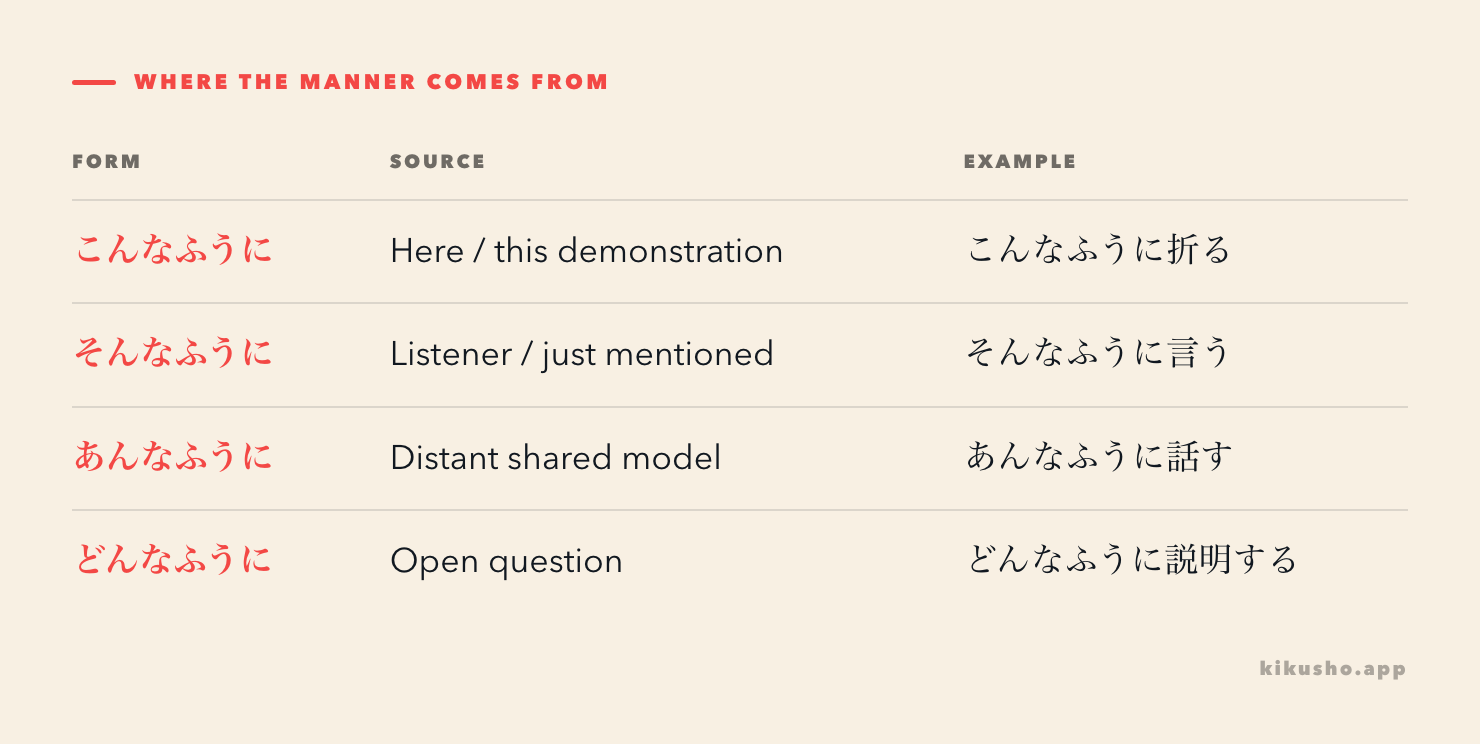
The corresponding こういう/そういう/ああいう/どういうふうに forms are also common. どういうふうに理解しましたか asks “How did you understand it?” The いう makes the description slightly more explicit, but it does not create a new attachment rule: the whole expression still names a manner before に links it to the verb.
A clause before ふうに describes an air or appearance
When a plain clause precedes ふうに, the sentence often reports how someone's behavior appears rather than simply pointing to a visible demonstration.
彼は何も知らないふうに話した。
He spoke as if he knew nothing.
聞いていないふうに振る舞っているが、本当は全部聞いている。
He is acting as if he is not listening, but he is actually hearing everything.
彼女は困っているふうには見えなかった。
She did not look troubled.
The first two examples can imply performance or pretense because 話す and 振る舞う are controllable behaviors. The third stays with visible impression: the observer did not perceive the air of someone in trouble. Context, not ふうに alone, decides whether the appearance is deliberate.
This pattern is useful when you want to avoid claiming access to another person's inner state. 彼女は困っていた states that she was troubled. 彼女は困っているふうに見えた reports the observer's impression. The distinction resembles other evidence markers, but ふうに here specifically packages the style or air detected in behavior.
The larger form clause + というふうに can package a whole statement, category or formulation. It is a separate N2 curriculum target, so do not treat every occurrence of というふうに as a longer spelling of the narrower demonstrative pattern taught here.
に remains when は adds contrast
Learners sometimes see ふうには and assume that two particles have collided. Their jobs are separate. に marks the manner in which the following state or action holds; は contrasts that manner with another possibility.
私はそんなふうには考えていません。
I do not think about it that way.
説明を聞く前は、こんなふうには理解していなかった。
Before hearing the explanation, I did not understand it this way.
Removing は gives the neutral adverbial そんなふうに考えていません. Adding it makes the rejected interpretation more contrastive: “that is not the way I think about it,” with another view left open. The same layering appears in ordinary combinations such as 学校には行かない, where the location or goal particle remains before contrastive は.
ふうに, ように and とおりに set different standards
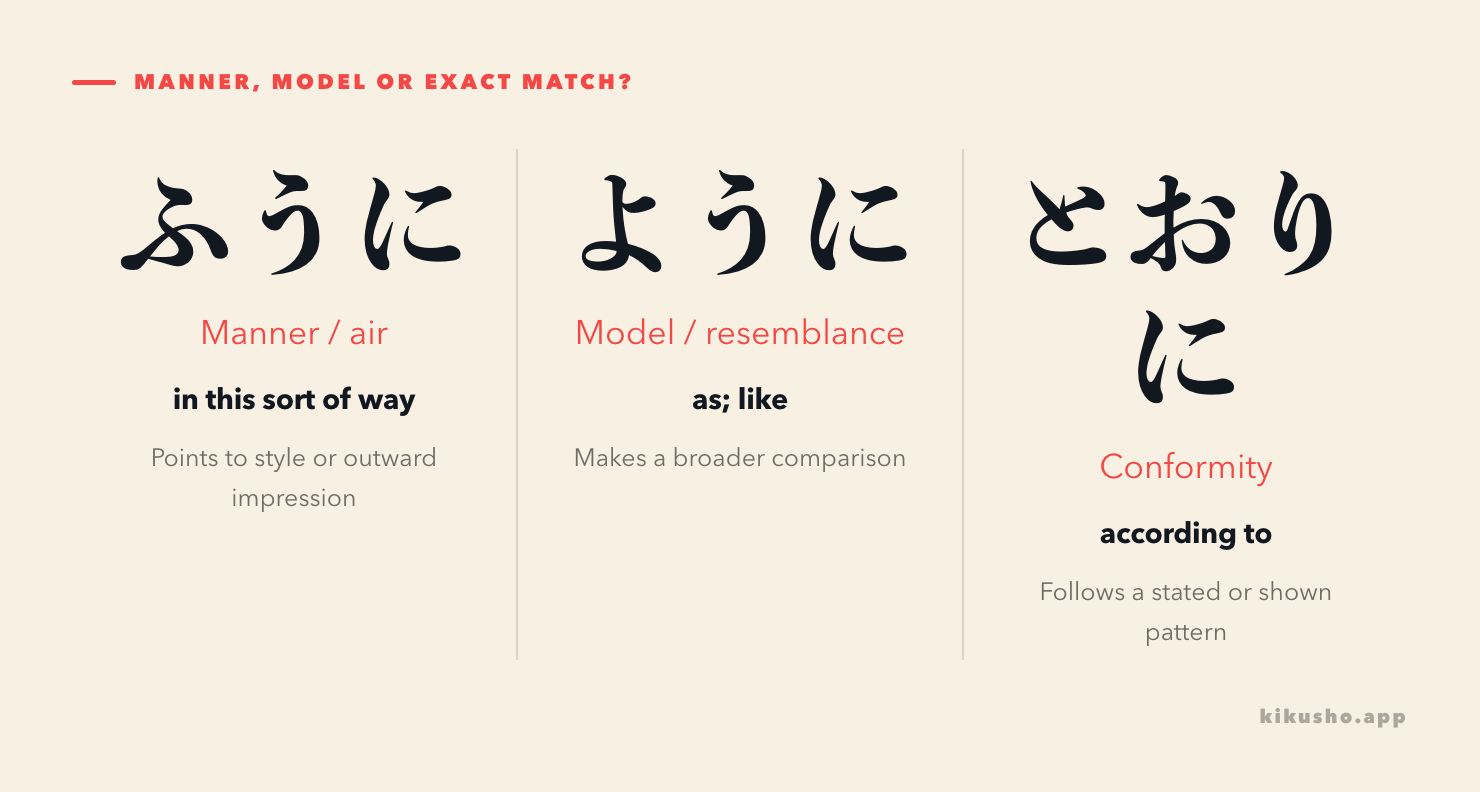
Three expressions may all become “like” or “as” in English. Ask what kind of relationship the sentence needs.
こんなふうに字を書いてください。
Write the character in this sort of way.
先生が見せたように字を書いてください。
Write the character as the teacher showed you.
見本のとおりに字を書いてください。
Write the character exactly according to the model.
ふうに points to the manner or style being demonstrated. ように makes a broader comparison to what the teacher showed. とおりに sets the sample as the pattern to follow and often suggests closer conformity. Real contexts can make the first two overlap, but ふうに is especially at home with demonstratives and outward manner, while ように has many additional jobs that ふうに cannot replace, including purpose and resulting-state patterns.
The 途中で and とおりに lesson develops exact sequence and conformity. For evidence-based resemblance among そう, よう, らしい and みたい, use the appearance and evidence comparison.
どんなふうに and どうやって overlap, but ask from different angles
Both questions can request an explanation of a method:
この機械はどうやって動かしますか。
How do you operate this machine?
この機械はどんなふうに動きますか。
In what way does this machine move or work?
どうやって readily asks for means or procedure: which controls, tool or sequence makes the action happen? どんなふうに asks for a characterization of the manner, shape or behavior. The first question above invites operating steps. The second can invite a description of the machine's movement.
In ordinary conversation the boundary is flexible. どんなふうに説明すればいいですか and どうやって説明すればいいですか may both mean “How should I explain it?” The first foregrounds the form the explanation should take; the second foregrounds the method for producing it. Choose from the answer you expect rather than forcing a different translation for every sentence.
The register is standard, with こんなふうに and どんなふうに common in speech. Formal instructions may prefer このように or どのように, especially when the “manner” is an abstract procedure rather than a visible style. そんなふうに言わないで belongs naturally to conversation because it reacts to a particular way of speaking.
For a Kikusho card, keep the demonstration or behavior that supplies the manner. A card with only こんなふうに = like this loses what “this” points to. Save the line before it or a short note such as “speaker demonstrates the fold”; the retrieval cue then includes both the deictic choice and the action shaped by に.
Practice: identify where the manner comes from
Resolve all six prompts by locating the model, behavior or expected answer before opening the key.
Question 1 — grammar choice. A teacher demonstrates a fold and asks students to copy the general manner. Which sentence fits?
- こんなふうに折ってください。
- こんなふうを折ってください。
- こんなふうで折ってください。
- こんなふうが折ってください。
Question 2 — grammar choice. Complete “Don't say it like that”: __ふうに言わないで。
- どの
- その
- そんな
- そうな
Question 3 — text grammar. Read 彼は何も知らないふうに話した。 Does the sentence prove that he knew nothing? Explain what ふうに commits the speaker to.
Question 4 — grammar choice. Which question most clearly asks for the machine's operating procedure rather than the manner of its movement?
- この機械はどんなふうに動きますか。
- この機械はどうやって動かしますか。
- この機械はあんなふうに動きますか。
- この機械は動いているふうに見えますか。
Question 5 — sentence composition. Use 私/そんな/ふうに/は/考えていない to say “I don't think about it that way,” preserving the contrastive particle.
Question 6 — text grammar. Read 説明を聞く前は、こんなふうには理解していなかった。 What does に connect to, what does は add, and what earlier context must make こんな recoverable?
Answers and explanations
Answer 1: 1. こんなふうに折ってください uses に to make the demonstrated manner modify 折る. を, で and が do not perform that adverbial job in this pattern.
Answer 2: 3, そんな. そんなふうに points to the listener's manner of speaking or the manner just heard. その would require a following noun directly, while そうな belongs to a different appearance construction.
Answer 3. No. The sentence says that his way of speaking gave the air or impression of knowing nothing. He may truly know nothing, or he may be performing ignorance; ふうに commits the speaker to the observed manner, not the hidden fact.
Answer 4: 2. どうやって動かしますか asks what means or procedure the operator uses. Choice 1 asks how the machine moves or behaves, choice 3 points to a known distant example, and choice 4 asks whether it appears to be moving.
Answer 5. 私はそんなふうには考えていない。 に connects the manner to 考える, and は contrasts that rejected way of thinking with another possible interpretation.
Answer 6. に makes “this way” the manner of 理解する. は highlights that manner as the one that did not apply before the explanation, leaving a different earlier understanding in contrast. The conversation, a diagram or the speaker's current explanation must already show what こんな points to; without that source, “this way” is incomplete.
Common questions
What does ふうに mean in Japanese?
ふうに means “in the manner of,” “in this or that way,” or “in a way that gives the impression that.” The noun-like ふう names a manner or air, and に lets that manner modify the following action or state.
What is the difference between ふうに and ように?
ふうに often points to a manner, style or outward impression, especially with こんな, そんな, あんな and どんな. ように is broader and can make a direct comparison, follow a model, or express purposes and resulting states.
Is ふうに normally written with the kanji 風?
The productive grammar pattern is commonly written in hiragana. Kanji is possible, while established style compounds such as 和風 and 洋風 normally keep 風 and belong to vocabulary rather than this grammar pattern.