On this page
~ざるを得ない means “to have no choice but to do” or “to be unable to avoid doing.” The first negative is ざる, “not doing”; the second is 得ない, “cannot.” Together they say that not doing the action is not an available option.
終電がなくなり、タクシーで帰らざるを得なかった。
The last train was gone, so I had no choice but to go home by taxi.
The sentence does more than announce an obligation. It presents the action as the result left after circumstances remove the alternatives.
The two negatives point to one unavoidable action
The shape looks difficult because modern Japanese preserves an older negative inside it:
| Part | Role | Plain-language idea |
|---|---|---|
| 帰ら | the base used before ない | go home |
| ざる | literary negative | not go home |
| を | marks that negative course as the thing at issue | the option of not going |
| 得ない(えない) | cannot obtain or cannot manage | is unavailable |
This is a useful way to remember the meaning, though you should learn the whole pattern as one construction. 帰らざるを得ない does not leave the action negative. It means that avoiding 帰る is impossible, so 帰る becomes necessary.
The older ざる is related to the literary negative ず. In classical grammar, ざる is an attributive form, but you do not need a full classical paradigm to use this N2 pattern. The Bunpro explanation of ざるを得ない also analyzes ざる as an old negative and contrasts external compulsion with an overpowering personal state.
If you want to see how older negatives survive in other advanced expressions, ~まじき and ~ずして belong to the same larger story. They are separate constructions, so their attachment rules do not transfer automatically.
Build it from the ない-form, with one crucial exception
Start with the plain negative. Remove ない, then attach ざるを得ない.
| Verb class | Dictionary form | ない-form | ~ざるを得ない |
|---|---|---|---|
| godan | 行く | 行かない | 行かざるを得ない |
| godan | 読む | 読まない | 読まざるを得ない |
| ichidan | 食べる | 食べない | 食べざるを得ない |
| irregular | する | しない | せざるを得ない |
| irregular | 来る(くる) | 来ない(こない) | 来ざるを得ない(こざるをえない) |
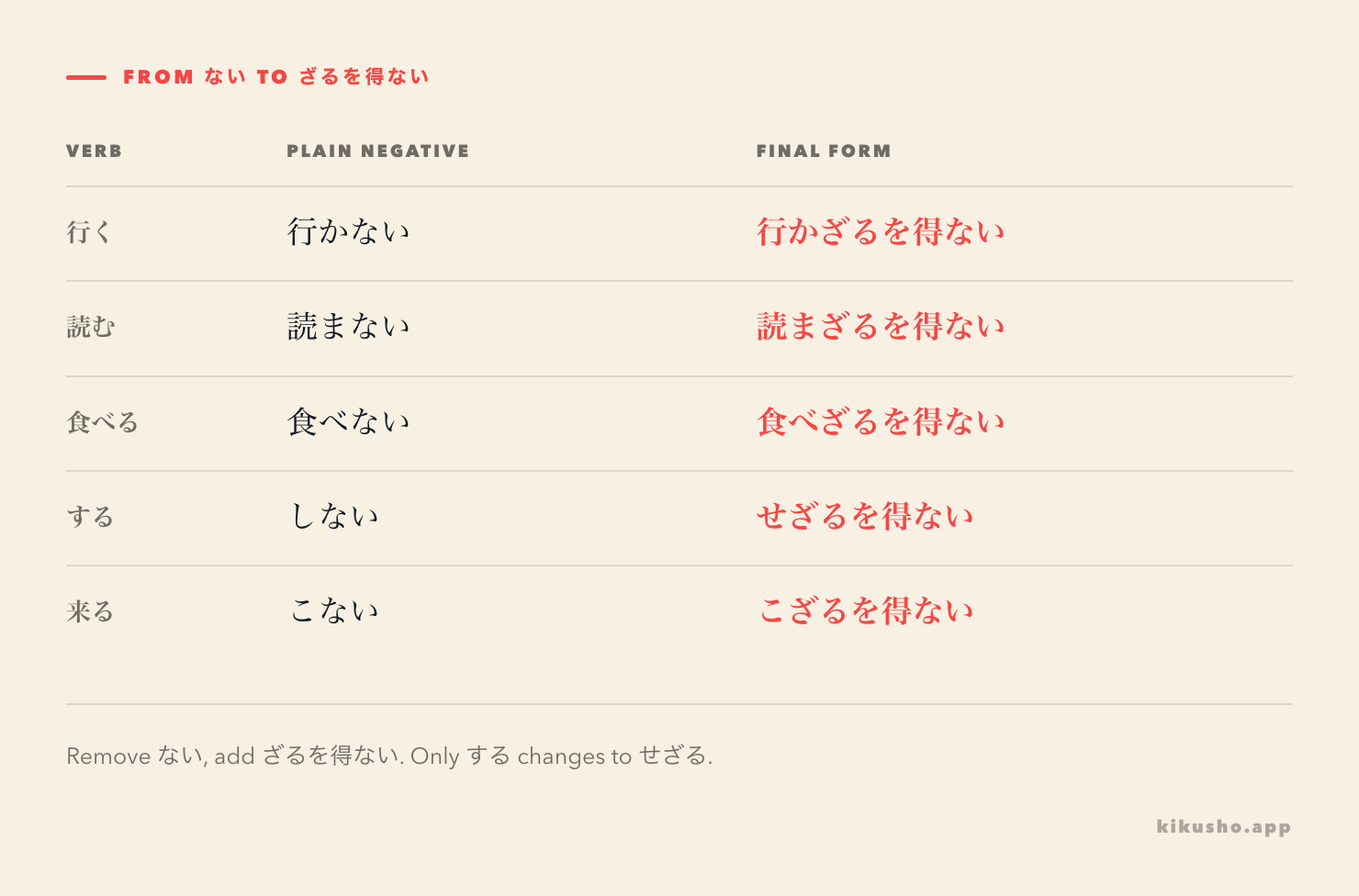
The する exception matters most because noun + する verbs occur constantly in formal situations:
- 計画を変更せざるを得ない。
We have no choice but to change the plan. - その事実を認めざるを得ない。
We cannot avoid acknowledging that fact. - 会議を延期せざるを得なかった。
We had no choice but to postpone the meeting.
Do not build the first one as 変更しざるを得ない. The negative base preserved in this pattern is せ, not し.
The form at the end carries tense and politeness:
| Form | Example | Meaning |
|---|---|---|
| non-past plain | 待たざるを得ない | have no choice but to wait |
| past plain | 待たざるを得なかった | had no choice but to wait |
| non-past polite | 待たざるを得ません | have no choice but to wait |
| connective | 待たざるを得なくなった | reached a point where waiting became unavoidable |
Keep 得 if you write the final verb in kanji, and read it え here. Writing the entire ending in kana, ざるをえない, is also possible.
Use it when the alternatives have collapsed
The most natural sentence supplies a pressure, limit, or fact that closes off the preferred route:
部品が手に入らないため、発売を延期せざるを得ない。
Because the parts are unavailable, we have no choice but to delay the launch.
証拠を見れば、彼の説明が正しかったと認めざるを得ない。
Looking at the evidence, we have to acknowledge that his explanation was correct.
The first is an unwanted practical decision. The second is an intellectual concession: the evidence makes continued denial untenable. The subject need not complain aloud, but the expression commonly carries resignation, reluctance, or a negative evaluation of the situation.
This is why a free choice sounds odd:
△ 天気がいいので、公園を散歩せざるを得ない。
Intended: The weather is nice, so I have no choice but to walk in the park.
Nothing in that sentence removes other options, and the walk sounds welcome. Add a real constraint and the form settles:
車が故障し、駅まで歩かざるを得ない。
The car broke down, so I have no choice but to walk to the station.
The Japanese Foundation's guide to expressions of obligation describes ~ざるを得ない as written in tone and as presenting an action taken because no other choice remains. It also observes that the form is most comfortable when speakers assess their own unavoidable action. When judging another person's obligation, でしょう or と思います can keep the sentence from sounding like an unsupported claim about that person's inner position:
林さんも責任者として説明せざるを得ないでしょう。
Hayashi will probably have no choice but to explain, as the person responsible.
It is heavier and more written than a routine “must”
Compare four ways to reach a necessary action:
| Form | What motivates the action | Typical tone |
|---|---|---|
| ~なければならない | a rule, requirement, or general necessity | neutral to formal |
| ~しかない | this is the only workable option | common and direct |
| ~ないわけにはいかない | not doing it would violate duty, common sense, or social expectations | reflective; common in speech |
| ~ざるを得ない | circumstances make avoidance impossible | formal, written, often resigned |
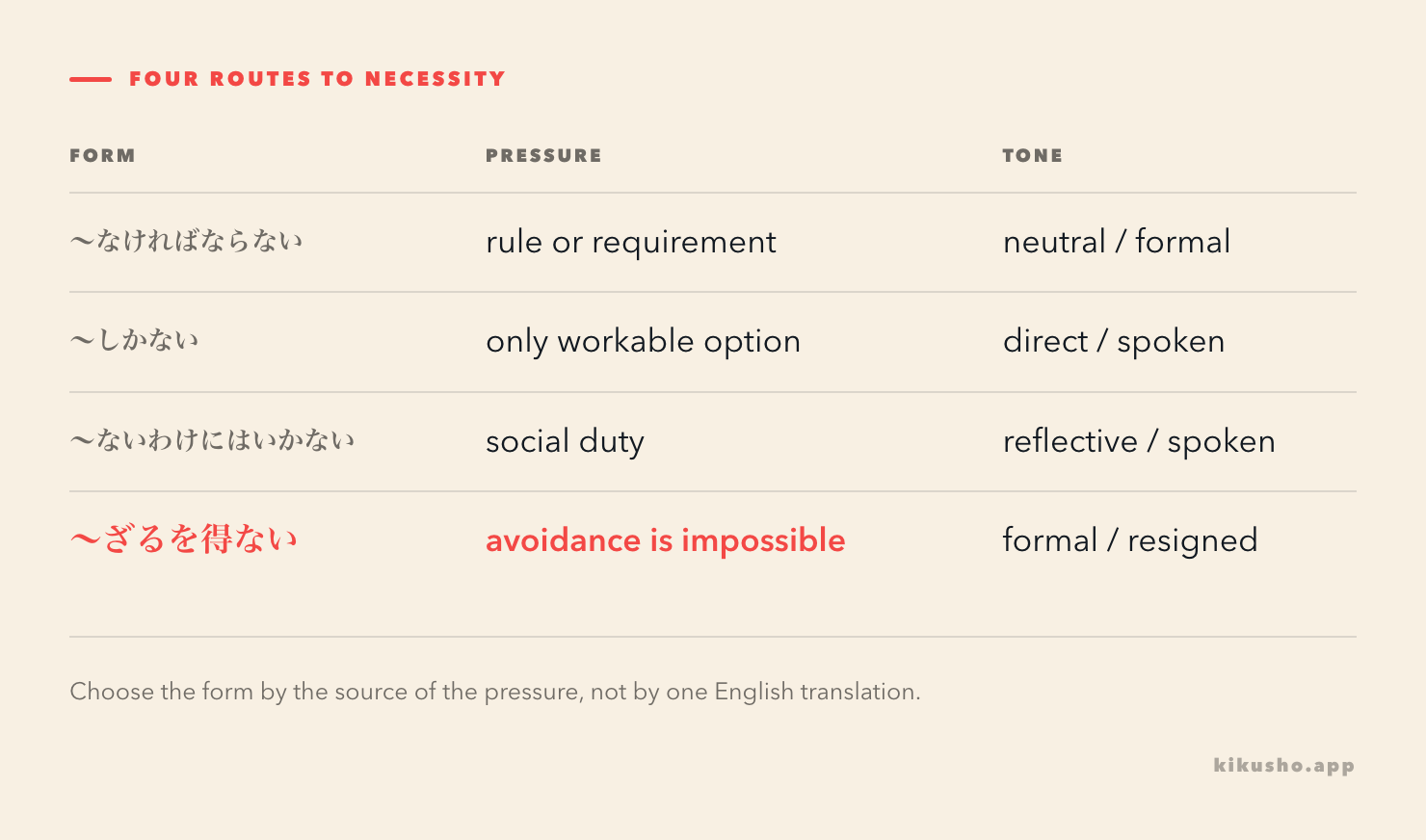
Suppose a team must cancel an event:
- 規則上、イベントを中止しなければならない。
The rules require us to cancel the event. - 会場が使えないので、中止するしかない。
The venue is unavailable, so cancellation is the only option. - 主催者として、安全を無視するわけにはいかない。
As organizers, we cannot simply disregard safety. - 台風が接近しており、中止せざるを得ない。
A typhoon is approaching, leaving us no choice but to cancel.
These descriptions can overlap. The choice tells the reader where you place the pressure. The Japan Foundation comparison ties ~ないわけにはいかない to social norms and past experience, while ~ざるを得ない foregrounds the absence of another choice. A detailed Japanese Grammar Navigator comparison likewise treats ~ざるを得ない, ~ないわけにはいかない, and ~しかない as close in core meaning while separating their attachment and behavior.
For a judgment about what someone ought to do, ~べき is often the more direct form. The lesson on ~はず and ~べき separates expected truth from a speaker's recommendation or judgment.
Do not use the English translation as the attachment rule
English “must,” “cannot help,” and “have to” cover several Japanese constructions. Build from the Japanese relation instead:
- Avoidance is practically impossible: ざるを得ない
- Only one route remains: しかない
- Duty makes non-action unacceptable: ないわけにはいかない
- A rule or requirement applies: なければならない
“Cannot help” is especially risky. An emotion that rises by itself often takes ~てしょうがない or ~ずにはいられない, depending on the meaning. ~ざるを得ない can appear with reactions such as 驚かざるを得ない or 感動せざるを得ない, but it frames the reaction as an unavoidable conclusion or response. It does not simply mean “very.”
When you meet the form in a report, editorial, or workplace message, save the whole sentence rather than the ending alone. The reason clause tells you what removed the alternatives, and that relation is what a one-line gloss loses. Kikusho can turn the sentence you found into a card with its reading, nuance, example, and audio, then schedule it for review.
The mistakes are visible at both ends
Four checks catch most errors:
- The expression attaches to a verb, not directly to a noun or adjective.
- Build from the ない-form base: 書かない → 書かざる, not 書きざる.
- Change する to せざる, including noun + する verbs.
- Conjugate 得ない for tense and politeness; do not change ざる.
The construction itself already contains the negative logic. Adding another negative can reverse or distort the intended action:
予算が削減され、計画を縮小せざるを得なかった。
The budget was cut, so we had no choice but to scale down the plan.
Here the unavoidable action is 縮小する. If the intended action were “not reduce the plan,” you would need a different sentence that makes that negative action clear. Do not mechanically place ざるを得ない after an English phrase.
Practice: make all ten choices before checking
Question 1. Which meaning best matches 出発を延期せざるを得ない?
- Option A: We are forbidden to delay departure.
- Option B: We have no choice but to delay departure.
- Option C: We might choose to delay departure.
- Option D: We have already avoided delaying departure.
Question 2. Choose the correct form of 行く.
交通機関が止まったが、病院まで行か__。
- Option A: ずを得ない
- Option B: ざるを得ない
- Option C: ないざるを得ない
- Option D: ざるが得ない
Question 3. Which sentence has the correct する attachment?
- Option A: 方針を変更しざるを得ない。
- Option B: 方針を変更せざるを得ない。
- Option C: 方針を変更さざるを得ない。
- Option D: 方針を変更するざるを得ない。
Question 4. Put the four chunks in the correct order. Which chunk belongs in ★?
システムが止まり、休日に __ __ ★ __。
- 出社
- 得なく
- せざるを
- なった
Question 5. A friend says, “The last train has left, so walking is the only practical option.” Which sounds most natural in casual conversation?
- Option A: 歩くしかないね。
- Option B: 歩くべきではないね。
- Option C: 歩くざるを得ないね。
- Option D: 歩いたわけではないね。
Question 6. Which context best supports ~ざるを得ない?
- Option A: You freely choose your favorite dessert.
- Option B: A broken server forces the company to delay a release.
- Option C: You recommend a film to a friend.
- Option D: You guess that tomorrow will be sunny.
Question 7. Choose the best expression for duty grounded in social convention.
お世話になった先生の退職式だから、挨拶に行か__。
- Option A: ないわけにはいかない
- Option B: ざるそうだ
- Option C: なかったことがある
- Option D: ずてもいい
Question 8. Read the short passage and choose the best form.
新製品には重大な問題が見つかった。会社は発売を続けたかったが、安全を保証できない以上、計画を__。
- Option A: 見直さざるを得なかった
- Option B: 見直さなくてもよかった
- Option C: 見直すはずがなかった
- Option D: 見直したことがなかった
Question 9. Which correction is required?
締め切りが早まり、予定を変更しざるを得なくなった。
- Option A: 締め切り → 締め切った
- Option B: 早まり → 早まらず
- Option C: 変更しざる → 変更せざる
- Option D: 得なくなった → 得ないだった
Question 10. Match each source of pressure with its best ending.
A. 法律で決まっているので、申請書を提出し__。
B. 代わりの部品がないので、この機械を修理し__。
- Option A: A なければならない / B ざるを得ない
- Option B: A ざるを得ない / B べきかもしれない
- Option C: A しかなかった / B なくてもいい
- Option D: A ないわけではない / B なければよかった
Finish all ten questions before continuing. Every solution and explanation is collected below.
Answers and explanations
1
Answer: Option B. The construction makes delaying departure unavoidable. Option A is prohibition, C leaves the choice open, and D claims the delay was avoided.
2
Answer: Option B, 行かざるを得ない. 行く has the negative 行かない. Removing ない gives 行か, which takes ざるを得ない. Option A uses ず where this fixed pattern requires ざる.
3
Answer: Option B, 方針を変更せざるを得ない. 変更する follows the special する pattern: する → せざる. The other three endings do not form this construction.
4
Answer: Chunk 2, 得なく. The full order is 1 → 3 → 2 → 4: 休日に出社せざるを得なくなった, “it became unavoidable to go to work on the day off.” 得ない changes to 得なく before なる.
5
Answer: Option A, 歩くしかないね. ~しかない directly presents walking as the only option and fits casual speech. Option C attaches ざる to the dictionary form, B advises against walking, and D denies a claim about having walked.
6
Answer: Option B. A server failure is an external fact that removes the preferred option. A free preference, recommendation, or weather guess does not by itself create unavoidable action.
7
Answer: Option A, ないわけにはいかない. The speaker feels obliged because of the relationship with the teacher and the convention of acknowledging that support. The other options are malformed or express a different meaning.
8
Answer: Option A, 見直さざるを得なかった. 見直す becomes 見直さない, then 見直さざる. The safety problem makes reviewing the plan unavoidable despite the company's wish to continue. B says review was unnecessary, C says it was not expected, and D says the company had never reviewed it.
9
Answer: Option C. 変更する becomes 変更せざるを得ない. The connective ending 得なくなった is already correct and means that circumstances changed until revision became unavoidable.
10
Answer: Option A. Sentence A states a legal requirement, so なければならない fits. Sentence B says the lack of replacement parts has eliminated alternatives, so ざるを得ない brings that practical pressure into focus.
Once this form stops looking like a long suffix, its tone becomes easier to hear. Look left for the action being resisted, then farther left for the fact that made resistance impossible.
Common questions
What does ~ざるを得ない mean?
It means that circumstances leave someone no choice but to do something. It is often translated as “have to,” “cannot avoid,” or “cannot help but.”
How do you form ~ざるを得ない?
Take a verb's ない-form, remove ない, and add ざるを得ない. 行かない becomes 行かざるを得ない and 食べない becomes 食べざるを得ない. The important exception is する, which becomes せざるを得ない.
Is ~ざるを得ない formal?
Yes. It has a formal, written tone, though it also appears in serious spoken explanations. In ordinary conversation, ~しかない is often more direct.
What is the difference between ~ざるを得ない and ~ないわけにはいかない?
Both can express unavoidable action. ~ざるを得ない emphasizes that no other practical choice remains, while ~ないわけにはいかない often points to duty created by social expectations, common sense, or one's position.