On this page
Use 途中で/途中に when an event happens while a route, activity or process is still unfinished. Use とおりに when someone follows a model or when reality matches an instruction, plan or prediction.
駅へ行く途中で、友達に会った。
えきへ いく とちゅうで、ともだちに あった。
I met a friend on the way to the station.
地図のとおりに歩いた。
ちずの とおりに あるいた。
I walked according to the map.
The first sentence answers when or where along an unfinished route? The second answers according to what model? That decision separates inventory items g-cde9dede23f8, 途中で/途中に, and g-cf58aff048ad, とおりに.
Ask whether the phrase locates an event or supplies a model
The similar sounds can distract from the different jobs. 途中(とちゅう) is a noun meaning the middle of a route, action or process. The particle after it helps place another event inside that unfinished span. とおり means a way, pattern or correspondence; it tells you that one action or result matches another.
| Question answered | Pattern | Example | Meaning |
|---|---|---|---|
| At what stage did B happen? | A 途中で/途中に B | 会議の途中で出た | left during the meeting |
| What model did B follow? | A とおりに B | 指示のとおりに入力した | entered it as instructed |
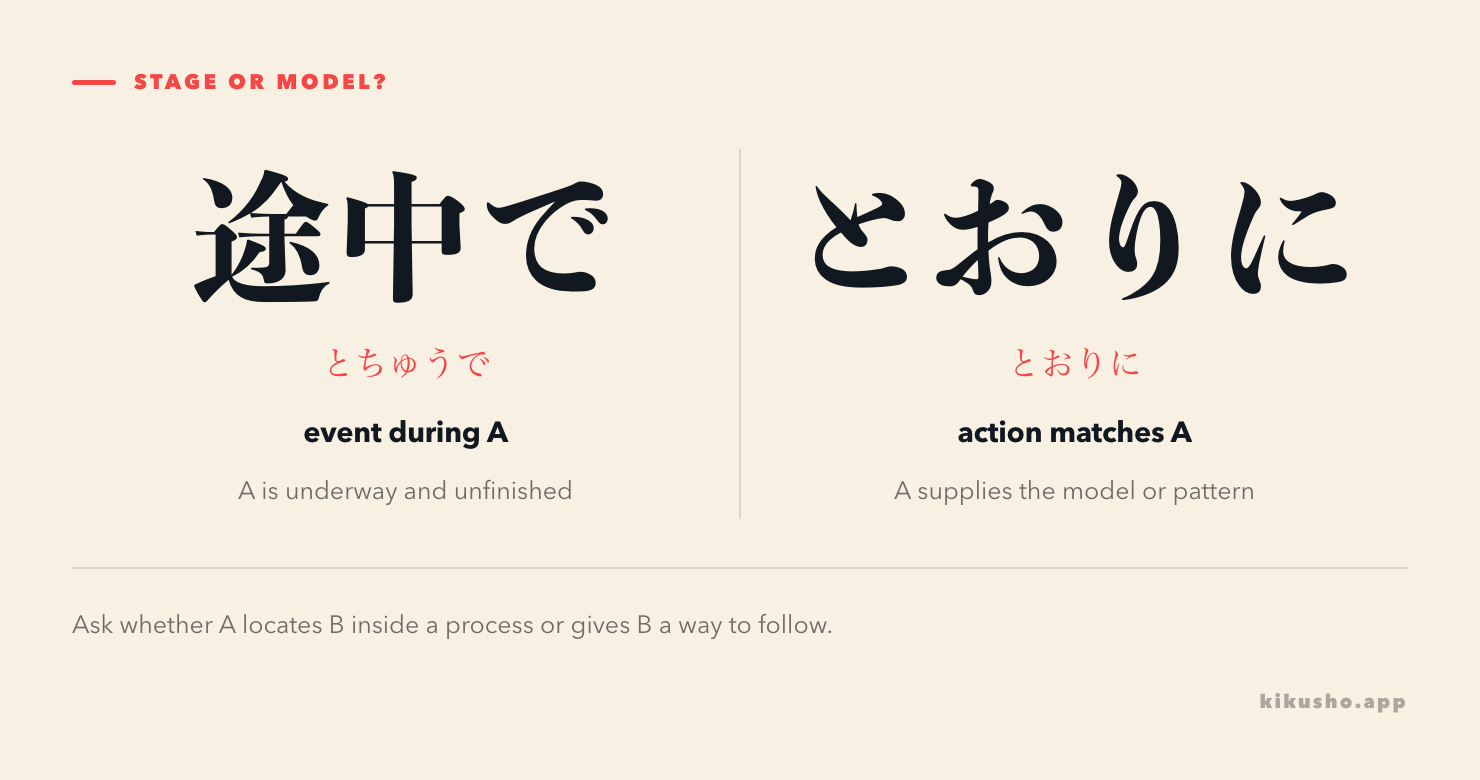
Do not test these forms by translating both with one English preposition. Draw a timeline for 途中: A has begun, B occurs, and A has not yet reached its end. Draw a model and a matching action for とおり: A supplies the pattern, and B conforms to it.
途中 places B inside an unfinished route or process
Attach 途中 to a dictionary-form verb, an ongoing ている form or a noun plus の. Travel expressions also form compounds such as 帰宅途中(きたくとちゅう), “on the way home.”
| What is unfinished? | Attachment | Example |
|---|---|---|
| a route or projected action | V dictionary + 途中で/に | 学校へ行く途中で |
| an action visibly in progress | Vている + 途中で/に | 食べている途中に |
| a named event or process | Nの + 途中で/に | 会議の途中で |
| a familiar compound | N + 途中で/に | 帰宅途中で |
テーブルまで行く途中で、転んだ。
テーブルまで いく とちゅうで、ころんだ。
I fell on the way to the table.
昼ご飯を食べている途中に、電話が鳴った。
ひるごはんを たべている とちゅうに、でんわが なった。
The phone rang while I was eating lunch.
会議の途中で、気分が悪くなって部屋を出た。
かいぎの とちゅうで、きぶんが わるくなって へやを でた。
I felt ill during the meeting and left the room.
The action before 途中 establishes a span rather than a finished result. 駅へ行った途中で is therefore not the ordinary way to say “on the way to the station”: 行った presents the trip as completed before 途中 tries to place something inside it. Use 駅へ行く途中で.
途中で and 途中に overlap
Some explanations offer a helpful tendency: で often presents the route or process as the setting or occasion for an action, while に often focuses on a point when an event occurs. That is a tendency, not a mechanical rule.
駅から学校へ行く途中で、先生に会った。
えきから がっこうへ いく とちゅうで、せんせいに あった。
I met my teacher on the way from the station to school.
帰る支度をしている途中に、客が来た。
かえる したくを している とちゅうに、きゃくが きた。
A visitor arrived while I was getting ready to leave.
These examples sound natural, but switching the particles does not automatically produce a different grammar point or an impossible sentence. The event verb, the speaker's perspective and established usage influence the choice. Learn complete examples instead of memorizing “human action equals で” or “sudden event equals に.”
The bare noun also appears when the relationship is clear: 家に帰る途中、本屋に寄った, “I stopped at a bookstore on the way home.” This lesson focuses on the assigned forms with で and に, but the particles are not part of the noun itself.
とおり gives the model that an action or result matches
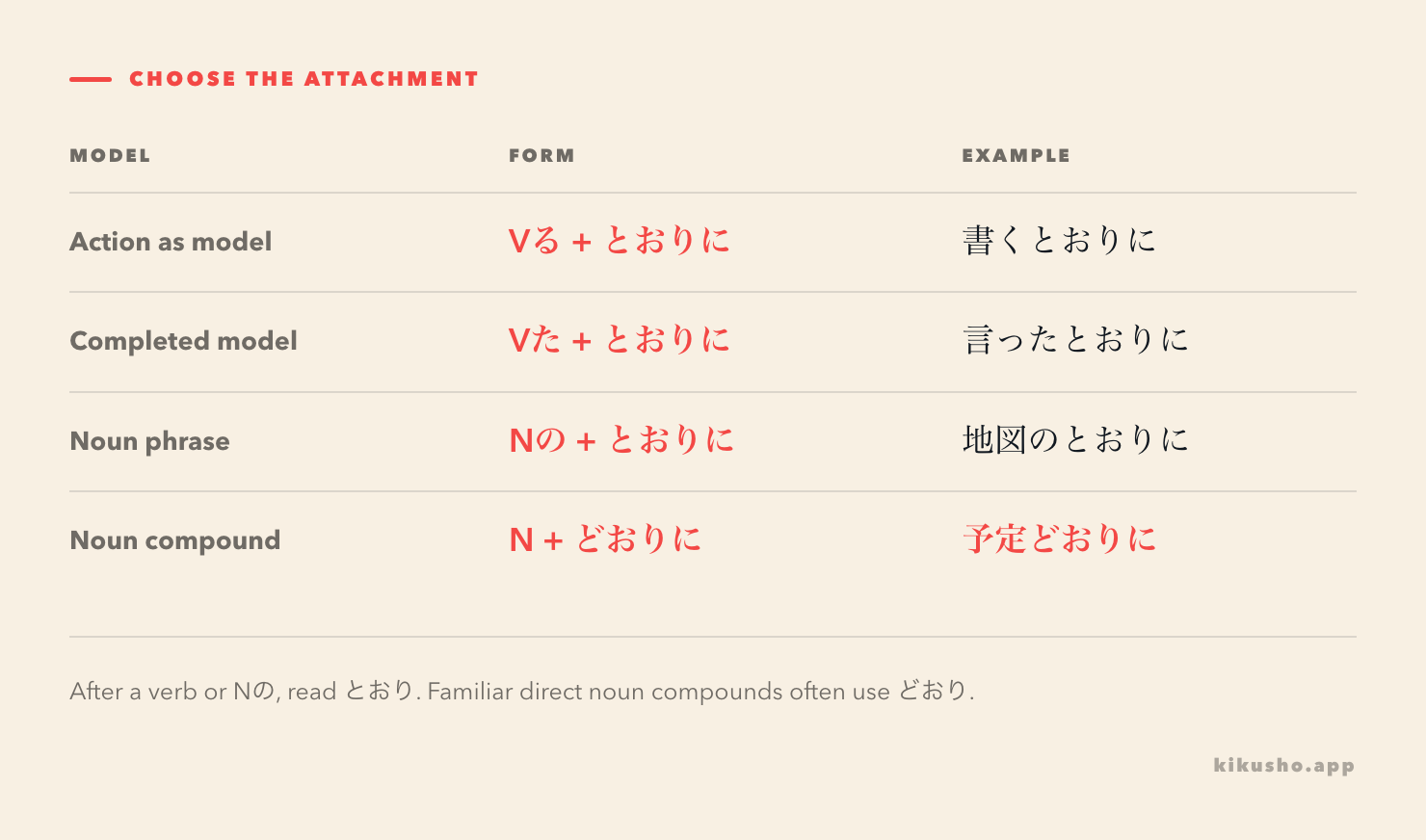
Attach とおりに to a dictionary-form or past verb. With nouns, use Nのとおりに or the suffix-like Nどおりに found in familiar combinations such as 予定どおり and 予報どおり.
| Model | Shape | Example |
|---|---|---|
| an action as someone performs it | V dictionary + とおりに | 先生が書くとおりに |
| something already said or shown | V past + とおりに | 説明したとおりに |
| a noun phrase | Nの + とおりに | 地図のとおりに |
| a common noun compound | N + どおりに | 予定どおりに |
先生が書くとおりに、漢字を書いてください。
せんせいが かく とおりに、かんじを かいて ください。
Please write the kanji the way the teacher writes them.
先生に言われたとおりに、作文を直した。
せんせいに いわれた とおりに、さくぶんを なおした。
I revised the composition as the teacher told me.
電車は予定どおりに到着した。
でんしゃは よていどおりに とうちゃくした。
The train arrived as scheduled.
The first verb need not be past merely because the following action is past. 先生が書くとおりに書いた treats the teacher's writing as the way to imitate. 先生が書いたとおりに書いた treats the completed demonstration as the model.
とおり, どおり and に change the sentence shape
The reading stays とおり after a verb and in Nのとおり. In many compounds directly after a noun, it becomes どおり: 予定どおり, 予想どおり, 時間どおり. These combinations are learned as units; do not voice every noun automatically.
The final に marks manner before an action, but other sentence shapes are possible.
| Shape | Job | Example |
|---|---|---|
| とおりに/どおりに + verb | describes how an action occurs | 指示どおりに操作する |
| とおり/どおり + verb | に omitted in a natural context | 思ったとおり進んだ |
| とおりだ/どおりだ | finishes the predicate | 結果は予想どおりだ |
| とおりの/どおりの + noun | modifies a noun | 説明どおりの結果 |
天気予報のとおり、午後から雨が降った。
てんきよほうの とおり、ごごから あめが ふった。
Just as the forecast said, it rained from the afternoon.
Here とおり frames the following result, so に is absent. In 予報どおりに試合を延期した, に more plainly marks the manner or basis of the action.
Keep 途中 apart from 最中, ところ and ように
最中に(さいちゅうに) emphasizes being right in the middle of an activity: 会議の最中に電話が鳴った. 途中に/途中で can describe that kind of interruption, but it also covers a route or any intermediate stage: 駅へ行く途中で. 最中 is tighter and often highlights the intrusion.
ところ locates an action around a particular phase: 食べるところだ is about to eat, 食べているところだ is eating now, and 食べたところだ has just eaten. The lesson on ところ follows those aspect changes. 途中 instead views a route or process as unfinished and places another event within it.
ように can also translate as “as,” but it often expresses resemblance, a target or a requested manner. 見本のとおりに作る asks for correspondence with the model; 見本のように作る can allow a broader “make it like the example.” とおり normally claims a closer match.
When an instruction controls an action, にしたがって can approach とおりに: 指示にしたがって入力する and 指示どおりに入力する both mean to enter information according to instructions. The にしたがって comparison also covers linked change, where とおりに cannot replace it.
Practice: decide between a stage and a model
Question 1. Choose the natural form.
駅へ向かう( )、財布を落としたことに気づいた。
- A. 途中で
- B. とおりに
Question 2. Choose the natural form.
画面の説明( )、名前と住所を入力してください。
- A. の途中に
- B. のとおりに
Question 3. Complete the sentence with 途中で, 途中に, のとおりに or どおりに.
発表の__、パソコンが急に止まった。
Question 4. Which attachment is unnatural for the intended meaning “I did it as the teacher said”?
- A. 先生が言ったとおりにした。
- B. 先生に言われたとおりにした。
- C. 先生の言うとおりにした。
- D. 先生を言ったどおりにした。
Question 5. Rewrite with a common noun compound: 計画のとおりに進みました.
Question 6. Choose the sentence that specifically means the phone rang while the meal was in progress.
- A. 食事の途中に電話が鳴った。
- B. 食事のとおりに電話が鳴った。
- C. 食事どおりに電話が鳴った。
Question 7. Use the context to complete both blanks.
駅へ行く(甲)、工事中の道がありました。そこで、地図(乙)別の道を歩きました。
- ア. 甲 とおりに / 乙 の途中で
- イ. 甲 途中で / 乙 のとおりに
- ウ. 甲 途中に / 乙 どおりで
- エ. 甲 の途中で / 乙 のとおりだ
Answers and explanations
Answer 1. A, 途中で. The wallet realization occurs during the unfinished trip toward the station. No instruction or model is being followed.
Answer 2. B, のとおりに. The on-screen explanation supplies the model for entering the information. 説明の途中に would mean that something happened partway through an explanation.
Answer 3. 途中で and 途中に are both possible. 発表の途中で、パソコンが急に止まった presents the presentation as the setting; 発表の途中に focuses on the time at which the computer stopped. The overlap is real, so context does not force only one particle here.
Answer 4. D. The object particle を cannot link 先生 to 言った in this meaning, and a verb takes とおり rather than the noun-compound reading どおり. A–C all provide a grammatical model: what the teacher said, what one was told by the teacher, or what the teacher says.
Answer 5. 計画どおりに進みました。 Both 計画のとおりに and the familiar compound 計画どおりに mean “it proceeded according to plan.” The direct noun compound voices と as ど.
Answer 6. A. 食事の途中に places the ringing during the unfinished meal. The other choices incorrectly treat the meal as a model that the phone follows.
Answer 7. イ. 駅へ行く途中で locates the roadwork during the trip. 地図のとおりに presents the map as the model for the alternate route. The two blanks therefore test different relationships, despite the similar sounds.
The references agree on an N3 placement for とおりに: JLPT Sensei, Bunpro and J-nihongo all use that label. The boundary for 途中で/途中に is less settled: JLPT Sensei and Nihongo Net teach it at N3, whereas Bunpro files it under N2. These are editorial study levels because the current JLPT provides no exhaustive public grammar list. The useful exam skill is stable across those labels: ask whether the phrase locates B inside an unfinished A or makes A the model that B follows.
Common questions
What is the difference between 途中で and とおりに?
途中で locates an event during an unfinished route or process. とおりに says that an action or result matches a model, instruction, plan or prediction.
What is the difference between 途中で and 途中に?
Their uses overlap. で often presents the route or process as the setting for an action, while に often focuses on a point when something occurs. The following verb and ordinary usage matter more than a rigid rule.
How do verbs and nouns attach to とおりに?
Use a dictionary-form or past verb plus とおりに, a noun plus のとおりに, or many familiar noun compounds plus どおりに, as in 予定どおりに.
Are 途中で, 途中に and とおりに N3 grammar?
JLPT Sensei lists both families at N3, as do other teaching references used here. Bunpro places 途中に and 途中で at N2. These are editorial estimates because the current JLPT publishes no exhaustive grammar list.