On this page
逆に turns the discussion toward an opposite or inverse relation. もっとも leaves the main claim standing, then adds a reservation: “that said” or “though.” The choice is therefore between changing direction and narrowing what you just said.
昼は道が混んでいる。逆に、夜は空いている。
ひるは みちが こんでいる。ぎゃくに、よるは すいている。
The roads are crowded during the day. Conversely, they are clear at night.
夜は道が空いていて便利だ。もっとも、バスの本数は少ない。
よるは みちが すいていて べんりだ。もっとも、バスの ほんすうは すくない。
The clear roads make nighttime travel convenient. That said, there are few buses.
The first passage flips from day to night and from crowded to clear. The second keeps the favorable assessment, but prevents it from sounding unconditional.
The test: opposite relation or reservation?
| Ask about the second statement | Choose | Argument move |
|---|---|---|
| Does it show the opposite side, direction or relation? | 逆に | A points one way; B points the other way |
| Does it reconsider the first claim without withdrawing it? | もっとも | A remains valid; B limits how far to take it |
Both expressions can open a new sentence. Neither requires a particular verb form:
- A。逆に、B。
- A。もっとも、B。
That similar position can make them look interchangeable. Their logic is different. With 逆に, look for a pair of directions, roles or results. With もっとも, look for a speaker who has said something, stepped back and added a caution about it.
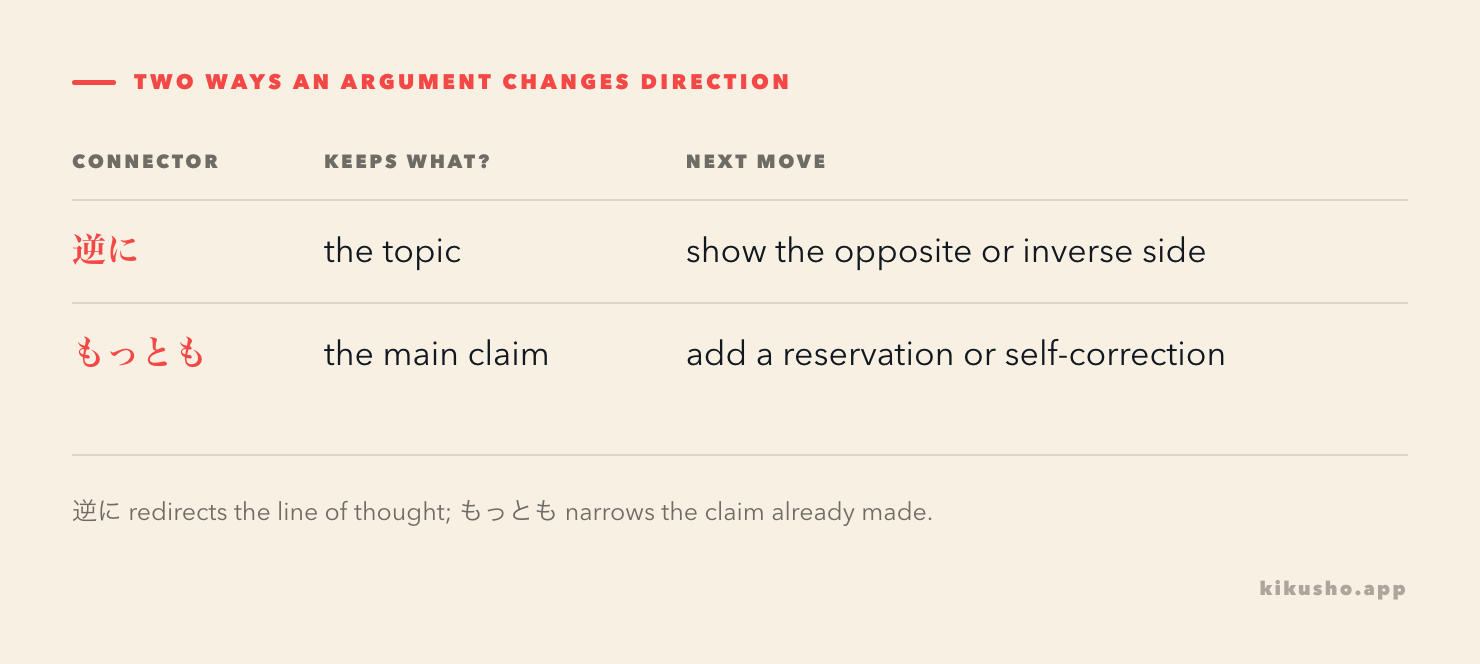
逆に redirects the line of thought
逆に combines 逆, “reverse” or “opposite,” with the adverbial particle に. It can describe literal reverse direction, but in an argument it commonly introduces a relation that runs the other way.
日本語から英語に訳すのは難しい。逆に、英語から日本語に訳すのも簡単ではない。
にほんごから えいごに やくすのは むずかしい。ぎゃくに、えいごから にほんごに やくすのも かんたんではない。
Translating from Japanese into English is difficult. Conversely, translating from English into Japanese is not easy either.
The source and target languages exchange roles. No surprise or failed plan is necessary. 逆に simply asks the reader to inspect the reverse relation.
The opposition can also concern how two people evaluate the same event:
私はこの静けさが好きだが、妹は逆に寂しいと感じるらしい。
わたしは この しずけさが すきだが、いもうとは ぎゃくに さびしいと かんじるらしい。
I like this quietness, but my younger sister apparently finds it lonely instead.
Here the people take contrary views of one setting. The adverb may follow the contrasted topic, as in 妹は逆に, or begin the next sentence as in 逆に、妹は.
Kotobank's entry for 逆 defines the core as an order or direction being opposite. Bunpro and JLPT Sensei both place 逆に at N2 and show it introducing a contrasting or reverse direction.
もっとも adds a self-correction
The conjunction もっとも looks back at a completed statement. The speaker still presents that statement as broadly worth saying, then adds another view, practical limit or reservation.
この計画は実現できる。もっとも、十分な予算があればの話だ。
この けいかくは じつげんできる。もっとも、じゅうぶんな よさんが あればの はなしだ。
This plan can be carried out. That said, that is assuming there is enough funding.
The second sentence does not claim that the plan is impossible. It makes the first claim less sweeping.
この店の料理はおいしい。もっとも、毎週通えるほど安くはない。
この みせの りょうりは おいしい。もっとも、まいしゅう かよえるほど やすくはない。
This restaurant's food is good. Though it is not cheap enough to visit every week.
The speaker keeps the positive judgment and then steps back from a possible overgeneralization. That reflective move makes もっとも especially useful in explanations, essays and measured conversation.
A dictionary definition describes the connector as affirming the preceding matter while adding an exception or partly contrary content. A detailed study by Izuhara distinguishes it from ただし: もっとも often presents the writer's own reconsideration, while ただし is well suited to required conditions and restrictions in objective notices. See the dictionary entry and Izuhara's analysis.
The three different もっとも forms
Do not identify the connector by sound alone. Three common forms share the reading もっとも:
| Form | Job | Example | Meaning |
|---|---|---|---|
| もっとも | conjunction | もっとも、時間はかかる | that said, it takes time |
| 最も | superlative adverb | 最も高い山 | the highest mountain |
| もっともだ | な-adjective predicate | 反対するのももっともだ | it is understandable that they object |
最も directly modifies a scale, such as 高い, 重要だ or 多い. もっともだ evaluates a reaction or argument as reasonable. The connector links two statements and introduces the speaker's reservation. The degree-adverb lesson separates superlative 最も from the other readings, while ~のももっともだ teaches the “understandable” predicate.
Keep 逆に separate from かえって
Both words can be translated with “instead” in some contexts, but かえって needs an expectation that the outcome overturns.
説明を短くしたら、かえって分かりにくくなった。
せつめいを みじかくしたら、かえって わかりにくくなった。
When I shortened the explanation, it became harder to understand instead.
Shortening an explanation normally predicts greater clarity. The actual result contradicts that prediction, so かえって fits. Compare a neutral reversal:
初心者には説明を短くした。逆に、上級者には詳しい資料を渡した。
しょしんしゃには せつめいを みじかくした。ぎゃくに、じょうきゅうしゃには くわしい しりょうを わたした。
We shortened the explanation for beginners. Conversely, we gave advanced learners detailed material.
The second action is opposite in direction, but nothing has backfired. The いよいよ and かえって lesson develops that expectation reversal. For two qualities belonging to the same subject, 反面 and 一方で provide different clause-attaching structures.

The level labels are estimates
JLPT Sensei labels both 逆に and もっとも as N2. Bunpro agrees on N2 for 逆に but places connector もっとも at N3. This is a teaching-order disagreement, not a change in meaning.
The JLPT publishes no exhaustive official grammar list. Kikusho groups these connectors here because N2 reading requires tracking whether a writer has introduced an opposite relation or reconsidered a claim. A learner who met もっとも earlier still needs that same discourse distinction.
Practice: follow the writer's move
1 · Reverse the relation
Choose the natural completion: 昼は観光客が多い。__、早朝は人が少なくて静かだ。
A. もっとも
B. 逆に
C. かえって
D. 最も
2 · Add a reservation
Choose the natural completion: この案は面白い。__、実現にはかなりの費用がかかる。
A. もっとも
B. 逆に
C. 最も
D. いよいよ
3 · Find the hidden expectation
Which sentence specifically says that an attempted improvement produced an unexpectedly worse result?
A. 文字を大きくしたら、かえって読みにくくなった。
B. 子ども向けは文字が大きい。逆に、大人向けは文字が小さい。
C. この本は読みやすい。もっとも、内容は簡単ではない。
D. この本が最も読みやすい。
4 · Identify the job of もっとも
In 会議は必要だ。もっとも、毎週開く必要はない, what does もっとも do?
A. It rejects the need for meetings completely.
B. It ranks this meeting above all others.
C. It keeps the first claim but limits its frequency.
D. It reverses the roles of two participants.
5 · Write the qualification
Join these ideas with connector もっとも: “The new library is convenient. It closes earlier than the old one.”
6 · Read the whole argument
Read: オンライン授業なら通学時間を減らせる。逆に、教室での交流は少なくなる。この方法は多くの学生に便利だ。もっとも、すべての授業に向いているわけではない。 Which description is accurate?
A. 逆に adds a reservation, and もっとも compares two travel directions.
B. Both connectors say that online classes had an unexpected result.
C. 逆に introduces the opposite side, and もっとも limits the favorable claim.
D. もっとも says online classes are the most convenient possible method.
Answers and explanations
1 · B, 逆に. Daytime crowds and quiet early mornings point in opposite directions. No attempted solution has produced a surprise, and the first claim does not need a reservation.
2 · A, もっとも. The proposal remains interesting. The cost makes that praise less absolute, so the writer steps back and qualifies it.
3 · A. Enlarging text is intended to help reading, but it had the opposite effect. That failed expectation licenses かえって. B gives a neutral contrast, C qualifies a claim and D uses the superlative 最も.
4 · C. Meetings are still presented as necessary. The second sentence restricts how often they need to happen; it does not retract the first judgment.
5 · 新しい図書館は便利だ。もっとも、前の図書館より早く閉まる. The first sentence gives the main evaluation, and もっとも introduces the drawback that keeps it from sounding unconditional. A different sentence is acceptable when it preserves that same reservation.
6 · C. The first connector turns from saved travel time to reduced classroom interaction. The second accepts the method's usefulness, then prevents the reader from extending that claim to every class.
In a long passage, ask what survives after the connector. After 逆に, the topic may remain while the relation turns around. After もっとも, the main claim survives while its scope becomes smaller. That single question keeps two similar-looking sentence openings apart.
Common questions
What is the difference between 逆に and もっとも?
逆に redirects the discussion toward an opposite or inverse relation. もっとも keeps the preceding claim in place but adds a reservation or self-correction.
What is the difference between 逆に and かえって?
逆に can neutrally show the opposite side or direction. かえって marks an outcome that runs contrary to an expectation or intention.
Is the connector もっとも the same as 最も?
No. 最も is the superlative adverb “most.” The connector もっとも means “that said” or “though” and looks back at a preceding statement.
Is もっとも N2 or N3 grammar?
Study resources disagree: JLPT Sensei places this connector at N2, while Bunpro places it at N3. The JLPT publishes no exhaustive official grammar list.