On this page
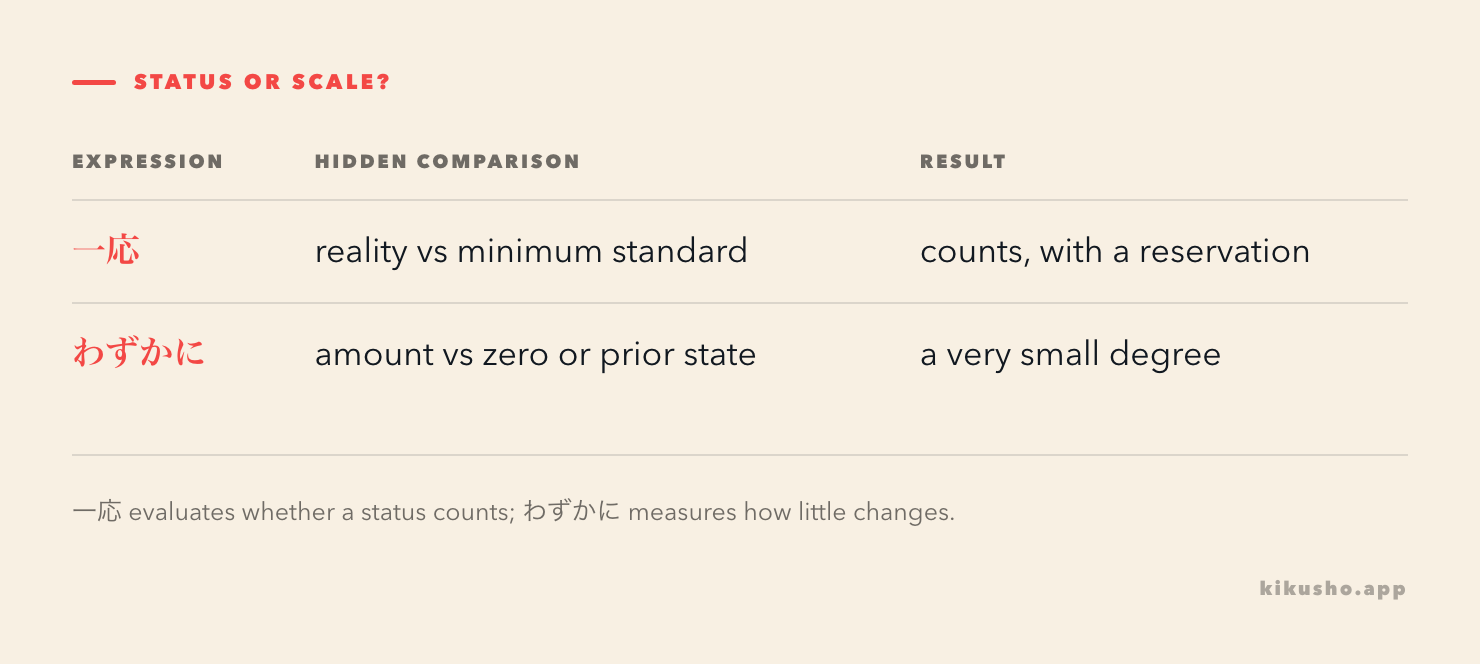
一応 evaluates whether something counts as done, acceptable or worth doing as a precaution, while leaving a reservation. わずかに measures how small a change, amount or difference is. Ask whether the sentence judges a status or measures a degree.
報告書は一応完成した。
ほうこくしょは いちおう かんせいした。
The report is finished, more or less.
報告書は昨日よりわずかに長くなった。
ほうこくしょは きのうより わずかに ながくなった。
The report became slightly longer than it was yesterday.
The first speaker lets the report count as complete but does not present it as perfect or final. The second sentence compares lengths and says the increase is small.
The test: status or scale?
| What is the speaker doing? | Choose | Typical result |
|---|---|---|
| Giving something provisional, minimally sufficient or precautionary status | 一応 | “more or less,” “for now,” “just in case” |
| Measuring a very small quantity, difference or degree | わずかに | “slightly,” “barely,” “only” |
Both expressions are adverbial and can stand before a phrase:
- 一応 + phrase: 一応確認した, checked just in case
- わずかに + phrase: わずかに増えた, increased slightly
The surface pattern does not decide the answer. The surrounding claim does. 一応 implies a standard or reason for caution; わずかに implies a scale on which the amount is near the low end.
一応 marks a minimum that counts
In its provisional use, 一応(いちおう) says that something has reached the minimum needed to receive a label, even if the speaker sees limits.
必要な資料には一応目を通したが、数字はまだ確認していない。
ひつような しりょうには いちおう めを とおしたが、すうじは まだ かくにんしていない。
I have gone through the necessary materials, more or less, but I have not checked the figures yet.
The reading is broad enough to count as having looked through the materials. The following clause names what remains. This is why 一応 can sound modest when speakers describe their own work: they avoid claiming complete mastery.
It can also make an arrangement tentative:
次の会議は一応金曜日の予定です。
つぎの かいぎは いちおう きんようびの よていです。
The next meeting is tentatively scheduled for Friday.
Friday is the working plan, but the wording leaves room for change. 一応 does not mean that Friday is a short time or that the meeting will be brief.
Kotobank records two central adverbial senses: something is done broadly though not fully, and something is checked as a precaution despite seeming likely to be correct. Bunpro describes the N2 provisional use as meeting a minimum requirement without being perfect or ideal.
一応 can also introduce a precaution
The same idea of satisfying a minimum requirement explains the “just in case” use. A risk may be unlikely, but one action is enough to cover it.
雨は降らないと思うが、一応傘を持っていく。
あめは ふらないと おもうが、いちおう かさを もっていく。
I do not think it will rain, but I will take an umbrella just in case.
The sentence does not call the umbrella incomplete. It says the action is a precaution beyond the speaker's main expectation.
This use is close to 念のため, “to be safe.” 一応 is common in ordinary conversation and can also soften a claim about identity or qualification:
一応、私もこのチームの責任者です。
いちおう、わたしも この チームの せきにんしゃです。
Technically, I am also the person responsible for this team.
The speaker has the title, but the context may make it surprising or less straightforward than the bare statement suggests. Tone matters: using 一応 about another person's work or position can sound dismissive because it implies that the standard was met only minimally.
わずかに places something near zero
わずかに, also written 僅かに, says that a quantity, difference, movement or degree is very small.
朝になって、気温がわずかに上がった。
あさに なって、きおんが わずかに あがった。
By morning, the temperature had risen slightly.
The temperature changed. The adverb measures the size of that change. It makes no claim about whether the rise is sufficient, provisional or precautionary.
二つの案には、わずかに違いがある。
ふたつの あんには、わずかに ちがいが ある。
There is a slight difference between the two proposals.
The difference exists but is small. With countable amounts, わずか may appear without に:
締め切りまでわずか三日しかない。
しめきりまで わずか みっかしか ない。
There are only three days until the deadline.
Use わずかな + noun when directly modifying a noun: わずかな差, a slight difference; わずかな希望, a small amount of hope. Kotobank distinguishes the small quantity or degree sense from the related “barely managed” sense and notes the noun-modifying form. JLPT Sensei and Bunpro both give the productive わずかに + phrase pattern.
One project, two different reservations
Set the forms beside the same project report:
新しい機能は一応完成した。
あたらしい きのうは いちおう かんせいした。
The new feature is complete, more or less.
処理速度はわずかに改善した。
しょりそくどは わずかに かいぜんした。
Processing speed improved slightly.
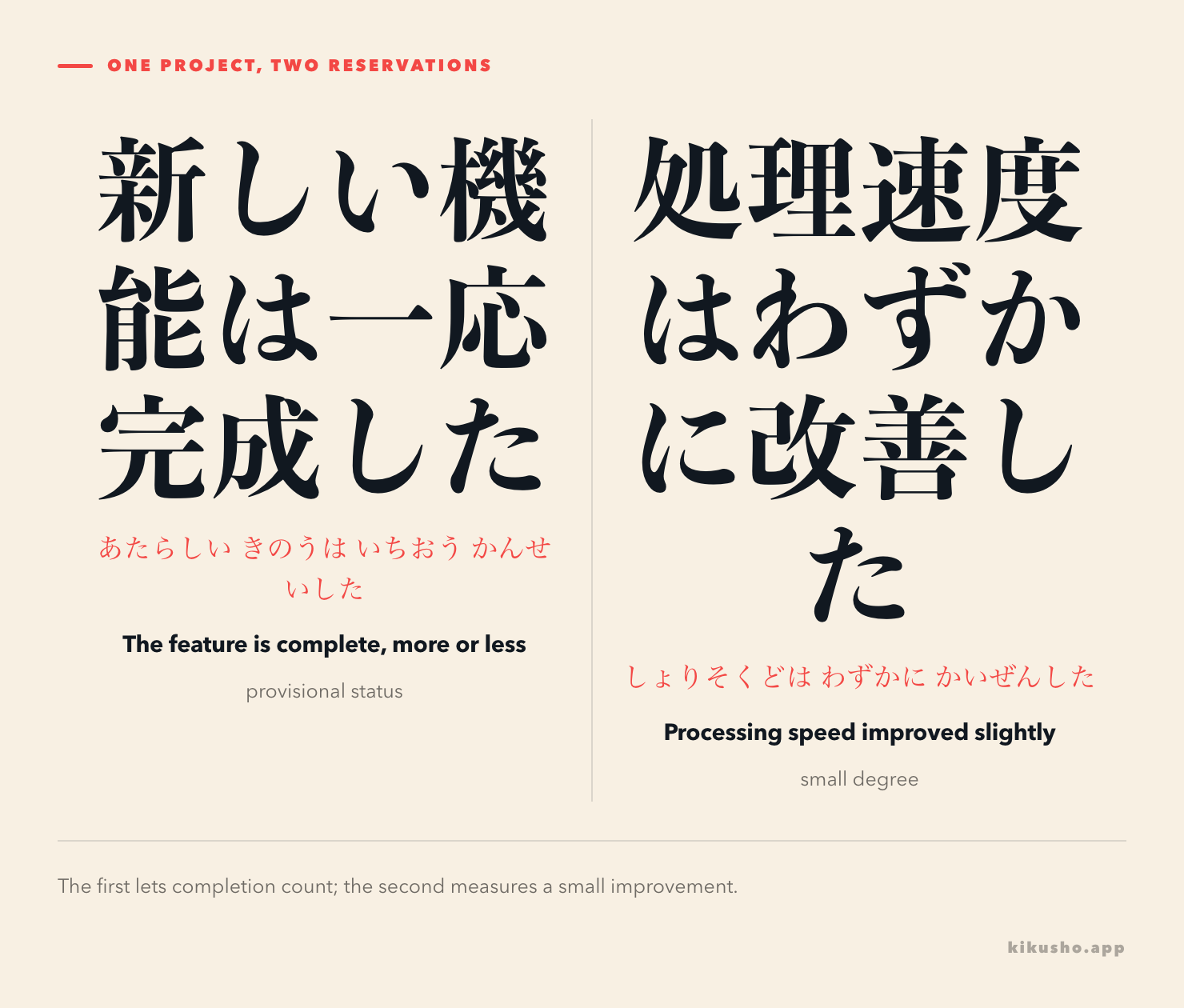
In the first sentence, completion is treated as a category with some room around its edges. In the second, improvement is a scale, and the movement on that scale is small. わずかに完成した is generally a poor replacement because completion is normally treated as an endpoint rather than a gradual quantity. 一応改善した is possible, but it changes the message: the speaker says the result can at least be called an improvement, rather than measuring its size.
Nearby minimum expressions answer other questions. 少なくとも sets a lower bound, while せめて presents the minimum the speaker wants. The せめて and 少なくとも lesson separates those bounds from provisional 一応. わずかに belongs with degree expressions, but it emphasizes an objectively or rhetorically tiny amount; the degree-strength lesson shows how other forms judge excess or compare a result with an expectation.
The level label is a study estimate
JLPT Sensei places both 一応 and わずかに at N2. Bunpro also places the provisional use of 一応 and 僅かに at N2. Dictionaries describe wider everyday words rather than exam levels.
The JLPT publishes no exhaustive official grammar list. Treat N2 as a useful study placement, not a guarantee that each surface form belongs only to one test level. The practical reading skill is to identify the hidden standard behind 一応 and the small scale behind わずかに.
Practice: find the hidden standard or scale
1 · A provisional finish
Choose the natural completion: 細かい修正は残っているが、原稿は__完成した。
A. わずかに
B. 一応
C. 最も
D. せめて
2 · A small rise
What belongs in the blank? 午後になって、気温が__上がった。
A. 一応
B. とりあえず
C. わずかに
D. 必ず
3 · Precaution behind the call
Why does the speaker use 一応 in 予約は不要だと思うが、一応店に電話してみる?
A. The call will last only a few seconds.
B. The speaker measures a small change in the reservation.
C. The speaker takes a precaution despite expecting no reservation to be needed.
D. The restaurant is tentatively closed.
4 · Choose the noun form
Complete: 二つの結果には__差しかなかった。
A. 一応の
B. わずかな
C. わずかにの
D. 一応に
5 · Change the meaning
Rewrite 性能は一応改善した so that it specifically says the amount of improvement was slight.
6 · Read the whole update
Read: 試作品は一応完成した。念のため、明日もう一度確認する予定だ。重さは前の型よりわずかに減ったが、目標にはまだ届いていない。 Which account is accurate?
A. The prototype is perfect, and its weight fell dramatically.
B. The prototype provisionally counts as complete, and the weight reduction is small.
C. 一応 measures the weight, while わずかに makes completion tentative.
D. Both expressions mean that the final check is unnecessary.
Answers and explanations
1 · B, 一応. The manuscript has reached a status that counts as complete, while minor revisions remain. The sentence evaluates sufficiency rather than the size of a change.
2 · C, わずかに. Temperature provides a scale, and the rise on that scale is small. 一応 would introduce a minimum standard or precaution instead.
3 · C. The speaker expects that no booking is required but calls to avoid a possible problem. That extra check is the precautionary use of 一応.
4 · B, わずかな. 差 is a noun, so the な-adjective form directly modifies it. わずかに modifies a following phrase or predicate and does not take の here.
5 · 性能はわずかに改善した. The rewrite replaces the judgment that the result counts as an improvement with a direct measurement of its small degree.
6 · B. 一応 allows the prototype to count as complete without claiming perfection. わずかに measures the reduction in weight as small, and the final clause confirms that the target has not yet been reached.
When either adverb appears in a reading passage, reconstruct what the writer is comparing. 一応 compares reality with a minimum standard or a possible risk. わずかに compares a quantity with zero or with another measured state. The implied comparison reveals the intended meaning.
Common questions
What is the difference between 一応 and わずかに?
一応 says that something meets a basic standard, remains tentative or is done as a precaution. わずかに measures a very small amount or degree.
What does 一応終わった mean?
It means the task is finished enough to count as finished, while leaving room for imperfections, later changes or unfinished details.
Can 一応 mean just in case?
Yes. In 一応確認する, the check is an extra precaution taken even though it may not be necessary.
Does わずかに always contain に?
No. わずかに commonly modifies a predicate, while わずかな modifies a noun. わずか can also appear directly before a number or counter.