On this page
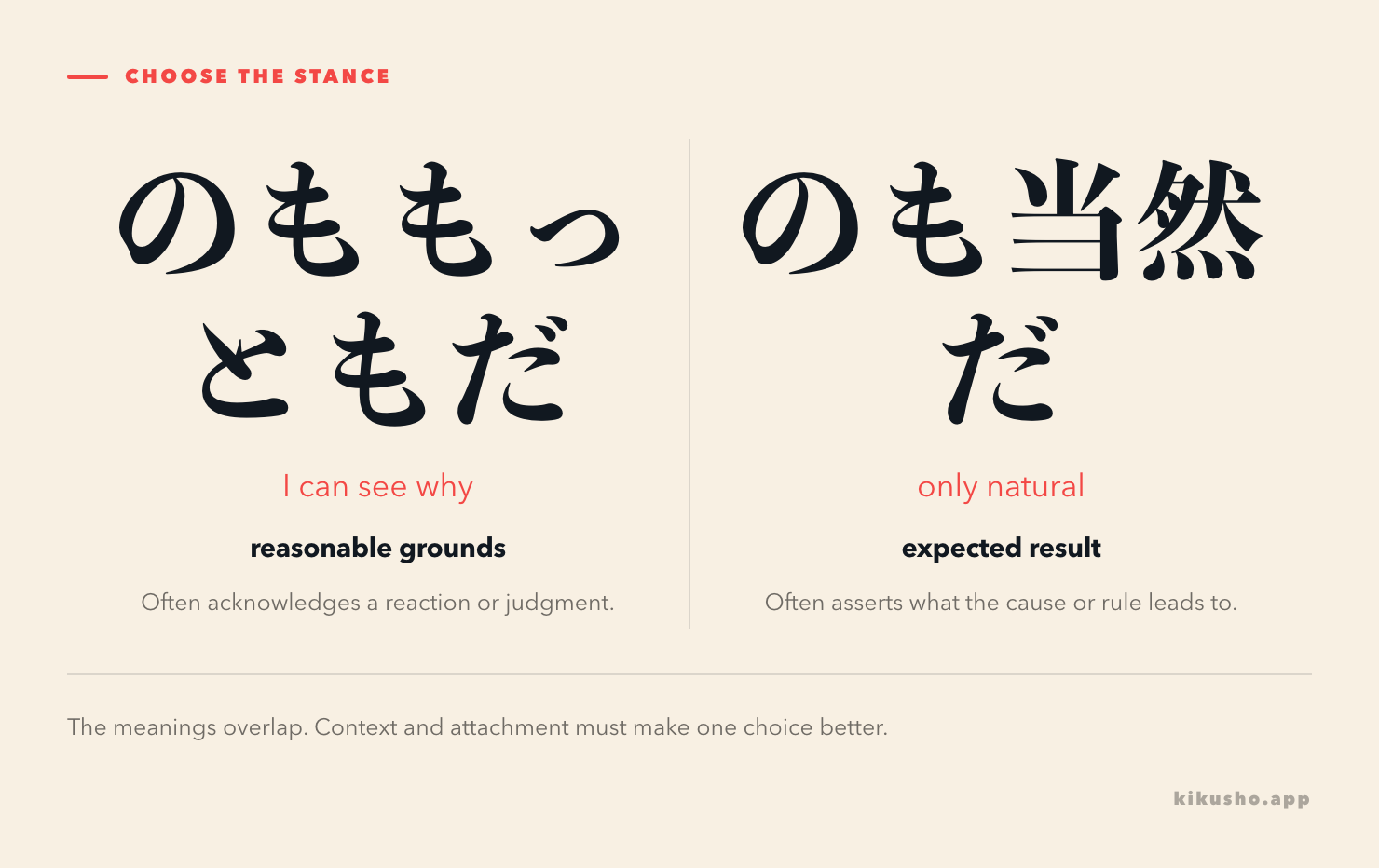
~のももっともだ says that a reaction or judgment has understandable grounds. ~のも当然だ can describe the same situation, but often states more directly that the outcome is expected or deserved; the two overlap, so context matters more than a rigid one-form-only rule.
Begin with the reason for the judgment
Compare two comments after a customer has waited for two hours:
二時間も待たされたのだから、客が怒るのももっともだ。
にじかんも またされたのだから、きゃくが おこるのも もっともだ。
Given that the customer was made to wait for two hours, it is understandable that they are angry.
二時間も待たされたのだから、客が怒るのも当然だ。
にじかんも またされたのだから、きゃくが おこるのも とうぜんだ。
Given that the customer was made to wait for two hours, it is only natural that they are angry.
Both are natural. The first readily sounds like an evaluation of the customer's grounds: “I can see why.” The second presents the anger as an expected consequence of the delay. Tone and context can narrow or erase that difference, so a question offering only these two complete sentences with no further cue would be ambiguous.
The academic paper 「もっともだ」の意味についての予備的考察 examines corpus examples alongside 当然だ and notes their close meaning while finding differences in the structures they favor. That evidence supports a tendency-based comparison rather than two mutually exclusive translations.
のももっともだ acknowledges a defensible reaction
The の nominalises the preceding clause: it turns “she feels anxious” into “the fact that she feels anxious.” も then includes that fact among things the speaker can judge reasonable.
初めて一人で海外へ行くのだから、彼女が不安なのももっともだ。
はじめて ひとりで かいがいへ いくのだから、かのじょが ふあんなのも もっともだ。
Since she is going abroad alone for the first time, it is understandable that she feels anxious.
The main attachment frames are:
| Input | Connection | Built judgment |
|---|---|---|
| Verb | plain form + のももっともだ | 怒るのももっともだ |
| い-adjective | plain form + のももっともだ | 高いのももっともだ |
| な-adjective | stem + なのももっともだ | 不安なのももっともだ |
| Noun predicate | noun + なのももっともだ | 彼が代表なのももっともだ |
Past and negative plain forms can appear before の: 理解できなかったのももっともだ means the failure to understand was reasonable in the circumstances. The variant のはもっともだ is also common. The contrast between は and も changes discourse emphasis, but both can make the central judgment.
J-nihongo's formation table confirms verb and い-adjective plain forms plus のは/のも, and なのは/なのも after な-adjectives and nouns. Bunpro's lesson independently describes the pattern as recognizing the logic that led to a response.
Acknowledging grounds is not blanket approval:
説明が何度も変わったのだから、住民が抗議するのももっともだ。ただし、すべての要求が認められるとは限らない。
せつめいが なんども かわったのだから、じゅうみんが こうぎするのも もっともだ。ただし、すべての ようきゅうが みとめられるとは かぎらない。
Since the explanation changed repeatedly, it is understandable that residents protested. However, that does not mean every demand will be accepted.
The first sentence validates the reason for protesting. It does not prove every statement made during the protest or commit the speaker to every remedy.
当然だ presents a natural, expected or deserved result
当然, read とうぜん, judges something as a consequence that follows naturally from the facts, rules or expectations supplied by the context.
準備をしなかったのだから、発表がうまくいかないのも当然だ。
じゅんびを しなかったのだから、はっぴょうが うまく いかないのも とうぜんだ。
Since no preparation was done, it is only natural that the presentation did not go well.
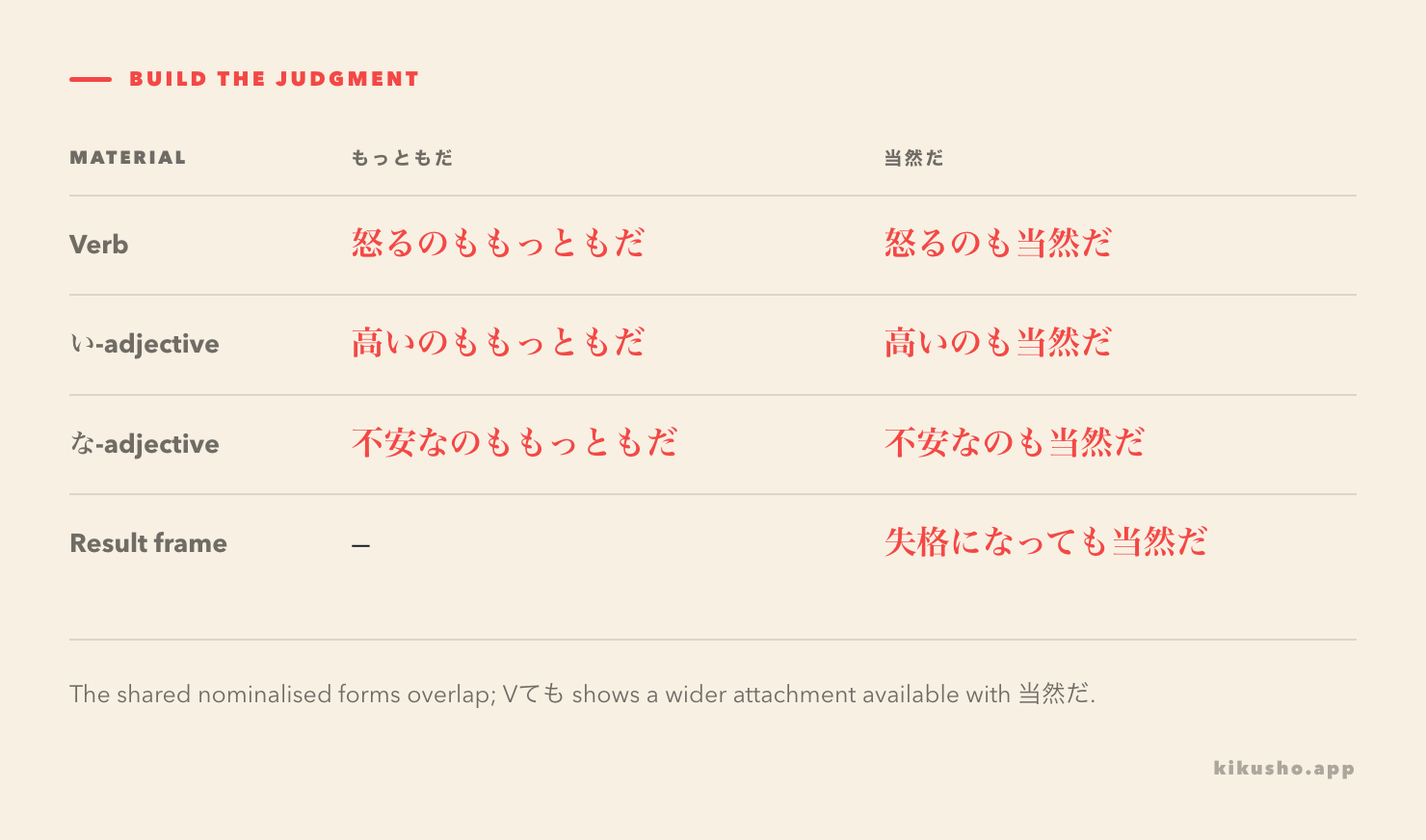
This uses the same nominalised clause frame as もっともだ. 当然だ also supports connections that are not simply copied to もっともだ:
規則を破れば、失格になっても当然だ。
きそくを やぶれば、しっかくに なっても とうぜんだ。
If you break the rules, it would be unsurprising or justified even if you were disqualified.
約束した仕事を終えるのは当然だ。
やくそくした しごとを おえるのは とうぜんだ。
It is expected that you finish the work you promised to do.
The first can sound like a deserved consequence; the second can state a norm. もっともだ does not automatically inherit Vても当然だ or every obligation-like use of 当然.
Mainichi Nonbiri's も当然だ reference gives noun, plain-clause and な-adjective connections, and describes A as the reason that makes B a natural result. Its examples also show Vても当然だ. The academic comparison finds that て-based connections are available with 当然だ in ways that distinguish its structural range from もっともだ.
Use stance as a preference, not a false rule
These questions often help:
- Are you responding to someone's feelings, judgment or reaction with “I can see why”? のももっともだ is a strong choice.
- Are you presenting a result as what the cause, rule or conduct leads you to expect? のも当然だ or another 当然だ frame is a strong choice.
- Does the sentence expressly use Vても for an unsurprising or deserved consequence? Keep 当然だ.
Still, the first two questions do not prove that the other expression is wrong. 彼が怒るのももっともだ and 彼が怒るのも当然だ can both fit after unfair treatment. A well-designed exercise needs an attachment cue, a larger passage or a stance that makes one answer better.
This is also why “もっともだ is gentle, 当然だ is harsh” is too crude. 当然だ can neutrally describe an obvious result, while もっともだ can support a stern criticism if the grounds are serious. Polite endings もっともです and 当然です change how the judgment addresses the listener, not the underlying relation.
Keep three different もっとも forms apart
The target pattern usually appears in hiragana. It can be written 尤もだ, meaning reasonable or justified. Do not replace it with 最も, the adverb “most”:
この案が最も現実的だ。
この あんが もっとも げんじつてきだ。
This plan is the most realistic.
The sound is the same, but the grammar is different. You may also meet sentence-initial もっとも, meaning “however” or “although that said.” That connector adds a qualification to an earlier statement; it is not the predicate もっともだ judging a reaction.
When saving an example in Kikusho, keep the reason and the evaluated response together. 不安なのももっともだ shows the attachment, but adding the first solo trip explains why the anxiety is reasonable. For 失格になっても当然だ, preserve the rule violation so that the card tests a consequence rather than a free-floating judgment.
For an expression that accepts an unwanted outcome because it cannot reasonably be helped, compare ても仕方がない. For “not difficult to understand or imagine,” に難くない makes a different kind of judgment about comprehension.
The curriculum sources place both assigned items at N2, and Bunpro, J-nihongo and the Japanese-teacher reference agree on N2 for the uses cited here. This remains a teaching placement rather than an official exhaustive JLPT grammar specification. Prerequisites include plain-form nominalisation with の, adjective and noun predicate attachment, and conditional or causal clauses that supply the grounds.
Practice
Read all six situations before opening the explanations.
Question 1: attach after a な-adjective
初めて一人で発表するのだから、彼女が不安( )もっともだ。
A. だのも
B. なのも
C. でのも
D. にも
Question 2: identify the expected consequence
練習を一度もしなかったのだから、本番で失敗する( )。
A. のも当然だ
B. なのももっともだ
C. ことにした
D. に違いないとは限らない
Question 3: acknowledge grounds without full agreement
説明が三回も変わったので、利用者が不満を感じる( )。ただし、すべての要求を受け入れるかは別に検討します。
Which completion best foregrounds “we understand why they feel that way”?
A. のももっともです
B. ても始まりません
C. より当然です
D. のが最もです
Question 4: use the wider 当然だ frame
重大な規則違反をしたのだから、参加資格を失っ( )。
A. たのも最もだ
B. てはもっともだ
C. ても当然だ
D. たほどではない
Question 5: judge two complete sentences
After a two-hour delay, compare 客が怒るのももっともだ and 客が怒るのも当然だ. Which statement is accurate?
A. Only the first is grammatical after a verb.
B. Only the second can describe a person's feeling.
C. Both are possible; the first readily acknowledges the grounds, while the second more directly presents an expected result.
D. They differ only in politeness.
Question 6: explain the reading
新入社員には説明が一度しかなかった。手順を間違えたのももっともだ。まず研修方法を見直す必要がある。
In one sentence, explain what the writer accepts as reasonable and what action the writer proposes next.
Answers and explanations
1 — B. なのも. 不安 is a な-adjective, so its stem takes なのも before もっともだ: 不安なのももっともだ.
2 — A. のも当然だ. The absence of practice supplies a cause, and failure is presented as its expected result. B has the wrong attachment after the verb and shifts the pattern.
3 — A. のももっともです. The following sentence explicitly separates understanding the dissatisfaction from accepting every demand. That stance makes the recognition of reasonable grounds especially suitable.
4 — C. ても当然だ. 失っても当然だ presents loss of eligibility as an unsurprising or deserved consequence. This ても frame belongs naturally with 当然だ and cannot be copied mechanically to もっともだ.
5 — C. The two patterns overlap in this situation. The contrast is a useful stance tendency, not a rule that makes one complete sentence ungrammatical.
6 — One natural answer: The writer accepts that the new employee's procedural mistake is understandable because there was only one explanation, then proposes reviewing the training method. もっともだ evaluates the grounds for the mistake; it does not say the procedure was correct.
Common questions
What does のももっともだ mean?
It says that a reaction, judgment or outcome has understandable grounds. The speaker can acknowledge why someone reacted that way without endorsing every action or claim that followed.
What is the difference between のももっともだ and のも当然だ?
Their meanings overlap substantially. もっともだ often foregrounds the speaker's recognition that the grounds are reasonable, while 当然だ can assert more directly that the outcome is expected or deserved. Context can make either possible.
How do もっともだ and 当然だ attach after a な-adjective or noun?
Before the parallel nominalised form, use な plus の: 不安なのももっともだ and 初心者なのも当然だ. 当然だ also allows patterns such as Vても当然だ, which もっともだ does not simply copy.
Is もっとも in this pattern the same as 最も meaning most?
No. This もっとも means reasonable or understandable and may be written 尤も. 最も is the superlative adverb most, as in 最も高い.