On this page
いわゆる introduces a name or category that people commonly use: いわゆる五月病 is “what is commonly called May blues.” Put it before the recognised label; do not use it merely because you want to invent a fresh comparison or give one particular thing a name.
English translations such as “so-called,” “what is called” and “commonly known as” all appear in dictionaries. They do not have identical tones. Japanese いわゆる can be neutral, explanatory or distancing, so the surrounding sentence decides whether the speaker accepts the label or questions it.
JLPT Sensei and Bunpro place いわゆる at N2 and give the core shape いわゆる + noun. The Digital Daijisen entry defines it as “generally said in society” or “commonly said.” The JLPT publishes no exhaustive grammar syllabus, so N2 is a supported study placement rather than an official list boundary.
いわゆる points forward to a recognised label
The basic frame is compact:
いわゆる + noun or nominal label
彼はいわゆる本の虫だ。
He is what people call a bookworm.
The person is not literally an insect. 本の虫 is an established expression for an avid reader, and いわゆる signals that the speaker is selecting that familiar label. It does not conjugate, agree with the noun or carry tense. Tense and politeness appear later in the sentence: 本の虫だ, 本の虫だった, 本の虫です.
| Kind of label | Frame | Example |
|---|---|---|
| familiar social term | いわゆる + noun | いわゆる五月病 |
| established figurative name | いわゆる + idiom | いわゆる本の虫 |
| term shown as a term | いわゆる + quotation | いわゆる「推し活」 |
| longer noun phrase | いわゆる + adjective + noun | いわゆる典型的な例 |
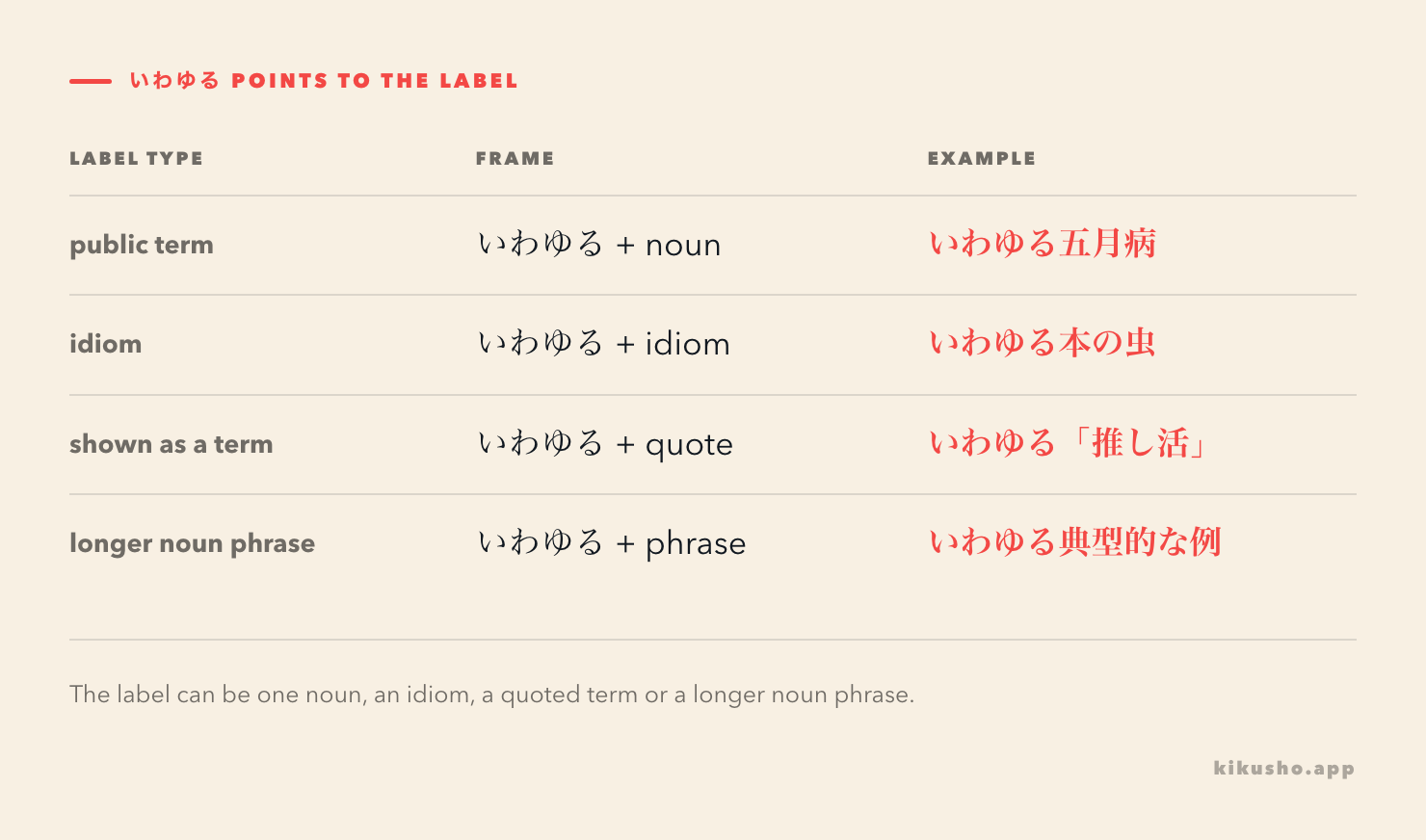
The last row matters. The classroom shortcut says いわゆる + noun, but the label may be a complete noun phrase rather than one bare word:
これはいわゆる典型的な成功例です。
This is what is commonly regarded as a typical success story.
Here 典型的な sits inside the noun phrase headed by 成功例. いわゆる presents the whole expression 典型的な成功例 as the recognisable description. It has not suddenly become an adverb modifying 典型的だ.
The name normally exists before the speaker uses it
いわゆる looks outward to a community of speakers. The phrase after it may be a technical term, a popular category, an idiom, a cliché or a recently widespread expression. The important point is that the speaker treats the wording as available beyond this one sentence.
この症状は、いわゆる五月病です。
These symptoms are what is commonly called May blues.
週末に好きな作家を応援する活動は、いわゆる「推し活」だ。
Supporting a favourite creator on weekends is part of what is commonly called “oshi-katsu.”
Quotation marks are optional. They are useful when the speaker wants readers to notice the term itself, when the expression is new, informal or contested, or when its boundary needs discussion. A familiar unmarked category can appear without them: いわゆる先進国, “the countries generally called developed countries.”
The pattern becomes a poor choice when no wider label exists. Suppose you name your own morning routine 青いノート法 for the first time. Say 私が「青いノート法」と名付けた勉強法, “the study method I named the Blue Notebook Method.” いわゆる青いノート法 would imply that this is already a recognised expression, which contradicts the situation unless other people have begun using it.
That test is more reliable than translating word by word. Ask: “Am I pointing to wording people already use, or creating wording for this moment?” The first supports いわゆる. The second needs a naming construction or an explicit comparison.
“So-called” can sound more skeptical than いわゆる
In English, “so-called” often casts doubt on a name: “a so-called expert” can imply that the person is not an expert at all. Japanese いわゆる does not carry that challenge by itself.
画面を暗い配色にする機能は、いわゆるダークモードです。
The feature that gives the screen a dark colour scheme is commonly called dark mode.
This is a neutral identification. Nothing says the feature is fake, badly named or unworthy of the category. “What is commonly called dark mode” preserves the tone better than a suspicious English “so-called dark mode.”
Distance can still arise when the sentence supplies it:
彼はいわゆる「専門家」だが、資格も実務経験もない。
He is a so-called “expert,” but he has neither qualifications nor practical experience.
The quotation marks and the following contradiction make the skepticism clear. A critical topic can also colour the label. A Japanese-teacher explanation at 毎日のんびり日本語教師 notes that negative distance frequently appears with disfavoured labels. That is a contextual tendency, not a fixed meaning that every use must carry.
When translating, decide the stance after reading the whole sentence. Neutral options include “what is called,” “commonly known as” and sometimes no separate phrase at all. Reserve skeptical “so-called” for a context that supports it.
いわば creates a reformulation; いわゆる retrieves a label
The two expressions resemble each other in sound and in loose English translation, but they solve different problems.
彼はいわゆる本の虫だ。
He is what people call a bookworm.
この町は、いわば私の第二の故郷だ。
This town is, so to speak, my second home.
本の虫 is a conventional label, so いわゆる retrieves it. 第二の故郷 is the speaker's comparison for their relationship with the town, so いわば introduces a reformulation: “if I were to put it another way.” The Kotobank entry for 言わば defines it with 言ってみれば and たとえて言えば, explicitly connecting it to explanation and analogy.
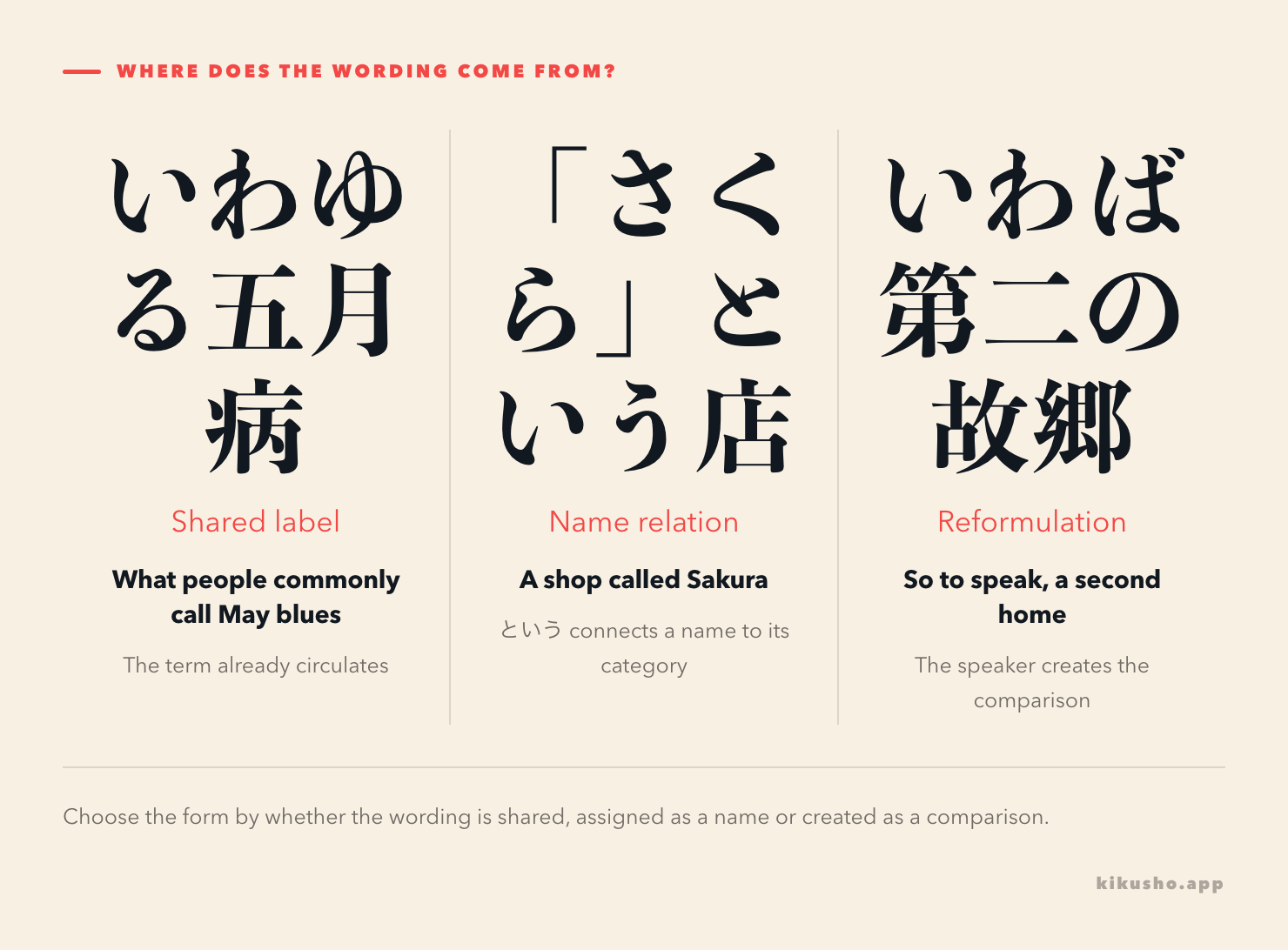
Their placement also gives a clue. いわゆる attaches directly to the nominal label. いわば often comments on the phrase or clause that follows and is readily separated by a comma in writing. Compare:
- いわゆる第二の故郷: the place belongs to a category that people conventionally call “a second home”
- いわば私の第二の故郷だ: the speaker chooses “my second home” as a way to describe it
Both can be grammatical in a suitable context. The source of the wording changes: shared label versus the current speaker's reformulation.
という names something without claiming a public label
という connects quoted wording to the noun it names or specifies:
「さくら」という店で昼ご飯を食べた。
I ate lunch at a shop called Sakura.
The shop has that name. The sentence does not claim that さくら is a familiar social category, so いわゆるさくら would not replace 「さくら」という店. The broad という lesson develops names, quoted content and noun definitions.
The two forms can occur together because their jobs differ:
いわゆる五月病というものは、正式な病名ではない。
The phenomenon commonly called May blues is not an official medical name.
いわゆる comments on 五月病 as the familiar label. という then connects that wording to もの, the thing being discussed. In many shorter sentences, one form is enough. これはいわゆる五月病だ identifies the category; 五月病という言葉を初めて聞いた quotes the term as the content of 言葉.
と呼ばれる places the naming statement after its target: この現象は五月病と呼ばれている, “This phenomenon is called May blues.” That form can report the naming process objectively. いわゆる五月病 packages the same public availability into a modifier before the label. Choose by the sentence you need, rather than treating the two as interchangeable particles.
Hiragana is the practical spelling
The kanji form is 所謂, read いわゆる. This is a special whole-word reading rather than a sequence a learner can reliably derive from the two characters. Taishukan's Kanji Culture reference connects 所謂 historically with 謂う所の, “what is called,” and classifies the modern reading as 熟字訓.
Modern teaching references mark the kanji as uncommon, and hiragana いわゆる is the safest form to produce. You may still meet 所謂 in essays, older writing or typography that deliberately favours kanji. Read it as the same fixed modifier; do not try to conjugate 謂 inside it.
The expression works in conversation and prose, but its focus on naming gives it an explanatory tone. In casual speech it often appears with ってやつ or というもの: これがいわゆる青春ってやつかな, “Maybe this is what people call youth.” The casual ending belongs to the rest of the sentence; いわゆる itself does not change shape.
When saving the pattern in Kikusho, keep the public label attached. A card with only いわゆる = so-called invites the English skeptical reading every time. Save 画面を暗くする、いわゆるダークモード and mark “shared name, neutral here.” A later review can then test the social source of the label as well as the translation.
Practice: decide where the label comes from
Complete all six prompts, then open the single explanation block.
Question 1 — grammar choice. Which expression completes this neutral identification? これは、__五月病です。
ア. いわゆる イ. いわば ウ. いわゆれば エ. いわゆるに
Question 2 — grammar choice. Choose the best form for the speaker's personal comparison: この町は、__私の第二の故郷だ。
ア. いわゆる イ. いわば ウ. という エ. と呼ばれる
Question 3 — text grammar. Read この機能はいわゆるダークモードです。 Does いわゆる prove that the speaker distrusts the term? What does it establish?
Question 4 — text grammar. Read 「さくら」という店で昼ご飯を食べた。 Why does という fit better than いわゆる?
Question 5 — build the sentence. Arrange these chunks: 彼は/いわゆる/本の虫/で/週末はいつも読書をしている.
Question 6 — text grammar. Read 彼女はいわゆるミニマリストだ。持ち物の少ない部屋は、いわば静かな展示室のようだ。 What is the source of each description, and why should the two forms not be exchanged mechanically?
Answers and explanations
Question 1 answer — ア, いわゆる. 五月病 is a recognised social label, and いわゆる goes directly before it. いわば would introduce a reformulation, while the other two choices invent inflections that this fixed word does not have.
Question 2 answer — イ, いわば. “My second home” is the speaker's way of rephrasing their relationship with the town. The sentence does not present 私の第二の故郷 as a generally recognised public label.
For Question 3: No. The sentence neutrally identifies ダークモード as the familiar name for the feature. Skepticism would need support from quotation marks, tone or context that challenges the name.
For Question 4: という joins the particular name さくら to the category 店. A proper name need not be a public category or conventional description, which is the relation いわゆる would imply.
For Question 5: 彼はいわゆる本の虫で、週末はいつも読書をしている。 いわゆる immediately introduces the established figurative label 本の虫; で then links that description to the second clause.
For Question 6: ミニマリスト is treated as an already circulating category, so いわゆる retrieves its public name. 静かな展示室 is the speaker's comparison for the room, so いわば frames a new reformulation. Exchanging them would change a shared category into a personal analogy and the personal analogy into a supposedly conventional label.
Common questions
What does いわゆる mean in Japanese?
いわゆる introduces a name, expression or category that people commonly use. It comes before the label, as in いわゆる五月病, “what is commonly called May blues,” and 彼はいわゆる本の虫だ, “He is what people call a bookworm.”
Is いわゆる always negative or sarcastic?
No. いわゆる can neutrally identify a familiar term. Skepticism comes from context, quotation marks, tone or a later challenge to the label. English so-called is therefore sometimes stronger than the Japanese expression.
What is the difference between いわゆる and いわば?
いわゆる points to an established public label, while いわば lets the speaker rephrase or compare something: この町は、いわば第二の故郷だ means “This town is, so to speak, my second home.”
How is いわゆる different from という?
という builds a naming or quotation relation, as in 「さくら」という店, “a shop called Sakura.” いわゆる instead comments that the following label is generally used or recognised.