On this page
~なければならない says an action is required: 今日中に申込書を出さなければならない (きょうじゅうに もうしこみしょを ださなければならない) means “I must submit the application form today.” In casual speech, なければ can shrink to なきゃ, and the closing ならない can disappear: 今日中に出さなきゃ still means “I have to submit it today.” なくては → なくちゃ follows a second route to the same obligation.
This N4 study page brings together six related forms so you can read a careful instruction and recognize the shorter thing someone says aloud. The Kikusho September 2026 reference inventory assigns four of these source rows to N5 and two to N4; this is a comparison lesson, not a claim that every variant first appears at N4. JLPT Sensei labels なければならない N4 but なくちゃ N5. Those study labels are publisher estimates, since the exam organizers do not enumerate every grammar point. You need the verb's ない-form first; for a broader account of why written and spoken endings differ, see the textbook-to-speech guide.
A negative condition makes a must-do meaning
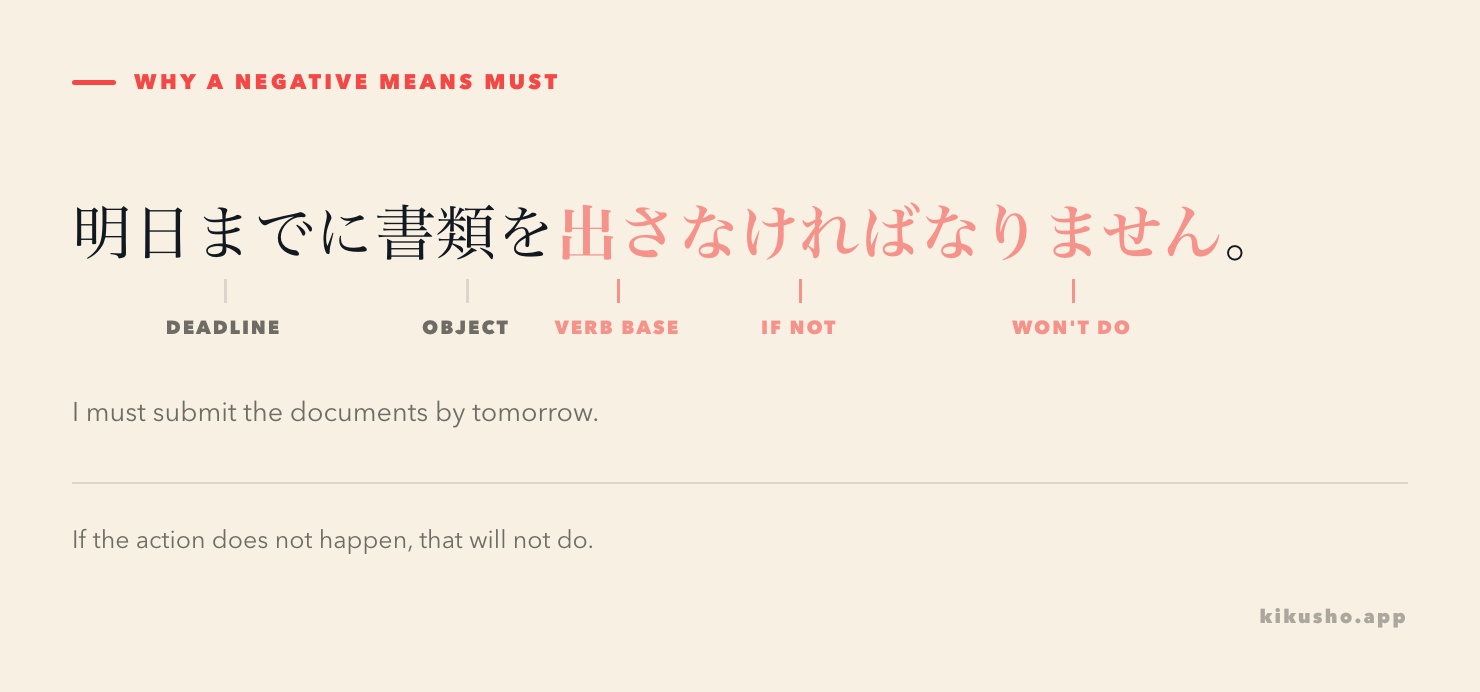
Start with 行く → 行かない (いく → いかない), “go → not go.” Turn that negative into a condition: 行かなければ, “if I do not go.” Add ならない, “it will not do,” and 行かなければならない (いかなければならない) means “I must go.” The action is affirmative even though the construction contains negative pieces. To speak politely, change the final ならない to なりません: 行かなければなりません.
出す → 出さない → 出さなければならない (だす → ださない → ださなければならない) works the same way. For an ichidan verb, 食べる → 食べない → 食べなければならない (たべる → たべない → たべなければならない). する → しない → しなければならない must be built from its actual negative form. Do not attach なければ to the dictionary verb: 行くなければ is not the intended obligation form. JLPT Sensei's N4 reference and Mango Languages' instructor-authored guide both derive it from the negative verb form.
Six forms share the obligation but differ in shape
Keep 行かない as the starting point. The six assigned source constructions below all express the need to go; the left and right halves choose how to present that need. The level column reports the dated reference inventory's source placements, not an official JLPT syllabus.
| Construction | From 行かない | Typical place | Reference placement |
|---|---|---|---|
| なければならない | 行かなければならない | Careful rules or formal writing; なりません is polite | N4 |
| なければいけない | 行かなければいけない | Full form in careful speech or writing; いけません is polite | N4 |
| なくてはならない | 行かなくてはならない | Full なくては route with the more formal ならない | N5 |
| なくてはいけない | 行かなくてはいけない | Full なくては route in careful speech or writing | N5 |
| ないといけない | 行かないといけない | Conversational “if not”; sometimes just 行かないと | N5 |
| なくちゃ | 行かなくちゃ | Casual shortening of なくては; a tail may be added | N5 |
These are not six degrees of legal force. The obligation is broadly similar; the main differences are route and register. A linguistic NKG obligation-and-permission chapter describes ならない as somewhat more formal than いけない, and shows that the condition and final judgement can vary independently. Bunpro's なければいけない comparison also places the なければ route somewhat above なくては in formality, without pretending there is a sharp semantic boundary.
One form can appear in several settings. Japan Foundation Marugoto teacher notes explicitly teach なければなりません in written work alongside なきゃいけないんです in conversation. The full form is not confined to writing: choose it when you need a clear, careful expression of duty, and recognize its shorter neighbours when listening.
なきゃ and なくちゃ shorten different branches
The sound change is easier to hear when you know which full condition it came from. 行かなければ → 行かなきゃ (いかなければ → いかなきゃ). 行かなくては → 行かなくちゃ (いかなくては → いかなくちゃ). Either short condition can retain いけない or ならない, as in 行かなきゃいけない and 行かなくちゃならない. In casual speech the tail may be understood and left off: もう行かなきゃ or もう行かなくちゃ says “I have to go now.”
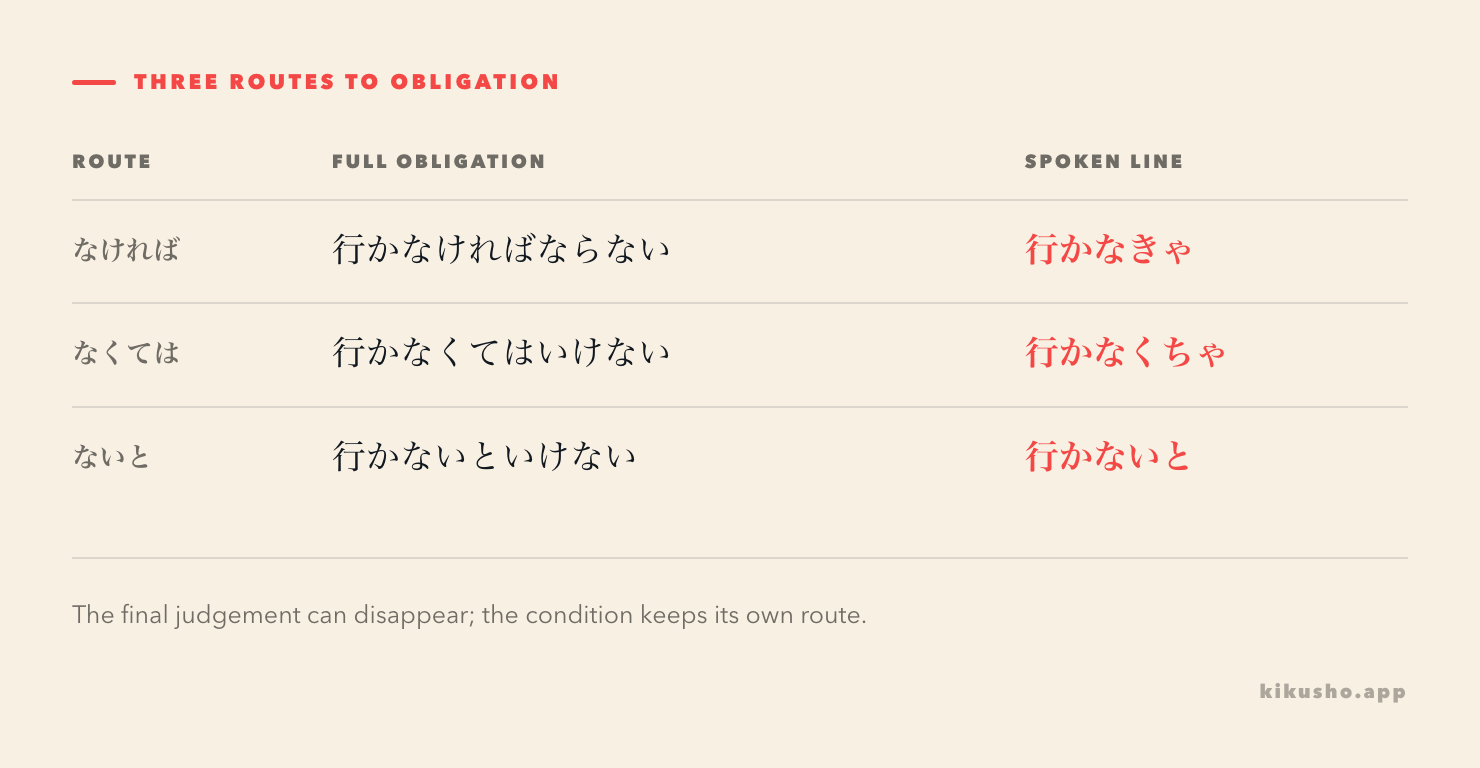
ないといけない is a third route: 行かない + と + いけない. Its usual shorter line is 行かないと, with いけない omitted; ないと does not contract to なきゃ. The NKG chapter and Mango Languages separately document these routes and the missing tail. This lets you expand an overheard 行かないと without confusing it with 行かなきゃ.
なくちゃ is a complete casual obligation too. 洗濯しなくちゃ (せんたくしなくちゃ), “I have to do the laundry,” does not need ならない to make sense. With a tail, 洗濯しなくちゃいけない makes the judgement explicit. JLPT Sensei's なくちゃ entry documents both bare and tailed uses; Japan Foundation Irodori uses なくちゃならない as a casual counterpart of なければならない. A contraction can live inside a polite sentence, but a formal written instruction normally keeps the full condition.
The negative shape does not mean “must not”
Read the direction of the obligation before translating English “must.” ここで待たなければならない (ここで またなければならない) requires waiting here. ここで待ってはいけない forbids waiting here. ここで待たなくてもいい makes waiting optional. The first begins with a negative condition, “if you do not wait”; the other two answer different questions. Mango Languages teaches the obligation/prohibition distinction and the optional-action reply.
Nor is every enthusiastic English “You must try this cake!” a duty. A recommendation can be warm without なければならない; this construction presents something as necessary or required. The Mango guide warns against treating a recommendation or a speculative “It must be raining” as this kind of obligation. For a different distinction between duty and advice, see ~はず versus ~べき; for pressure that leaves no workable alternative, see ~ざるを得ない.
When you hear a clipped 行かなきゃ in a conversation, keeping only “なきゃ = must” on a card loses the deadline, speaker and register. Kikusho can take the line by voice or text, let you check the reading and nuance before saving it, and keep it for offline review. Save 明日の朝、病院に行かなきゃ as a whole: now the short form still points to the speaker's reason for going.
Practice: choose the route and direction
Attempt all six questions before opening the single answer section below.
Question 1 — grammar choice. A polite written notice says every visitor is required to sign. Which sentence expresses that duty?
- A. 来場者は署名しなければなりません。
- B. 来場者は署名してはいけません。
- C. 来場者は署名しなくてもいいです。
Question 2 — grammar choice. Which pair gives the correct casual reductions in this order: なければ → ? and なくては → ?
- A. なきゃ/なくちゃ
- B. なくちゃ/なきゃ
- C. ないと/なくちゃ
Question 3 — sentence composition. Write a polite instruction that an application form must be submitted by five o'clock. Use 申込書を, 五時までに, and 出す. Choose the full なければならない route.
Question 4 — sentence composition. You tell a friend you have to go home now. Use もう, 帰る, and the bare casual なくちゃ form, with no final judgement word.
Question 5 — text grammar. A careful workplace note says, “Before the meeting starts, we must prepare the materials.” Complete it with the full なくてはいけない form of 用意する: 会議が始まる前に、資料を__。
Question 6 — text grammar. You forgot your employee pass and need a temporary pass at reception. Complete the second sentence with ないといけない built from もらう: 社員証を忘れました。受付で仮の入館証を__。
Answers and explanations
Answer 1. A, 来場者は署名しなければなりません。 (らいじょうしゃは しょめいしなければなりません) requires each visitor to sign. B forbids signing; C says signing is unnecessary. All three sentences are grammatical, but only A matches the notice's direction.
Answer 2. A, なきゃ/なくちゃ. なきゃ comes from なければ; なくちゃ comes from なくては. B reverses the branches. C substitutes ないと, a third condition, for the reduction of なければ.
Answer 3. One model answer is 申込書を五時までに出さなければなりません。 (もうしこみしょを ごじまでに ださなければなりません). 出す → 出さない → 出さなければ supplies the negative condition, and なりません is the polite final judgement. Moving 五時までに before 申込書を keeps the meaning.
Answer 4. もう帰らなくちゃ。 (もう かえらなくちゃ), “I have to go home now.” 帰る → 帰らない → 帰らなくては → 帰らなくちゃ is the route. The listener supplies the missing “it won't do” ending; adding one would be grammatical but would not meet this question's bare-form instruction.
Answer 5. 用意しなくてはいけない completes 会議が始まる前に、資料を用意しなくてはいけない。 (かいぎが はじまるまえに、しりょうを よういしなくてはいけない), “We must prepare the materials before the meeting begins.” する becomes しない, then しなくては; いけない completes this full route. 用意するなくては would attach the condition to the wrong verb shape.
Answer 6. もらわないといけない completes 受付で仮の入館証をもらわないといけない。 (うけつけで かりの にゅうかんしょうを もらわないといけない), “I have to get a temporary entry pass at reception.” もらう → もらわない keeps the complete negative ない before と. もらわなくちゃ could express an obligation in conversation, but it does not answer the requested ないといけない route.
Common questions
What does なければならない mean in Japanese?
It means that doing an action is necessary: 行かなければならない is “I must go” or “I have to go.” Make the verb's ない-form first, change its ending to なければ, then add ならない. Its polite ending is なりません.
Are なきゃ and なくちゃ the same contraction?
They express a similar obligation, but come from different branches: なければ shortens to なきゃ, while なくては shortens to なくちゃ. Either can stand alone in casual speech when the final judgement is understood.
Does ないといけない become なきゃ?
No. ないといけない uses the verb's complete ない-form plus と. Speakers often leave off いけない and say ないと, while なきゃ shortens なければ.
Is なければならない the same as “must not”?
No. 行かなければならない requires going. 行ってはいけない forbids going, and 行かなくてもいい says going is optional. The negative condition in なければならない points toward doing the action.