On this page
Attach 上 directly to an established noun and read it じょう when you mean “from the standpoint of,” “in terms of,” or “as far as this domain is concerned.” Thus 理論上可能だ means “it is theoretically possible,” while 健康上の理由 means “a health-related reason”; neither 上 is read うえ.
Bunpro classifies this 上 as N2 grammar, and Nihongo Net gives the same N+上 formation. These are study-list placements rather than an official JLPT syllabus, but they agree on the form and its central standpoint meaning. The difficult part is not translating it once. It is knowing which noun combinations are established and separating this suffix from several unrelated patterns written with the same kanji.
N+上 creates a compact standpoint compound
The noun and 上 form one unit. There is no の between them, and 上 takes the reading じょう.
| Base noun | Compound | Meaning in context |
|---|---|---|
| 法律(ほうりつ) | 法律上(ほうりつじょう) | legally; under the law |
| 理論(りろん) | 理論上(りろんじょう) | theoretically; in theory |
| 健康(けんこう) | 健康上(けんこうじょう) | concerning health |
| 経験(けいけん) | 経験上(けいけんじょう) | from experience |
| 表面(ひょうめん) | 表面上(ひょうめんじょう) | on the surface; outwardly |
この契約は法律上、有効です。
このけいやくは ほうりつじょう、ゆうこうです。
This contract is legally valid.
The statement is judged within the domain of law. The sentence does not describe a physical position “above” a law, nor an action performed after consulting one.
この方法は理論上は可能ですが、費用がかかりすぎます。
このほうほうは りろんじょうは かのうですが、ひようが かかりすぎます。
This method is possible in theory, but it costs too much.
Here は follows the completed compound 理論上 and sets up a contrast: theory permits it, while practical cost blocks it.
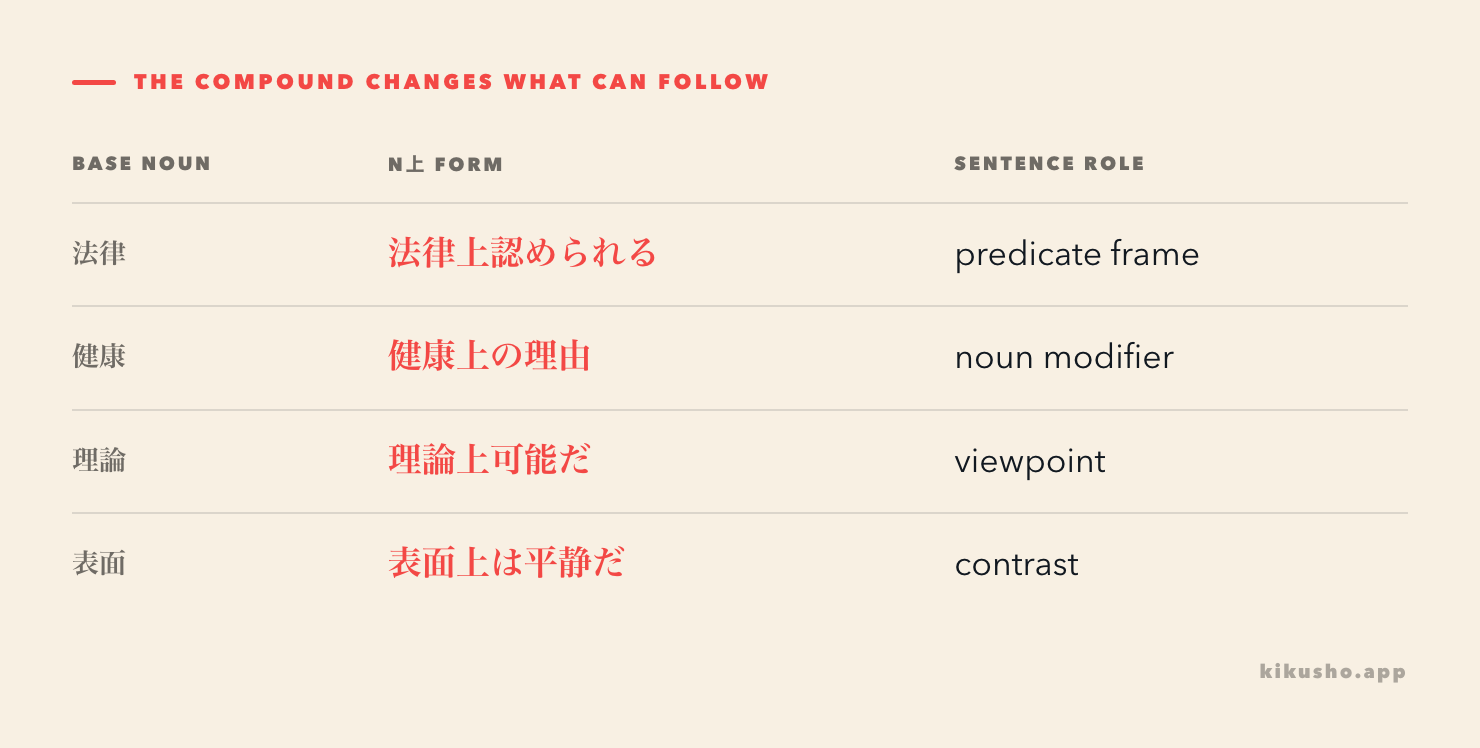
What follows the compound decides its sentence job
Once N+上 has been formed, it can frame a predicate, modify a following noun with の, or take a particle such as は.
N上+predicate
This form tells you the domain in which the predicate holds.
この地域では、安全上必要な設備を毎月点検しています。
このちいきでは、あんぜんじょう ひつような せつびを まいつき てんけんしています。
In this area, equipment required for safety is inspected every month.
経験上、この時期は予約が取りにくいと分かっています。
けいけんじょう、このじきは よやくが とりにくいと わかっています。
From experience, I know that reservations are hard to get at this time.
N上の+noun
Add の when the whole compound modifies a noun.
健康上の理由で、夜勤を減らしました。
けんこうじょうの りゆうで、やきんを へらしました。
I reduced my night shifts for health reasons.
会社には利用者の情報を守る法律上の責任があります。
かいしゃには りようしゃの じょうほうを まもる ほうりつじょうの せきにんが あります。
The company has a legal responsibility to protect user information.
The の comes after 上, because 法律上 is already the compound modifying 責任. 法律の上 would create a different structure and reading.
N上は+predicate
Particles can follow the compound. は often contrasts the named standpoint with another reality.
表面上は平静でしたが、内心では不安でした。
ひょうめんじょうは へいせいでしたが、ないしんでは ふあんでした。
Outwardly I was calm, but inwardly I was anxious.
The contrast does not change the reading: 表面上は is ひょうめんじょうは.
The suffix prefers established combinations
N+上 is productive only within recognisable collocations. It is safer to learn the combinations by the kind of relationship they express than to treat 上 as something that can follow any noun.
| Family | Common compounds | Typical question answered |
|---|---|---|
| rules and systems | 法律上, 規則上, 制度上 | What does the rule or system permit? |
| knowledge and analysis | 理論上, 歴史上, 経験上 | From what body of knowledge is this judged? |
| practical constraints | 健康上, 安全上, 都合上, 立場上, 仕事上 | What reason or circumstance limits the action? |
| status and appearance | 表面上, 形式上, 名目上, 事実上 | Is this outward, official, nominal or real? |
Hedgehog Japanese lists these recurring N+上 combinations and describes the construction as judging something from a particular standpoint. The list matters because a grammatical template does not guarantee a natural new compound. For example, 学校上 is not a general way to say “at school.” Depending on the intended meaning, Japanese may need 学校では, 学校生活上, or a more specific noun.
The same caution applies when translating English “in terms of.” Do not start with that English phrase and attach 上 to the nearest noun. First check whether Japanese already uses an established N+上 compound for that domain.
Some compounds have specialised meanings
Several common forms are lexicalised: their meaning is more specific than a word-for-word “from the standpoint of N.”
事実上 means “in effect” or “de facto.” It describes what functions as reality even if the official label differs.
形式上 means “formally” or “as a matter of form.” It can identify an official arrangement that does not tell the whole practical story.
名目上 means “nominally” or “in name.” 表面上 means “on the surface” or “outwardly.” 想像上の often means “imaginary,” as in 想像上の生き物, “an imaginary creature.”
形式上は別の会社ですが、事実上は同じ組織です。
けいしきじょうは べつの かいしゃですが、じじつじょうは おなじ そしきです。
Formally they are separate companies, but in effect they are the same organisation.
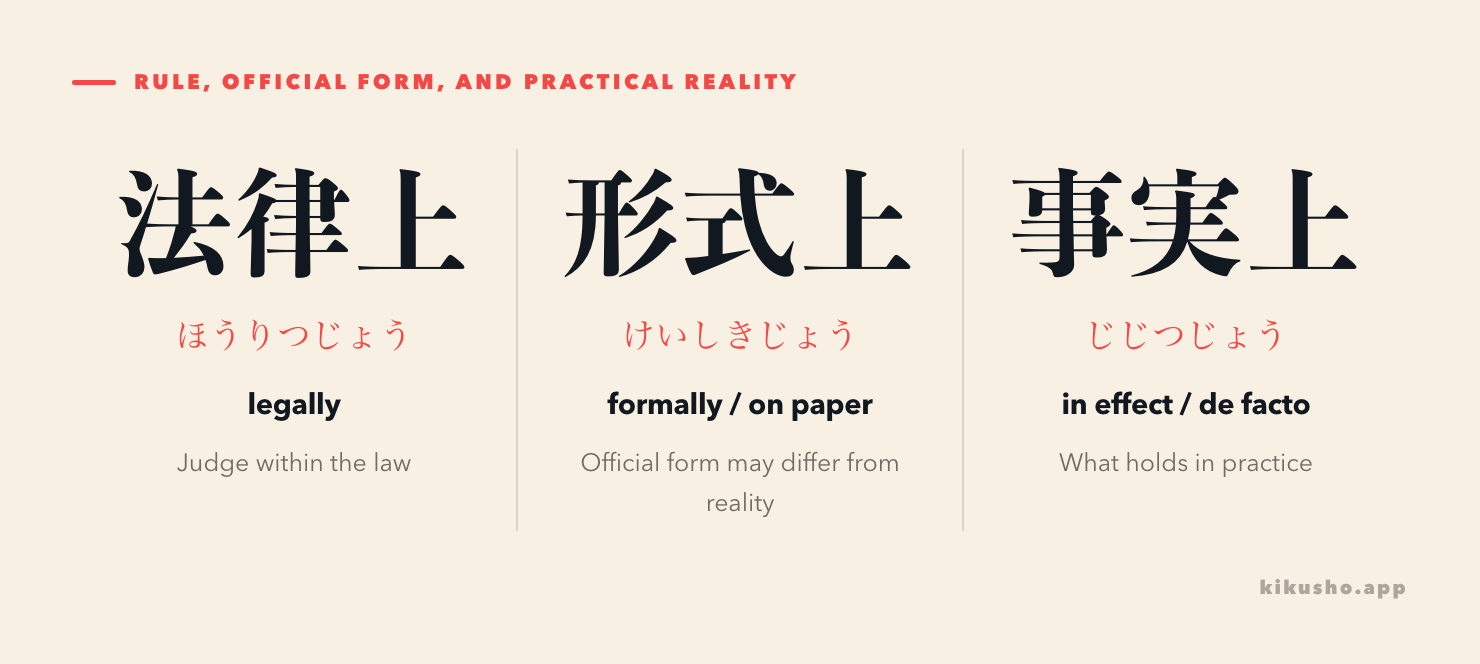
These compounds often create useful contrasts, but opposition is not built into the suffix itself. 歴史上重要だ, for example, simply judges importance within history.
上(じょう)and の上(うえ)では can overlap
Both forms can introduce a standpoint:
理論上は可能です。
りろんじょうは かのうです。
It is theoretically possible.
理論の上では可能です。
りろんのうえでは かのうです。
From a theoretical standpoint, it is possible.
The first is a compact compound and fits reports, rules and concise explanations. The second presents the standpoint more explicitly with Nの上では. Tanosuke's comparison of 上(じょう)and の上では notes that established combinations control the choice. 表面上 has the idiomatic meaning “outwardly”; replacing it mechanically with 表面の上では would not express the same idea. Conversely, a familiar expression with の上では does not automatically guarantee a natural N上 compound.
The practical rule is to learn 法律上, 健康上, 理論上 and other frequent units as compounds. When you meet Nの上では, read 上 as うえ and decide whether the noun names an abstract standpoint or a literal surface from the context.
Four other 上 patterns sit outside this suffix
The kanji alone cannot identify the grammar. Read the material immediately before and after it.
| Form | Reading | Job |
|---|---|---|
| 机の上 | うえ | literal position: on top of the desk |
| 確認した上で | うえ | completed prerequisite: after checking |
| 便利な上に | うえ | addition: convenient and furthermore… |
| 決めた上は | うえ | commitment after a decision |
| 法律上 | じょう | standpoint or domain: legally |
The lesson on 上で and 上に covers prerequisite, activity-frame and additive uses. The lesson on 上は explains the commitment pattern. Keeping those verbal structures separate leaves one clean test here: a recognised noun attaches directly to 上, and 上 is read じょう.
Register and use
N+上 is compact and often formal. It appears naturally in news, policies, workplace explanations, reports and careful argument. Fixed compounds such as 仕事上, 経験上 and 健康上の理由 also occur in ordinary speech when their meaning fits.
The form itself is neutral about whether the result is good or bad. 法律上認められている says something is legally recognised; 法律上禁止されている says it is legally prohibited. The predicate supplies the judgment.
When reading, keep the compound intact long enough to identify its domain. Kikusho can help you save the full unit—健康上の理由, not only 健康—so later reviews preserve the attachment and the reading じょう.
Practice
Work through the form, reading, contrast, composition and passage questions before revealing the shared explanations.
Question 1
Choose the form that means “theoretically possible.”
この計画は理論__可能です。
ア. 上
イ. の上
ウ. 上に
エ. 上で
Question 2
Choose the natural phrase for “a health-related reason.”
健康__理由で、しばらく休みます。
ア. 上
イ. 上な
ウ. 上の
エ. の上に
Question 3
Read the sentence. What contrast do the two compounds create?
形式上は別の会社ですが、事実上は同じ組織です。
ア. Past action versus future action
イ. Official form versus practical reality
ウ. Physical position versus direction
エ. Personal wish versus obligation
Question 4
In 法律上禁止されています, how is 上 read, and why is this not the prerequisite pattern “after doing”?
Question 5
Build one sentence from the four pieces.
__ __ __ __。
- 安全上の\
- この入口は\
- 閉鎖されています\
- 理由で
Question 6
Read the short passage and identify the job of each bold form.
経験上、この方法は初心者にも使いやすいと思います。ただし、教育上の問題がないか、専門家にも確認します。
What does 経験上 frame? What noun does 教育上の modify?
Answers and explanations
Answer 1
ア. 上. 理論+上 forms 理論上(りろんじょう), a compound meaning “theoretically” or “in theory.” 理論の上 can introduce a standpoint in a different Nの上 structure, but the blank here tests the compact suffix.
Answer 2
ウ. 上の. 健康上 is the compound, and の lets the whole compound modify 理由: 健康上の理由. 上な is not the required noun-modifying form.
Answer 3
イ. Official form versus practical reality. 形式上 identifies the formal arrangement; 事実上 identifies what functions as the real situation. Both take contrastive は after the completed compound.
Answer 4
上 is read じょう, so the phrase is ほうりつじょう きんしされています. 法律 is a noun attached directly to the suffix, and the compound frames the domain in which the prohibition applies. A prerequisite pattern would use a verb in the た-form before 上で, such as 確認した上で.
Answer 5
2 → 1 → 4 → 3: この入口は安全上の理由で閉鎖されています。安全上の modifies 理由, and 理由で gives the reason for the closure.
Answer 6
経験上 frames the speaker's judgment: the opinion comes from experience. 教育上の modifies 問題, so it means “an educational problem” or “a problem from an educational standpoint.” The first compound modifies the proposition; the second uses の to modify a noun.
Common questions
What does 上 mean when it is read じょう?
Attached directly to an established noun, 上 (じょう) marks the domain, standpoint or practical constraint from which a statement applies. 法律上 means legally, 理論上 means theoretically, and 健康上の理由 means a health-related reason.
What is the difference between N上 and Nの上では?
N上 is a compact compound and is common in formal explanations. Nの上では uses 上 read うえ and presents a standpoint more explicitly. They sometimes overlap, as in 理論上は and 理論の上では, but established combinations decide what sounds natural, so the forms cannot be exchanged mechanically.
Is 上 read じょう or うえ in 法律上?
It is read じょう: 法律上 is ほうりつじょう. The うえ reading belongs to other structures such as 机の上, 確認した上で, 便利な上に and 決めた上は.
Can 上 be added to any Japanese noun?
No. The suffix favours established combinations such as 法律上, 理論上, 健康上, 安全上, 経験上 and 形式上. If a combination is unfamiliar, use a clearer frame such as Nでは or check how native sources phrase that domain.