On this page
限り(かぎり) marks the boundary inside which a statement remains valid: while a condition holds, as far as certain evidence reaches, or to the greatest available extent. に限って has a different shape and job; it attaches to a noun and singles out a particular case rather than maintaining a clause-wide boundary.
この町に住んでいる限り、車は必要ない。
このまちにすんでいるかぎり、くるまはひつようない。
As long as I live in this town, I do not need a car.
私が確認した限りでは、数字に間違いはありません。
わたしがかくにんしたかぎりでは、すうじにまちがいはありません。
As far as I checked, there are no errors in the figures.
The first boundary is a continuing situation. The second is the evidence the speaker has checked. The shared idea is “inside this limit,” but the practical reading changes with what stands before 限り.
One boundary model covers three uses
Start by asking what kind of boundary A provides:
| Use | Dependable form | What B claims |
|---|---|---|
| continuing condition | Vる / Vている / Vない + 限り(は) | B holds while A remains true |
| status as condition | N / な-adjective + である限り(は) | B holds while that status remains |
| evidence scope | Vる / Vた / Vている + 限り(では) | B is the judgment supported by A |
| maximum extent | できる限り / Nの限り | action reaches the available limit |
担当者である限り、この記録を管理する責任がある。
たんとうしゃであるかぎり、このきろくをかんりするせきにんがある。
As long as one is the person in charge, one is responsible for managing this record.
The noun 担当者 connects through formal である. 担当者だ限り and 担当者の限り do not form this conditional use. The は in 限りは can emphasize the boundary, but it does not create a separate meaning.
JLPT Sensei's N2 限り lesson gives the core nonpast verb and noun-plus-である attachments. Bunpro's N2 account explicitly organizes the form around a limit that controls the logic of the following clause.
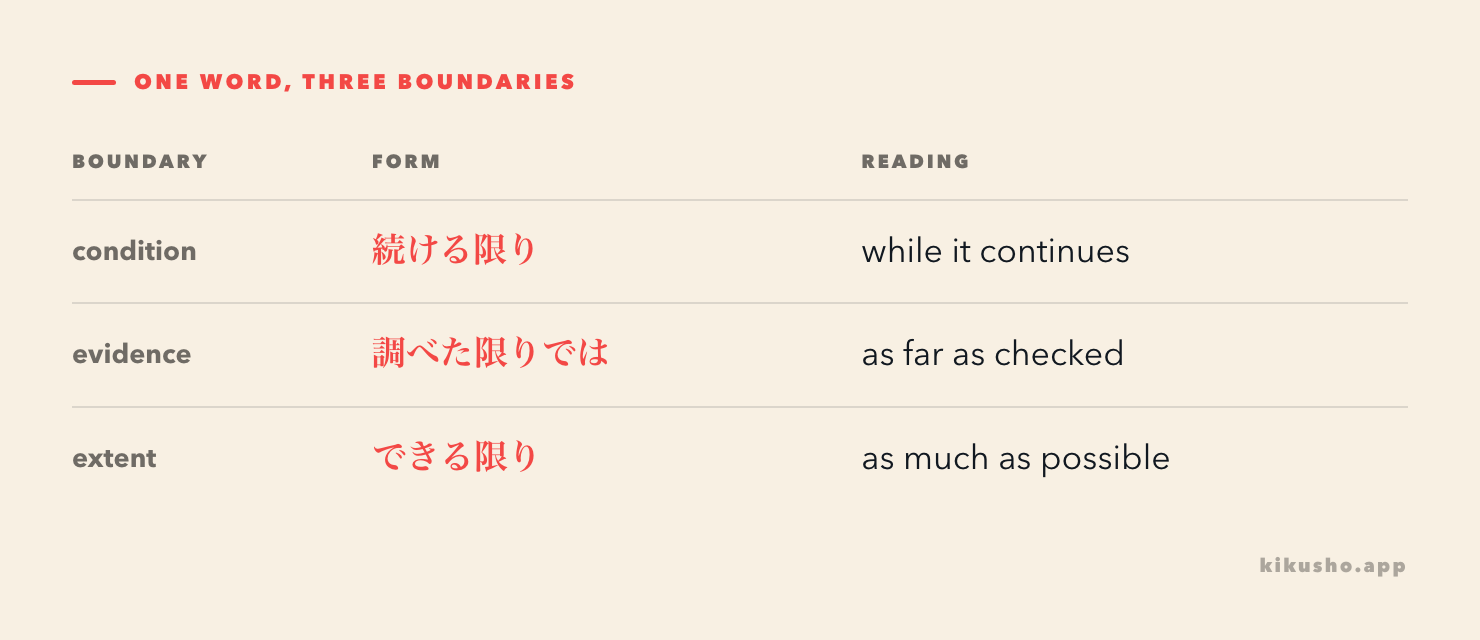
A continuing condition lasts exactly as long as A
With a nonpast or continuing verb, A限りB means that B continues throughout the period or situation in which A remains true.
この店が営業を続ける限り、私はここで働きたい。
このみせがえいぎょうをつづけるかぎり、わたしはここではたらきたい。
I want to work here for as long as this shop stays in business.
体が元気である限り、毎朝この道を歩くつもりだ。
からだがげんきであるかぎり、まいあさこのみちをあるくつもりだ。
As long as I remain healthy, I intend to walk this road every morning.
The form does not merely place B after A. It says that the truth of B is bounded by A's continuation. When the shop closes or the health condition changes, the speaker no longer guarantees the same plan.
This differs from 以上は and からには. Those forms accept A as a premise and derive a commitment or consequence. 担当者である限り focuses on how long the status continues; 担当者である以上は focuses on the duty that follows from accepting the role.
Japanese NET's explanation of the conditional range describes the result as holding throughout the time in which the action or state continues. That duration is why 限り cannot replace every English “if.”
Vない限り often becomes “unless”
With a negative condition, the main clause remains true while the named action does not happen. English usually handles this as “unless.”
責任者が許可しない限り、この資料は持ち出せません。
せきにんしゃがきょかしないかぎり、このしりょうはもちだせません。
Unless the person in charge gives permission, this document cannot be taken out.
The boundary is 許可しない, no permission. During that condition, 持ち出せません remains true. Permission would remove the stated barrier; the sentence does not promise that every other requirement has been met.
方法を変えない限り、同じ問題が起こるだろう。
ほうほうをかえないかぎり、おなじもんだいがおこるだろう。
Unless we change the method, the same problem will probably occur.
Avoid translating the two negatives word by word and losing their logic. 変えない限り、起こる means the problem continues if no change is made. 変えない限り、解決しない means it will not be solved unless a change is made. In both cases, the negative A defines the boundary.
The nearby さえ~ば pattern says that one condition is sufficient. 時間さえあればできる means time alone is enough. 時間がある限り続ける means continuing throughout the period in which time remains available.
限りでは limits how strongly you can claim B
Evidence-scope 限り(では) often follows verbs of knowing, seeing, hearing, reading, checking or investigating.
私の知る限りでは、この地域に同じ名前の店はありません。
わたしのしるかぎりでは、このちいきにおなじなまえのみせはありません。
As far as I know, there is no shop with the same name in this area.
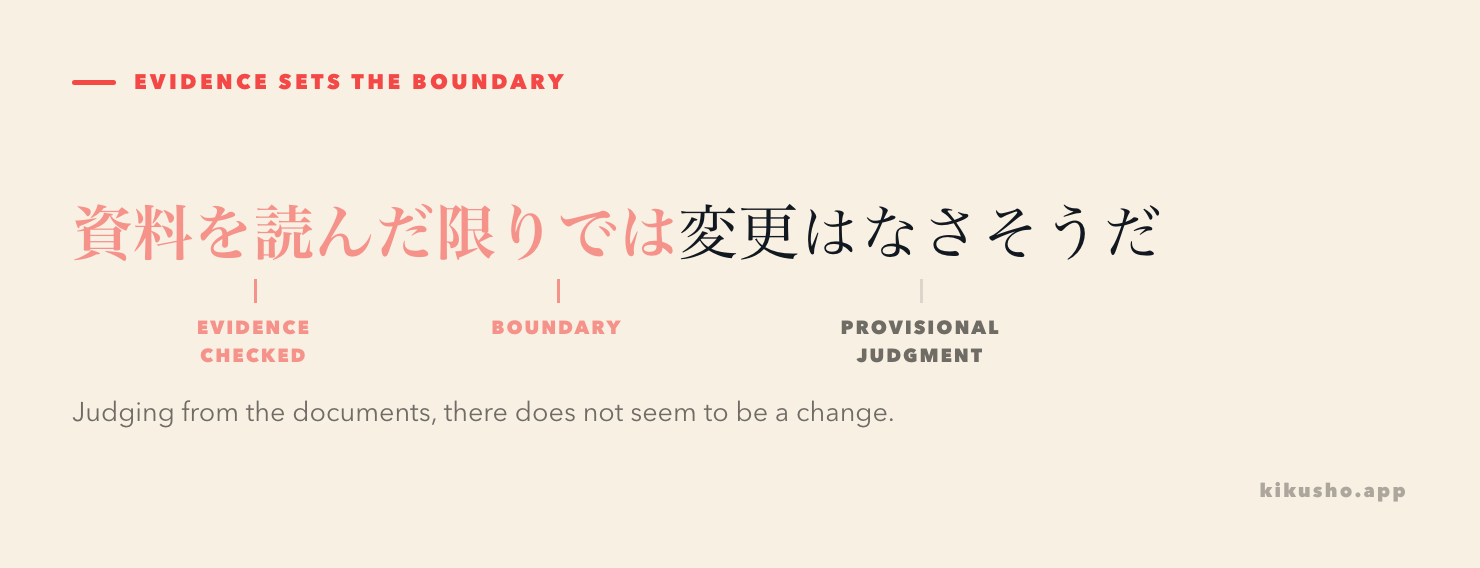
資料を読んだ限りでは、計画に大きな変更はなさそうだ。
しりょうをよんだかぎりでは、けいかくにおおきなへんこうはなさそうだ。
Judging from what I read in the documents, there does not seem to be a major change to the plan.
The second sentence does not certify that the plan is unchanged. It restricts the judgment to the documents read so far. New documents may support a different conclusion. では makes that “within this evidence” frame especially clear; 知る限り and 見た限り also occur without it.
The tense before 限り matters here. 調べた限りでは points to an investigation already performed. 知っている限りでは describes the speaker's current range of knowledge. A past form is therefore normal in the evidence use even though the continuing-condition use usually relies on a nonpast state.
できる限り pushes an action toward its maximum
In できる限り, the boundary is what is possible.
できる限り早く、結果をご連絡します。
できるかぎりはやく、けっかをごれんらくします。
We will contact you with the result as soon as possible.
選手たちは力の限り走った。
せんしゅたちはちからのかぎりはしった。
The athletes ran with all their strength.
できるだけ is the common conversational alternative to できる限り. The latter makes the available limit more explicit and fits formal promises, requests and written instructions. It still depends on real constraints: できる限り早く means as early as circumstances allow, not at a guaranteed clock time.
Other fixed-looking combinations keep the same extent idea. 見渡す限り means as far as one can see; 思いつく限り means everything one can think of. Japanese NET's maximum-extent 限り page groups できる限り, 力の限り and 見渡す限り around reaching a limit.
に限って selects a case instead of sustaining a boundary
Compare the forms directly:
この町に住んでいる限り、車は必要ない。
As long as I live in this town, I do not need a car.
今日に限って、バスが遅れている。
きょうにかぎって、バスがおくれている。
Today of all days, the bus is late.
The first attaches 限り to the clause 住んでいる and makes that living situation the boundary for B. The second attaches に限って to the noun 今日 and singles today out against an expectation about other days.
The full に限る, に限り, に限らず and に限って comparison covers restriction, recommendations, inconvenient occasions and trust-based judgments. On this page, the contrast has one purpose: do not insert に before bare conditional or evidence-scope 限り. 知っているに限って cannot mean “as far as I know.”
When you capture an N2 sentence in Kikusho, keep the clause on both sides of 限り. A card containing only 限り = limit cannot show whether the boundary is time, evidence or effort. Mark A = boundary and B = claim inside it, then check which part of A supplies the limit.
Practice: identify what the boundary contains
Complete the six tasks before opening the explanation panel.
Question 1 — continuing condition. Choose the phrase that means “as long as I live here.”
ここに__、この地域の活動に参加したい。
- ア. 住んでいる限り
- イ. 住んでいたに限って
- ウ. 住むに限り
- エ. 住んだ以上に
Question 2 — unless. Choose the form that keeps entry impossible until permission is given.
管理者が許可__、この部屋には入れません。
- ア. する限り
- イ. しない限り
- ウ. した限りでは
- エ. するに限って
Question 3 — evidence scope. Which completion makes the conclusion provisional and limited to the investigation?
私が__、機械に故障は見つかりませんでした。
- ア. 調べない限り
- イ. 調べるに限って
- ウ. 調べた限りでは
- エ. 調べるからには
Question 4 — sentence composition. Arrange the chunks into “I will reply as clearly as possible.” Use each once.
- できる
- 分かりやすく
- 限り
- 返事をします
Question 5 — connected text. Read the passage and choose the supported interpretation.
報告書を読んだ限りでは、工事は予定どおり進んでいるようです。ただし、現場にはまだ行っていません。
- ア. The speaker guarantees the work is on schedule from every possible source.
- イ. The report supports that impression, but the speaker has not checked the site.
- ウ. The work will stay on schedule as long as the report exists.
- エ. Only the report is allowed to enter the construction site.
Question 6 — 限り or に限って. Choose the pair that preserves both meanings.
この仕事を続けている( )、毎日記録を取る。普段は順調なのに、今日( )機械が止まった。
- ア. に限って/限り
- イ. 限り/に限って
- ウ. 限りでは/に限り
- エ. からには/限りでは
Answers and explanations
Answer 1. ア, 住んでいる限り. The continuing living situation sets the time boundary for participating. に限って would single out a noun or case, and the other choices do not form the requested continuing condition.
Answer 2. イ, しない限り. While permission has not been given, entry remains impossible. English naturally expresses the relationship as “unless the manager gives permission.”
Answer 3. ウ, 調べた限りでは. The past verb identifies the completed investigation, and 限りでは restricts the conclusion to that evidence. It leaves open what another inspection might find.
Answer 4. できる限り分かりやすく返事をします. できる限り sets the maximum possible extent, 分かりやすく describes how the reply will be given, and 返事をします completes the promise.
Answer 5. イ. The first sentence says that the report supports the impression that work is on schedule. The second explicitly limits the speaker's evidence because they have not visited the site. Nothing guarantees that unseen conditions match the report.
Answer 6. イ, 限り/に限って. 続けている限り makes the duration of the job the boundary for daily record keeping. 今日に限って singles today out as an exceptional day when the machine stopped.
Level and review note
JLPT Sensei, Bunpro and Japanese NET all place this bare 限り family at N2. The frozen inventory records no level disagreement for the assigned unit. The related に限って item is also N2, but it was already taught and reviewed in its own comparison lesson and receives no additional coverage credit here.
The level is a reference placement. The official JLPT FAQ states that detailed grammar, vocabulary and kanji lists are not published. For reading, the useful question is concrete: does 限り bound a continuing condition, the evidence behind a judgment, or the extent of an action?
OpenAI Codex reviewed this version as an AI agent, including the Japanese examples, readings, translations and all six answer explanations. No human language review was performed.
Common questions
What does 限り mean in N2 grammar?
限り draws a boundary. It can mean while a condition continues, within the evidence available to the speaker, or to the greatest possible extent. The form before it and the clause after it identify the use.
What does Vない限り mean?
Vない限り means unless V happens or as long as V does not happen. The result in the main clause remains true while the negative condition holds.
What is the difference between 限り and に限って?
Bare 限り follows a clause and marks its continuing boundary, or follows a source of evidence or possible extent. Noun plus に限って singles out one particular person, time or case, often against an expectation.
What is the difference between 知る限り and 調べた限りでは?
Both limit a judgment to available information. 知る限り means as far as one knows; 調べた限りでは means judging from what one investigated. The statement may change if more evidence appears.