On this page
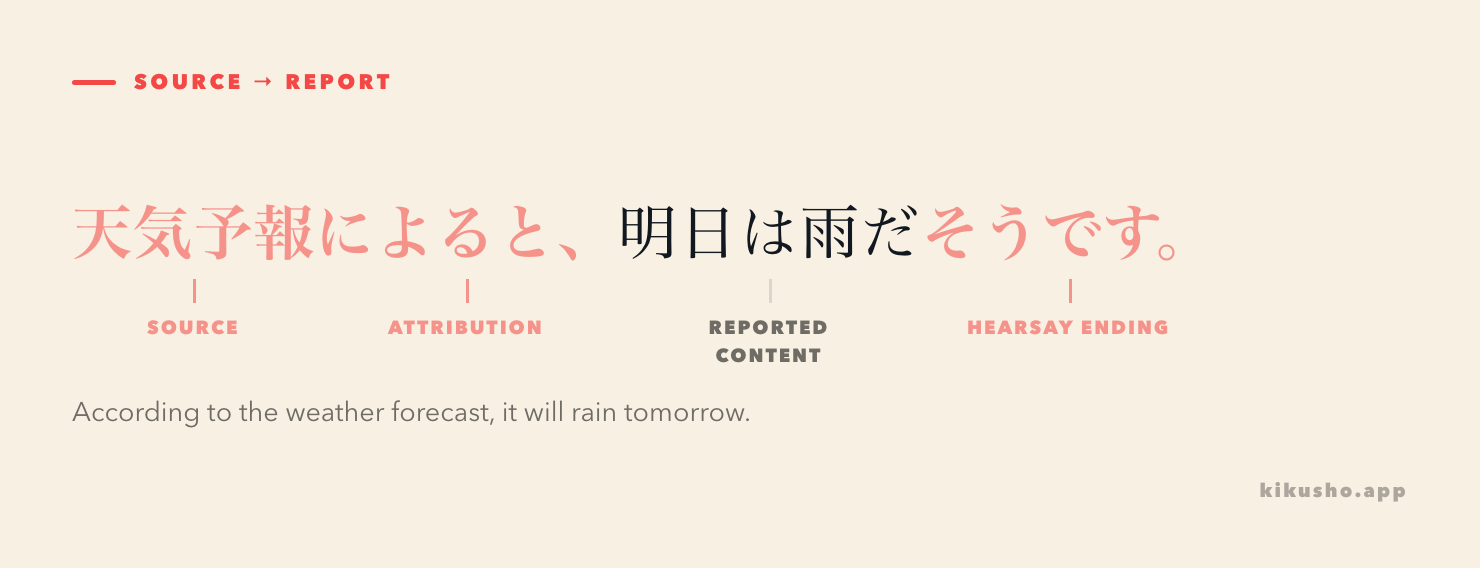
Put によると or によれば after a person, document, announcement, survey, or other source when you pass on information from it. The source comes first; the following clause gives the content of the report.
天気予報によると、明日は雨だそうです。
てんきよほうに よると、あしたは あめだそうです。
According to the weather forecast, it will rain tomorrow.
This is N3 grammar in the study lists maintained by JLPT Sensei and Bunpro. The JLPT publishes no exhaustive grammar syllabus, so N3 is a useful study placement rather than an official guarantee about one test paper.
The noun before the form must be an information source
The core pattern is simple:
| Source | Marker | Reported content |
|---|---|---|
| 天気予報 | によると | 明日は雨だそうです |
| 警察の発表 | によれば | 事故は午前中に起きました |
| 先生の話 | によると | 試験の日が変わったとのことです |
Attach the marker directly to the source noun. Do not add の between them.
市の発表によれば、来月からこの道は通行止めになります。
しの はっぴょうに よれば、らいげつから この みちは つうこうどめに なります。
According to the city's announcement, this road will be closed from next month.
田中さんの話によると、会議は三時に終わるそうです。
たなかさんの はなしに よると、かいぎは さんじに おわるそうです。
According to Tanaka, the meeting will end at three.
A person's name can itself be the source, as in 田中さんによると. Adding 話, “account” or “what someone said,” is also natural and makes the information path explicit. For a discovered fact, a survey or study can be the source: 調査によると、利用者の半数は毎日ログインしています, “According to the survey, half of the users log in every day.”
Bunpro records noun attachment and also notes a verb plus ところ pattern when the source is expressed as the place from which information was obtained. For production at N3, a clear source noun such as 発表, 記事, 話, or 調査 is the safest starting point.
The ending shows how you present the report
The source marker does not quote the content by itself. It opens a frame, and the rest of the sentence states what came from that source. Hearsay endings are common because they preserve the distance between the reporter and the claim.
| Ending | What it adds | Example |
|---|---|---|
| ~そうだ / ~そうです | explicitly heard or reported information | 雪が降るそうです |
| ~らしい | information presented as apparently true | 道が混んでいるらしい |
| ~とのことだ / ~とのことです | a formal or compact report | 受付は終了したとのことです |
| direct statement | the source phrase already handles attribution | 売上は去年より増えました |
新聞によると、駅の工事は来年終わるそうです。
しんぶんに よると、えきの こうじは らいねん おわるそうです。
According to the newspaper, the station construction will finish next year.
報告書によれば、売上は去年より増えました。
ほうこくしょに よれば、うりあげは きょねんより ふえました。
According to the report, sales increased compared with last year.
The second sentence does not need そうです. The report itself is named, so the speaker can present its stated result directly. Conversely, そうです without a source can still mark hearsay. The lesson on そう, よう, らしい and みたい separates hearsay そう from appearance そう.
Do not force an invitation, order, or personal wish after the source phrase. 天気予報によると、傘を持っていきましょう awkwardly makes the forecast sound like the speaker of “let's take umbrellas.” Split the report from your response instead:
天気予報によると、午後は雨だそうです。傘を持っていきましょう。
According to the forecast, it will rain this afternoon. Let's take umbrellas.
The first sentence reports. The second belongs to the current speaker.
によると and によれば usually make the same attribution
Both forms identify the basis for the report. によると contains the conditional と shape of よる; によれば contains its ば form. In this fixed source construction, however, neither asks you to compare ordinary conditional rules each time.
案内によると、入口は二階にあります。
あんないに よると、いりぐちは にかいに あります。
According to the guide, the entrance is on the second floor.
案内によれば、入口は二階にあります。
あんないに よれば、いりぐちは にかいに あります。
According to the guide, the entrance is on the second floor.
The practical meaning is the same. によれば can retain a faint “if one goes by the guide” feeling, while によると is an ordinary neutral choice for introducing information. Context, source quality, and the sentence ending say more about confidence than this choice alone.
Teaching references disagree about a finer nuance. Bunpro describes によると as tending toward firmer information, while Yatta treats the forms as interchangeable in most contexts and gives によれば only a slight “if one goes by” shade. That difference is too small to use as a mechanical test. First learn the shared source function; let the surrounding wording carry certainty.
In formal speech, you may hear によりますと:
駅員によりますと、電車は十分ほど遅れているとのことです。
えきいんに よりますと、でんしゃは じゅっぷんほど おくれているとの ことです。
According to the station employee, the train is about ten minutes late.
The polite shape matches an announcement or broadcast. It does not make the underlying source more reliable.
Three English “according to” meanings need different Japanese
English hides several relationships inside the same translation. Ask what the noun does in the sentence.
| Relationship | Japanese | Diagnostic question |
|---|---|---|
| source of a report | N + によると / によれば | Who or what supplied this information? |
| method, cause, evidence, agent, or varying factor | N + によって | How did it happen, become known, or vary? |
| a response adjusted to a condition | N + に応じて | What is being adapted to match N? |
防犯カメラの映像によって、車の色がわかりました。
ぼうはんカメラの えいぞうによって、くるまの いろが わかりました。
The security-camera footage made the car's colour known.
The footage is evidence used in a discovery. It is not a publication whose statement you are repeating. The broader によって lesson covers this evidence use along with cause, method, variation, and passive agents.
参加者の経験に応じて、練習内容を変えます。
さんかしゃの けいけんに おうじて、れんしゅうないようを かえます。
We change the practice content according to the participants' experience.
Experience sets the condition to which the content is adapted. No outside report is being cited. The distinction matters even when an English translation uses “according to” for both.
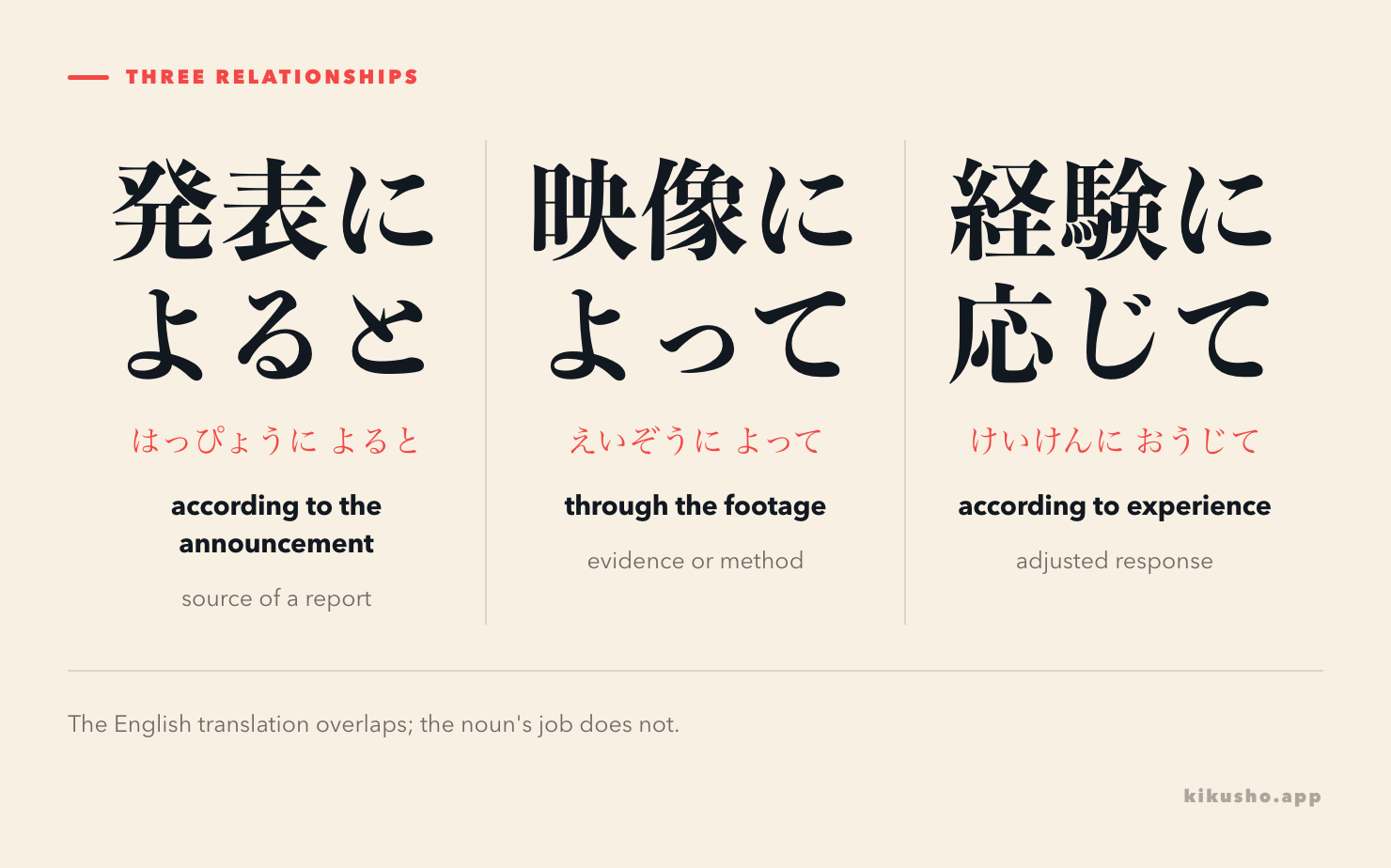
The に応じて comparison develops that responsive relationship. Keep it separate from attribution.
Your own opinion is not an outside report
私によると is normally a poor way to mean “according to me.” You are not passing your own opinion along as secondhand information. Choose a phrase that matches what you mean:
| Intended meaning | Natural frame |
|---|---|
| in my opinion | 私の意見では / 私は~と思います |
| according to what I heard | 私が聞いた話では |
| according to Tanaka | 田中さんによると / 田中さんの話によると |
| according to the document | 資料によると / 資料によれば |
This limit gives you a quick test: the noun before によると should be something you can treat as the source of the following information. A person, article, notice, forecast, survey, and official announcement all pass. Your current decision or request does not.
Practice
Work through the full set first; the solutions begin only after Question 7.
Question 1 — choose the source marker. Complete the report: 天気予報( )、明日は雪が降るそうです。
- ア. によって
- イ. によると
- ウ. に応じて
- エ. にとって
Question 2 — choose the relationship. Which sentence means “The footage revealed the car's colour” rather than “According to the footage”?
- ア. 映像によると、車の色がわかりました。
- イ. 映像によれば、車の色がわかりました。
- ウ. 映像によって、車の色がわかりました。
- エ. 映像に応じて、車の色がわかりました。
Question 3 — select a natural continuation. Complete: 市の発表によれば、来月から____。
- ア. この道は通行止めになるとのことです
- イ. この道を通ってください
- ウ. 一緒に別の道を探しましょう
- エ. 私はこの道が好きです
Question 4 — sentence composition. Put every chunk in a natural order: によると / 会議は三時に / 田中さんの話 / 終わるそうです
Question 5 — choose the first-person frame. You want to say “In my opinion, this plan is difficult.” Which opening fits?
- ア. 私によると
- イ. 私の意見では
- ウ. 私によって
- エ. 私に応じて
Question 6 — identify the polite source form. Which expression is a polite version commonly heard in an announcement?
- ア. によりますと
- イ. によってですと
- ウ. によるでしたら
- エ. に応じますと
Question 7 — text grammar. Choose the pair that keeps the information source separate from the speaker's response.
天気予報( 甲 )、午後は雨だそうです。だから、傘を( 乙 )。
- ア. 甲: によって / 乙: 持っていくそうです
- イ. 甲: によると / 乙: 持っていきましょう
- ウ. 甲: に応じて / 乙: 持っていくらしいです
- エ. 甲: にとって / 乙: 持っていくとのことです
Answers and explanations
Answer 1. イ. によると. The weather forecast is the source of the reported snow forecast. によって would present a method, cause, evidence, agent, or varying factor; the other two forms do not mark an information source here.
Answer 2. ウ. 映像によって、車の色がわかりました. The footage functions as evidence through which the colour became known. によると and によれば would treat 映像 as a source making a report, which is not the intended relationship. に応じて would require an action or result adjusted to match the footage.
Answer 3. ア. この道は通行止めになるとのことです. This continuation presents the content of the city's announcement. The request, joint suggestion, and personal preference belong to a current speaker rather than to the cited source.
Answer 4. 田中さんの話によると、会議は三時に終わるそうです. 田中さんの話 names the source, によると attaches directly to it, and 終わるそうです marks the meeting time as reported information.
Answer 5. イ. 私の意見では. The sentence gives the speaker's own judgment. 私によると treats the speaker unnaturally as an outside source; によって and に応じて express different relationships.
Answer 6. ア. によりますと. This is the polite form used to attribute information in settings such as broadcasts and station announcements. The other choices do not form the polite source construction.
Answer 7. イ. 甲: によると / 乙: 持っていきましょう. The first sentence attributes the rain information to the forecast. The second then gives the current speaker's suggestion. The other choices either use the wrong relationship marker or present the response as another report.
Preserve both voices when you save an example
A useful example has two voices: the named source supplies the claim, and the current speaker chooses how to relay it. If you capture 駅員によりますと、電車は遅れているとのことです, keep the source phrase and the report ending together. Kikusho lets you edit the example and register fields before saving, so the card can preserve the announcement style you encountered instead of reducing the sentence to “according to.”
Common questions
What do によると and によれば mean?
They mean “according to” when the noun before them names the source of reported information. 天気予報によると、明日は雨だそうです attributes the rain forecast to the weather report.
What is the difference between によると and によれば?
They are usually interchangeable as source markers. によると is a neutral, common choice; によれば can have the slight feel of “if one goes by that source.” Neither changes the reported fact into an ordinary condition.
Must a sentence with によると end in そうです?
No. そうだ, らしい, とのことだ and similar endings often make the secondhand status explicit, but a report can also end directly when the source phrase already makes attribution clear.
What is the difference between によると and によって?
によると names a source whose statement or data is being reported. によって can name a method, cause, varying factor or passive agent, so it does not introduce a report in the same way.