On this page
Your friend asks how to improve their listening, so you say 毎日少しずつ聞くことだ: “You should listen a little every day.” A child deliberately damages someone else's belongings, so an adult says 人の物を壊すものではない: “You should not damage other people's things.”
Both endings can sound like “should” in English. ことだ points the listener toward a useful action in their particular situation; ものではない invokes a broader standard and admonishes them for crossing it.
Start with the source of the advice
The deciding question is not simply positive advice versus negative advice. ことだ itself can recommend doing or not doing something. Ask where the speaker's authority comes from:
| Pattern | Basis of the message | Typical force |
|---|---|---|
| Vる/Vないことだ | a concrete problem, condition or goal | “The thing for you to do is…” |
| Vるものではない | a social, moral or common-sense norm | “One should not behave that way” |
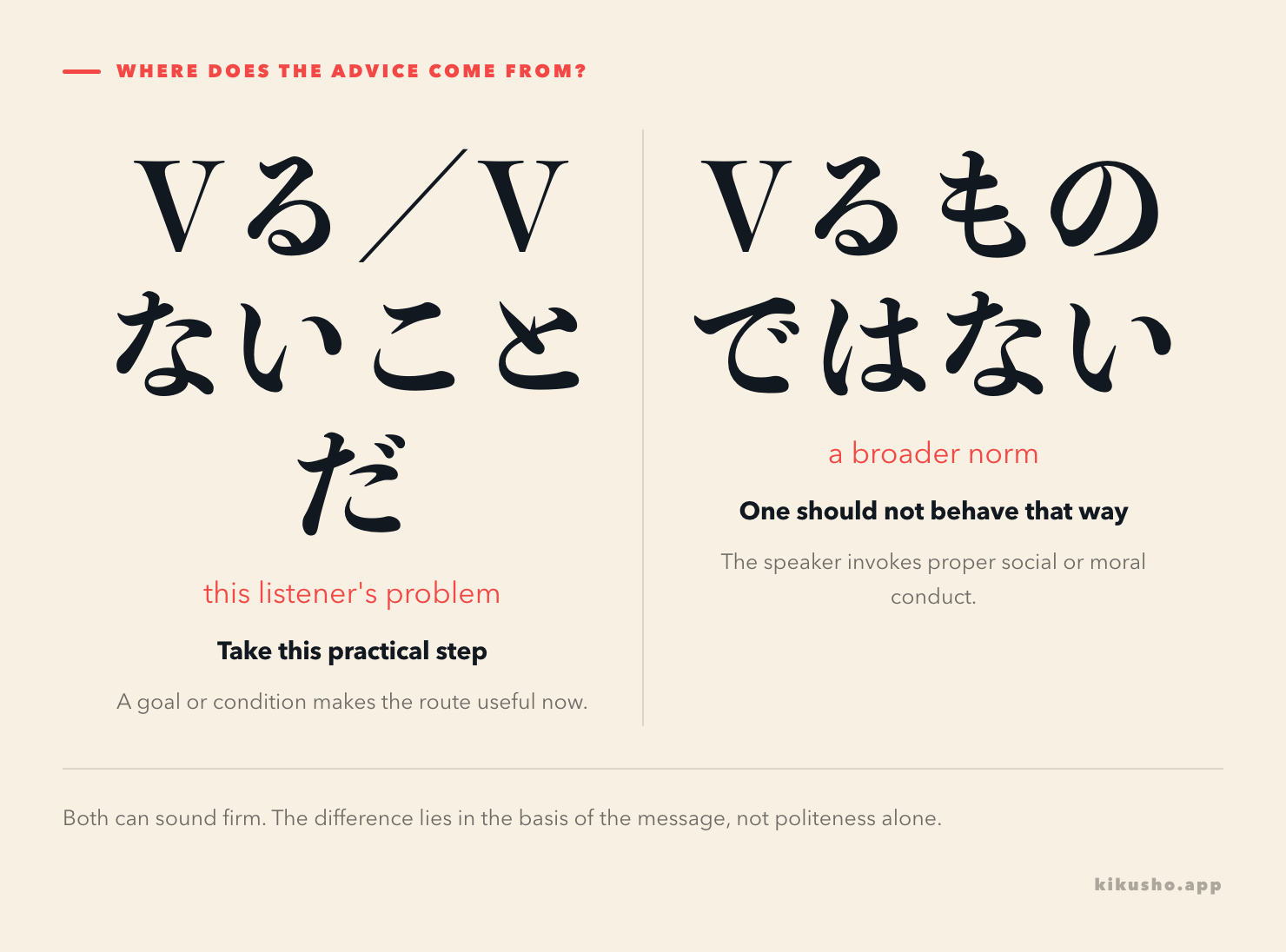
A conditional clause often makes the individual problem visible:
試験に合格したいなら、毎日少しずつ復習することだ。
しけんにごうかくしたいなら、まいにちすこしずつふくしゅうすることだ。
If you want to pass the exam, you should review a little every day.
The goal 合格したい supplies the reason for the recommendation. By contrast, ものではない can correct conduct without solving one private problem:
困っている人を笑うものではない。
こまっているひとをわらうものではない。
One should not laugh at someone who is in trouble.
The speaker presents the behaviour as wrong according to a standard that should apply beyond this one listener.
ことだ gives a course of action
For advice, attach ことだ to a dictionary-form or ない-form verb.
| Desired advice | Formation | Example |
|---|---|---|
| recommend an action | Vる + ことだ | 相談することだ |
| recommend avoiding an action | Vない + ことだ | 一人で悩まないことだ |
分からないなら、早めに先生に相談することだ。
わからないなら、はやめにせんせいにそうだんすることだ。
If you do not understand, you should consult the teacher early.
失敗しても、すぐに諦めないことだ。
しっぱいしても、すぐにあきらめないことだ。
Even if you fail, you should not give up immediately.
The second sentence puts the negative inside the verb: 諦めない + ことだ. This is a central production rule. A Chiba University study of formal-noun endings notes the contrast between Vないことだ, advice not to perform an action, and Vることはない, which says that performing it is unnecessary. It also distinguishes advice ことだ from a hypothetical negation ことではない.
The Japan Foundation's account of sentence-final こと describes ことだ and bare こと as indirect advice or commands. Their settings still differ. ことだ commonly addresses a person whose situation is under discussion; bare こと is compact in rules, notices and written instructions:
風邪を引いたなら、温かくして寝ることだ。
If you have caught a cold, you should keep warm and sleep.
レポートは金曜日までに提出すること。
Submit the report by Friday.
The focused lesson on bare こと in written instructions develops that second use and separates it from nominalization.
Tone matters before you give this advice
ことだ can sound firm, teacher-like or superior-to-junior. Japanese NET's advice entry explicitly cautions against directing it at a social superior. ことです is grammatically polite, but the speaker still positions themselves as someone entitled to prescribe the solution.
Suppose a colleague asks how to remember new words. 出会った文ごと記録することです can work in an explanation or instructional talk: “You should record the whole sentence in which you met the word.” In an ordinary conversation with a superior, 出会った文ごと記録するといいと思います is less imposing.
Do not treat ことだ as a neutral replacement for every たほうがいい. The latter can offer a choice more gently. ことだ often sounds as though the speaker has identified the correct route.
ものではない invokes expected conduct
For the admonition use, attach an affirmative dictionary-form verb to ものではない:
約束を簡単に破るものではない。
やくそくをかんたんにやぶるものではない。
One should not casually break promises.
相手の話を最後まで聞かずに決めつけるものではない。
あいてのはなしをさいごまできかずにきめつけるものではない。
One should not jump to conclusions without hearing the other person out.
The final frame rejects the conduct as inappropriate. The dictionary verb is affirmative because the negation belongs to ものではない as a whole.
The Japan Foundation's discussion of もの explains that advice with ものだ presents the action as natural or socially expected, while ものではない presents conduct as inappropriate. Japanese NET likewise describes this use as advice grounded in social common sense. The speaker may sound as if they are teaching a general lesson, so the construction readily becomes admonishing or preachy.
Common ending choices include:
| Ending | Form |
|---|---|
| plain | 約束を破るものではない |
| polite | 約束を破るものではありません |
| conversational | 約束を破るものじゃない |
| shortened conversational | 約束を破るもんじゃない |
Polite ありません changes how the utterance addresses the listener; it does not turn the norm into a tentative suggestion.
Negative placement changes the construction
The visual difference is small, but the grammar makes two distinct moves:
| Form | Where the negative sits | Reading |
|---|---|---|
| 無理をしないことだ | on the verb | You should not overdo it |
| 人を傷つけるものではない | on the final frame | One should not hurt people |
| 約束を破らないものだ | on the verb before ものだ | People normally do not break promises |
| 簡単にできるものではない | on the final frame in a description | It is not something easily done |
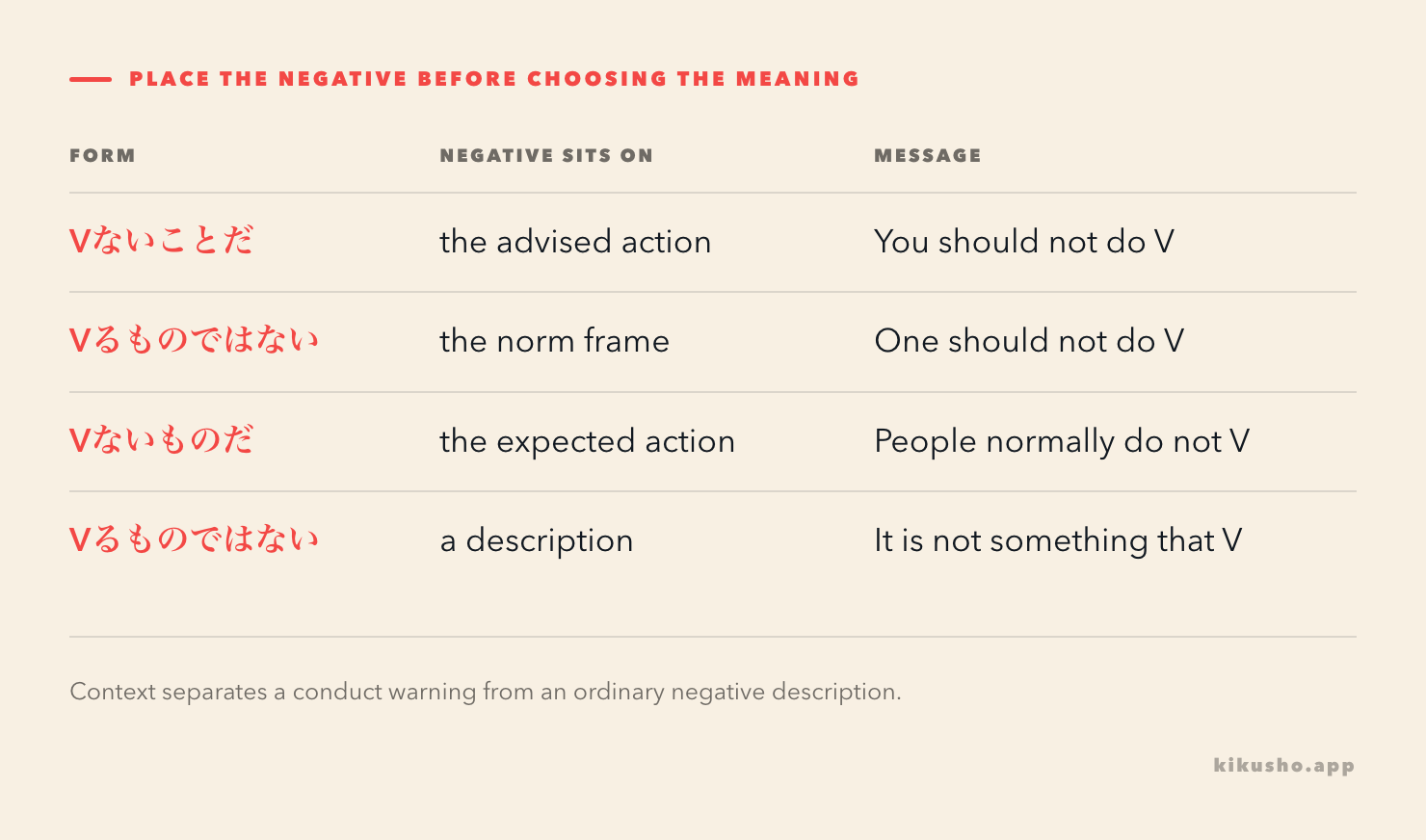
The final row gives an important limit. Not every ものではない is aimed at someone's behaviour:
この作業は一日で簡単に終わるものではない。
このさぎょうはいちにちでかんたんにおわるものではない。
This task is not something that can be finished easily in one day.
Here the subject is a task and the sentence rejects a description of its ease. There is no person being told to behave better. With a controllable human action such as 約束を破る, a listener and a norm in the situation support the admonition reading.
The broader ものだ and ものではない lesson covers recollection, general expectation, admiration and the descriptive boundary. This article uses only the warning sense needed for the advice comparison.
The same listener can receive either pattern
Imagine a new employee who is worried about a mistake:
同じ間違いを防ぎたいなら、原因をメモしておくことだ。
If you want to prevent the same mistake, you should write down its cause.
That is a solution to the employee's goal. Now imagine that the employee hid the mistake and blamed a colleague:
自分の間違いを人のせいにするものではない。
One should not blame other people for one's own mistake.
That is a correction based on expected conduct. The two forms do not merely represent mild and strong versions of one message. They frame the reason for speaking differently.
This distinction also explains why ものではない is a poor fit for many ordinary tips. 電車に乗り遅れたくないなら、早めに家を出ることだ gives a practical route to one outcome. Turning it into 早めに家を出るものではない would assert a general norm about leaving early, and the negative warning 遅く家を出るものではない would sound like a lesson about proper conduct rather than a tailored travel suggestion.
JLPT study guides disagree on placement. Kikusho's inventory and JLPT Sensei place advice ことだ at N2, while Bunpro places it at N3. Japanese NET labels it N2, while other teaching sites use N3. Treat those labels as sequencing guidance: the JLPT does not publish a complete official grammar list.
When saving an example in Kikusho, include the situation that licenses the advice. 復習することだ alone does not show whose goal is being solved, and 笑うものではない alone does not identify the conduct being judged. A condition or a short line of context preserves the speaker's reason for choosing the form.
Practice: identify the speaker's basis
Complete all six questions before opening the solution block.
Question 1
A friend wants to improve their pronunciation. Choose the form that gives a practical course of action.
発音をよくしたいなら、自分の声を録音して聞く( )。
A. ことだ
B. ものではない
C. ことはない
D. ものだった
Question 2
An adult tells a child that mocking another person's mistake is unacceptable conduct. Choose the best ending.
人の失敗を笑う( )。
A. ことだ
B. ものではない
C. ないことだ
D. ものだった
Question 3
Supply the correct negative advice with ことだ.
疲れているなら、無理を( )。
“If you are tired, you should not overdo it.”
Question 4
Which interpretation fits この仕事は一人で簡単にできるものではない?
A. One should never work alone because it is immoral.
B. The speaker remembers doing the work alone.
C. The job is not something that can be done easily by one person.
D. One person should do the work immediately.
Question 5
Compose a sentence with ものではない: “One should not reveal another person's secret.” Use 人の秘密, 話す, and ものではない.
Question 6
Read the exchange. Which completion preserves the move from a personal remedy to a conduct rule?
A:最近、寝不足で仕事に集中できないんです。
B:まず、夜はスマートフォンを見ない( ① )。それから、約束した時間に連絡せず、相手を待たせる( ② )。
A. ①ことだ/②ものではない
B. ①ものではない/②ことだ
C. ①ことはない/②ものだった
D. ①ものだ/②ないことだ
Before revealing the explanations, name the listener's concrete problem in the first blank and the broader conduct standard in the second.
Answers and explanations
The explanations below identify the source of the speaker's authority in each situation.
Answer 1. A, ことだ. The goal 発音をよくしたい creates an individual problem, and recording one's voice is the recommended route. ものではない would reject the action as improper rather than recommend it.
Answer 2. B, ものではない. Mocking someone's mistake is presented as conduct that violates a general interpersonal norm. C would produce 笑うないことだ, which is malformed; negative advice with ことだ requires the ない-form 笑わないことだ.
Answer 3. しないことだ. The full sentence is 疲れているなら、無理をしないことだ. Negate する before adding ことだ. 無理をすることではない is not the negative form of this advice construction.
Answer 4. C. The sentence describes the difficulty of the job: it is not something one person can do easily. The subject and predicate do not establish an admonition about morally proper conduct.
Answer 5. One natural answer is 人の秘密を話すものではない (ひとのひみつをはなすものではない). The speaker treats revealing another person's secret as inappropriate according to a general norm.
Answer 6. A. 見ないことだ recommends one concrete step for B's sleep-related problem. 相手を待たせるものではない admonishes people against keeping someone waiting after agreeing on a time. The first solves this listener's stated problem; the second invokes expected conduct that applies more broadly.
Common questions
What is the difference between ことだ and ものではない?
Vる/Vないことだ recommends a course of action for a person's particular problem or goal. Vるものではない tells someone not to act in a way the speaker presents as socially, morally or generally inappropriate.
How do you make negative advice with ことだ?
Negate the verb before ことだ: 焦らないことだ means “you should not rush.” Do not use Vることではない as the negative of this advice pattern.
Why does ものではない use an affirmative verb?
In the admonition pattern, the final ものではない frame is negative: 人を傷つけるものではない means one should not hurt people. Vないものだ is a different structure that presents not doing something as expected conduct.
Are ことだ and ものではない polite advice?
Both can sound authoritative. Final です or ありません changes politeness, but it does not remove the speaker's stance as an adviser or enforcer of a norm. Softer forms are usually safer with a superior.