On this page
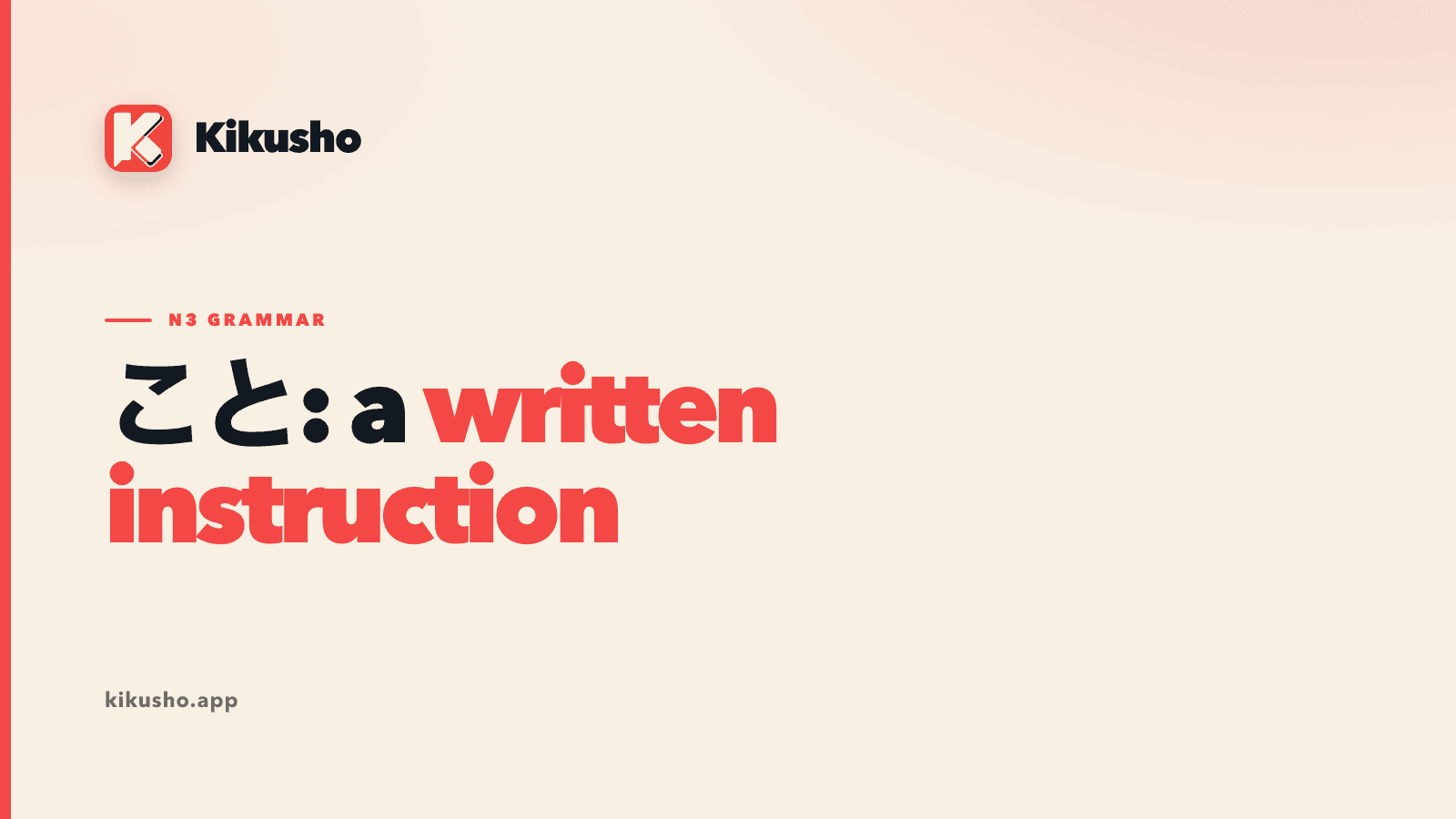
At the end of a written rule, verb + こと tells the reader what to do or what not to do. 提出物には名前を書くこと means “Write your name on submitted work,” while 試験中は辞書を使わないこと means “Do not use a dictionary during the exam.”
This is the compact こと (koto) found in school rules, workplace instructions, notices and checklists. It does not make a polite request to one named listener. It presents the action as a requirement that applies to whoever reads the rule.
Build the instruction with the dictionary or negative form
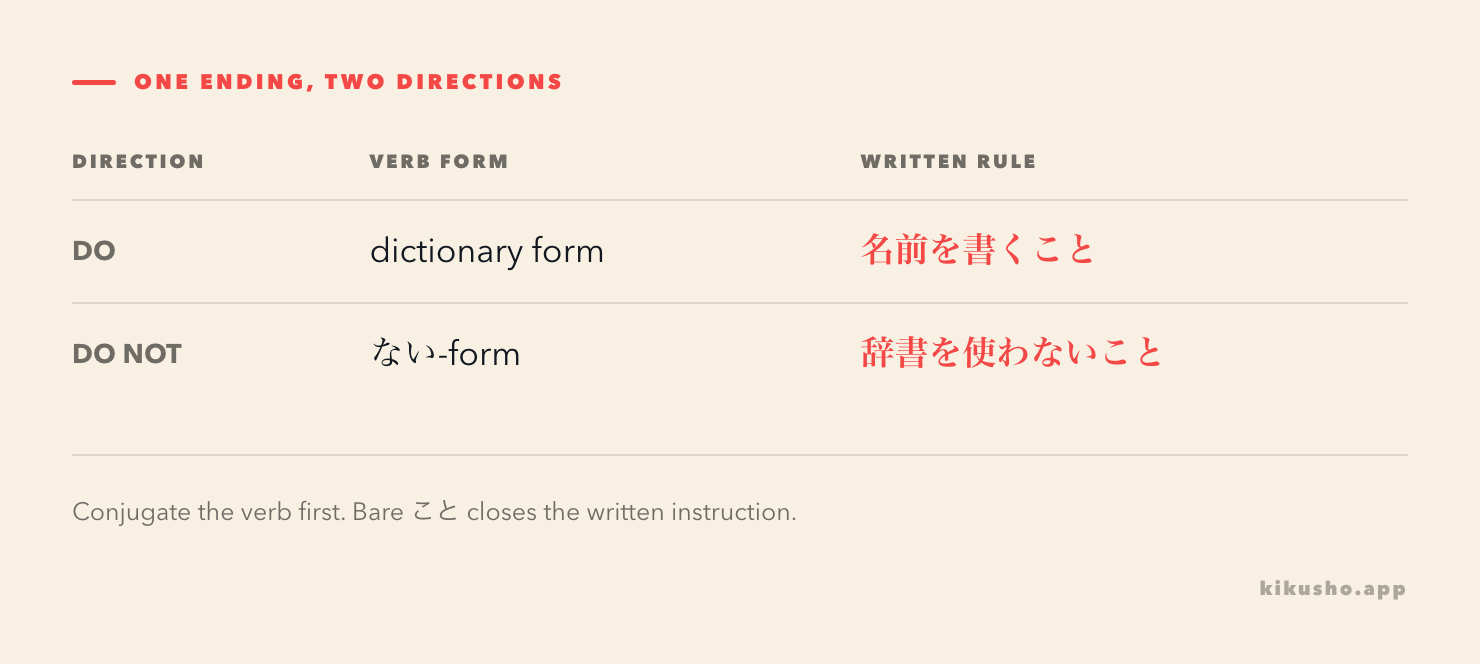
The required action uses the dictionary form + こと. The prohibited action uses the ない-form + こと.
| Direction | Pattern | Example | Meaning |
|---|---|---|---|
| require an action | V dictionary form + こと | 名前を書くこと | Write your name. |
| prohibit an action | Vない + こと | 辞書を使わないこと | Do not use a dictionary. |
入室前に手を洗うこと。
にゅうしつまえに てを あらうこと。
Wash your hands before entering.
この部屋で飲食しないこと。
この へやで いんしょくしないこと。
Do not eat or drink in this room.
期限までに申込書を提出すること。
きげんまでに もうしこみしょを ていしゅつすること。
Submit the application form by the deadline.
The negative belongs inside the verb: 使わないこと, not 使うないこと. Conjugate the verb to its ordinary ない-form first, then add こと. The ending is normally written in hiragana in this grammar, rather than as the noun 事.
Tanosuke's N3 lesson describes the pattern as written language used for notices, instructions and rules. JLPT Sensei independently gives the same dictionary-form and ない-form contrast at N3. These are teaching classifications, not an official exhaustive JLPT syllabus.
Written rules sound impersonal, not polite
A sign or handout does not need to identify a speaker. Bare こと lets the institution state a requirement without 私 or あなた, and without a final です or ます.
Imagine an exam sheet:
問題用紙に名前を書くこと。
もんだいようしに なまえを かくこと。
Write your name on the question sheet.
試験が終わるまで席を立たないこと。
しけんが おわるまで せきを たたないこと。
Do not leave your seat until the exam has ended.
Neither line says “please,” yet neither needs to sound like an angry personal command. The document itself supplies the authority. The result is concise and official, which is why the form works in regulations, classroom rules, safety notes and lists of duties.
That register does not make bare こと a general replacement for a spoken request. If you ask a visitor to fill in a form, こちらに名前を書いてください addresses that person politely and directly. The ~てください lesson explains that listener-facing request. Writing 名前を書くこと on the form instead presents the same action as an instruction on the page.
| Setting | Natural choice | What it does |
|---|---|---|
| rule printed on a form | 名前を書くこと | states an impersonal requirement |
| staff speaking to a visitor | 名前を書いてください | politely directs the listener |
| parent or teacher giving an order | 名前を書きなさい | speaks from authority to a person |
The last option is still a direct command. The な and なさい lesson compares authoritative positive instructions with blunt prohibitions. Bare こと shifts attention away from the speaker-listener relationship and onto the written rule.
Position separates an instruction from nominalization
You may already know こと as a nominalizer: it turns an action into something a sentence can treat as a topic, object or fact. That use usually has more grammar after こと.
日本語を勉強することは楽しいです。
にほんごを べんきょうすることは たのしいです。
Studying Japanese is enjoyable.
Here こと is followed by は and the evaluation 楽しいです. Nothing tells anyone to study. Compare a rule posted in a Japanese-only class:
教室では日本語で話すこと。
きょうしつでは にほんごで はなすこと。
Speak Japanese in the classroom.
The sentence stops at こと. In the rule's setting, that bare ending gives 話すこと directive force. Punctuation and line breaks can make the boundary even clearer in a list:
教室のルール
一、時間を守ること。
二、授業中は携帯電話を使わないこと。
Classroom rules\
- Be on time.\
- Do not use a mobile phone during class.
The lesson on こと and の as nominalizers covers clauses such as 勉強することは大切です. Bunpro places that broad nominalizing こと at N4 and notes that a short sentence ending in こと can instead carry the rule or command nuance. This is a scope difference: the N4 page teaches how an action becomes noun-like, while this N3 lesson isolates the written directive.
Bare こと is not the same as ことだ advice
ことだ can recommend a course of action to a person. It often translates as “you should” or “you ought to.”
疲れているなら、早く寝ることだ。
つかれているなら、はやく ねることだ。
If you are tired, you should go to bed early.
That sentence offers firm advice based on the listener's situation. A household plan headed 今週の目標, “this week's goals,” could instead list 毎晩早く寝ること, “Go to bed early every night,” as an assigned rule.
Bunpro's N3 ことだ entry covers advice and light commands. It overlaps with written direction, but the final だ and the personal advisory setting deserve separate attention. The Japan Foundation's account of sentence-final こと shows that both こと and ことだ can indirectly express an order or recommendation, including レポートは今月末までに提出すること as a deadline instruction.
Use these cues when reading:
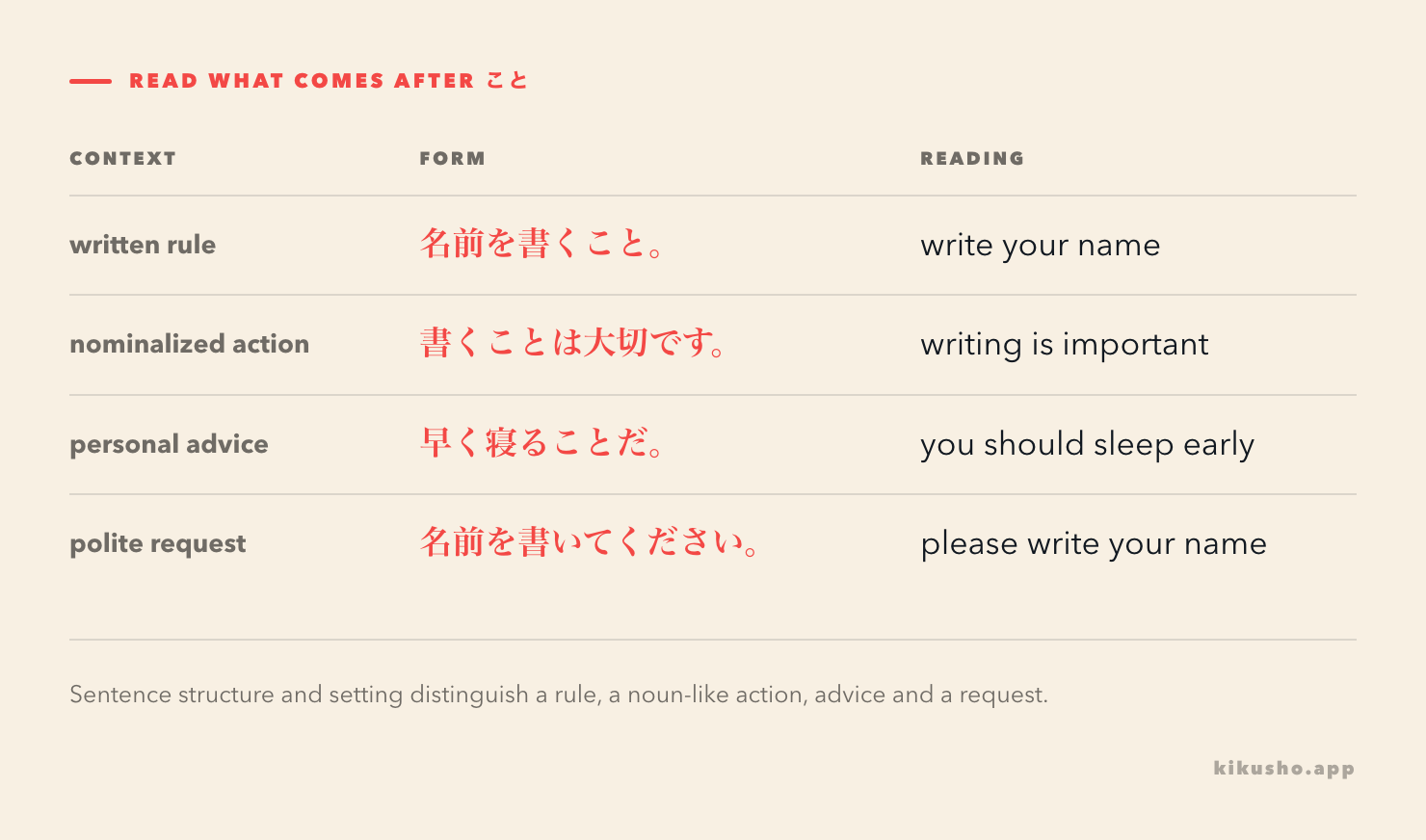
| Form in context | Likely reading |
|---|---|
| Vること。 / Vないこと。 in rules or instructions | do / do not do |
| Vることは… / Vることが… | the action is nominalized |
| Vることだ after a person's problem | you should do |
| Vてください addressed to a listener | please do |
These are tendencies tied to sentence structure and context. They are more reliable than translating every こと as “thing” or every directive as “must.”
Read the whole instruction before choosing the force
Written instructions often put the condition or deadline before the required action. Keep that information attached when you translate:
欠席する場合は、授業の前に先生へ連絡すること。
けっせきする ばあいは、じゅぎょうの まえに せんせいへ れんらくすること。
If you will be absent, contact the teacher before class.
The requirement is 連絡すること. 欠席する場合は limits when it applies, and 授業の前に supplies the deadline. Reducing the line to “contact the teacher” would lose part of the rule.
Kikusho can turn a notice like this into separate cards for 欠席, 授業 and 連絡する, while keeping the complete sentence as context. That matters here because the vocabulary alone does not reveal whether こと nominalizes the action or closes an instruction; the whole line does.
Practice
Question 1 — choose the instruction
A sign requires visitors to wash their hands before entering. Which ending fits?
A. 入室前に手を洗うこと。
B. 入室前に手を洗うことは。
C. 入室前に手を洗わないこと。
Question 2 — make the prohibition
Complete an exam rule meaning “Do not use a dictionary during the exam.”
試験中は辞書を( )こと。
A. 使うない
B. 使わない
C. 使ってください
Question 3 — identify the sentence role
Does 毎日歩くことは健康にいいです give an instruction? Explain what こと is doing.
Question 4 — sentence composition
Write this rule in Japanese using sentence-final こと:
“Submit the application form by Friday.”
Use 金曜日までに, 申込書, and 提出する.
Question 5 — choose for the interaction
A receptionist is speaking politely to one visitor: “Please write your address here.” Which is the better choice?
A. ここに住所を書くこと。
B. ここに住所を書いてください。
Question 6 — text grammar
Read the two rules:
一、会議には五分前に来ること。
二、会議中は携帯電話を使わないこと。
What action is required, what action is prohibited, and which verb form marks each direction?
Question 7 — distinguish こと from ことだ
Which line most naturally gives personal advice to a tired friend rather than stating a written rule?
A. 疲れているなら、早く寝ることだ。
B. 毎晩十一時までに寝ること。
Answers and explanations
Answer 1. A. 洗う is the dictionary form, so 洗うこと requires the action. B is unfinished because は announces a topic without a predicate. C prohibits washing, which reverses the sign's meaning.
Answer 2. B. The prohibition is 試験中は辞書を使わないこと. Make the ない-form 使わない before adding こと. 使うない mixes the dictionary and negative forms, while 使ってくださいこと does not form this pattern.
Answer 3. It is not an instruction. 毎日歩くこと is a nominalized action marked as the topic by は, and 健康にいいです evaluates it: “Walking every day is good for your health.” The grammar after こと keeps the sentence from ending as a bare directive.
Answer 4. 金曜日までに申込書を提出すること。 The deadline precedes the required action, and dictionary-form 提出する + こと closes the written rule.
Answer 5. B. ここに住所を書いてください politely directs the visitor who is present. A would fit better as a printed instruction on the form or a rule in a list; it does not manage the face-to-face request in the same way.
Answer 6. Coming five minutes early is required: 来る is the dictionary form in 来ること. Using a mobile phone is prohibited: 使わない is the negative form in 使わないこと. Both rules end in bare こと, while verb polarity supplies the direction.
Answer 7. A. With the friend's problem in the first clause, 早く寝ることだ gives firm advice: “You should go to bed early.” B has the compact shape of an assigned rule or goal: “Go to bed by eleven every night.”
Common questions
What does sentence-final こと mean in Japanese rules?
At the end of a written instruction, dictionary-form + こと requires an action and ない-form + こと prohibits one. 名前を書くこと means “Write your name,” while 辞書を使わないこと means “Do not use a dictionary.”
Is the こと in a written instruction the same as the nominalizer?
They share the same form, but their sentence roles differ. In 日本語を勉強することは楽しい, こと packages an action as the topic before は. In a rule such as 日本語で話すこと, bare sentence-final こと closes a directive.
What is the difference between こと and ことだ?
Bare sentence-final こと commonly presents an impersonal written rule or instruction. ことだ can give a person advice, as in 早く寝ることだ, “You should go to bed early.” The forms overlap in directive force but are not interchangeable in every setting.
Is written-instruction こと N3 grammar?
JLPT Sensei, Tanosuke and 日本語NET teach this directive use at N3. Bunpro's N4 こと page covers the broader nominalizer, a different use, while its N3 ことだ page covers related advice. JLPT levels are study-guide placements, since the test maker does not publish an exhaustive grammar syllabus.