On this page
確かに says that a claim is true or worth accepting. 例えば does a different job: it selects one case that helps the listener understand a broader claim. Ask whether you are agreeing with the statement or opening an illustration.
確かにこの店は安い。でも、駅から遠い。
たしかに このみせは やすい。でも、えきから とおい。
This shop is certainly inexpensive. But it is far from the station.
この町には静かな場所が多い。例えば、川沿いの公園は朝でも人が少ない。
このまちには しずかな ばしょが おおい。たとえば、かわぞいの こうえんは あさでも ひとが すくない。
This town has many quiet places. For example, the riverside park has few people even in the morning.
The shop's low price is accepted before a drawback appears. The park is one member of a larger set of quiet places. Replacing one marker with the other would change the relation between the two thoughts.
The test: truth or instance?
| Question to ask | Choose | Result |
|---|---|---|
| Am I confirming or conceding this claim? | 確かに | “That is true / certainly” |
| Am I naming one possible case? | 例えば | “For example / for instance” |
確かに points back to the truth of a proposition. The speaker may have heard it from someone else, noticed it independently or chosen to grant it before disagreeing with something else.
例えば points forward. The following word, phrase or sentence is not the whole category; it is a sample that makes the category concrete.
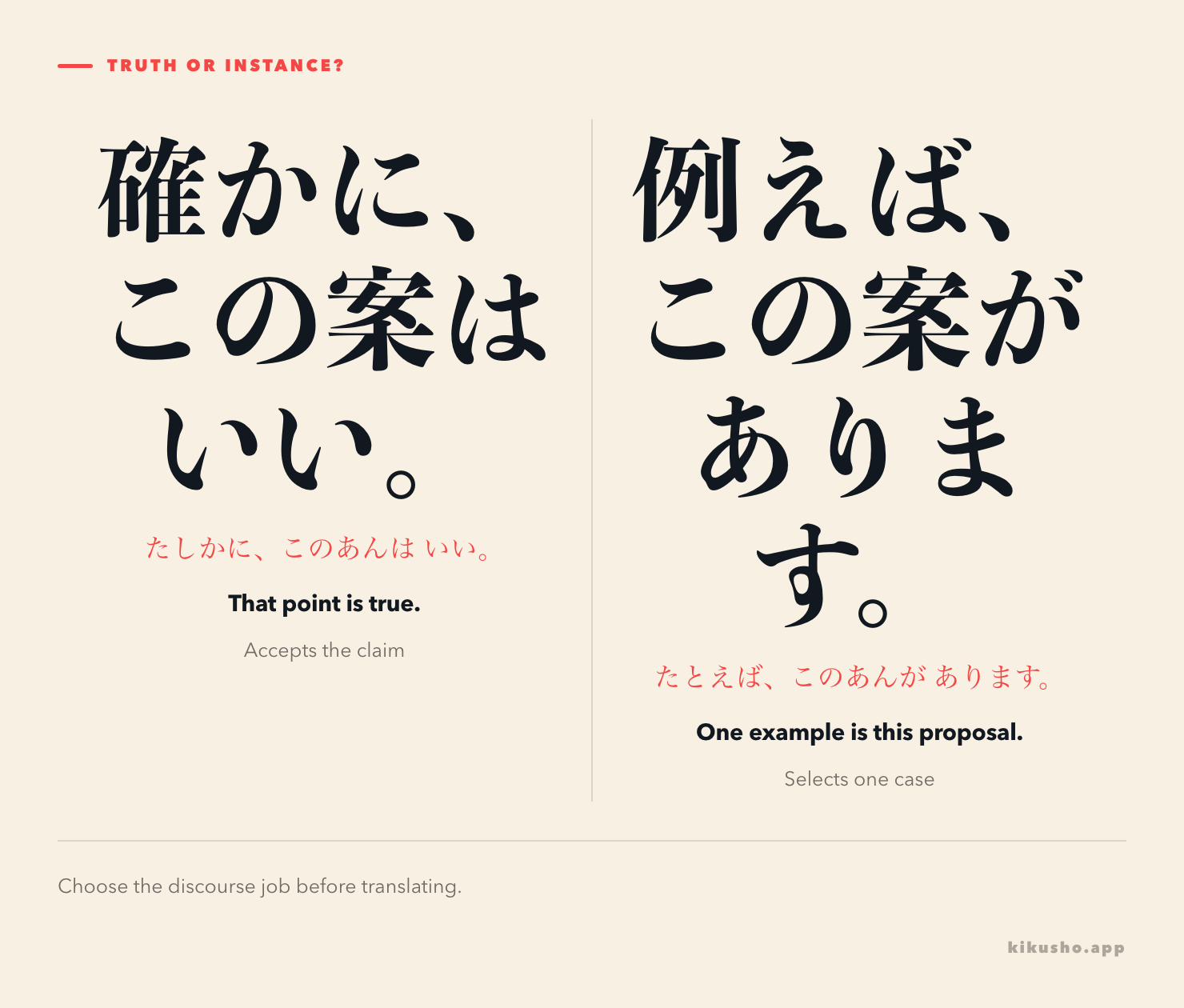
確かに accepts the proposition
確かに is an adverb, so it does not attach to a particular verb ending. It can stand at the beginning of a sentence or immediately before the part being confirmed.
彼の説明は確かに分かりやすかった。
かれの せつめいは たしかに わかりやすかった。
His explanation certainly was easy to understand.
A:この計画には時間がかかりますね。
この けいかくには じかんが かかりますね。
This plan will take time, won't it?B:確かにそうですね。
たしかに そうですね。
That is true.
The reply accepts A's observation. It does not mean that the plan itself is an example of something.
A common argumentative frame is 確かに P が/けれど(も)、Q. The speaker grants P, then limits it or adds a competing point in Q:
確かにこの案は費用がかかるが、長期的には必要だ。
たしかに このあんは ひようが かかるが、ちょうきてきには ひつようだ。
It is true that this proposal costs money, but it is necessary in the long term.
The contrast is common, but it is not part of the word itself. 確かにそうです can end the response with full agreement. The Bunpro entry for 確かに likewise treats it as an adverb that affirms a phrase and notes both agreement and contrast contexts.
例えば opens one case
例えば can introduce a noun phrase, a full clause or a short scenario. What follows should be one possible member of the wider idea already under discussion.
| Wider claim | Example introduced by 例えば |
|---|---|
| 家でできる運動がある | 例えば、ヨガや筋力トレーニングだ |
| この地域には古い建物が残っている | 例えば、駅前の図書館は百年前に建てられた |
| 連絡する方法はいくつかある | 例えば、メールを送ることができる |
家でできる運動もある。例えば、ヨガなら広い場所は要らない。
いえで できる うんどうも ある。たとえば、ヨガなら ひろい ばしょは いらない。
Some exercise can be done at home. For example, yoga does not require a large space.
The example may support an explanation, suggest an option or make an abstract category easier to picture. It does not prove that every member of the category behaves the same way.
The Japanese Page's N3 lesson on たとえば presents it as “for example” before a suggested instance. A Japanese government language-policy discussion also describes 例えば as introducing one example and records the kanji spelling as an established form.
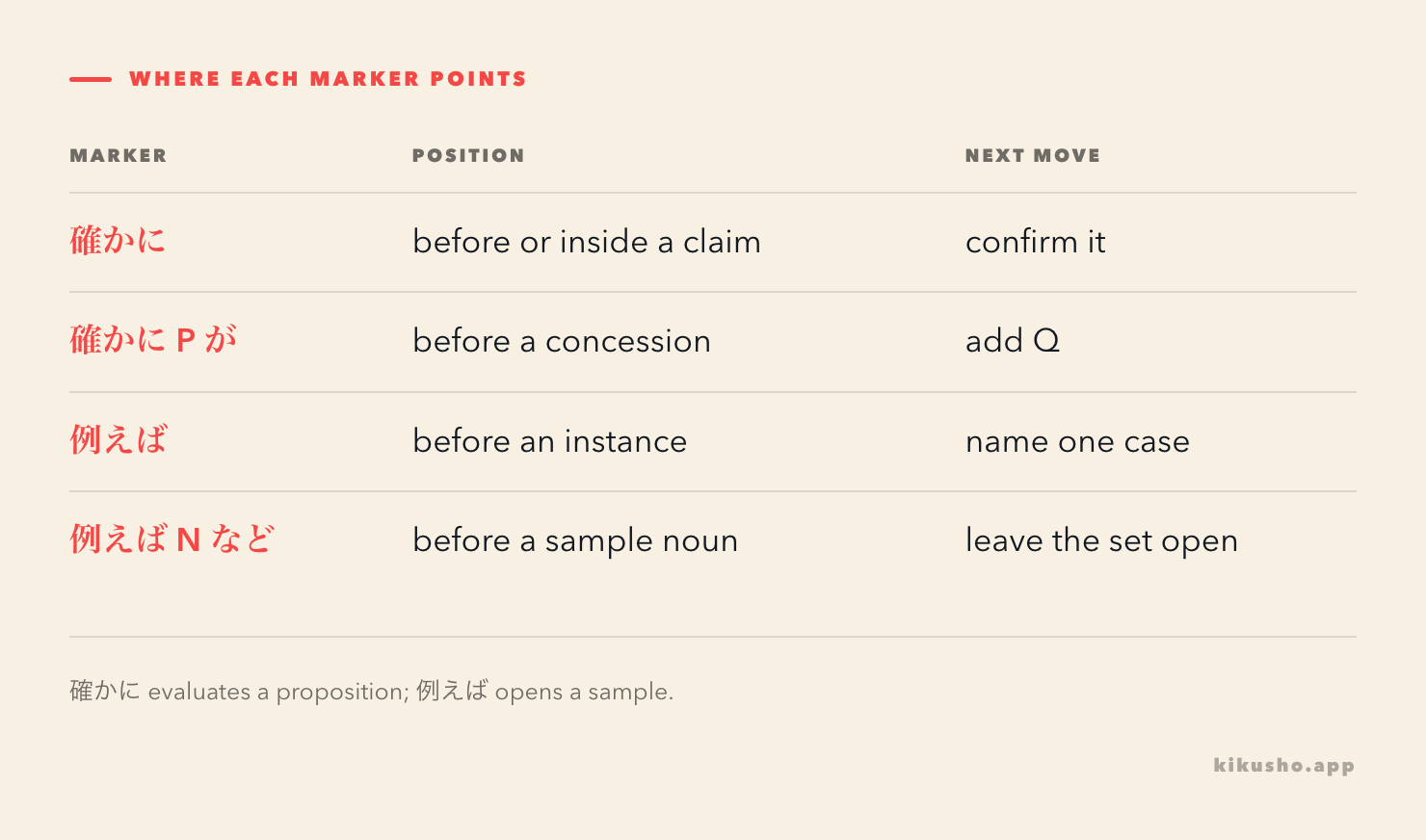
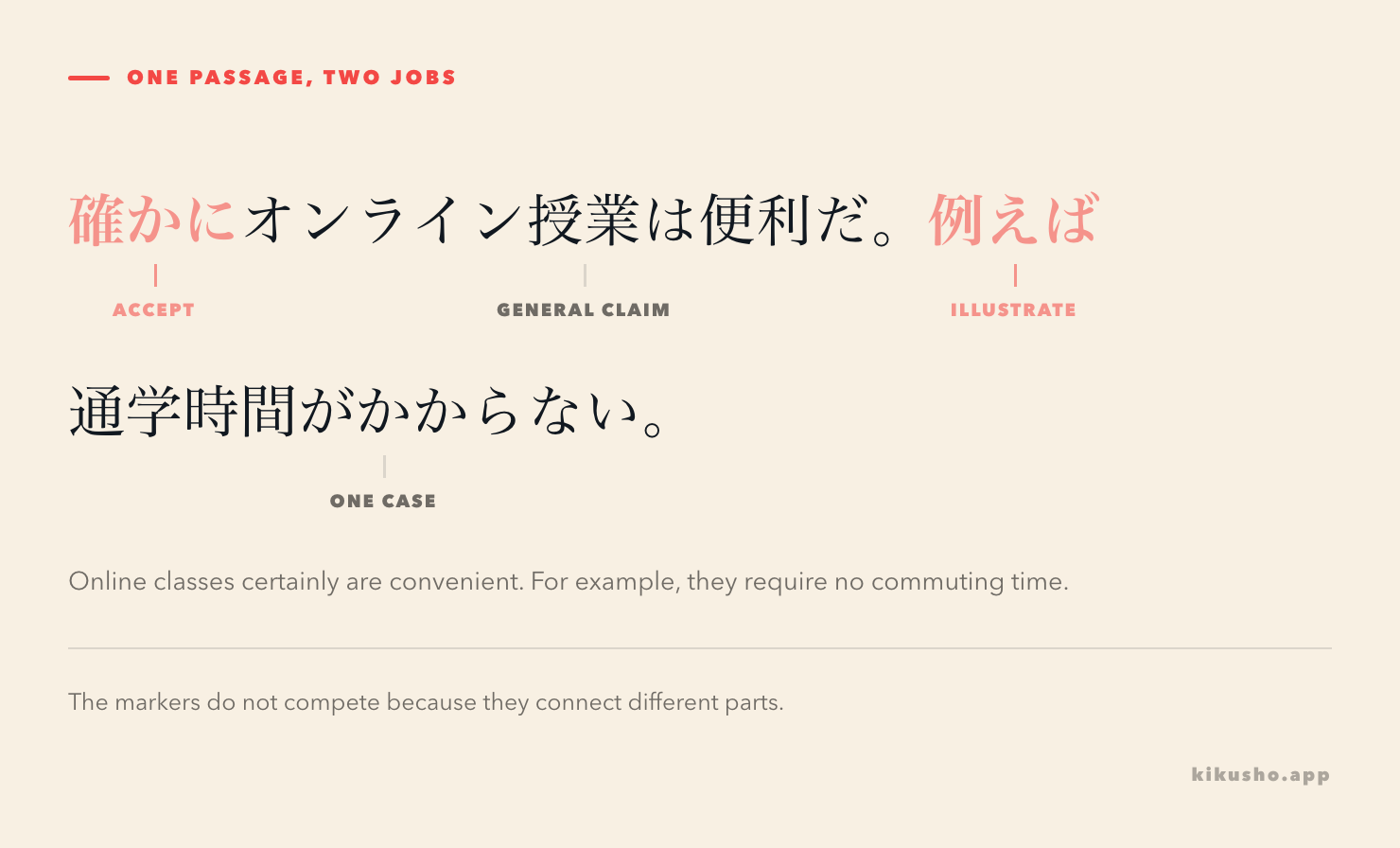
They can work together without overlapping
One passage can need both markers:
確かにオンライン授業は便利だ。例えば、通学時間がかからない。
たしかに オンラインじゅぎょうは べんりだ。たとえば、つうがくじかんが かからない。
Online classes certainly are convenient. For example, they require no commuting time.
The first sentence confirms the general assessment 便利だ. The second gives one reason or instance that makes the convenience concrete. The sequence is not redundant because each marker controls a different relation.
The same distinction separates 例えば from the reformulation markers in the すなわち and つまり lesson. If B is only one member of A, 例えば fits. If B renames or summarizes A, use a reformulation marker instead.
Two missing に sounds change the meaning
The nearest traps are 確か and たとえ.
確か is uncertain memory
確か、会議は三時からだったと思います。
たしか、かいぎは さんじから だったと おもいます。
If I remember correctly, I think the meeting started at three.
Without に, 確か often tells the listener that the speaker's memory is not completely reliable. That is almost the opposite of the firm confirmation in 確かに三時からです, “It is definitely from three.” A Japanese Agency for Cultural Affairs teaching text explicitly warns learners about this difference between 確かに and memory-based 確か.
たとえ starts a concession
たとえ雨が降っても、試合は行います。
たとえ あめが ふっても、しあいは おこないます。
Even if it rains, the match will take place.
たとえ~ても creates a hypothetical obstacle that does not change the result. 例えば introduces an example. The concession lesson on たとえ~ても develops that pattern separately.
| Form | Reading | Discourse job |
|---|---|---|
| 確かに | たしかに | firm confirmation or agreement |
| 確か | たしか | uncertain memory: “if I recall correctly” |
| 例えば | たとえば | introduction of an example |
| たとえ~ても | たとえ~ても | concession: “even if” |
JLPT Sensei places both 確かに and 例えば at N3, while Bunpro places 確かに at N2. These labels are study estimates rather than an official boundary: the JLPT does not publish an exhaustive grammar list.
Read the relation, then save the sentence
In longer prose, the marker may be easy to translate but hard to remember because the decisive information sits in the sentence before it. Keep that relation when you make a card. For 例えば, preserve the general claim as well as the example. For 確かに, preserve the proposition being accepted and, if present, the later contrast.
Kikusho's text capture can turn the passage you met into an editable card. Check that the saved example retains the sentence that gives the marker its job; a card containing only 例えば、駅前の図書館 no longer shows what the library was an example of.
Practice: six questions
Choose or assemble the marker from the relation between the statements. Complete all six before moving to the explanations.
Question 1: grammar choice.
A:このホテルは駅から近くて便利ですね。
B:( )。でも、部屋は少し狭いです。
- A. 例えばそうですね
- B. 確かそうですね
- C. 確かにそうですね
- D. たとえそうですね
Commit to the reply that accepts A's point before adding a drawback.
Question 2: grammar choice.
日本には火山がたくさんあります。( )、富士山や桜島があります。
- A. 確かに
- B. 例えば
- C. たとえ
- D. 確か
Treat the two mountain names as members of the wider category.
Question 3: meaning.
確か、山田さんは来週戻ると言っていました。
What does 確か show here?
- A. The speaker is correcting Yamada firmly.
- B. The speaker is giving Yamada as an example.
- C. The speaker is recalling the information with some uncertainty.
- D. The speaker accepts a claim before disagreeing.
Keep the missing に in view without checking the earlier table.
Question 4: sentence assembly.
Arrange all four chunks into a natural sentence.
- 長期的には必要だ
- 確かに
- が
- この案は費用がかかる
Use each numbered chunk once.
Question 5: grammar choice.
( )雨が降っても、予定は変えません。
- A. 確かに
- B. 例えば
- C. たとえ
- D. 確か
Decide whether rain is evidence, an illustration or a hypothetical obstacle.
Question 6: text grammar.
新しい図書館は( )便利だ。( )、夜九時まで利用できる。
Choose the pair that preserves both discourse jobs.
- A. 確かに/例えば
- B. 例えば/確かに
- C. 確か/たとえ
- D. たとえ/確か
Read the first sentence as an assessment and the second as one supporting case.
Answers and explanations
Answer 1. C: 確かにそうですね. B accepts that the hotel is convenient and then adds a limitation. 確かそうですね would mean something like “that seems certain” and does not serve as the natural agreement formula here. 例えば introduces an instance, while たとえ needs a concessive frame such as ~ても.
Answer 2. B: 例えば. 富士山 and 桜島 are two examples from the larger set of Japanese volcanoes. 確かに would confirm the preceding claim but would not introduce the names as examples. Bare たとえ and memory-based 確か do not express the relation.
Answer 3. C. Without に, 確か often means “if I remember correctly.” The speaker recalls what Yamada said but leaves room for a faulty memory. 確かに would convey confirmation or agreement instead.
Answer 4. 2 → 4 → 3 → 1: 確かにこの案は費用がかかるが、長期的には必要だ。 The speaker concedes the cost before presenting the competing judgement. Read 費用 as ひよう and 長期的 as ちょうきてき.
Answer 5. C: たとえ. The complete pattern is たとえ雨が降っても, “even if it rains.” The rain is a hypothetical condition that will not alter the plan. 例えば would introduce an example and cannot form this concessive frame.
Answer 6. A: 確かに/例えば. The first marker confirms the assessment that the library is convenient. The second introduces late opening hours as one concrete reason. Reversing them would make the first clause an incomplete example and treat the supporting detail as a separate confirmation.
Common questions
What is the difference between 確かに and 例えば?
確かに accepts or confirms that a statement is true, sometimes before a contrast. 例えば introduces one case that illustrates a broader statement.
Can 確かに and 例えば appear in the same passage?
Yes. 確かに can confirm the general claim, and 例えば can then introduce evidence or a representative case. They perform different discourse jobs.
What is the difference between 確か and 確かに?
確かに expresses firm confirmation or agreement. 確か without に often means “if I remember correctly,” so it marks uncertainty in the speaker's memory.
Is 確かに N3 or N2 grammar?
JLPT Sensei lists 確かに at N3, while Bunpro places it at N2. 例えば is commonly listed at N3. These are study estimates because the JLPT publishes no exhaustive grammar list.