On this page
帰ろう means “I’ll go home” when you decide to leave, or “let’s go home” when you propose leaving together. The volitional ending expresses someone's will to act; it does not predict that a future event will occur. Add と思う to tell someone what you intend to do: 帰ろうと思います, “I think I'll go home.”
This N4 grammar lesson teaches two linked items: 意向形(いこうけい), the volitional verb form, and ~ようと思う(~ようとおもう), the form followed by the quotative と and 思う. You need to know whether a verb is godan, ichidan or irregular before you change its ending. The verb-group guide gives that prerequisite, including why 帰る is godan.
The ending changes with the verb group
Godan verbs change the last kana to the お row
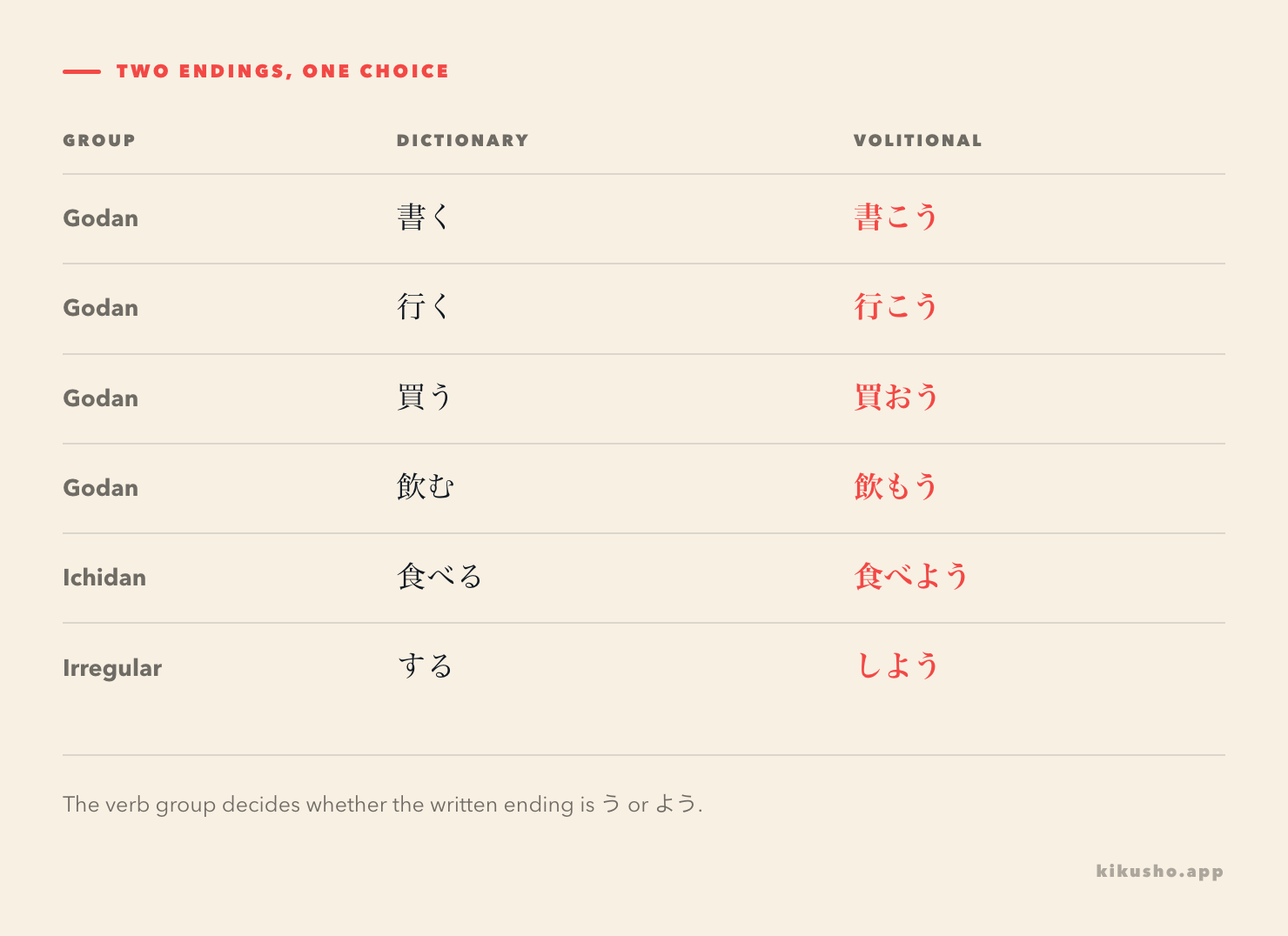
Take the dictionary form, move its final kana to the corresponding お-row kana, then add う. 書く changes く to こ, so it becomes 書こう(かこう). The written お+う is pronounced as one long ō sound; do not shorten it to a single お in spelling.
| Dictionary form | Ending change | Volitional | Reading | Meaning |
|---|---|---|---|---|
| 書く | く → こう | 書こう | かこう | write |
| 行く | く → こう | 行こう | いこう | go |
| 買う | う → おう | 買おう | かおう | buy |
| 話す | す → そう | 話そう | はなそう | speak |
| 飲む | む → もう | 飲もう | のもう | drink |
| 帰る | る → ろう | 帰ろう | かえろう | go home |
帰る matters because its -eru sound can fool you into treating it as an ichidan verb. Its polite form is 帰ります and its volitional is 帰ろう. The same group decision governs both endings. The Japan Foundation's Irodori lesson gives the godan お+う pattern, including 買おう, and Tofugu's volitional reference shows the matching kana changes for 書く and other endings.
Ichidan and irregular verbs use よう
For an ichidan verb, remove る and add よう: 食べる → 食べよう(たべよう) and 見る → 見よう(みよう). The two irregular verbs must be learned separately: する → しよう and 来る(くる)→ 来よう(こよう). Notice that 来る changes its reading too. A する compound keeps that irregular ending, so 勉強する → 勉強しよう.
| Group | Dictionary form | Volitional | Reading | Meaning |
|---|---|---|---|---|
| Ichidan | 食べる | 食べよう | たべよう | eat |
| Ichidan | 見る | 見よう | みよう | look or watch |
| Irregular | する | しよう | しよう | do |
| Irregular | 来る | 来よう | こよう | come |
The Irodori conjugation chart and Tofugu both give these endings. The table is selectable text, so you can check a form even if you cannot see the figure.
The bare form makes a choice or invites a companion
The plain volitional has two everyday jobs. The first is a decision voiced at the moment you make it:
もう遅い。帰ろう。
もう おそい。かえろう。
It's late. I'll go home.
The second brings a listener into an action you propose:
一緒に映画を見よう。
いっしょに えいがを みよう。
Let's watch a film together.
The verb ending is the same; 一緒に and the listener's presence settle the second reading. For a polite invitation, use ~ましょう instead: 一緒に映画を見ましょう. The plain 見よう fits familiar conversation; 見ましょう is safer when you need polite speech. This is a register choice, not a change from intention to prediction. Tofugu distinguishes the plain volitional from polite ~ましょう and explains both invitation and self-directed resolve.
~ようと思う tells someone about an intention
For a plan you want to state to someone, put と directly after the volitional, then conjugate 思う. You are presenting the action you have in mind, rather than simply announcing the action with a bare verb.
| What you want to say | Pattern | Example | English |
|---|---|---|---|
| A decision now | volitional + と思います | 今日から日記を書こうと思います。 | I think I'll start writing a diary today. |
| A continuing intention | volitional + と思っています | 来月、図書館で勉強しようと思っています。 | I've been thinking of studying at the library next month. |
Read 日記 as にっき (diary) and 図書館 as としょかん (library). In the first row 書こう is the intention; と思います presents it to your listener. In the second row 思っています places the thought over a stretch of time. The contrast is a tendency, not a stopwatch: context can make a plan with 思います older than a single minute. The Japan Foundation lesson says 思っています is used when a thought has continued since it arose; Mango Languages' lesson by Mayumi Ito makes the same comparison with earlier decisions.
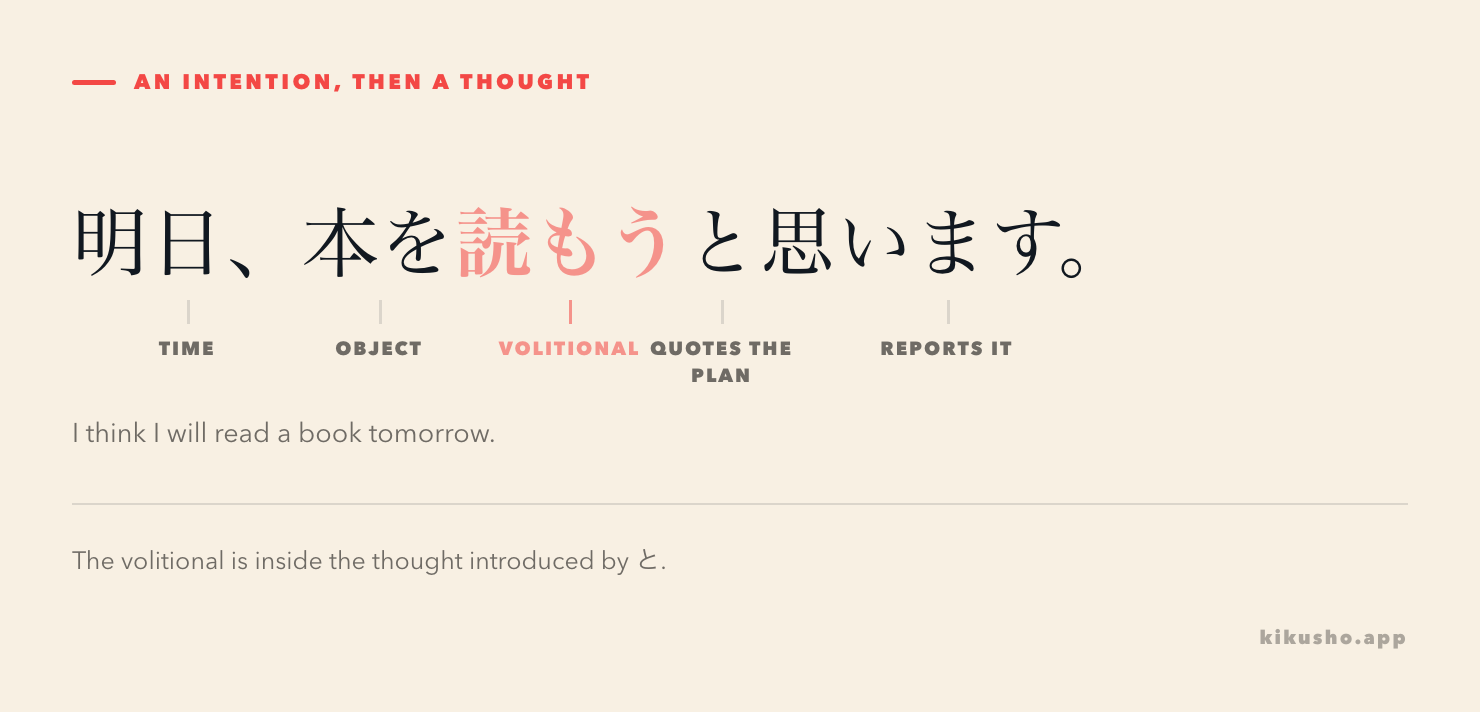
In selectable text, 明日、本を読もうと思います (あした、ほんを よもうと おもいます) means “I think I'll read a book tomorrow.” 読む → 読もう follows the godan む → もう rule. The と quotes the intention. It is not the と of a conditional; see と and たら for that separate use.
The form does not predict rain or read another person's mind
明日は雨が降ると思います (あしたは あめが ふると おもいます) means “I think it will rain tomorrow.” The speaker is making a prediction, not deciding to make rain fall. 降ろう would turn the event into an attempted act of will and is unsuitable for an ordinary weather forecast. Mango Languages and a Japanese modality survey distinguish intentional verbs from events a speaker cannot control.
The bare form also speaks from the speaker's perspective. 田中さんは帰ろう cannot simply mean “Tanaka plans to go home.” If Tanaka told you their plan, report it as a thought and show how you know: 田中さんは帰ろうと思っているそうです (たなかさんは かえろうと おもっているそうです), “I heard Tanaka is thinking of going home.” The volitional now sits inside Tanaka's reported thought. It is possible to describe someone else's intention; you must not silently assign your own volitional stance to them. Mango Languages explains the third-person ~ようと思っている pattern with hearsay.
For a settled negative plan, 今日は出かけないつもりです means “I don't plan to go out today”; it does not require an invented negative volitional ending. For a choice to leave something undone, 出かけないでおこうと思います says “I think I'll stay in.” Tofugu's negative-use section explains ~ないでおこう; Irodori contrasts ~ようと思う with the more concrete ~つもりだ. These are nearby options, not extra inventory items taught here.
One sound can hide two different よう patterns
The よう in 食べよう is a verb ending. The ように in 読めるように勉強する (“study so that you can read”) introduces a desired outcome and attaches in a different way. A learner who recognizes the sound yō may misread one for the other; the verb shape tells you which construction you are looking at. The purpose guide explains ~ように and ~ために without treating them as volitional endings.
Search results for “you to suru” may also discuss ~ようとする, “try to” or “be about to.” Its とする is not と思う and gives the sentence a different job. Mango Languages distinguishes the two. For this N4 lesson, keep your attention on forming the volitional and using ~ようと思う accurately.
If you hear a friend say 今日は早く帰ろうと思っています, keep the whole sentence rather than only 帰ろう. The time word, the quoted intention and the continuing thought help you recall what the ending was doing. Kikusho can turn that spoken line into a card you review later, with the wording you heard still attached to the form.
Practice: choose the speaker's meaning
All solutions are in the Answers and explanations section below the last question. Try each sentence before looking there.
Question 1 — grammar choice. You have just decided to write tonight. Which is the volitional form of 書く?
- A. 書きよう
- B. 書こう
- C. 書くよう
Question 2 — grammar choice. You see clouds and predict rain tomorrow. Which sentence says that prediction?
- A. 明日は雨が降ろうと思います。
- B. 明日は雨が降ると思います。
- C. 明日は雨が降りましょう。
Question 3 — sentence composition. Use 読む and ~ようと思います to say “I think I'll read a book tonight.” Write one natural Japanese sentence beginning 今夜、.
Question 4 — text grammar. A speaker has held this plan since yesterday. Complete the second sentence with the verb 勉強する: 昨日、来月の予定を決めました。来月は図書館で勉強__と思っています。
Question 5 — sentence composition. You invite a close friend to eat together. Use 一緒に and the plain volitional of 食べる. Write the sentence.
Question 6 — text grammar. You heard Tanaka's plan from Tanaka. Complete a report with 思う: 田中さんは明日帰ろうと__そうです。 Choose among 思います, 思っている, and 思いました.
Answers and explanations
Answer 1. B, 書こう(かこう). 書く is godan: く moves to こ and takes う. 書きよう borrows the ichidan よう ending after an i-row stem; 書くよう belongs to a different よう construction and is not the volitional of 書く.
Answer 2. B, 明日は雨が降ると思います。 This uses the ordinary non-past 降る inside a prediction. A treats rain as if the speaker could decide to make it fall. C is a polite proposal to perform an action, not a weather forecast.
Answer 3. 今夜、本を読もうと思います。 読む changes む to もう, then と quotes that intention before 思います. 読みようと思います is the wrong verb-group ending; 読むと思います says what you think will happen rather than presenting your decision to read.
Answer 4. しよう: 来月は図書館で勉強しようと思っています。 勉強する uses the irregular する → しよう. 思っています suits the plan the speaker says has continued since yesterday. すると思っています quotes a statement about doing it, but lacks the volitional intention the question asks for; しました places the study in the past.
Answer 5. 一緒に食べよう。 食べる is ichidan, so remove る and add よう. With 一緒に and a close friend as listener, the sentence invites them to share the action. 食べましょう would be a polite alternative; 食べようと思う would report your intention rather than directly invite your friend.
Answer 6. 思っている: 田中さんは明日帰ろうと思っているそうです。 そうです marks that the report came from what you heard, and 思っている attributes the continuing intention to Tanaka. 思います presents the speaker's thought and cannot simply substitute for Tanaka's; 思いました says the thinking happened in the past, which the question does not establish.
Common questions
Is Japanese ~よう a future tense?
No. The plain volitional ~う or ~よう presents a choice or invitation. 明日は雨が降ると思います predicts rain; 明日、勉強しようと思います reports an intention to study. English "will" can translate both.
How do I make the volitional form of 帰る?
帰る (かえる) is a godan verb despite its -eru sound. Change its final る to ろ and add う: 帰ろう (かえろう). It is not 帰よう.
What changes between ~ようと思います and ~ようと思っています?
Both report an intention. ~ようと思います often presents a decision made now; ~ようと思っています commonly presents an intention the speaker has held for some time. Context matters more than an exact time cutoff.
Can I use the volitional to report another person's plans?
A bare volitional expresses the speaker's own resolve or invites someone into an action. To report another person's intention, quote it with ~ようと思っている and make the source clear, for example with そうです.