On this page
Put a plain yes-or-no clause before かどうか, then finish the larger sentence with a verb such as 分かる, 知る, 確認する or 決める. In 田中さんが来るかどうか分かりません, the inner question is “Will Tanaka come?” and the complete statement is “I do not know whether Tanaka will come.”
The listener is not being asked to answer that inner question directly. かどうか packages the unresolved alternatives so you can say what someone knows, checks, asks, remembers or decides about them.
かどうか closes a binary question inside a larger sentence
The basic frame is:
plain yes-or-no clause + かどうか + main predicate
明日、雨が降るかどうか分かりません。
あした、あめが ふるかどうか わかりません。
I do not know whether it will rain tomorrow.
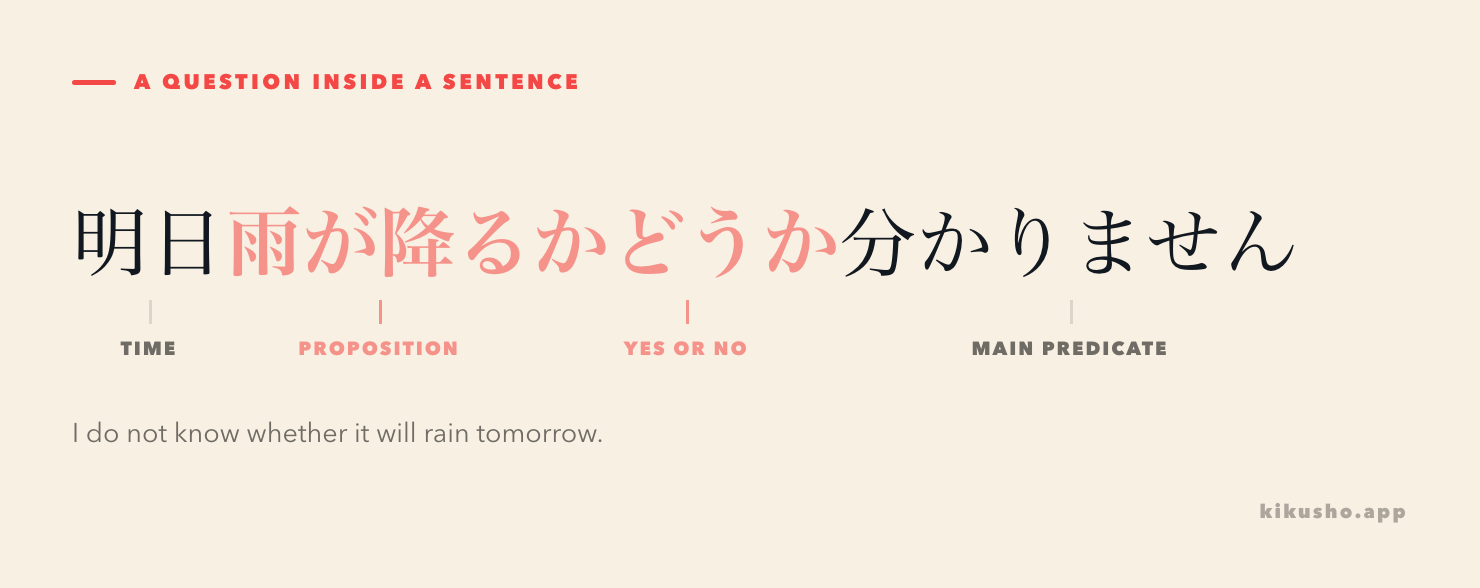
Try answering only the inner clause:
- 雨が降る。 Yes, it will rain.
- 雨が降らない。 No, it will not rain.
Because those are the two relevant possibilities, 雨が降るかどうか is a binary question. The final 分かりません tells you what the whole sentence does with that question.
Plain forms attach directly, but nonpast だ disappears
Use plain forms before かどうか. The attachment changes with the word class.
| Word class | Formation | Example |
|---|---|---|
| verb | plain verb + かどうか | 行くかどうか |
| い-adjective | plain adjective + かどうか | 高いかどうか |
| な-adjective | stem + かどうか | 静かかどうか |
| noun | noun + かどうか | 学生かどうか |
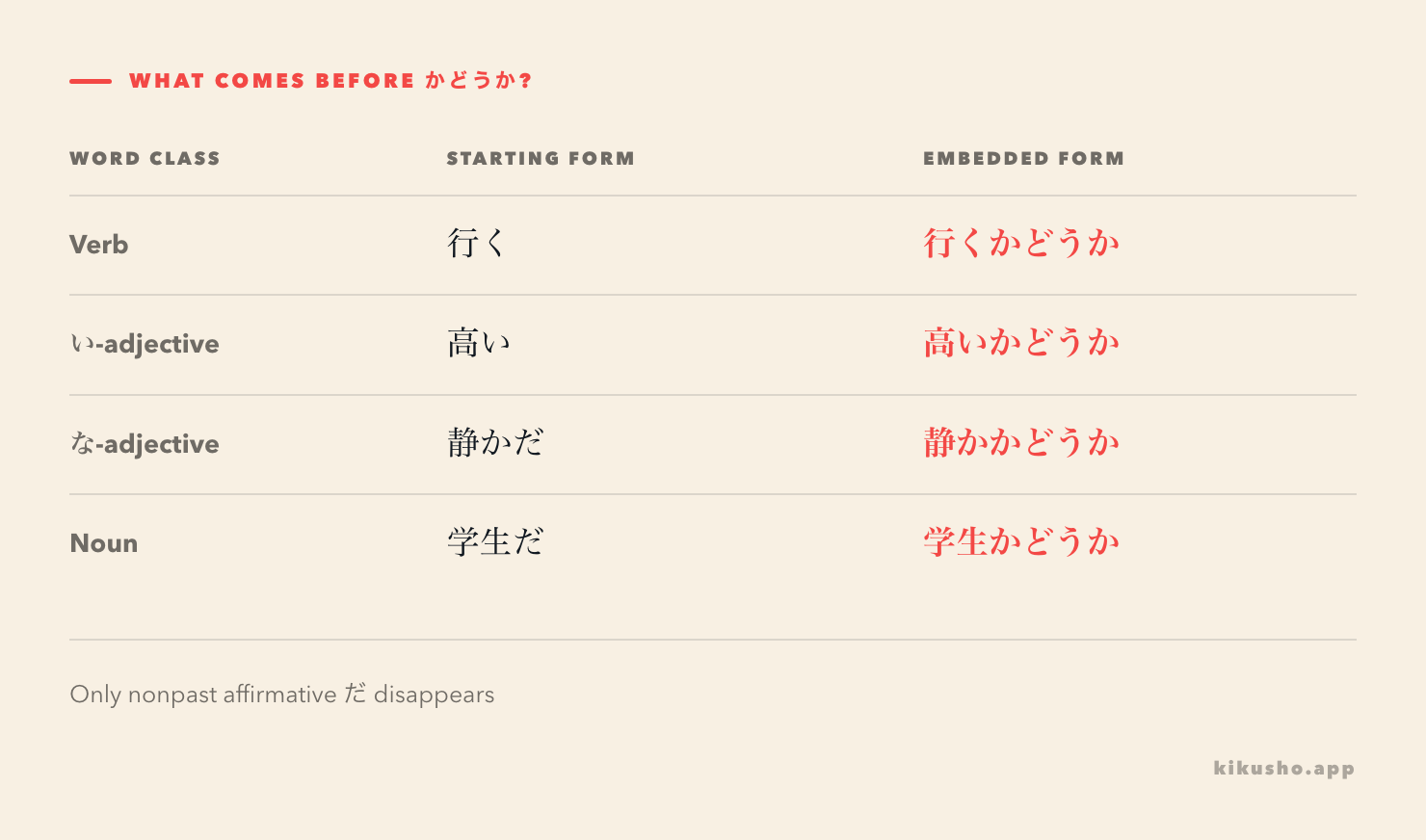
The polite form belongs in the main predicate, not inside the embedded clause:
田中さんが来るかどうか知っていますか。
たなかさんが くるかどうか しっていますか。
Do you know whether Tanaka is coming?
来ますかどうか mixes a polite direct-question ending into the inner clause. Use 来るかどうか and let 知っていますか carry the sentence's politeness.
For a nonpast affirmative noun or な-adjective, omit だ:
あの人が学生かどうか知りません。
あのひとが がくせいかどうか しりません。
I do not know whether that person is a student.
この町が静かかどうか調べています。
このまちが しずかかどうか しらべています。
I am checking whether this town is quiet.
The repeated かか in 静かかどうか is correct: the first か ends 静か, and the next か begins the construction.
Past and negative forms keep the endings that carry their meaning:
| Meaning | Form |
|---|---|
| whether they came | 来たかどうか |
| whether they do not come | 来ないかどうか |
| whether it was quiet | 静かだったかどうか |
| whether they were a student | 学生だったかどうか |
| whether it is not necessary | 必要ではないかどうか |
The rule is therefore narrower than “delete だ.” Only the nonpast affirmative だ is absent before かどうか.
The main predicate tells you what happens to the question
The same embedded question can feed several different actions.
| Main predicate | Complete sentence | What happens |
|---|---|---|
| 分かる | 開いているかどうか分かりません。 | the answer is unknown |
| 知る | 開いているかどうか知っていますか。 | someone possesses the answer |
| 確認する | 開いているかどうか確認します。 | someone checks the answer |
| 聞く | 開いているかどうか店員に聞きます。 | someone asks for the answer |
| 決める | 行くかどうか今日決めます。 | someone chooses between yes and no |
| 迷う | 行くかどうか迷っています。 | someone is wavering between the choices |
The phrase before かどうか is not complete communication on its own in these examples. Read through to the final predicate before deciding whether the speaker is uncertain, checking, asking or choosing.
With 確認する and similar transitive verbs, the question phrase may take を:
予約が必要かどうかを確認してください。
よやくが ひつようかどうかを かくにんしてください。
Please check whether a reservation is necessary.
The を is often omitted, especially in speech. Both versions keep the same boundary: 必要かどうか is the thing being checked.
A question word uses か alone
Use one test: can the inner question be answered with yes or no?
| Inner question | Embedded form | Reason |
|---|---|---|
| 来ますか。 Will they come? | 来るかどうか | yes or no |
| 高いですか。 Is it expensive? | 高いかどうか | yes or no |
| どこに行きますか。 Where will they go? | どこに行くか | needs a place |
| 何を買いますか。 What will they buy? | 何を買うか | needs a thing |
| 誰が来ますか。 Who will come? | 誰が来るか | needs a person |
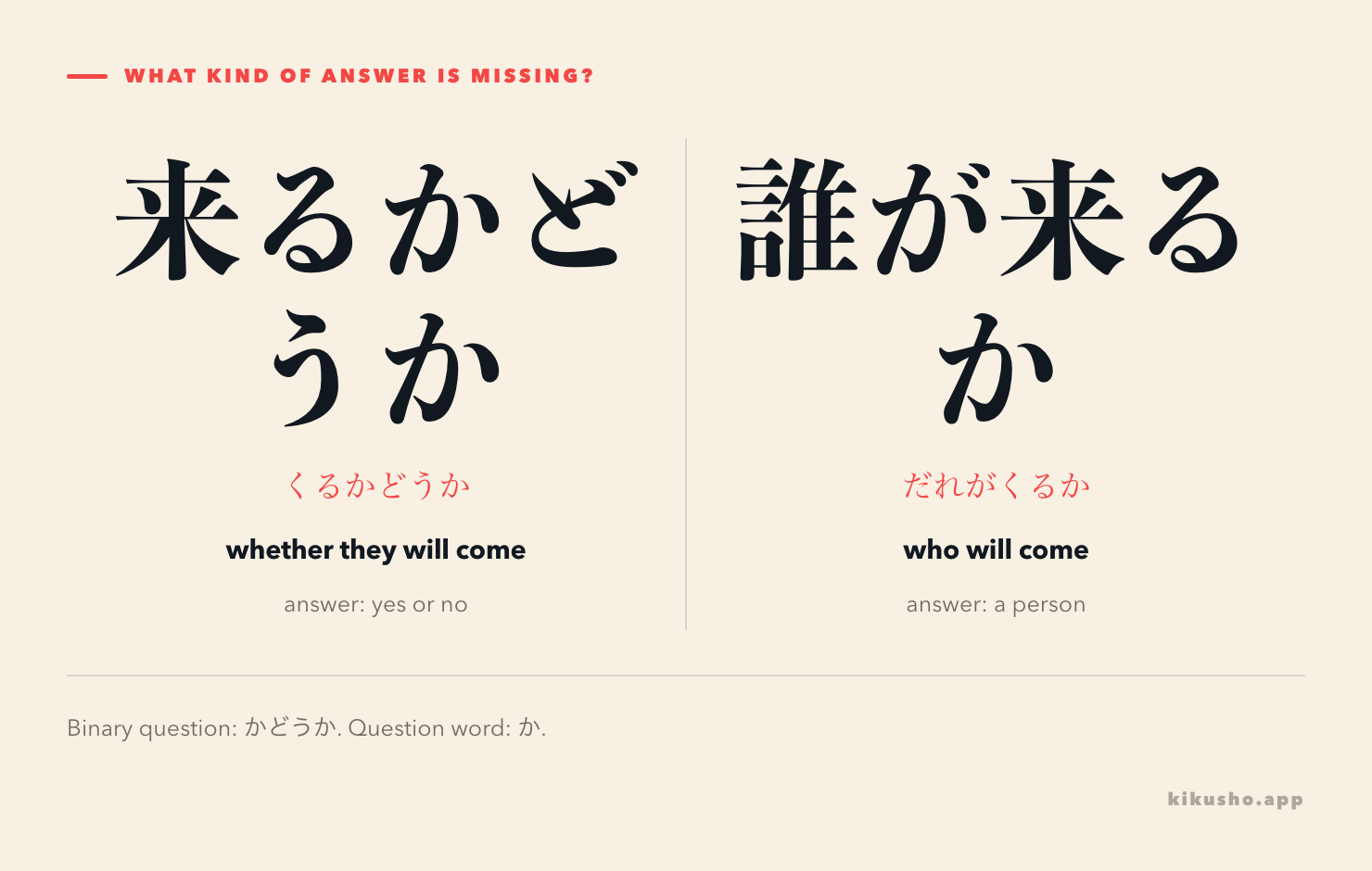
誰が来るか分かりません。
だれが くるか わかりません。
I do not know who will come.
誰が来るかどうか is not the intended pattern because 誰 already asks for a person, not a yes-or-no judgment. This extends the basic question-word lesson: a direct question becomes an embedded question when its plain clause closes with か.
かどうか is an open question, not a condition
English “if” can hide two different structures:
- I do not know if the shop is open. This embeds an unanswered question: 店が開いているかどうか分かりません.
- If the shop is open, I will go in. This states a condition and result: 店が開いていたら、入ります.
The first sentence does not say what will happen under one condition. It says the answer itself is unknown. The second uses たら to connect a condition with its result.
The same distinction separates かどうか from quoted と:
田中さんが来ると言いました。
Tanaka said that he would come.
田中さんが来るかどうか聞きました。
I asked whether Tanaka would come.
と presents the content as a statement that was said. かどうか preserves it as an unresolved question.
Bare か and explicit alternatives are nearby choices
A yes-or-no embedded question can also end in か without どうか:
明日、雨が降るか分かりません。
I do not know if it will rain tomorrow.
Adding どうか makes the yes-or-no opposition explicit. It is especially useful while learning because it keeps the binary structure visible. Do not turn that into a claim that bare か is wrong.
You can also spell out both poles:
行くか行かないか、まだ決めていません。
I have not decided whether to go or not.
The N5 question guide introduces AかBか as a choice frame. 行くかどうか leaves the negative alternative implicit; 行くか行かないか names it.
N4 references agree on this placement
Bunpro's かどうか guide places the construction at N4, gives verb and adjective attachments, and contrasts it with question-phrase + か. JLPT Sensei and the reference inventory use the same N4 placement.
Tae Kim's embedded-question guide independently explains that か lets a question function inside a larger sentence and that optional どうか makes the other side of a yes-or-no question explicit. The exam provider does not issue a complete grammar catalogue, so N4 remains shared teaching guidance rather than a guaranteed test specification.
When a message contains 参加するかどうか今日決めます, keep the entire decision frame in Kikusho. Text capture can preserve both the open choice and the final verb, and you can correct the drafted explanation before saving. A card for 参加する alone would lose the part that turns an action into a decision.
Practice: find the inner question and its job
Complete all seven questions before opening the explanation block.
Question 1
Select the expression that fills the blank: 田中さんが来る( )分かりません。
A. かどうか B. ですか C. ので D. と思う
Question 2
Which sentence correctly says “I will check whether this room is quiet”?
A. この部屋が静かだかどうか確認します。 B. この部屋が静かかどうか確認します。 C. この部屋が静かなかどうか確認します。 D. この部屋が静かですかどうか確認します。
Question 3
Choose the form that asks for an unknown place rather than a yes-or-no answer.
A. どこに行くか分かりません。 B. どこに行くかどうか分かりません。 C. 行くかどうか分かりません。 D. 行きますかどうか分かりません。
Question 4
Turn the direct question into an embedded question with 知りません.
あの人は学生ですか。 → 私は( )。
Question 5
Choose the sentence that means “Please check whether a reservation is necessary.”
A. 予約が必要かどうかを確認してください。 B. 予約が必要だったら確認してください。 C. 予約が必要と確認してください。 D. 予約が何かどうか確認してください。
Question 6
Put every item in a natural order:
決めていません / まだ / 行くかどうか
Question 7
Which reply completes this conversation naturally?
A: 来週の会議に参加しますか。 B: 予定を見てから、( )。
- 参加するかどうか決めます
- 参加しますかどうかです
- いつ参加するかどうか決めます
- 参加すると知っています
Answers and explanations
1
かどうか (A). 来る is the plain verb and the issue can be answered yes or no. ですか would turn the inner clause into a polite direct-question shape. ので gives a reason, while と思う would require a different sentence structure.
2
B. この部屋が静かかどうか確認します。 A nonpast affirmative な-adjective omits だ before かどうか. A keeps だ, C inserts attributive な without a noun, and D puts the polite direct-question form inside the larger sentence.
3
A. どこに行くか分かりません。 どこ requests a place, so か alone closes the embedded question. B wrongly adds the binary marker. C is grammatical but asks whether someone will go; D uses the polite form before the embedded marker.
4
One natural answer is 私はあの人が学生かどうか知りません。 学生 is a noun, so nonpast affirmative だ does not appear. あの人は in the direct question can become あの人が inside the embedded clause because it marks the subject of being a student.
5
A. 予約が必要かどうかを確認してください。 必要 is a な-adjective and attaches without だ; を marks the embedded question as what should be checked. B means “if a reservation is necessary, please check,” changing the logical relationship. C treats the proposition as a quotation, and D introduces 何 without forming the intended question.
6
行くかどうか、まだ決めていません。 “I have not yet decided whether to go.” The embedded choice comes before the main predicate 決めていません. まだ modifies the undecided state.
7
1. 参加するかどうか決めます. The speaker will look at their schedule and then decide between participating and not participating. Choice 2 mixes polite direct-question grammar into the embedded clause. Choice 3 contains いつ, which requires か alone and would ask when. Choice 4 says someone knows a quoted statement and does not express a decision.
Common questions
What does かどうか mean?
かどうか means “whether or not.” It closes an unresolved yes-or-no question so that the whole question can sit inside a larger sentence, as in 来るかどうか 分かりません, “I do not know whether they will come.”
What form comes before かどうか?
Use a plain form. Verbs and い-adjectives attach directly. Nonpast affirmative nouns and な-adjectives omit だ: 学生かどうか and 静かかどうか. Past and negative forms keep their normal endings.
Can かどうか follow a question word?
Use かどうか for a question answerable by yes or no. With 何, どこ, 誰, いつ or another question word, close the embedded question with か alone, as in どこに行くか分かりません.
Is どうか required in every embedded yes-or-no question?
No. Bare か can close a yes-or-no embedded question too. Adding どうか makes the two possibilities explicit and is the clearest N4 pattern to use when the issue is whether a proposition is true.