On this page
〜てしまう marks an action as finished, with nothing left of it to undo. Everything else it is said to mean (regret, embarrassment, the sense that something got away from you) is what a listener concludes from that, in a sentence where being unable to undo the action is bad news.
So the textbook line, it means completion or regret depending on context, is true and useless. It describes two readings without saying which one you are looking at. There is only one meaning, and the context does the rest.
The form says finished; the regret is something you work out
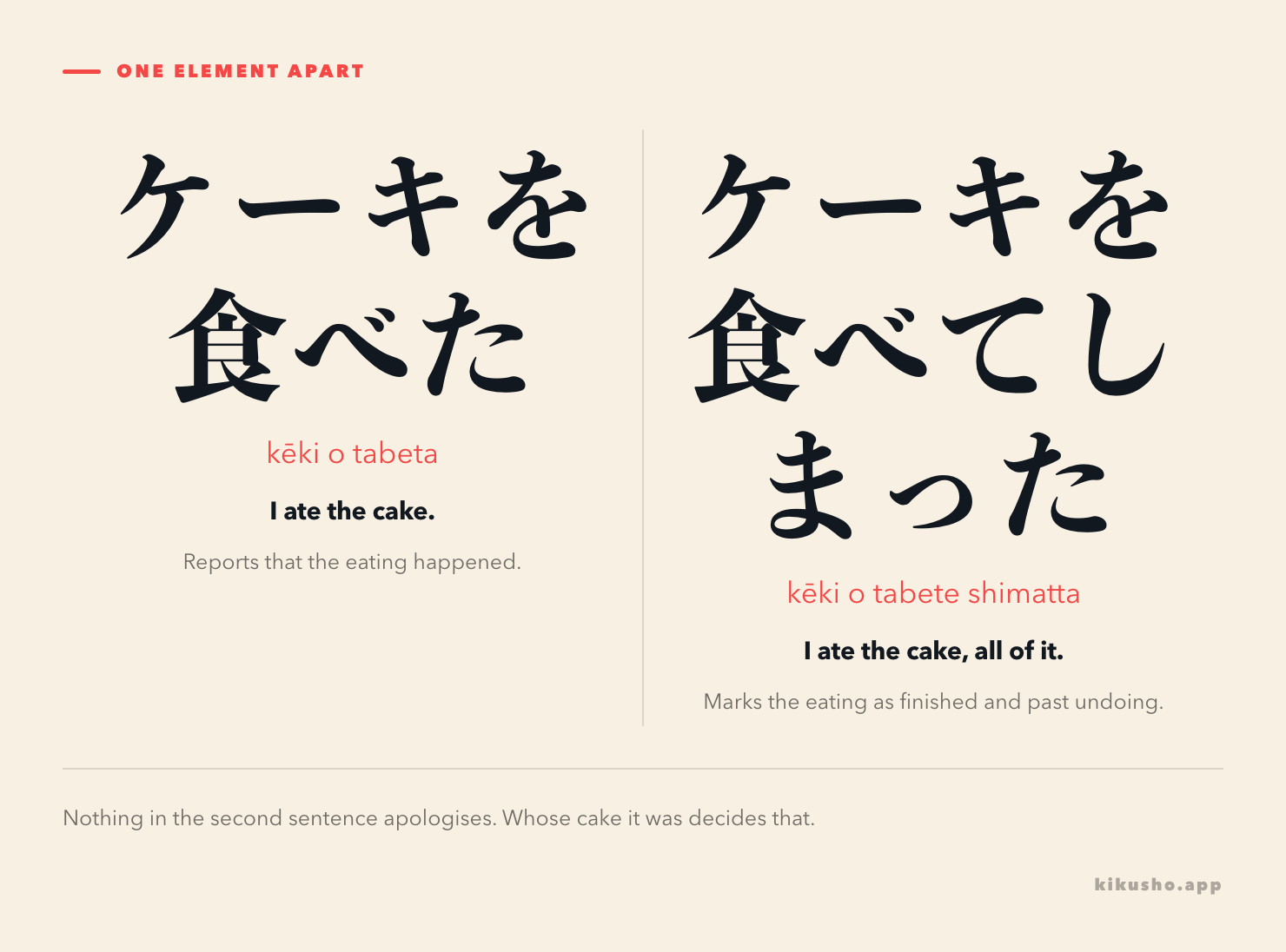
Compare two sentences that differ by one element:
- ケーキを食べた。 — I ate the cake.
- ケーキを食べてしまった。 — I ate the cake, all of it, and it is gone.
Neither sentence contains an apology. The second one adds that the eating ran to its end and the situation it produced is now fixed. Whether that is a confession or a small triumph depends entirely on whose cake it was.
Run the same test on a sentence where the outcome is plainly good and the regret reading evaporates:
- 宿題をやってしまった。 — I got the homework done.
That is not rueful. It is the satisfaction of a thing being finished and off the list, and it is the same grammar. A learner who has filed 〜てしまう under regret reads this sentence and hesitates, because the label does not fit and the grammar does.
The useful question is never is this completion or regret. It is what changed when the action reached its end, and is that good or bad for the speaker. The grammar answers the first half. The world answers the second.
It attaches to the て-form, and that is the whole conjugation
There is one thing to learn here, and you already know it if you know the て-form. Take the て-form, add しまう, then conjugate しまう like any other う-verb.
Verbs whose て-form ends in て
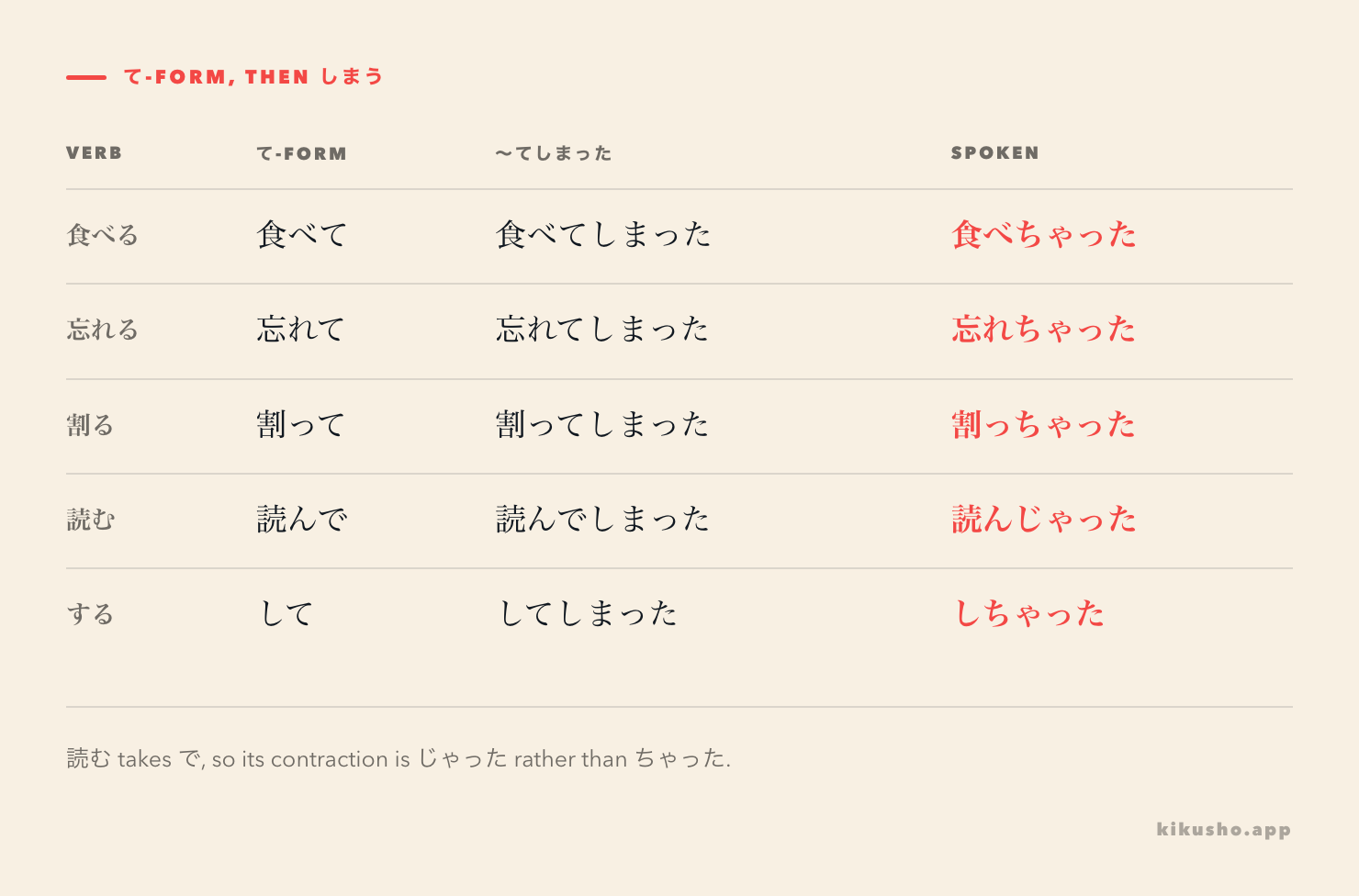
食べる becomes 食べて, so 食べてしまう. 忘れる becomes 忘れて, so 忘れてしまう. 割る becomes 割って, so 割ってしまう. Nothing irregular happens at the join.
Verbs whose て-form ends in で
読む becomes 読んで, and the しまう assimilates to the voicing already there: 読んでしまう. Same for 飲む → 飲んで → 飲んでしまう. This matters more than it looks, because the contraction in the next section splits along exactly this line.
する and 来る
してしまう and 来てしまう. Both behave.
Three jobs, and the sentence each one does
Finishing something off
本を全部読んでしまった。 — I read the whole book through.
Here the endpoint is the point. The book is not partly read; it is done, and saying so is the reason for the form.
Something getting away from you
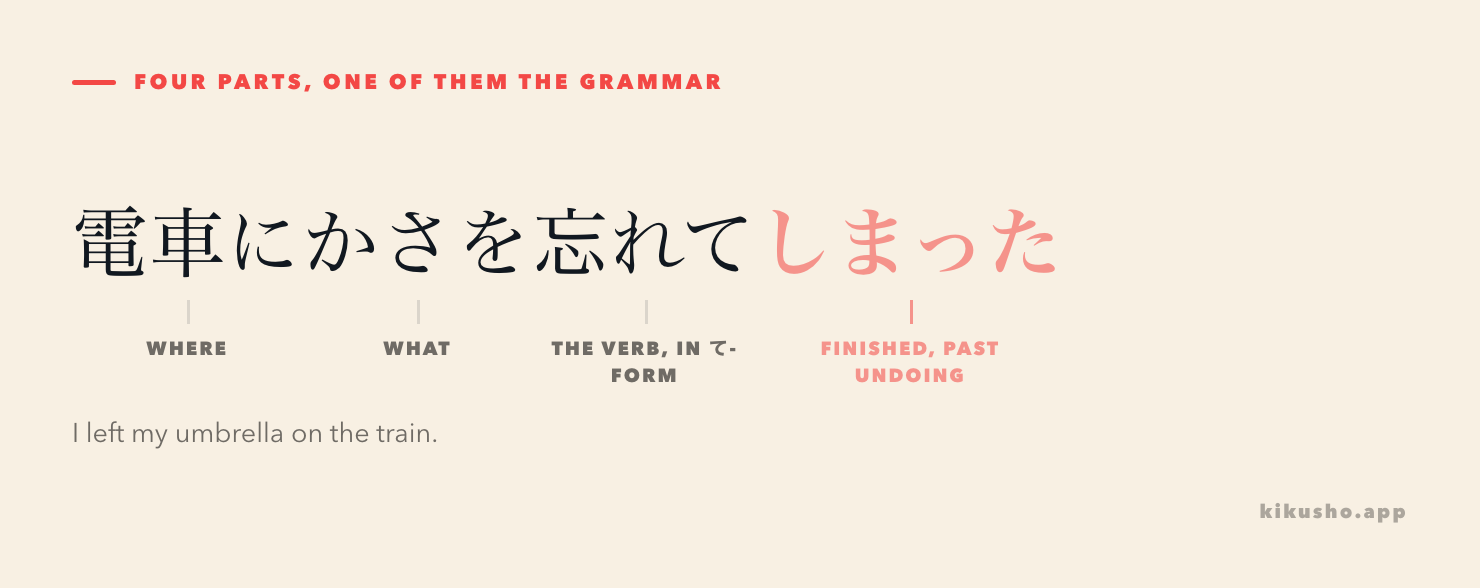
電車にかさを忘れてしまった。 — I left my umbrella on the train.
Nobody set out to do this. The action completed anyway, and the umbrella is not coming back. This is the use that gives 〜てしまう its reputation, and it is the same completion as the sentence above.
Committing to getting it over with
The volitional carries a particular flavour of resolve: 宿題をやってしまおう, let us just get the homework done. The speaker is proposing to move something from unfinished to finished in one go, usually because leaving it half-done is the worse option.
It will not attach to a state, and that is the limit nobody mentions
〜てしまう needs an event with an end. Give it something that merely is, and there is no endpoint for it to mark.
This shows up most clearly with adjectives, which cannot take it at all. There is no 〜いてしまう. When an adjective needs the same sense, the change becomes a verb first, with なる:
- 高くなってしまった。 — It has gone and got expensive.
- 暗くなってしまった。 — It got dark on us.
The なる supplies the event, a transition from one state to another, and 〜てしまう marks that transition as complete. This is worth knowing before you need it, because the instinct to reach for 〜てしまう arrives with the feeling of something has gone wrong, and that feeling attaches to adjectives constantly.
The same constraint explains why the form pairs so naturally with verbs of breaking, losing, forgetting and running out. Those verbs already name a transition with a far side. 〜てしまう is only pointing at the far side.
In speech it is ちゃった, which is why you have not been hearing it
This is the part that decides whether the grammar is any use to you outside a textbook. In ordinary conversation nobody says 忘れてしまいました. They say 忘れちゃった.
The contraction follows the て/で split exactly:
- 〜てしまう contracts to 〜ちゃう: 食べてしまった becomes 食べちゃった.
- 〜でしまう contracts to 〜じゃう: 読んでしまった becomes 読んじゃった, 飲んでしまった becomes 飲んじゃった.
Learners often meet ちゃった months before they meet 〜てしまう, hear it constantly, and never connect the two. The sound has moved far enough from the form that recognition fails, which is the same failure that makes spoken Japanese outrun the vocabulary you have already learned: you know the word, and the shape it arrives in is not the shape you filed.
There is a middle register too. 食べちゃいました keeps the casual contraction and adds the polite ending, and it is extremely common: a colleague telling you they finished the last of the coffee is far more likely to say that than either extreme. It sits alongside the other places where the register a textbook teaches is not the one spoken aloud.
The mistake that marks a learner is leaving it out
Textbooks warn about overusing 〜てしまう. In practice almost nobody does. The mistake that actually shows is the opposite one: leaving it off, and reporting mishaps in the same flat voice used for plans.
かさを忘れました is grammatical, and it lands oddly. It states that the forgetting happened, in the tone of a train announcement. A speaker who left their umbrella on a train and minds about it says 忘れちゃった, and the difference between the two sentences is not politeness or tense. It is whether the speaker is inside the event or filing a report about it.
This is the last piece of grammar learners add and the first thing a native speaker notices missing, because the marking is not optional in the way word order is optional. Japanese has a slot for and it cannot be undone, and leaving the slot empty is itself a choice that gets read.
Which is the argument for meeting the form in sentences rather than on a conjugation table. A card that says てしまう = completion, regret can be recalled perfectly and still leave you unable to hear 忘れちゃった or to produce it at the moment it is wanted. A card carrying the sentence somebody actually said, with the contraction in it, is doing a different job. That is the kind of card Kikusho is built to make: you hear 忘れちゃった, say it into the app, and the card that comes back keeps the spoken form rather than the dictionary one, with the register note that tells you where it belongs. The grammar you are collecting is the grammar you met, in the shape you met it.
Where it runs into other grammar
〜てしまう is not the only thing in Japanese that marks a completed action leaving a result behind. 〜ている does it too, with a different emphasis: 割れている reports a plate that is currently in pieces, while 割ってしまった reports the breaking as an event that has run its course. The first describes the world, the second describes what happened to it.
That distinction is worth sitting with, because it is the same instinct that decides whether a sentence marks its subject with は or が, or whether と or たら carries a conditional: one states an automatic result nobody had to choose, the other leaves room for a request the first form can never carry. Japanese keeps separate the thing that is true and the thing that is news, and it marks the difference rather than leaving it to intonation. 〜てしまう belongs to the second kind. It is a speaker stepping into the sentence to say that the door on this one has closed.
Common questions
Does 〜てしまう mean regret or completion?
Completion. It marks an action as finished with nothing left to undo. The regret reading is what a listener concludes when being unable to undo the action is bad news, which is why the same form works for 宿題をやってしまった (I got the homework done) and お皿を割ってしまった (I broke the plate).
What is the difference between てしまった and ちゃった?
None in meaning. ちゃった is the contracted spoken form of てしまった, and じゃった is the contraction for verbs whose て-form ends in で, so 読んでしまった becomes 読んじゃった. ちゃった is the ordinary conversational form, not slang.
How do you conjugate 〜てしまう?
Take the て-form of the verb and add しまう, then conjugate しまう as a regular う-verb: 食べる → 食べて → 食べてしまう → 食べてしまった. Verbs with a で-form keep the voicing: 読む → 読んで → 読んでしまう.
Can you use 〜てしまう with adjectives?
No. It attaches only to verbs, because it needs an action with an endpoint to mark. An adjective takes なる first, which supplies the transition: 高くなってしまった, it has gone and got expensive.