On this page
Use dictionary-form verb + には when you frame a goal and state what that goal requires, costs, or depends on. 日本で働くにはビザが必要です does not describe why someone got a visa; it says a visa belongs to the conditions for working in Japan.
A noun can fill the same frame: 登録には身分証が必要です, “Identification is required for registration.” In both shapes, the following clause tells you what the framed activity needs.
Read the sentence as goal, then requirement
The most reliable question is: “What must be true, available, or done for A?”
| Frame A | には | Requirement or condition B |
|---|---|---|
| 日本で働く | には | ビザが必要だ |
| 試験に合格する | には | 毎日勉強したほうがいい |
| 登録 | には | 身分証が要る |
日本で働くには、ビザが必要です。
にほんで はたらくには、ビザが ひつようです。
To work in Japan, a visa is necessary.
この山に登るには、十分な準備が要る。
この やまに のぼるには、じゅうぶんな じゅんびが いる。
Climbing this mountain requires adequate preparation.
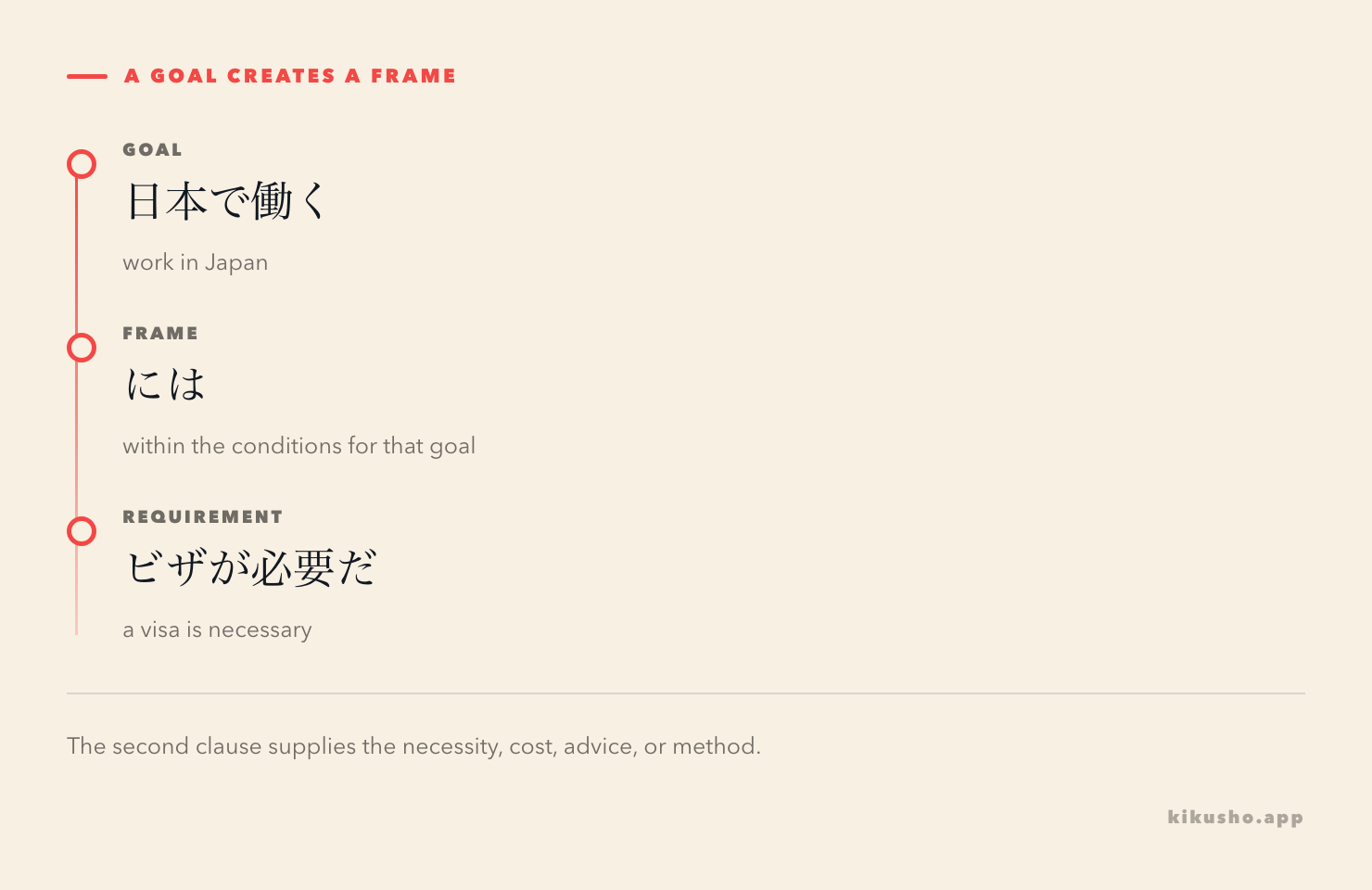
The second clause often contains 必要だ, 要る, かかる, なければならない, ほうがいい, or a question such as どうすればいい. These endings supply necessity, cost, advice, or the method being sought. には itself sets the frame.
JLPT Sensei's には lesson gives the N3 placement and the dictionary-form verb pattern. NIHONGO NET independently teaches the same goal-and-necessity relationship at N3.
Attach には to a dictionary-form verb or noun
For an action goal, use the nonpast dictionary form.
日本語が上手になるには、毎日使うことが大切だ。
にほんごが じょうずに なるには、まいにち つかうことが たいせつだ。
To become good at Japanese, using it every day is important.
駅まで行くには、どのバスに乗ればいいですか。
えきまで いくには、どの バスに のれば いいですか。
Which bus should I take to get to the station?
The goal is not yet asserted as a completed event. It is treated as the condition under which the advice or requirement matters.
A noun can name an activity, situation, or practical domain:
海外旅行には、パスポートが必要だ。
かいがいりょこうには、パスポートが ひつようだ。
A passport is necessary for overseas travel.
冬の運転には、このタイヤが役に立つ。
ふゆの うんてんには、この タイヤが やくに たつ。
These tires are useful for winter driving.
The noun version can be broader than a single goal. 冬の運転には establishes winter driving as the domain in which the tires are useful.
The は turns に's target into a frame
には combines に with topic or contrast particle は. に points to a target, situation, or purpose; は says that the following claim is being made within that frame. This helps explain why English translations vary among “to,” “for,” and “in order to.”
子どもには、この漢字は難しい。
こどもには、この かんじは むずかしい。
This kanji is difficult for children.
Here there is no action goal. Children are the group for whom the judgment holds. The same particle logic appears, but the N3 lesson's central production pattern is the verb or activity frame followed by a requirement.
Bunpro describes には as a contrastive frame built from に and は, with both verb and noun attachments. It places the entry at N2, creating the level disagreement recorded below.
には states a requirement; ために states a purpose
Compare two sentences about a passport:
海外で働くには、パスポートが必要だ。
To work abroad, a passport is necessary.
海外で働くために、パスポートを取った。
I obtained a passport in order to work abroad.
The first presents a general condition. The passport occupies the “required for the goal” slot. The second describes a person's intentional action and gives its purpose.
| What follows the goal | Natural frame | Example |
|---|---|---|
| a requirement, cost, method, or advice | Vる + には | 行くには予約が必要だ |
| an intentional action done for that goal | Vる + ために | 行くために予約した |
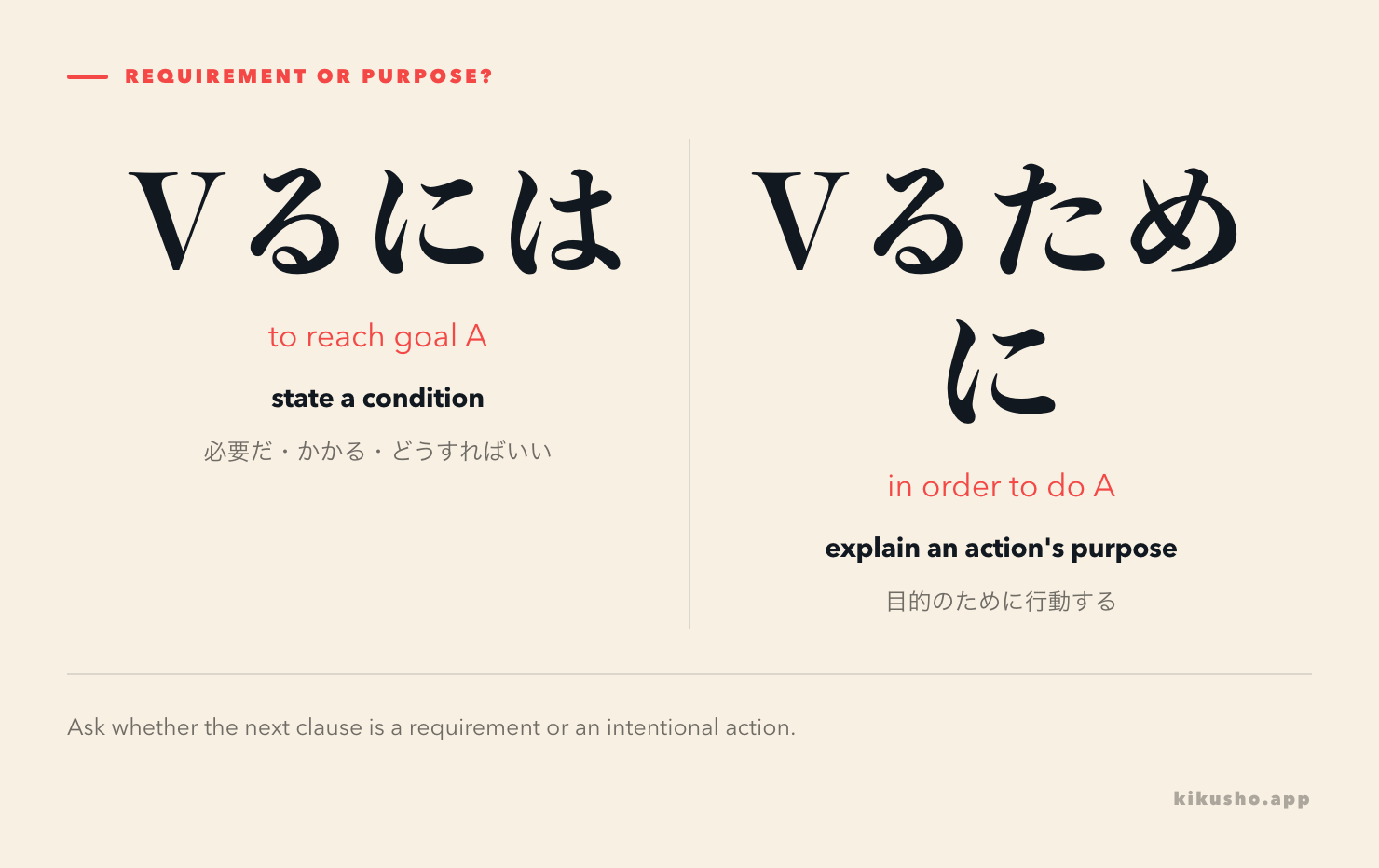
The ように and ために comparison develops purpose clauses and the role of control. This lesson keeps a narrower boundary: には frames what reaching a goal calls for rather than explaining an agent's reason for acting.
のに can name use without making a general condition
Purpose のに often connects an activity with a tool, time, money, or usefulness:
このはさみは、布を切るのに便利だ。
These scissors are convenient for cutting cloth.
布を切るには、よく切れるはさみが必要だ。
To cut cloth, sharp scissors are necessary.
The first evaluates one tool for a use. The second establishes the action as a frame and states a broader requirement. Both can be natural in nearby contexts, but they organise the information differently. The purpose のに lesson also separates this use from concessive のに, “although.”
Not every visible には is this requirement pattern
Because には is simply a particle combination, it also appears when a location, time, recipient, or viewpoint marked by に becomes the topic or contrast.
部屋には机があります。
へやには つくえが あります。
There is a desk in the room.
私には分かりません。
わたしには わかりません。
I do not understand it / It is not clear to me.
Neither sentence means “in order to room” or “in order to me.” Identify what precedes には. A dictionary-form action followed by necessity, cost, advice, or method strongly supports the target N3 reading.
Register and level placement
This use is standard in conversation and writing. It is natural in advice, instructions, planning, and explanations of prerequisites. A sentence can sound firm because it states a condition, but the form itself is not especially formal.
JLPT Sensei and NIHONGO NET file the goal-and-requirement pattern under N3. Bunpro files the particle combination under N2 and treats its noun and verb uses together. Kikusho retains the assigned N3 placement and names that publisher disagreement. Since no complete official grammar catalogue fixes these boundaries, the useful question is whether you can recognise the frame and produce it accurately.
Practice
Answer all seven prompts before consulting the explanations.
Question 1 — choose the requirement frame. Complete: 日本で働く( )、ビザが必要です。
- ア. ために
- イ. には
- ウ. のに
- エ. について
Question 2 — choose the purpose clause. You obtained a passport with the intention of working abroad: 海外で働く( )、パスポートを取った。
- ア. には
- イ. にとって
- ウ. ために
- エ. について
Question 3 — noun attachment. Complete: 登録( )、身分証が必要です。
- ア. には
- イ. では
- ウ. として
- エ. について
Question 4 — sentence composition. Put these chunks in a natural order: 毎日練習することが / 上手になるには / 大切だ
Question 5 — identify the relationship. What does には do in 駅まで行くには、どのバスに乗ればいいですか?
- ア. It reports a completed trip
- イ. It frames the goal for a method question
- ウ. It names the speaker's occupation
- エ. It gives a reason for a past action
Question 6 — distinguish a locative topic. Which sentence contains には but does not state a goal's requirement?
- ア. 合格するには勉強が必要だ。
- イ. この部屋には窓が二つある。
- ウ. 登録には身分証が要る。
- エ. 駅へ行くにはこの道が近い。
Question 7 — text grammar. Choose the pair that preserves the two relationships.
大会に参加する( 甲 )、申し込みが必要だ。友達と参加する( 乙 )、昨日申し込んだ。
- ア. 甲: ために / 乙: には
- イ. 甲: には / 乙: ために
- ウ. 甲: のに / 乙: について
- エ. 甲: として / 乙: にとって
Answers and explanations
Answer 1. イ. には. Working in Japan is the framed goal; the following clause states its visa requirement. ために would normally lead to an intentional action performed for that purpose.
Answer 2. ウ. ために. The sentence reports the intentional act of obtaining a passport and gives working abroad as its purpose.
Answer 3. ア. には. The noun 登録 directly takes には and establishes registration as the activity for which identification is required.
Answer 4. 上手になるには、毎日練習することが大切だ。 The dictionary-form goal comes before には, and the following clause names the important condition.
Answer 5. イ. It frames the goal for a method question. Reaching the station is the goal under discussion. どのバスに乗ればいい asks which method satisfies it.
Answer 6. イ. この部屋には窓が二つある. に marks the room as the location of existence, and は makes that location the topic. The other sentences frame an activity and state a necessity or useful condition.
Answer 7. イ. 甲: には / 乙: ために. The first clause states registration as a condition of participation. The second explains why the speaker performed the past action 申し込んだ.
Keep the condition beside the goal
A card containing only ビザが必要です teaches a fact but loses the situation that activates it. Preserve 日本で働くには with the requirement, or keep 駅まで行くには with the method question.
That pair makes the sentence reusable. On review, you recover the goal first and then the condition attached to it, which is the actual work には performs.
Common questions
What does verb plus には mean in Japanese?
Dictionary-form verb plus には frames a goal and introduces what is needed, useful, difficult, or costly for reaching it. 日本で働くにはビザが必要です means “To work in Japan, a visa is necessary.”
What is the difference between には and ために?
には asks what conditions or resources a goal requires. ために presents the goal or purpose behind an intentional action: 留学するために貯金しています means “I am saving money in order to study abroad.”
Can には follow a noun?
Yes. 登録には身分証が必要です means “Identification is required for registration.” The noun names the activity or frame for which the requirement holds.
Is には N3 or N2 grammar?
JLPT Sensei and NIHONGO NET place this use at N3, while Bunpro places it at N2. These are editorial study levels because the JLPT publishes no exhaustive grammar list.